Last updated 2026-07-26
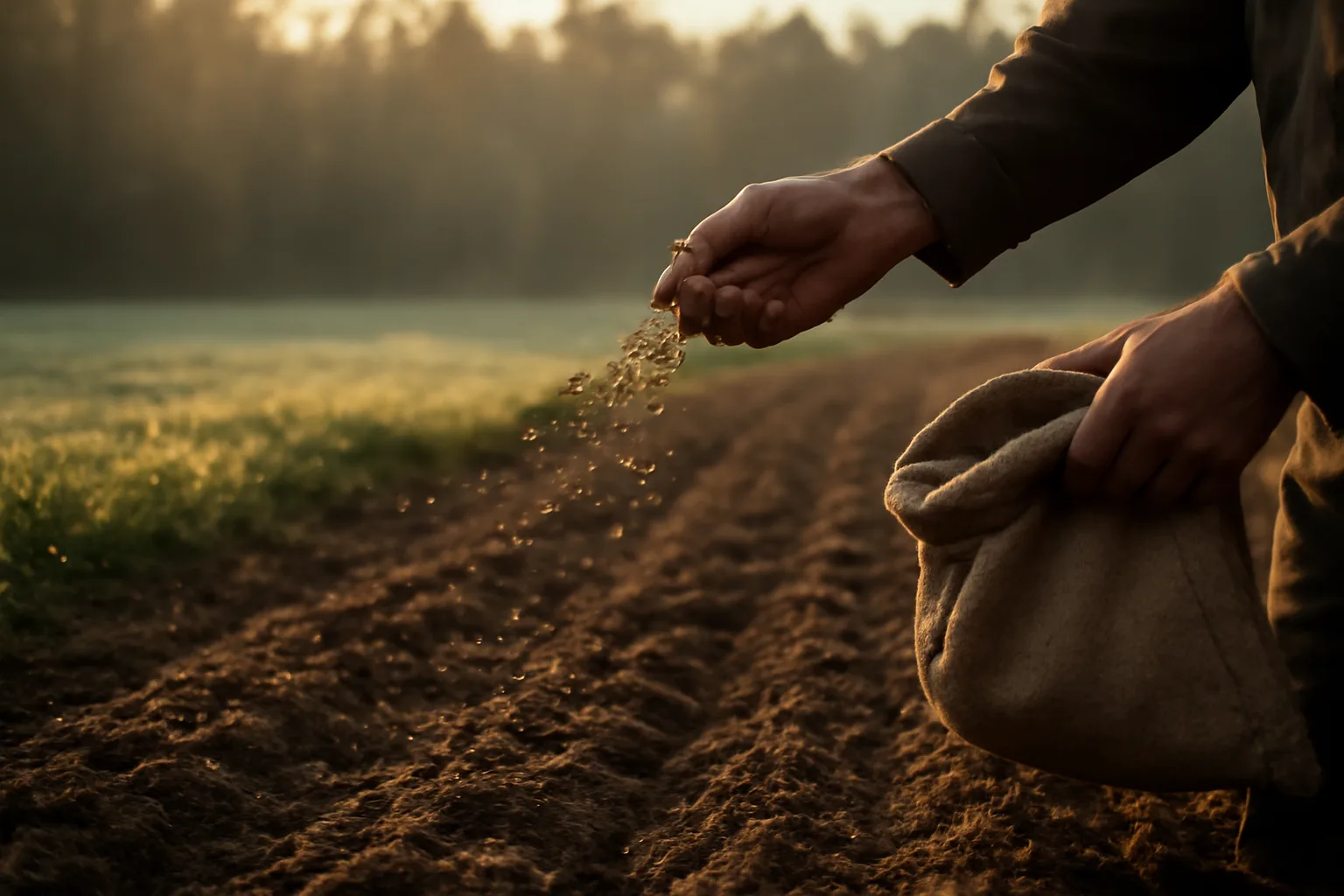
TL;DR
The best throw and grow food plots use small-seeded, shallow-planted species: clover, oats, winter peas, and brassicas like turnips or radish. Clover and oats germinate reliably with rain and light soil contact, no tillage required. True "throw and grow" success depends more on rainfall timing and seed-to-soil contact than the bag you buy.
what is a food plot
A food plot is a planted patch of forage on hunting land meant to feed deer and other wildlife and to pull animals into range of a stand or blind. Sizes run from small quarter-acre kill plots tucked into timber to multi-acre destination fields planted with corn or soybeans. The USDA Natural Resources Conservation Service treats food plots as a wildlife habitat practice, often supported through conservation programs aimed at improving forage availability for game and non-game species alike [1]. Most state wildlife agencies also publish food plot guidance because plots interact with baiting and supplemental feeding rules, which vary a lot by state. Throw and grow describes the simplest version of this idea: no disking, no drill, no cultipacker. You broadcast seed by hand or with a hand-crank spreader over disturbed or bare soil, sometimes right before rain, and let nature do the incorporation. It works best with small, forgiving seeds and it works worst with big seeds like corn or soybeans that need real burial depth. If you want a plan built around your specific soil test and property instead of guesswork, that's the whole point of a food plot whitetail strategy tailored to your ground rather than a generic bag mix.
what is the best throw and grow food plot
| Clover (white/red) | High | 1/4 inch or less | 3-10 | |
|---|---|---|---|---|
| Oats | High | 1/2 to 1 inch | 5-10 | |
| Winter peas | Moderate-High | 1/2 to 1 inch | 7-14 | |
| Brassicas (turnip/radish) | Moderate-High | 1/4 to 1/2 inch | 4-10 | |
| Winter wheat/rye | Moderate | 1 to 1.5 inches | 7-10 | |
| Soybeans | Low | 1 to 1.5 inches | 5-10 | |
| Corn | Very Low | 1.5 to 2 inches | 7-10 | The honest answer is that no seed defies physics. Throw and grow works when rain falls within a few days of broadcasting and when the seedbed has some loose soil, old leaf litter, or light disking to catch seed. On hard-packed clay or thick sod with no disturbance, even clover struggles. |
For most hunters, a clover and oat blend, or a clover and brassica blend, is the best throw and grow combination. Clover is a perennial legume that tolerates shallow planting and light soil contact, and it comes back year after year with basic mowing and fertility upkeep. Oats germinate fast, often in 5 to 10 days with good soil moisture, and they give deer green forage within a few weeks of a late summer rain [2]. Brassicas (turnips, radish, rape) are small-seeded and broadcast well too, but they need slightly finer soil contact than clover to hit good germination rates. A rough rule that guides a lot of extension planting guides: seed depth should run about 2 to 4 times the seed's diameter. Clover and brassica seeds are tiny, so a light rake pass or ATV drag chain, or just rainfall packing loose soil, is often enough. What doesn't throw and grow well: corn, soybeans, and most cereal grains planted at full rate without any soil disturbance. These need real burial, ideally 1 to 1.5 inches for beans and 1.5 to 2 inches for corn, and they get eaten by birds or rot on the surface if just broadcast onto sod [3]. Here's a rough comparison of common throw and grow candidates: | Species | Throw and grow success | Ideal seed depth | Days to germinate |
do deer eat clover
Yes. Clover is one of the most consistently preferred forages in whitetail diet studies, and it is also one of the easiest plants to establish with minimal equipment. University of Tennessee Extension lists white clover and red clover among the top perennial forage choices for food plots because of their protein content (often 25 to 30 percent crude protein in vegetative growth) and their tolerance of grazing pressure [4]. Clover regrows after deer bite it down, unlike a lot of annuals, which is why a single well-fertilized clover plot can feed deer from spring green-up through fall, then go dormant and come back the next year. It typically needs a soil pH near 6.0 to 6.5 to thrive, so a soil test matters more here than with almost any other plot species [4].
do deer like clover more than other food plot options
Deer show strong, repeated preference for clover in food plot settings, but "favorite" depends on season and what else is available. In spring and summer, clover often gets hit hard because it's high in protein when deer need it most for antler growth and lactation. In fall, deer often shift toward acorns, browse, and standing grain if it's available, and clover intake can drop some. Mississippi State University's deer research program and various state agency studies note that whitetail diets shift seasonally and regionally, and no single plant holds year-round top preference everywhere. Clover is a strong, reliable choice, not a magic bullet.
do deer eat sorghum
Yes, deer will eat grain sorghum, especially the seed heads once they mature and grain drops or gets accessible. Sorghum (milo) is more commonly planted as a screening or standing grain crop than a preferred throw and grow forage, because it needs real seed-to-soil contact and warm soil to establish well. It is not a strong throw and grow candidate on its own. Sorghum seed is small enough to broadcast, but germination and stand success drop off hard without at least a light disking pass, similar to how corn behaves. If you want sorghum in the mix, treat it as a planted row crop, not a broadcast species.
do deer like honey
This one comes up more than you'd think, and the answer is no, not in any meaningful food plot sense. Deer are not drawn to honey as a forage or attractant, and there's no research or extension guidance recommending it as bait or plot additive. Some hunters confuse this with "honey hole," a slang term for a great hunting spot, which has nothing to do with actual honey or bees. If you're looking for a sweet mineral or attractant angle, that's a mineral site conversation, not a food plot one, and it runs into state baiting law questions fast (see the baiting section below).
when to plant food plots for deer
Timing splits into two windows almost everywhere: spring/summer plots for warm-season annuals and perennials, and late summer plots for fall/winter forage. Spring plantings (soybeans, corn, warm-season clover establishment) typically go in after the last frost date, which varies from early April in the Deep South to late May or early June in the northern tier. Fall plot plantings (brassicas, oats, wheat, clover overseeding) typically go in 6 to 10 weeks before your area's first hard frost, so the plants have time to establish before cold shuts down growth. In much of the Midwest and Northeast that lands in the last two weeks of August through mid-September. In the Deep South it can push into late September or even October. Your local NRCS office or state extension planting calendar is the best single source, because frost dates and rainfall patterns shift a lot even within one state. Cooperative extension offices publish county-level planting windows for exactly this reason.
when to plant oats for deer
Plant oats for deer in late summer to early fall, generally 6 to 8 weeks before your first expected frost. Oats are a cool-season annual grain and they do their best growing in cooler, moist soil, not the heat of midsummer. In the Midwest and Northeast, that puts oat planting in the last half of August through mid-September. In the South, growers can push into October. Oats germinate fast, often within a week given good moisture, and they can be grazed within 3 to 4 weeks of planting, making them one of the quicker payoff options in a fall throw and grow blend [2]. A lot of hunters mix oats with clover in the same broadcast pass. The oats come up fast and give early season cover and forage while the clover establishes underneath more slowly, then the oats die back over winter in cold climates and the clover carries the plot into next year.
when to plant turnips for deer
Plant turnips for deer in late summer, roughly 60 to 90 days before your first hard frost, since brassicas need that runway to bulb up and reach peak palatability. Turnips actually get sweeter after a frost or two, because cold triggers the plant to convert starches to sugars, which is part of why deer often ignore turnip plots early and hammer them in late fall and winter. Most planting guides put turnip seeding windows at late July through early September depending on latitude, similar to other brassicas like radish and rape. Seed shallow, around 1/4 to 1/2 inch, and a light broadcast onto worked or lightly disked soil with decent rain afterward performs fine without a drill. One mistake worth flagging: planting turnips too early in hot, dry August soil often gets poor germination and bolting. Waiting for a rain forecast, even if it means planting a week or two later than the calendar ideal, usually beats planting into dust on schedule.
what are deer's favorite foods
Deer preference shifts by season, region, and what's locally available, but a few categories show up again and again in state agency and university forage studies: acorns and other hard mast, soybeans, clover, and, seasonally, brassicas after a frost. Georgia DNR and multiple state wildlife agencies note that acorns can make up a huge share of fall diet in mast years, sometimes pulling deer off planted plots entirely when a bumper acorn crop hits. Among planted forages, soybeans and clover consistently rank at the top of preference studies for their protein content and palatability during the growing season. Corn gets eaten heavily too, but mostly as a late fall and winter energy source once the plant matures and drops grain, not as a summer browse. There's no single universal "favorite": a deer on a Georgia pine plantation with a heavy acorn year behaves differently than a deer in an Iowa bean field.
how do you actually throw and grow a plot step by step
Start with a mowed or lightly disturbed seedbed. You don't need a full disk job, but bare dirt or short, dead vegetation beats thick standing grass every time, because seed-to-soil contact drives germination more than any other single factor. Broadcast your seed at or slightly above the bag's recommended rate, since throw and grow methods lose more seed to birds, wind, and poor coverage than drilled seed does. A hand-crank or ATV broadcast spreader works fine for plots up to a few acres. Drag something over the seed if you can: a section of chain-link fence, a piece of carpet, even a few tree branches tied together and pulled behind a four-wheeler. This knocks seed into light soil contact without full tillage. Time it to rain. Check the 5 to 7 day forecast and broadcast 1 to 2 days ahead of a real rain event if possible. This single factor probably explains more throw and grow failures and successes than seed choice, soil type, or fertilizer. Fertilize based on an actual soil test, not a guess. Your soil test lab is the real authority here on lime and fertilizer rates for your specific dirt; general planting guides can only give you ranges. If you want a starting point pulled together for your property and zone, a Custom Food Plot Plan from PlotSeason runs a flat $99 one-time and gives general species and timing guidance based on your inputs, though it's not a substitute for site-specific agronomy from your soil lab.
what mistakes ruin a throw and grow plot
Planting into thick thatch or standing grass without any disturbance is the top mistake. Seed sits on top, dries out, and either gets eaten by birds or never gets enough soil moisture contact to germinate. Second is planting too deep by trying to "help" the seed with a heavy drag or light disking pass that buries small seed like clover or brassica more than a quarter inch down. These species have very little stored energy in the seed and can't push through much soil. Third is ignoring pH. Clover in particular sulks in acidic soil below about pH 5.5, and University of Tennessee Extension recommends getting fields closer to 6.0 to 6.5 before expecting strong clover performance [4]. Lime takes months to fully react in soil, so testing and liming ahead of your planting season, not the week before, makes a real difference. Fourth is skipping the rain check. Throwing seed onto dry ground with no rain in the forecast for two weeks is close to wasted money and effort, no matter how good the seed blend is.
is throw and grow legal everywhere and does it count as baiting
Food plots are legal in every state, but the line between a food plot and illegal baiting or supplemental feeding gets drawn differently state to state, and it matters for throw and grow methods that leave loose seed on the surface. Some states define baiting as placing food to attract game, and a thin broadcast of seed on bare ground can sit in a gray area depending on how the state agency interprets "planted crop" versus "placed feed." Michigan, for example, has specific rules around baiting and feeding that differ from standing food plots, enforced through the Michigan Department of Natural Resources [5]. Other states like Pennsylvania restrict feeding but generally treat properly planted food plots as legal agriculture, not bait, through the Pennsylvania Game Commission's regulations [6]. Always check your specific state wildlife agency's current baiting and feeding regulations before you plant or before you hunt over any plot, because rules change and enforcement varies by county or unit in some states.
how does throw and grow compare to drilling or disking a plot
Drilling seed with a no-till drill gives the most consistent depth control and the highest germination rates, especially for larger seed like corn, soybeans, and cereal grains. It costs more in equipment (drills run from a few hundred dollars for small pull-behind units to well over ten thousand for larger no-till drills) and takes more time per acre. Disking before broadcasting sits in the middle: it loosens soil for better seed contact without needing a drill, and it works well for small grains, clover, and brassicas. It costs the price of a disk implement and a tractor or ATV pull, and it takes an afternoon for a small plot. Throw and grow costs the least (just seed and a spreader, sometimes free if you already own a hand-crank spreader) and takes the least time, but it has the lowest and least predictable germination rate of the three methods. It works best on small seed species and it works worst wherever rainfall timing is unreliable or soil is compacted. For a hunter with no tractor, a food plot budget under $200, and small kill-plot-sized clearings, throw and grow with clover, oats, and brassicas is a completely reasonable approach. For someone planting a multi-acre destination field with corn or beans, it's worth borrowing or renting a drill.
Frequently asked questions
Do deer eat sorghum in food plots?
Yes, deer eat grain sorghum, especially mature seed heads, but sorghum is not a strong throw and grow candidate. It needs real seed-to-soil contact similar to corn, so it works better as a lightly disked or drilled planting than a pure broadcast method.
Do deer eat clover, and is it worth planting?
Yes, clover is one of the most consistently preferred whitetail forages, often 25 to 30 percent crude protein in vegetative growth according to University of Tennessee Extension. It's also one of the easiest throw and grow species since it needs only shallow seed contact and returns as a perennial with basic upkeep.
When should I plant deer food plots?
Spring/summer plots go in after your last frost date, which ranges from early April in the South to late May or June up north. Fall plots (oats, brassicas, clover overseeding) go in 6 to 10 weeks before your first hard frost, generally late August through mid-September in most of the country.
When should I plant oats for deer?
Plant oats 6 to 8 weeks before your area's first hard frost, typically late August through mid-September in the Midwest and Northeast, later into October in the South. Oats germinate in about 5 to 10 days with good moisture and can be grazed within 3 to 4 weeks.
When should I plant turnips for deer?
Plant turnips roughly 60 to 90 days before your first hard frost, generally late July through early September depending on latitude. Turnips get sweeter after frost as the plant converts starches to sugar, so deer often prefer them more in late fall and winter than right after planting.
What is a food plot exactly?
A food plot is a planted patch of forage on hunting or wildlife land meant to feed deer or other game and draw them into range of a stand. Plots range from quarter-acre broadcast clover patches to multi-acre drilled corn or soybean fields, and the USDA NRCS recognizes them as a wildlife habitat practice.
What are deer's favorite foods overall?
There's no single universal favorite: preference shifts by season and region. Acorns and other hard mast dominate fall diets in mast years according to several state wildlife agencies, while soybeans and clover top preference studies among planted forages during the growing season.
Do deer like honey or sweet attractants?
No, honey isn't a real deer attractant or forage additive, and there's no extension or wildlife agency guidance recommending it. The term likely gets confused with "honey hole," hunter slang for a great spot, which has nothing to do with actual honey.
What's the best throw and grow food plot mix for beginners?
A clover and oat blend is the most forgiving combination for a first-time throw and grow plot. Oats germinate fast and give early cover and forage, clover establishes more slowly underneath and becomes a perennial base you can maintain for years with mowing and fertility upkeep.
Can you throw and grow corn or soybeans successfully?
Rarely with good results. Corn needs 1.5 to 2 inches of burial depth and soybeans need about 1 to 1.5 inches; broadcasting either onto undisturbed ground usually means heavy bird predation and poor germination. Both do much better disked in or drilled.
Does throw and grow count as illegal baiting?
It depends on your state. Some states distinguish planted food plots from placed bait or feed, but the line gets fuzzy with surface-broadcast seed on bare ground. Check your specific state wildlife agency's current baiting and feeding regulations before planting or hunting over any plot.
How much rain do I need after throwing seed for a food plot?
There's no exact universal number, but germination odds improve a lot with rain within 1 to 3 days of broadcasting for small seeds like clover and brassicas. Checking a 5 to 7 day forecast and timing your broadcast just ahead of a real rain event matters more than almost any other single factor.
Sources
- USDA Natural Resources Conservation Service, Wildlife Habitat Practices: Food plots are recognized as a wildlife habitat practice, often supported through federal conservation programs.
- University of Kentucky Cooperative Extension, Small Grains for Forage: Oats germinate quickly and can be grazed within a few weeks of planting given adequate moisture.
- Purdue University Extension, Corn and Soybean Planting Depth: Recommended planting depths for corn and soybeans and why shallow broadcast establishment fails for these crops.
- University of Tennessee Extension, Establishing and Managing Wildlife Food Plots: Clover crude protein content and optimal soil pH range of 6.0 to 6.5 for clover establishment.
- Michigan Department of Natural Resources, Baiting and Feeding Regulations: Michigan has specific baiting and feeding regulations distinct from standing food plot rules.
- Pennsylvania Game Commission, Feeding Regulations: Pennsylvania restricts supplemental feeding but treats properly planted food plots as legal agriculture, not bait.