Last updated 2026-07-26
TL;DR
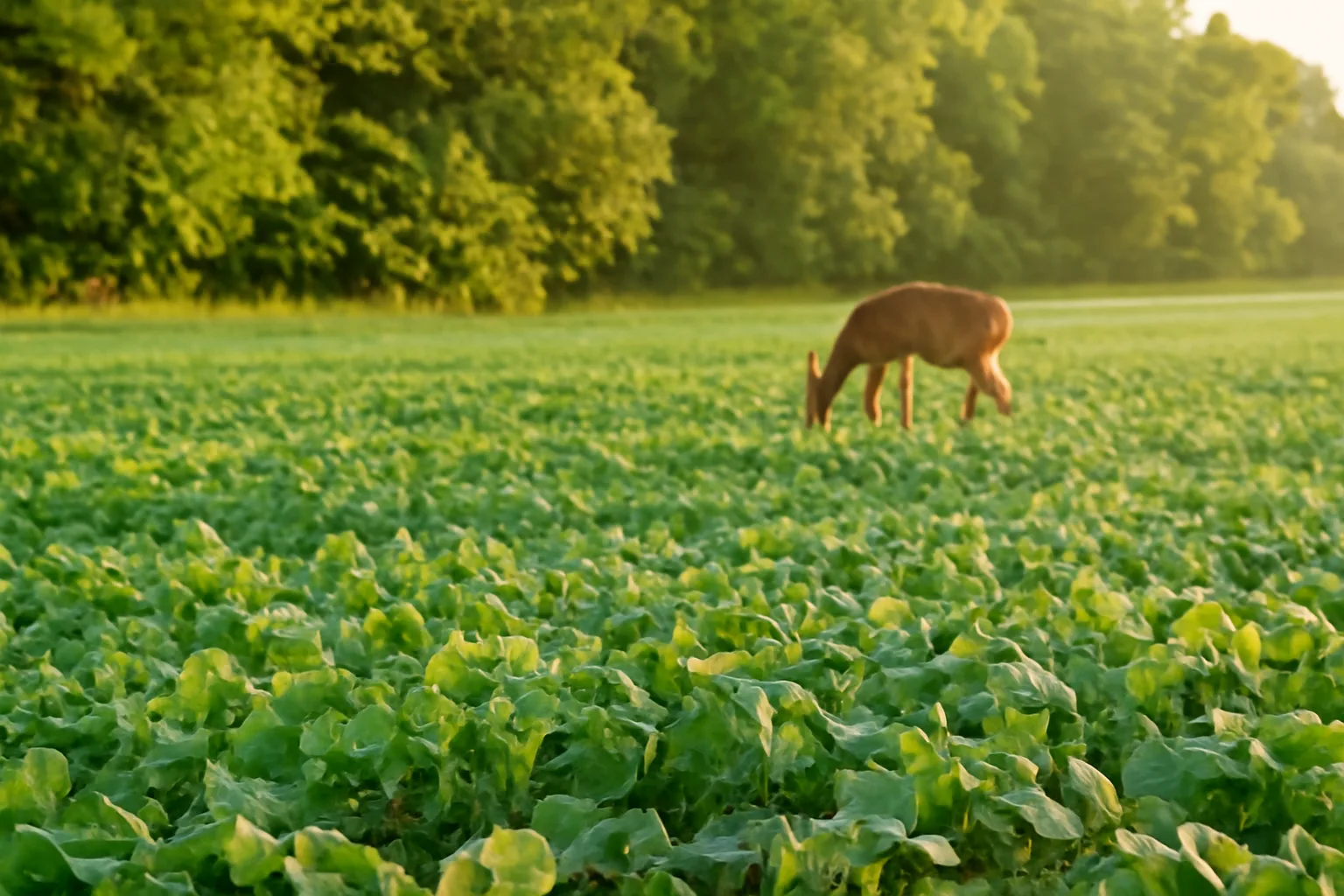
For most of the country, the best summer food plot is a warm-season legume blend, cowpeas, soybeans, or lablab, planted after last frost for high-protein forage during antler growth and lactation. Perennial clover is the close runner-up where you want a plot that keeps producing without replanting. Soil test first; fertility drives tonnage more than seed choice.
What is a food plot, exactly?
A food plot is a planted area on hunting or wildlife land, usually somewhere between a quarter acre and several acres, seeded with forage that deer and other wildlife will eat. It is not bait. Bait is food placed to attract animals to a spot for immediate harvest, and most states regulate or ban that practice for deer hunting. A food plot is agriculture: you till or no-till the ground, test the soil, add lime and fertilizer as needed, and plant a crop that grows on its own over weeks or months [1]. The distinction matters legally in a lot of states. Some states classify a standing, growing crop as legal even in areas where baiting is banned, because it is not concentrated feed dumped on the ground. Rules vary a lot by state, and some states regulate what counts as a food plot versus bait based on how the crop was planted and whether it is harvested normally. Check your state wildlife agency's regulations before you plant or hunt over anything, because a mistake here can cost you a license or worse [1]. Functionally, food plots do two jobs. Spring and summer plots supply protein for antler growth and fawn lactation. Fall and winter plots supply carbohydrates and standing forage when natural browse dies back. The "best" summer plot answers the first job, not the second, and that is where a lot of confusion starts.
What is the best summer food plot for deer?
| Soybeans (forage type) | 30-35% | 1 season | High, but can be wiped out by browsing before maturity | Moderate-high (seed cost) | |
|---|---|---|---|---|---|
| Cowpeas (iron/clay type) | 20-25% | 1 season | High, more browse-tolerant than soybeans | Moderate | |
| Lablab | 25-30% | 1 season | High, vines and regrows after browsing | Moderate | |
| White/ladino clover | 25-30% | 3-5 years with maintenance | High, sustained | Lower per-year over life of stand | |
| Grain sorghum | 8-11% (grain), lower forage value | 1 season | Low as a summer browse plot, better as fall/winter grain | Low-moderate | Protein figures are typical ranges reported for forage legumes and vary with maturity stage, soil fertility, and moisture, so treat them as approximate [2] [1]. If you can only plant one plot this summer and your goal is antler and body growth, go with a cowpea or lablab blend, or a soybean/cowpea mix. Straight soybeans look great in a seed catalog but in high-deer-density areas they often get grazed to the dirt before they mature, especially on plots under 2 to 3 acres. Cowpeas and lablab tolerate repeated browsing better because they keep sending up new growth [3]. |
For most of the whitetail's range, a warm-season annual legume, cowpeas, soybeans, or lablab (sometimes sold as tropical forage soybean or Alyce clover blends), is the best single summer plot choice. These plants pack roughly 20 to 35 percent crude protein in the leaf tissue during peak growth, which lines up with when does need protein for milk production and bucks need it for antler growth [2]. Perennial clover (white or red) is the strongest runner-up, and for a lot of landowners it is actually the better long-term play. Clover establishes in spring or late summer, keeps producing through most of the growing season, and comes back year after year with mowing and a little fertilizer instead of a full replant. The tradeoff is that clover alone gets hammered hard in high-deer-density areas and can struggle in real drought or heavy shade. Here is the honest comparison most articles skip: | Summer plot type | Crude protein (approx.) | Longevity | Deer preference under pressure | Cost to establish |
Do deer eat sorghum?
Yes, deer will eat sorghum, but it is not a strong choice as a dedicated summer forage plot. Grain sorghum (milo) is bred for grain production, and deer browse the leaves some in summer, but the real value comes later, when the grain heads mature in fall and provide a carbohydrate source similar to corn. Forage sorghum and sorghum-sudangrass hybrids are grown more for cattle silage and hay than deer nutrition, and they lack the crude protein punch of a legume. Where sorghum earns a spot is as a nurse crop or wind-block planted alongside soybeans, or as a standing fall/winter grain plot alongside corn. If your goal is specifically summer antler-growth nutrition, spend the seed budget on legumes instead.
Do deer eat clover, and do deer like clover?
Yes on both counts, and by a wide margin clover is one of the most consistently preferred forages in food plot research and in decades of practical use by wildlife managers. White clover and red clover both show up at the top of preference studies and land manager surveys, and deer will hit a clover plot hard from spring green-up through fall, only slowing down when frost knocks it back [4]. The reason clover works so well is a mix of taste, digestibility, and availability. It is a legume, so it fixes nitrogen and keeps producing quality forage without needing a fresh planting every year. A well-maintained clover stand can produce for 3 to 5 years before you need to till it up and start over, which is longer than almost any other food plot forage. University extension wildlife programs commonly recommend clover as a foundational perennial forage for deer food plots because of its combination of palatability, protein content, and regrowth after grazing [5]. The catch: clover needs decent soil pH (mid 6s is ideal), full or nearly full sun, and it will thin out if deer numbers are high relative to plot size. Mow it two or three times a season to knock back weeds and keep growth tender, and expect to spot-spray for grass encroachment eventually.
When to plant food plots for deer?
Timing depends entirely on what you're planting and where you are, but the general rule is: warm-season summer plots go in after your last spring frost date, and cool-season fall plots go in 60 to 90 days before your first fall frost. Check your local frost dates through your state's cooperative extension office or the NOAA climate normals for your county, since "summer" and "fall" planting windows shift by six to eight weeks between the Deep South and the northern Midwest . A rough national breakdown: - Deep South (zones 8-9): summer legumes go in April through May.
- Mid South / transition zone (zones 6-7): summer legumes go in May.
- Upper Midwest / North (zones 3-5): summer legumes go in late May through June, after soil temps hit 60-65°F. Soil temperature matters more than the calendar date for germination. Cowpeas, soybeans, and lablab all want soil temps consistently above 60°F before you drop seed, or germination is spotty and slow .
When to plant oats for deer?
Oats are a fall and early-winter plot, not a summer plot. Plant oats 6 to 8 weeks before your area's average first fall frost date, which lands most oats plantings somewhere between late August and mid-September depending on latitude . Oats germinate fast, tolerate cool soil, and put out tender, sweet forage that deer hit hard in October and November, especially after a light frost sweetens the leaves. They winterkill in most of the northern half of the country once temperatures drop into the teens, so in the North oats function as a fall attractant rather than a winter-long food source. Further south, oats can survive mild winters and keep producing into December or January.
When to plant turnips for deer?
Turnips are also a fall/winter brassica, planted roughly 90 to 100 days before your first hard frost so the plant has time to bulb up and the leaves mature before deer start hitting them hard . That planting window usually falls in late July through August across most of the whitetail's range. Turnips are a two-stage food source. Deer eat the leaves through fall, then after a couple of hard frosts convert the plant's starches to sugars, they start digging up and eating the bulbs, which can carry a plot into December or January in the North. Turnips are not a summer plot; if you plant them in June expecting summer browse, you'll get scattered leaf grazing and a lot of bolted, woody plants by August.
What are deer's favorite foods?
There is no single universal "favorite" food, because deer preference shifts with season, region, and what's locally available, but research and decades of plot data point to a consistent short list: acorns (especially white oak group), clover, soybeans, and native browse like greenbrier and honeysuckle rank at or near the top across most studies [4] . Acorns deserve special mention. Wildlife research shows deer will shift heavily toward acorns during a heavy mast year, sometimes ignoring food plots and agricultural fields nearby, because acorns deliver a fat and carbohydrate density that beats almost anything you can plant . That is one reason plot performance looks different year to year on the same property: it is not always your plot, it might be the oaks. Within planted forages, soybeans and clover consistently test as high-preference in cafeteria-style feeding trials (where deer are given several forage choices and researchers track which gets eaten first and most). Brassicas like turnips and radishes rank lower in preference in early fall but climb sharply after a frost.
Do deer like honey?
Deer are not drawn to honey itself in any meaningful way as a food plot or attractant strategy, and there is no research supporting it as a deer food source. What confuses people is honeysuckle, a woody vine that deer genuinely do favor as browse, especially in winter when other green forage is scarce. If you have seen deer camp lore about "deer and honey," it is almost certainly a mixup with honeysuckle, not the bee product. Some commercial deer attractant sprays and mineral products include molasses or sugar-based additives, which deer can be drawn to because of sugar content, but that is a different thing from plain honey and is closer to a mineral lick or supplement than a food plot strategy. Check your state's baiting laws before using any scent or sugar-based attractant, since several states classify these the same as bait [1].
How do soil and fertility affect which summer plot is best?
Your soil test is the single biggest factor in whether any summer plot succeeds, and it matters more than which seed bag you buy. Legumes like soybeans, cowpeas, and clover all want soil pH in the 6.0 to 6.8 range to access the nitrogen-fixing bacteria relationship that makes them low-input, high-protein crops. Below pH 6.0, that nitrogen fixation drops off and you'll need supplemental nitrogen fertilizer to get decent tonnage, which erases some of the cost advantage of planting a legume in the first place . Most land-grant extension soil labs will hand back a report with a specific lime and fertilizer recommendation in pounds per acre based on your actual sample, and that recommendation should be treated as the final word for your dirt, not a general article like this one. Lime takes months to fully react in the soil, so if your test comes back low (below pH 5.5), get lime down the prior fall if you can, not the week before planting . If you're staring at a soil test result and trying to figure out which summer seed makes sense for your pH, drainage, and sun exposure, that's exactly the kind of site-specific question a Custom Food Plot Plan is built to answer for $99, one time, no subscription. It is general planning guidance built around your test results and location, not a replacement for your soil lab's specific lime and fertilizer numbers.
Should you plant a monoculture or a blend for summer?
Blends beat monocultures for most summer plots, and the reasoning is pretty simple: a mix of cowpeas, soybeans, and a little sunflower or sorghum for structure spreads out risk. If drought stunts the soybeans, the cowpeas often keep pushing new growth. If deer browse pressure is heavy enough to wipe out a pure soybean plot before it matures, a blend gives the plot more total plant mass to absorb that pressure. Straight clover is the one exception where a near-monoculture (clover with a small percentage of chicory, which is common in commercial blends) makes sense, because you're optimizing for multi-year perennial performance rather than single-season tonnage. For readers comparing specific seed products or trying to match a blend to their acreage and soil type, deer food plot seed and food plot seed break down specific product lines and blend ratios in more depth than fits here.
What mistakes cost hunters the most on summer plots?
Planting too early is the number one mistake. Soil under 60°F germinates warm-season legumes slowly and unevenly, giving weeds a head start that can shade out or outcompete your planted seed before it establishes. Wait for soil temp, more than calendar date. The second mistake is planting a small plot (under an acre) with pure soybeans in a high-deer-density area and expecting it to survive to maturity. Deer will graze tender soybean shoots down to nothing in areas with heavy pressure, especially on small plots with no size to absorb browsing. Bigger plots, blends with browse-tolerant cowpeas or lablab, or exclusion cages to let part of the plot mature and reseed all help. Third is skipping the soil test and guessing on lime. A field at pH 5.2 planted with clover or soybeans without lime will underperform no matter how good the seed genetics are. A soil test costs very little through most state extension offices, often in the $10 to $20 range depending on the lab, and it is the cheapest insurance you can buy on a plot budget .
How does the summer plot fit into a full-season plot plan?
A summer legume plot is one piece of a season-long system, not a standalone decision. Most serious plot managers run two rotations: a warm-season protein plot (soybeans, cowpeas, lablab, or clover) from spring through summer, then transition part of that acreage or a separate field to cool-season brassicas and cereal grains (oats, wheat, turnips) in late summer for fall and winter hunting season forage. If you're mapping out a full property plan rather than a single plot, food plot whitetail and deer food plots cover how to sequence multiple plots across a season, and deer for food and domain food plot seed go deeper on specific regional seed selection if you want to compare options beyond what fits in this article.
Frequently asked questions
What is the single best summer food plot for deer?
A warm-season legume blend of cowpeas, soybeans, and lablab is the best all-around summer plot for most regions, delivering roughly 20 to 35 percent crude protein during antler growth and lactation season. Perennial clover is a close second choice, especially if you want a plot that keeps producing for 3 to 5 years without replanting.
Do deer eat sorghum?
Yes, deer browse sorghum leaves in summer, but it is a weak choice for a dedicated summer protein plot since it lacks the crude protein of legumes. Grain sorghum earns its keep as a fall/winter grain source once the heads mature, similar in role to corn, not as a spring/summer forage plot.
Do deer eat clover, and do deer like it?
Yes, clover ranks among the most preferred forages in food plot research and practical land management experience. White and red clover deliver roughly 25 to 30 percent crude protein, regrow quickly after grazing, and can produce for multiple years with basic mowing and fertility maintenance, making it one of the top perennial choices.
When should I plant food plots for deer?
Summer legume plots go in after your last spring frost, once soil temperatures hit 60 to 65 degrees F, timing that shifts from April in the Deep South to late May or June in the northern Midwest. Fall plots (oats, brassicas) go in 60 to 100 days before your area's first fall frost. Check your local extension office for exact dates.
When should I plant oats for deer?
Plant oats 6 to 8 weeks before your area's average first fall frost date, usually late August through mid-September. Oats germinate fast and produce sweet, tender forage deer favor in October and November, but they typically winterkill in the northern half of the country once temperatures drop into the teens.
When should I plant turnips for deer?
Plant turnips roughly 90 to 100 days before your first hard frost, generally late July through August. Deer eat the leaves through fall, then after a couple of hard frosts convert plant starches to sugar and start eating the bulbs, extending food availability into early winter.
What exactly is a food plot?
A food plot is a planted, cultivated area of forage seeded specifically to feed deer and other wildlife, distinct from bait because it is a standing crop grown over weeks or months rather than concentrated feed placed on the ground. Most states regulate food plots differently than bait piles, so check your state wildlife agency's rules.
What are deer's favorite foods overall?
Acorns, especially from white oak species, top most preference studies during mast years, followed by clover, soybeans, and native browse like greenbrier and honeysuckle. Preference shifts by season and region, and deer will largely favor acorns over food plots during a heavy mast fall.
Do deer like honey?
No, there's no evidence deer are drawn to honey as a food source or attractant. Confusion usually stems from honeysuckle, a woody vine deer genuinely favor as browse, particularly in winter. Some commercial attractants use molasses or sugar additives, which is a different product entirely from plain honey.
Should I plant soybeans or clover for a summer plot?
Soybeans deliver higher protein (30-35%) but are a single-season crop vulnerable to heavy browsing on small plots. Clover produces slightly less protein (25-30%) but persists 3 to 5 years with maintenance and handles sustained grazing pressure better. Many managers plant both: soybeans on larger acreage, clover on smaller high-traffic plots.
How big should a summer food plot be?
There's no fixed minimum, but plots under an acre in high-deer-density areas often get grazed down before crops like soybeans mature. One to three acres gives most warm-season legume blends enough size to absorb browsing pressure and still produce standing forage through summer. Smaller plots work better with browse-tolerant species like clover or cowpeas.
Do I need a soil test before planting a summer plot?
Yes. Soil pH below 6.0 significantly reduces nitrogen fixation in legumes like soybeans, cowpeas, and clover, cutting into the protein and tonnage you'll get regardless of seed quality. A soil test through your state extension office typically costs $10 to $20 and gives lime and fertilizer recommendations specific to your field.
Sources
- Oklahoma State University Extension, PSS-2129, Establishing Food Plots for White-tailed Deer: Legume forages like soybeans and cowpeas provide roughly 20-35% crude protein for deer nutrition
- University of Georgia Extension, Bulletin 1347, Wildlife Food Plots: Grain sorghum functions primarily as a fall/winter grain source rather than summer forage for deer
- NOAA National Centers for Environmental Information, U.S. Climate Normals: Frost dates vary by region and determine planting windows for warm and cool season food plots
- Clemson Cooperative Extension, Forage Brassicas for Deer Food Plots: Turnips should be planted 90-100 days before first hard frost to allow bulb development
- USDA Forest Service, Southern Research Station, General Technical Report SRS-101, oak mast and white-tailed deer: Deer shift heavily toward acorns during high mast years, reducing food plot use