Last updated 2026-07-26
TL;DR
Wet soil food plots need species bred for saturation and poor drainage, like certain clovers, brassicas, and sorghum, not standard blends that rot out in standing water. Test soil, pick tolerant species (arrowleaf clover, chicory, forage sorghum), and plant on a slight crown or bed if you can. Drainage fixes beat seed selection when water sits more than a few days.
what makes a food plot a wet soil food plot
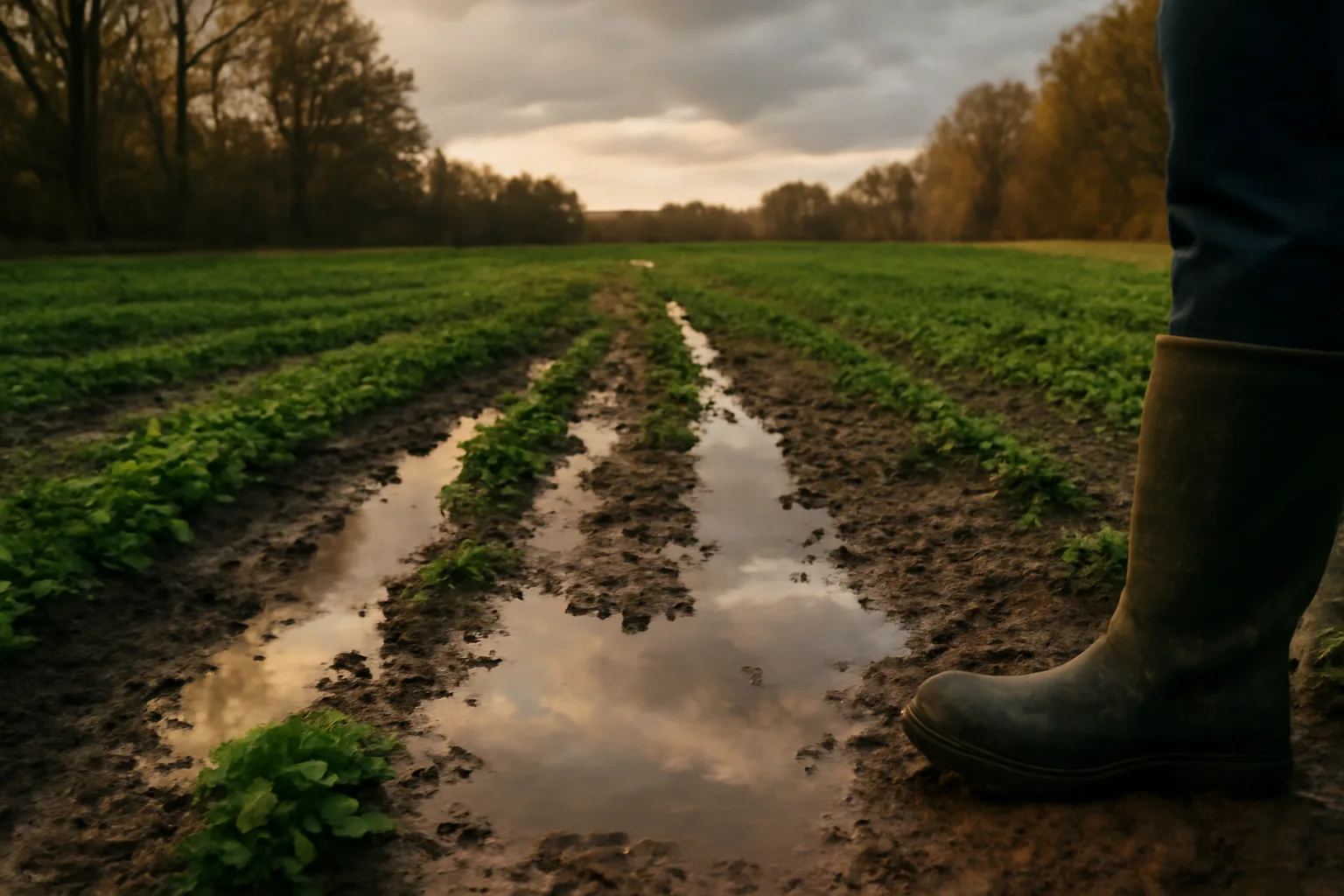
A wet soil food plot is any plot where water sits in the root zone for extended periods after rain, whether from a high water table, heavy clay, a low spot in a field, or a spot near a creek bottom or beaver pond. It's not the same as a plot that gets rained on. Most food plots handle a few inches of rain fine. A wet soil plot is one where you can dig six inches down in July and still hit mud, or where standing water is visible 24 to 48 hours after a storm. The core problem is oxygen, not water itself. Plant roots need oxygen in the soil pore spaces to respire. When soil stays saturated, oxygen gets displaced and roots start to suffocate and rot. Species vary enormously in how long they tolerate this. Some clovers and grasses evolved in bottomland and marsh edges and shrug off saturation for days. Others, like most food plot brassicas planted on upland ground, will yellow and die within 48 to 72 hours of standing water. Before picking seed, walk the plot after a hard rain and time how long water actually sits. That single observation tells you more than any seed tag. If water is gone in a day, you have more species options than you'd think. If it's still there on day three, you're in a narrower lane and drainage work probably matters more than species choice. A soil test still matters here just as much as on dry ground, maybe more, because wet clay soils often run more acidic and lock up phosphorus even when pH looks close to right. Your soil test lab's lime and fertilizer recommendation is the actual authority on your dirt. This article gives you the general species and timing logic, not a substitute for what your test says.
what is a food plot, and how is a wet-soil plot different to plan
A food plot is a planted area on hunting or agricultural ground, usually a half acre to a few acres, seeded with forage or grain species specifically to attract and hold deer or other wildlife, and often to supplement their diet through stress periods like late summer or winter. USDA's NRCS supports wildlife food plots and similar habitat plantings through its conservation practice standards, and cost-share funding in several states runs through those same programs as part of broader habitat plans [1]. A wet-soil food plot is planned the same way in terms of purpose (attraction, nutrition, holding cover), but every decision downstream of that purpose changes. Seedbed prep is different, since heavy wet clay can't be worked when saturated without turning to concrete when it dries. Planting windows shift, because you often need to wait longer in spring for ground to firm up enough to run equipment across it. Species selection narrows to the subset that tolerates saturation. And fertility decisions change too, since nitrogen leaches faster through waterlogged soil and phosphorus becomes less available in cold, wet, poorly aerated ground. If you're building a broader plan across multiple fields with mixed soil types, it's worth treating the wet spots as their own zone rather than blending them into a whole-farm seed order. A food plot whitetail plan for upland ground and a wet-bottom plan can use completely different seed lists even if they're 200 yards apart.
what species actually tolerate wet or poorly drained soil
| Arrowleaf clover | Good | Handles wet, low-fertility soil; annual, reseeds if allowed to go to seed [2] |
|---|---|---|
| Berseem clover | Good | Annual, fast growth, tolerates wetter ground than ladino |
| White (ladino) clover | Fair to poor | Thins out under prolonged saturation |
| Forage sorghum | Good | Tolerates heavy wet clay better than corn [3] |
| Chicory | Fair | Deep-rooted once established, poor in standing water as a seedling |
| Brassicas (turnips, radish) | Fair | Want well-drained loam ideally; struggle past 48-72 hrs of standing water [4] |
| Oats | Fair | Short-term flood tolerance, not a true wet-soil crop |
| Corn, soybeans | Poor | Standard row crop drainage needs, poor choice for standing water |
This is the question that matters most, and the honest answer is: fewer species than seed catalogs imply. A lot of blends marketed as all-purpose assume decent drainage. Arrowleaf clover and berseem clover both handle wetter, poorly drained soils better than red or white clover, and arrowleaf in particular is documented as tolerant of wet soils and low fertility in southern extension trials [2]. Ladino (white) clover is more sensitive to prolonged saturation and can thin out fast in a wet spring. Chicory has a deep taproot and does reasonably well in heavier soils once established, though seedling establishment in standing water is poor, so timing planting to avoid the wettest window still matters. Forage sorghum and grain sorghum both handle wetter soils and heavier clay better than corn does, and sorghum is more drought tolerant too, which makes it a flexible option for ground that swings between waterlogged in spring and dry in August [3]. Deer do eat sorghum readily, both the leaves and the grain heads once they mature, and it's a common late-summer and fall food source in the whitetail's range, though it's usually planted as a supplement or a nurse crop alongside legumes rather than a standalone attractant [3]. Brassicas (turnips, radishes, rape) are mixed. They tolerate wet soil better than corn or soybeans but still don't like standing water for more than a day or two during establishment. Turnips specifically want a well-drained loam according to most extension planting guides, so a low spot that holds water for 3+ days after rain is a poor turnip site even though turnips are otherwise a strong food plot performer [4]. Oats are more flood tolerant than many people expect for a short window right after planting, but sustained saturation still kills seedlings. Oats are best thought of as a wet-soil-tolerant cover crop for moderate conditions, not a true wetland species. | Species | Wet soil tolerance | Notes |
do deer eat sorghum
Yes. Deer readily eat sorghum, both the foliage while it's green and growing and the grain heads once they mature and dry down in late summer and fall. Sorghum is grown as a food plot and wildlife planting across much of the whitetail's range specifically because it tolerates heat, drought, and poor soils better than corn, while still producing a grain deer will hit hard once the plant matures [3]. It's not usually the plant deer prefer most early in its growth. Deer often ignore young sorghum in favor of clover or beans if both are available. But as sorghum heads fill out and the plant dries, it becomes a strong late-season draw, especially in areas without much standing corn nearby. It also works well as a nurse crop, giving cover and structure for a clover interseeding, or as a screen planting since it grows 5 to 8 feet tall depending on variety. On wet ground specifically, sorghum is one of the better grain options because it tolerates saturated clay far better than corn does, which struggles with root rot and stand loss in standing water [3].
do deer eat clover, and do deer like clover
Deer eat clover constantly and most whitetail managers consider it one of the most reliable food plot species available. Clover is high in protein (often 20 to 30 percent crude protein depending on variety and growth stage) and deer use it heavily spring through fall wherever it's planted [2]. It's also a preferred food, more than an available one; deer will often select clover over many other plot options when both are present. Do deer like clover more than other plants? There's no perfect ranking since preference shifts by season, region, and what else is available, but clover consistently shows up near the top of preference studies and hunter observation alike. The tradeoff is establishment and maintenance. Clover needs decent soil pH (most varieties want 6.0 to 6.5) and it can't be planted and forgotten; it benefits from mowing and occasional herbicide to control competing weeds and grass [2]. On wet ground, arrowleaf and berseem clover are the better picks over ladino, as covered above. If your wet plot has a drier upper edge or crown, that's often the spot to run ladino, with arrowleaf filling the lower, wetter fringe.
do deer like honey, and what's actually a deer's favorite food
Deer don't seek out honey in any meaningful way in the wild, and it's not a food plot or attractant question with real research behind it; deer are herbivores built to digest forage, browse, mast, and grain, not concentrated sugar sources like honey. Some hunters ask this because of sugar-based mineral or attractant products, but there's no credible wildlife agency or extension guidance recommending honey as a deer attractant, and in many states, using any food-based attractant to draw deer for hunting purposes falls under baiting regulations that vary widely by state. Wisconsin, for example, defines baiting and feeding restrictions by county and deer management zone, and violating them is a real citation, not a technicality [5]. As for a true "favorite food," deer are opportunistic browsers and their preference shifts hard by season and region. In general, deer prioritize whatever gives them the best combination of protein, digestibility, and low search cost at that time of year. Acorns are a heavily preferred natural food in fall wherever oaks are present, often outcompeting planted food plots when there's a strong mast year. Among planted crops, clover, soybeans, and standing corn or grain sorghum tend to rank high, with brassicas becoming more attractive after a hard frost sweetens the leaves through starch conversion. There's no single universal favorite. A plot that gets hit hard in one county can sit untouched in another because of mast availability, ag crop density nearby, or herd density. That's part of why a one-size seed blend rarely performs the same on two different farms.
when to plant food plots for deer
Timing splits into two windows almost everywhere in whitetail range: a spring/summer planting for warm-season annuals and perennials, and a late-summer planting for fall annuals like brassicas and cereal grains. The exact dates shift by USDA plant hardiness zone and your local frost dates, so a state extension planting calendar for your specific state is the most reliable source, not a national blanket date [6]. Spring plantings (clover, chicory, soybeans, sorghum) generally go in after your last frost date, once soil temperatures warm into the mid-50s Fahrenheit, commonly April through May in the upper Midwest and Northeast, and as early as March in the deep South [6]. Fall plantings (brassicas, oats, cereal rye, winter wheat) are timed backward from your first frost date, usually going in 60 to 90 days before that date so brassicas have time to bulb and cereal grains establish before hard freeze. On wet ground specifically, add a buffer. Wet clay dries out and warms up slower in spring than well-drained loam, so you may need to wait one to two weeks longer than a neighbor planting the same species on better-drained ground. Pushing equipment onto saturated clay too early both damages soil structure and gives you a rough, unpredictable seedbed.
when to plant turnips for deer
Turnips are a fall planting, timed 60 to 80 days before your area's first fall frost, which lines up with late July through early September across most of whitetail range depending on latitude [4]. Extension guidance generally recommends planting when soil temperatures are still warm enough for fast germination but with enough growing season left before frost to build bulb size and leaf mass. Turnips want a well-drained, fertile loam soil according to most university extension forage guides, and they're notably less tolerant of standing water than sorghum or arrowleaf clover [4]. On a wet-soil plot, turnips work best on the higher, better-drained portion of the field, not the low spot that holds water after every rain. If your whole plot is genuinely wet, a turnip-heavy blend is probably the wrong call; lean toward brassicas mixed with a more tolerant cereal grain, or skip brassicas there entirely in favor of arrowleaf clover or sorghum. Deer preference for turnips is real but delayed. Deer often ignore turnip leaves and bulbs until after the first hard frost converts starches to sugars, making the plant noticeably more palatable. If you're hunting early season, don't expect turnips to be the draw; they become one later.
when to plant oats for deer
Oats are typically planted as a fall annual, going in 6 to 8 weeks before your first expected frost, which puts most plantings from late August through mid-September depending on region [6]. Oats germinate fast, often within 5 to 10 days in warm, moist soil, and deer will hit young oat shoots hard almost immediately, which makes oats a popular quick-establishing option for hunters planting close to season. Oats can also go in as a spring planting in some regions, mainly as a nurse crop for a clover or alfalfa seeding, since the oats germinate fast and provide some structure and weed suppression while the slower perennial establishes underneath. On wet ground, oats hold up reasonably well through short saturation events right after planting but don't treat them as a true wet-soil specialist. If your plot floods regularly for days at a time, sorghum and arrowleaf clover are the safer long-term bet, with oats reserved for the drier portions or as a fast-establishing companion crop.
how do you fix drainage instead of just picking tougher seed
Species selection only gets you so far. If a plot holds standing water for more than 3 to 4 days after a normal rain, no seed choice solves that reliably, and you're better off addressing water movement first. The simplest fix is often a shallow crown down the center of the plot, a few inches of grade built up with a disk or box blade so water sheds to the field edges instead of pooling in the middle. This is cheap and doable with equipment most plot owners already have. Where the whole field sits low relative to surrounding ground, a shallow ditch or swale along the low edge, tied into an existing drainage path, can move water off faster without needing tile. Always check for wetland protections before digging drainage on ground near a stream, pond, or mapped wetland. USDA's Highly Erodible Land and Wetland Conservation provisions (commonly called Swampbuster) can restrict drainage work on wetland acres tied to farm program eligibility, and altering a jurisdictional wetland can also trigger Clean Water Act Section 404 permitting requirements administered by the Army Corps of Engineers [7]. This isn't a small technicality; converting a wetland without proper review can affect USDA program eligibility on the whole farm, more than that field. Subsurface tile drainage is the permanent fix but it's a real cost, commonly running from roughly $500 to over $1,500 per acre depending on tile spacing, depth, and local contractor rates, and that's before permitting or wetland determination costs if they apply . For most food plot budgets, that math only makes sense if the plot is large, important, and clearly worth the investment relative to leased or owned acreage value. For most hunters, a cheaper middle path works fine: crown the plot for basic surface drainage, plant a wet-tolerant species mix, and accept that the wettest years will just be rough years for that field. Trying to engineer a perfect fix on a half-acre plot rarely pencils out.
how does fertility and pH work differently on wet soil
Wet, poorly drained soils often run more acidic than upland soils on the same farm, partly because standing water slows organic matter breakdown and encourages the buildup of organic acids, and partly because heavy clay soils common in low spots hold onto acidity more stubbornly than sandy or loamy soils. That means the lime rate on your soil test for a wet bottom plot is frequently higher than the rate for a well-drained field nearby, even if both read similar in raw pH before adjustment. Nitrogen behaves differently too. In saturated soil, nitrogen can be lost through denitrification, a microbial process that converts soil nitrate into gaseous forms that escape to the atmosphere, which is faster and more significant in wet, low-oxygen soil than in well-drained ground. Practically, that means a wet plot may need a split nitrogen application, some at planting and some as a topdress later, rather than one big shot up front that partly evaporates before the crop can use it. Phosphorus, meanwhile, becomes less available to plant roots in cold, wet, poorly aerated soil, which is part of why brassicas and clovers alike can look stunted and purple-tinged (a classic phosphorus deficiency symptom) on a wet spring even when the soil test says P levels are adequate. None of this changes the basic rule: your soil test lab, not a blog article, is the authority on your specific lime and fertilizer rate. What changes on wet ground is that the test result deserves more trust than a gut-feel guess, since wet clay soils behave less intuitively than well-drained loam.
what planting method works best on wet or heavy clay ground
Broadcasting and light incorporation generally beats deep tillage on wet clay. Heavy clay that's tilled while too wet turns into dense clods that dry rock-hard, ruining seed-to-soil contact for weeks or the whole season. If you can dig a handful of soil and it forms a slick ribbon between your fingers rather than crumbling, it's too wet to work. A no-till or minimum-till drill is the better tool on these soils if you have access to one, since it disturbs less soil structure and gets seed to the right depth without turning the whole profile over. Where a drill isn't available, broadcasting seed onto a lightly disked or cultipacked seedbed, timed for right before a rain, works reasonably well for small grains, clover, and brassica seed, all of which are shallow-planted anyway. Corn and soybeans, which need more precise planting depth and better drainage generally, are a tougher fit for chronic wet ground regardless of equipment. If a plot floods repeatedly, steering away from row crops toward broadcast-friendly species like clover, brassica, and cereal grain blends saves both seed cost and frustration. For readers building out a full-farm seed plan across multiple soil types, it's worth pricing a deer food plot seed mix built for your specific zones rather than one blanket bag for the whole property. Wet bottoms, upland ridges, and shaded interior plots often want three different seed lists, not one.
putting it together: building a wet-soil plot plan
The short version: confirm how long water actually sits after rain, pull a real soil test, and pick species from the tolerant end of the list rather than whatever's on sale at the farm store. Arrowleaf clover, berseem clover, and forage sorghum are the workhorses for genuinely wet ground. Turnips, oats, and ladino clover are fine on the drier margins of a wet plot but not the low spots that hold water for days. If drainage is bad enough that nothing establishes reliably, a shallow crown or swale is often worth more than any seed upgrade, and it's cheap compared to tile. Check wetland status before digging anything near a stream or pond; USDA's Swampbuster provisions and Clean Water Act Section 404 both carry real consequences if you drain a protected wetland without review [7]. This kind of planning gets specific fast once you factor in your actual zone, frost dates, and soil test numbers, which is more than a general article can nail down for your exact acre. PlotSeason's $99 Custom Food Plot Plan (/plot-plan-builder) builds a species and timing plan around your specific soil test results, zone, and plot conditions, wet spots included, as one-time general guidance, not a substitute for your soil lab's site-specific lime and fertilizer recommendation. For readers still deciding what to plant across a whole property, the deer food plots and food plot seed guides cover species selection for drier ground, and the deer for food piece walks through matching species to deer nutritional needs by season.
Frequently asked questions
Do deer eat sorghum in food plots?
Yes. Deer eat sorghum foliage while it's green and hit the grain heads hard once they mature in late summer and fall. Sorghum tolerates heat, drought, and wet heavy clay better than corn, making it a solid grain option for wet-soil plots, though deer often prefer clover or soybeans over young sorghum early in the growing season.
Do deer eat clover, and do deer like clover more than other plants?
Deer eat clover heavily and it's one of the most reliably preferred food plot species, offering 20 to 30 percent crude protein depending on variety and growth stage. There's no universal ranking of deer's single favorite food since preference shifts by season and region, but clover consistently ranks near the top in both research and hunter observation.
When should you plant food plots for deer?
Timing splits into spring plantings (clover, chicory, sorghum, soybeans) after your last frost date and fall plantings (brassicas, oats, cereal grains) 60 to 90 days before your first fall frost. Exact windows depend on your USDA hardiness zone; a state extension planting calendar gives the most accurate local dates.
When do you plant turnips for deer food plots?
Plant turnips 60 to 80 days before your area's first fall frost, usually late July through early September depending on latitude. Turnips want well-drained fertile loam and struggle in standing water, so on wet-soil plots, plant them on the higher, drier ground rather than the low spot that holds water.
When do you plant oats for deer?
Oats typically go in 6 to 8 weeks before first frost, roughly late August through mid-September in most of whitetail range, and germinate in 5 to 10 days. They can also be planted in spring as a nurse crop for clover. Oats tolerate brief saturation but aren't a true wet-soil specialist long term.
What is a food plot?
A food plot is a planted area, usually a half acre to a few acres, seeded with forage or grain species to attract and provide supplemental nutrition to deer or other wildlife. USDA's NRCS supports food plot and habitat plantings through its conservation practice standards, and several state cost-share programs support them as part of broader habitat plans.
What are deer's favorite foods overall?
There's no single universal favorite; deer preference shifts by season, region, and what's available. Acorns are heavily preferred in fall wherever oaks grow and often outcompete planted plots in strong mast years. Among planted crops, clover, soybeans, and grain sorghum rank consistently high, with brassicas gaining appeal after a hard frost.
Do deer like honey or sugar-based attractants?
Deer don't naturally seek out honey; they're herbivores adapted to forage, browse, mast, and grain, not concentrated sugars. There's no credible extension or wildlife agency guidance recommending honey as an attractant, and many states regulate food-based baiting for hunting, so check your state wildlife agency's rules before using any attractant.
What food plot species tolerate wet or poorly drained soil best?
Arrowleaf clover, berseem clover, and forage sorghum handle wet, poorly drained soil noticeably better than ladino clover, corn, or soybeans. Brassicas and oats tolerate moderate wetness but struggle if standing water persists more than 48 to 72 hours, so they perform best on the drier margins of a wet plot.
How long can standing water sit before it kills food plot seedlings?
Most upland food plot species, including corn, soybeans, and standard brassicas, show stress and stand loss within 48 to 72 hours of standing water due to root oxygen deprivation. Wetter-tolerant species like arrowleaf clover and forage sorghum handle longer saturation, but no common food plot species tolerates water standing for a week or more.
Is it worth installing drain tile for a food plot?
Tile drainage commonly costs $500 to over $1,500 per acre depending on spacing, depth, and contractor rates, before permitting costs. For most food plot budgets, that only makes sense on larger, high-value plots. A cheaper crown or shallow surface swale often gets a small plot workable enough without that expense.
Do I need a permit to drain a wet food plot?
Possibly. If the low area qualifies as a wetland, USDA's Swampbuster provisions under the Food Security Act can restrict drainage and affect farm program eligibility, and altering a jurisdictional wetland can trigger Clean Water Act Section 404 permitting through the Army Corps of Engineers. Get a wetland determination before digging near a stream, pond, or mapped wetland.
Does pH and fertilizer need to be different for wet-soil food plots?
Often yes. Wet, poorly drained soils tend to run more acidic and may need higher lime rates than nearby well-drained fields, and nitrogen can be lost faster through denitrification in saturated soil. Your soil test lab's specific recommendation is the authority here; treat this as a reason to test that plot separately, not a reason to guess.
Sources
- USDA NRCS, Conservation Practice Standard: Wildlife Habitat Planting (Code 420): food plot and wildlife habitat plantings are recognized and cost-shared through NRCS conservation practice standards
- University of Georgia Extension, Arrowleaf Clover, Bulletin 1274: arrowleaf clover tolerates wet and low-fertility soils better than many other clover species
- Oklahoma State University Extension, Forage Sorghums, PSS-2587: forage sorghum tolerates heat, drought, and wet, poorly drained soils better than corn
- University of Tennessee Extension, Brassicas for Forage and Wildlife, SP731-A: turnips and other brassicas perform best on well-drained fertile loam and struggle with standing water
- Wisconsin Administrative Code, NR 19.60, Baiting and Feeding of Wild Animals: food-based attractants for hunting deer are regulated by rule and restrictions vary by county and deer management zone
- USDA NRCS, Highly Erodible Land and Wetland Conservation (Swampbuster), 7 CFR Part 12: draining a designated wetland can affect USDA farm program eligibility under Swampbuster provisions
- Iowa State University Extension, Agricultural Drainage Water Management Costs, PM 3080: subsurface tile drainage installation costs commonly range roughly $500 to over $1,500 per acre depending on spacing and depth