Last updated 2026-07-25
TL;DR
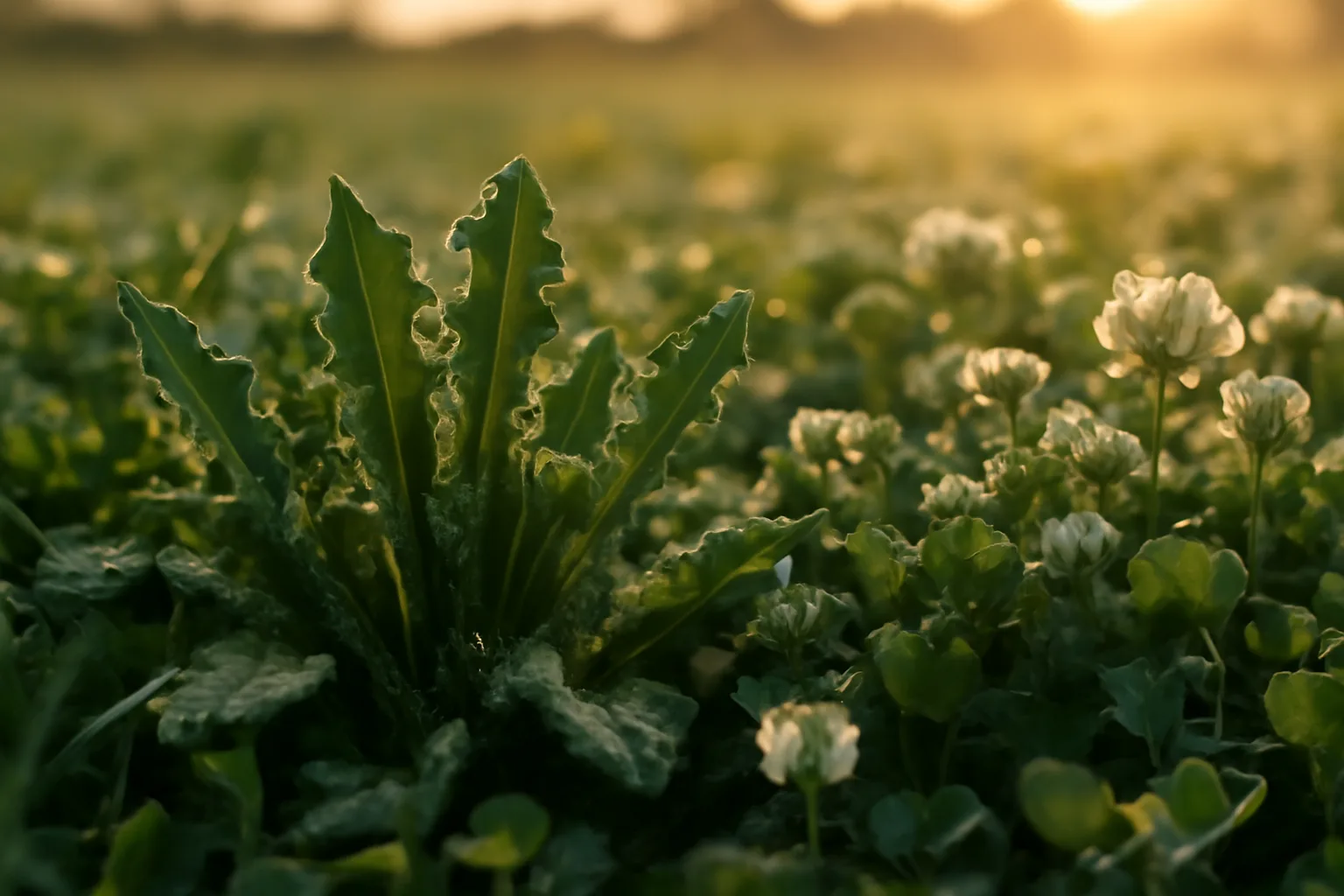
In a food plot, chicory looks like a low rosette of long, jagged, dandelion-shaped leaves 6 to 12 inches tall, deep green and slightly hairy underneath. Forage varieties rarely bolt into their 3 to 5 foot flowering stalk if kept grazed. It often gets planted mixed with clover, so look for that broad-leafed rosette poking up between clover's rounder trifoliate leaves.
What does chicory look like in a food plot?
Chicory (Cichorium intybus) starts as a low rosette that looks a lot like a big, ragged dandelion. The leaves are long, deeply lobed or toothed along the edges, dark green on top, and a bit fuzzy or hairy on the underside and along the midrib. That rosette stays close to the ground for most of its first year, usually 6 to 12 inches tall in a managed plot, with leaves radiating out from a central taproot crown. If you let it go to seed, forage chicory sends up a tough, hollow, branching flower stalk that can hit 3 to 5 feet or more, topped with pale blue, dandelion-like flowers that open in the morning and close by early afternoon. In a food plot managed for deer, you generally don't want to see that stalk. Once chicory bolts, the leaves toughen up, palatability drops, and deer lose interest in the plant. Regular mowing or grazing pressure keeps it in the leafy rosette stage, which is exactly what you want. The root is the other giveaway. Chicory has a thick, deep taproot, sometimes called a carrot-like root, that can plunge several feet into the soil. That root is why chicory tolerates drought so well and why it keeps producing new leaves through hot, dry stretches when clover is wilting. If you ever pull a plant to confirm ID, that long, pale, forking taproot with a milky sap is your confirmation. Snap a leaf or stem and you'll see the same white, slightly bitter latex sap that's typical of the whole chicory and dandelion family. Color and texture-wise, chicory reads a shade darker and coarser than clover in the same plot. Clover leaves are rounded, often with a pale chevron marking, and grow close and mat-like. Chicory leaves are longer, more jagged, and stand a bit more upright out of the crown. Once you've seen both side by side in a mixed plot, telling them apart takes about two seconds.
How do I tell chicory apart from clover, dandelion, or plantain in my plot?
Chicory gets confused with three other broadleaf plants that show up in food plots: dandelion, plantain, and clover. Here's the fast way to sort them out. Dandelion leaves are similar in shape to chicory (both are deeply lobed and grow in a rosette), but dandelion stays smaller and flatter to the ground, tops out at maybe 4 to 8 inches of leaf spread, and produces the familiar solitary yellow flower on a single hollow, leafless stalk. Chicory's leaves run longer and the plant, once mature, produces a tall branched stalk with pale blue flowers, not yellow ones. Broadleaf plantain has smooth-edged, oval to egg-shaped leaves with parallel veins running the length of the leaf, nothing like chicory's toothed, elongated look. Buckhorn plantain has narrower leaves but again, no deep lobing like chicory. Clover is the easy one. Clover leaves are trifoliate (three small rounded leaflets per stem), low-growing, and matting. Chicory leaves are single, long, and jagged, growing from a central crown rather than trailing runners. In a clover-chicory blend, which is one of the most common food plot mixes sold, you'll see both growing together: the low mat of clover and the more upright, ragged rosette of chicory poking up through it. That contrast is actually a nice visual cue that your blend established well.
What is a food plot?
A food plot is a planted area, usually somewhere between a quarter acre and several acres, established specifically to grow forage that attracts and feeds deer or other wildlife. Instead of relying only on natural browse, landowners and hunters plant clover, brassicas, cereal grains, chicory, or corn and soybeans to supplement nutrition and concentrate deer activity in a spot where hunting or observation is easier. Food plots fall into two rough categories. Annual plots get replanted every year (brassicas like turnips and radishes, cereal grains like oats and wheat, or warm-season plants like soybeans). Perennial plots (clover, chicory, alfalfa) get established once and then maintained through mowing, spraying, and periodic fertilization for 3 to 5 years or more before they need to be reseeded. Most state wildlife agencies and university extension programs treat food plots as a habitat management tool, not a magic bullet. The USDA Natural Resources Conservation Service and many state agencies offer technical guidance and, in some cases, cost-share programs for wildlife food plots and habitat plantings [1]. If you're planning your first plot or you're not sure what your soil and climate call for, a Custom Food Plot Plan for $99 gives you species picks and a timeline based on your zip code and soil test, but plenty of hunters build a solid plot with a soil test, a seed tag, and this kind of reference guide.
When to plant food plots for deer?
Timing depends entirely on what you're planting and where you live. Cool-season perennials and annuals (clover, chicory, brassicas, cereal grains) go in during late summer to early fall in most of the whitetail's range, timed so seedlings establish before the first hard frost. Warm-season plots (soybeans, corn, sunflowers, sorghum) go in during spring, after your last frost date, similar to a garden planting window. As a rough national framework: northern states (much of the Midwest and Northeast) plant fall plots from mid-July through early September. Transition zone states (mid-South, lower Midwest) plant from late August through mid-September. Deep South and Gulf states often plant fall plots from September through October, since the growing season runs longer and heat stress is a bigger risk earlier in the year. Extension services in each state publish specific fall planting windows for forages based on average first frost dates, so checking your state's cooperative extension calendar is worth the five minutes [2]. Spring plots for warm-season annuals generally go in from mid-April through June, again depending on soil temperature and frost risk. Soil temperature matters more than the calendar date. Most warm-season legumes and grains want soil in the 60 degree F range before germination really takes off.
When to plant clover for deer?
Clover is a cool-season perennial, and it establishes best with a late-summer or early-fall planting, or a very early spring planting known as a frost-seeding. Fall plantings, typically 45 to 60 days before your first expected hard frost, let clover develop a root system and some top growth before winter dormancy, so it comes back strong the following spring [3]. Spring planting works too, especially in northern climates where the growing season is short, but it comes with more weed competition since clover seedlings are slow to establish and can get crowded out by faster-growing spring weeds. If you go the spring route, plant as early as the soil can be worked, often March through May depending on latitude. Clover needs decent seed-to-soil contact and a shallow planting depth (1/4 inch or less; clover seed is tiny and doesn't want to be buried deep). A firm seedbed, whether from a cultipacker or just foot traffic and rain, makes a real difference in germination rates.
When to plant turnips for deer?
Turnips are a fall brassica, and they go in during late summer, generally 80 to 100 days before your area's first hard frost, since deer often don't hit turnip bulbs hard until after a couple of frosts sweeten the starches into sugars [4]. In most of the whitetail range that puts planting somewhere between late July and mid-August, though the Deep South can push into early September. Turnips like a fine, firm seedbed and shallow planting, about 1/4 to 1/2 inch deep. They're one of the more forgiving brassicas in terms of soil fertility, but they still respond well to phosphorus and potassium according to your soil test, and most brassica blends want a soil pH in the 6.0 to 6.5 range for best nutrient uptake [2]. One real-world note: deer often ignore turnip tops and bulbs early in the season when other food is available, then hammer the plot hard once acorns run out and a frost or two has hit. Don't judge a turnip plot's success in October. Wait until December or January.
When to plant oats for deer?
Oats are typically planted as a fall annual, from late August through September in most of the Midwest and Northeast, and a few weeks later in the Deep South. Oats germinate fast and put on lush green growth within 2 to 3 weeks, making them one of the quickest food sources you can get in the ground for early bow season attraction. Oats can also be planted in early spring, but they're mainly a cool-season grain and they'll head out and get tough once summer heat arrives, so most food plotters use them as a fall-only plant. Oats are also winter-hardy only in the milder end of the whitetail range; in the northern tier they typically die back with hard winter cold, while in the South they may persist and green back up in late winter. Oats mixed with a brassica or clover blend is a common combination because the oats provide fast cover and early attraction while the slower-establishing plants catch up underneath.
Do deer eat sorghum?
Yes, deer eat sorghum, particularly the grain heads once they mature and dry down in late summer and fall. Grain sorghum (milo) is more commonly planted as a food plot for upland birds and turkeys, but deer will browse the leaves when young and eat the grain heads later in the season, especially when other preferred forages are scarce. Sorghum isn't typically anyone's first choice as a dedicated deer food plot species, though. It's more heat and drought tolerant than corn, which makes it useful in the southern Plains and parts of the Southeast where corn struggles, and it also works well as a cover component or as part of a diverse warm-season blend. If deer pressure is your main goal, soybeans, corn, or a clover/chicory mix generally pull more consistent attraction than sorghum on its own.
Do deer eat clover, and do deer like clover?
Yes, deer eat clover, and it's one of the most consistently preferred food plot forages across the whitetail's range. Clover is high in crude protein, often 20 to 25 percent in a well-maintained stand, and it stays palatable through most of the growing season since deer can graze it repeatedly and it regrows quickly [5]. Deer like clover because it's soft, high in protein, low in fiber compared to grasses, and available for a long window, spring through fall in most climates, sometimes longer in the South. That long window of use is a big reason clover shows up in nearly every food plot mix on the market, often blended with chicory, which offers similar drought tolerance and protein content but with a deeper root system. The tradeoff with clover is establishment time and maintenance. It takes a season to really get going, needs mowing to control weeds and prevent it from getting too mature and stemmy, and it can get hammered hard enough by early browsing pressure that it never fully establishes in a small plot with a dense deer herd. That's part of why blending it with a tougher companion like chicory is common; chicory's root reserves let it recover from heavy grazing pressure that would wipe out clover alone.
What are deer's favorite foods?
Deer preference shifts by season and region, but a few categories consistently top the list in feeding studies and food plot trials: acorns (especially white oak family acorns, which are lower in tannins and more palatable than red oak acorns), soybeans, clover, and other legumes, and in fall, standing corn and brassicas after a frost. Acorns are often cited as the single most preferred natural fall food, and deer will frequently abandon food plots entirely during a heavy acorn drop, which is one reason plot hunters sometimes get frustrated in years with a big mast crop. Agricultural crops like soybeans and corn are heavily used where available, both for the grain and, with soybeans, the leafy forage stage in summer. Within planted food plot species, clover and soybeans generally rank as top preference forages through the growing season, with brassicas (turnips, radishes, rape) becoming highly preferred in late fall and winter once cold weather converts starches to sugars in the bulbs and leaves [4]. There's no single universal "favorite" food, since preference studies consistently show deer selection depends on what's available, the season, and regional habitat, but acorns and soybeans show up near the top across most of the literature.
Do deer like honey?
Deer don't naturally forage for honey in the wild, and it's not part of any legitimate food plot or wildlife feeding practice. Deer are herbivores built to digest plant fiber through a four-chambered rumen system, and while individual deer might investigate or lick something sweet if they happen to encounter it, honey isn't a natural or recommended attractant. More importantly, using honey, molasses, or other feed attractants to draw deer crosses directly into baiting and supplemental feeding regulations in many states, which are separate from food plot rules. Baiting laws vary widely: some states ban bait outright for deer hunting, others allow it with restrictions on distance from a stand or blind, and definitions of what counts as "bait" versus a legitimate agricultural planting differ by state. A properly planted food plot of a normal agricultural crop is treated differently than bait piles or feeders in most states' regulations, but the line can be technical, so check your state wildlife agency's current hunting regulations before adding any feed additive, mineral lick, or planted crop near a stand [6].
How do you plant and maintain chicory in a food plot?
Chicory is planted shallow, about 1/4 inch deep, into a firm, weed-free seedbed, generally at the same time as clover: late summer to early fall in most regions, or early spring as an alternative. It germinates in 7 to 10 days under decent moisture and soil temperatures in the 60s to 70s F. Chicory tolerates a wide pH range but performs best in the 6.0 to 7.0 range, similar to clover, and it responds well to phosphorus and potassium per your soil test recommendations. Since chicory pulls nutrients from deep in the soil profile through that long taproot, it's often more drought and heat tolerant through July and August than clover growing in the same plot, and you'll notice it staying green and leafy when the clover next to it starts looking stressed. Maintenance is straightforward: mow it periodically (every 4 to 6 weeks during the growing season) to knock back weeds and keep chicory from bolting to seed, which toughens the leaves and drops palatability. A well-maintained chicory or clover-chicory stand can last 3 to 5 years before it thins out enough to need reseeding, similar to clover's typical stand life [3]. If you're building a mixed perennial plot and want species ratios and a fertility plan specific to your soil test, that's exactly the kind of detail a Custom Food Plot Plan covers for a flat $99, though plenty of hunters run a straight clover-chicory blend successfully using nothing more than the seed tag instructions and their extension office's regional guidance.
What food plot types pair well with chicory?
Chicory rarely gets planted alone in a deer food plot. It's almost always part of a perennial clover blend, since the two species complement each other: clover gives you a dense, high-protein mat, and chicory adds drought tolerance, deep nutrient cycling, and season-long green forage when clover slows down in summer heat. A typical mixed perennial plot might run 60 to 80 percent clover species (white clover, red clover, or a blend) with 20 to 40 percent chicory by seed weight, though exact ratios vary by product and region. Chicory also gets used in some pasture and forage blends outside the hunting world, since livestock graziers value the same drought tolerance and mineral uptake that makes it attractive to deer managers. For readers comparing plot types and deciding whether a perennial clover-chicory blend fits their property versus an annual brassica or grain plot, it helps to look at the tradeoffs side by side. A food plot whitetail plan built around perennials generally needs less annual labor once established but a bigger upfront investment in soil prep and lime, while annual plots need replanting every year but let you rotate species and target specific hunting windows more precisely. Reading through options like deer food plot seed or a general food plot seed guide before you buy helps you avoid an expensive blend that's wrong for your soil or climate.
Frequently asked questions
What does chicory look like when it's young versus mature?
Young chicory is a low rosette of jagged, dandelion-like leaves, 6 to 12 inches tall, dark green with a slightly hairy underside. If left unmowed, mature chicory sends up a tall, branching flower stalk 3 to 5 feet high with pale blue flowers, but in a managed plot you generally keep it mowed to prevent that bolting stage.
Does chicory look like a weed in my food plot?
To an untrained eye, yes. Its jagged, dandelion-shaped leaves can look like an unwanted broadleaf weed, especially before you know what you planted. Check your seed bag or blend label first; if you planted a clover-chicory mix, that rosette growing between the clover is chicory doing exactly what it's supposed to do.
Do deer eat sorghum in food plots?
Yes, deer browse young sorghum leaves and eat the mature grain heads in late summer and fall, especially when other food is scarce. It's more commonly planted for upland birds and turkeys than as a primary deer food plot species, since crops like soybeans, corn, and clover generally draw more consistent deer use.
Do deer like clover more than other food plot plants?
Clover ranks among the most consistently preferred food plot forages because of its high crude protein (often 20 to 25 percent) and long grazing window from spring through fall. It's not the single favorite in every situation, since deer preference shifts with season and available mast, but it's a reliable top performer across most of the whitetail range.
When should I plant food plots for deer?
Fall perennials and annuals (clover, chicory, brassicas, cereal grains) generally go in from mid-July through October depending on your region, timed 45 to 100 days before first frost depending on species. Spring warm-season plots (soybeans, corn) go in after your last frost date, typically mid-April through June.
When is the best time to plant turnips for deer?
Plant turnips 80 to 100 days before your area's first expected hard frost, generally late July through mid-August in most of the whitetail range, later into early September in the Deep South. Deer often ignore turnips until frost sweetens the bulbs, so peak use typically shows up in December or January, not October.
When should oats be planted for deer food plots?
Oats are usually planted in late August through September as a fall annual, since they germinate fast and give lush green growth within 2 to 3 weeks for early bow season attraction. They can be spring-planted too, but oats are a cool-season grain that heads out and toughens once summer heat arrives.
What exactly is a food plot?
A food plot is a planted area, usually a quarter acre to several acres, established to grow forage crops like clover, brassicas, chicory, or grains specifically to feed and attract deer or other wildlife. It supplements natural browse and concentrates animal activity in a spot chosen for hunting or observation.
What is a deer's favorite food overall?
There's no single universal favorite; preference shifts by season and region. Acorns, especially from white oak species, are consistently ranked among the most preferred natural fall foods, while soybeans and clover rank high among planted forages, and brassicas become highly preferred after frost converts starches to sugars in the bulbs.
Do deer like honey or sweet attractants?
Deer aren't natural honey foragers and it isn't a legitimate wildlife feeding practice. More importantly, sweet attractants like honey or molasses can cross into baiting regulations, which vary significantly by state; some states restrict or ban bait for deer hunting entirely, so check your state wildlife agency's current rules before using any attractant.
How tall does chicory get before it flowers?
Forage chicory kept in its leafy rosette stage through regular mowing stays around 6 to 12 inches. If left unmowed, it bolts into a flowering stalk that reaches 3 to 5 feet or taller, topped with pale blue flowers, at which point the leaves toughen and deer palatability drops.
Can I identify chicory by its root or sap?
Yes. Chicory has a thick, deep taproot similar to a carrot, sometimes reaching several feet down, and both the leaves and stems release a white, slightly bitter, milky sap when snapped or cut. That combination of a deep taproot and milky sap is a reliable field confirmation alongside the jagged rosette leaves.
Sources
- USDA Natural Resources Conservation Service, Wildlife Habitat Practices: USDA NRCS offers technical and cost-share assistance for wildlife habitat plantings including food plots
- University of Tennessee Extension, "Establishing Wildlife Food Plots": Fall food plot planting windows vary by region and are tied to average first frost dates
- Mississippi State University Extension, "Clover for Wildlife Food Plots": Clover plantings are typically timed 45-60 days before first frost and can persist as a stand for several years with maintenance
- Mississippi State University Extension, "Brassicas for Deer": Deer use of brassica bulbs and tops increases after frost converts starches to sugars
- University of Georgia Extension, "Wildlife Food Plots": Clover forage can provide crude protein levels commonly cited in the 20 to 25 percent range for deer nutrition
- Michigan Department of Natural Resources, Hunting Digest (Baiting and Feeding Regulations): State baiting and feeding regulations for deer hunting vary and are defined separately from agricultural food plot plantings