Last updated 2026-07-25
TL;DR
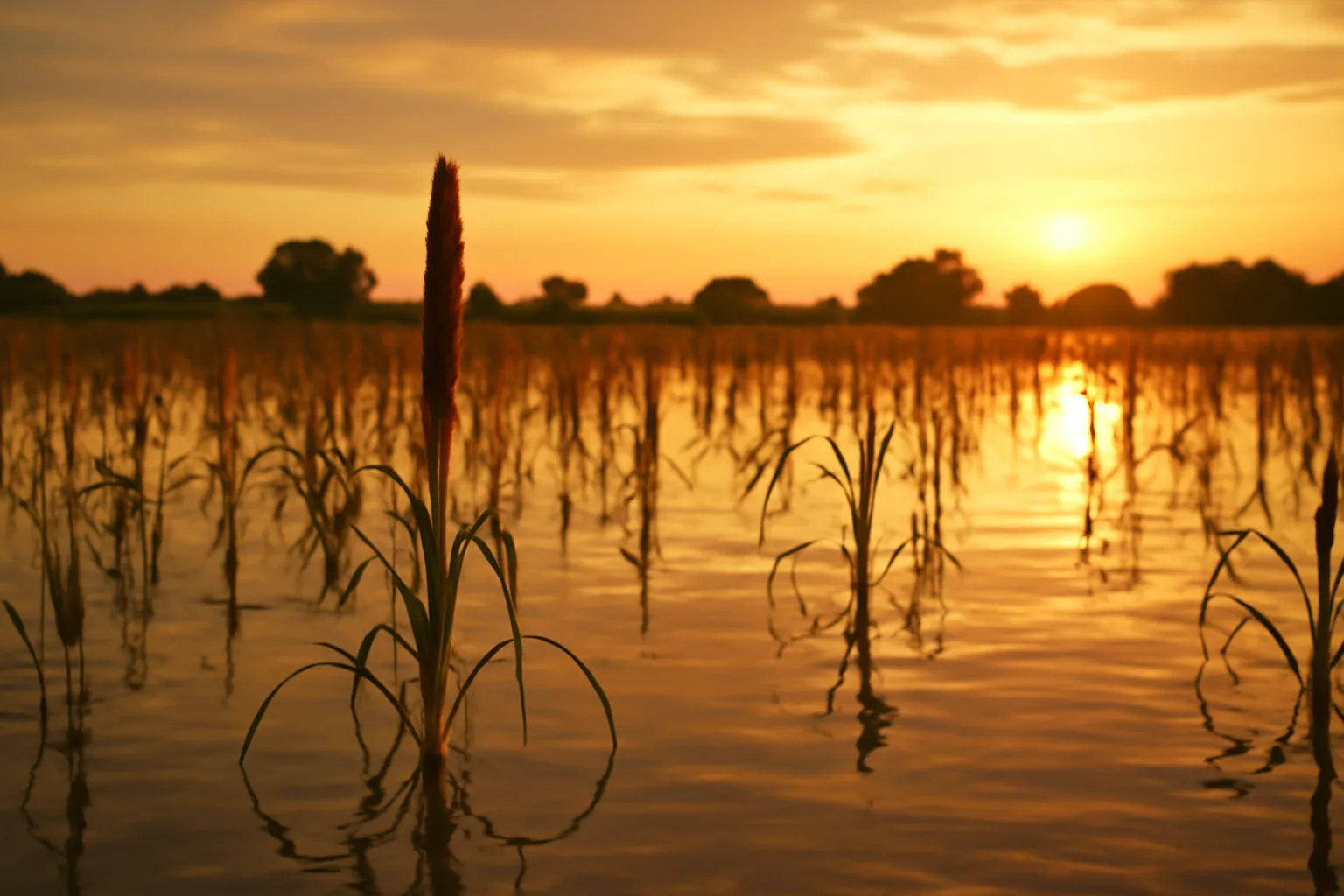
Waterfowl food plots run on grain and moist-soil plants: Japanese millet, corn, milo (grain sorghum), and native smartweed or barnyardgrass flooded in fall. Plant most in late spring to early summer (May to June in most states), then flood a few inches deep once the crop matures and ducks arrive. Check your state's baiting rules before you plant or hunt over any grain.
What is a food plot, and how is a waterfowl plot different from a deer plot?
A food plot is any planted area of land managed to grow food that draws in and holds wildlife, usually planted with agricultural or native seed instead of left to grow up in weeds and brush. For deer, that means clover, brassicas, or beans planted on dry upland ground. For waterfowl, the whole game changes because the food has to sit in shallow water when ducks and geese show up in fall. Waterfowl plots are built on moist-soil management or flooded grain fields. You're either growing native wetland plants that respond to a summer drawdown (mudflat exposed, seeds germinate, then you reflood in fall) or you're planting a domesticated grain crop like corn, milo, or millet on ground you can flood later with a levee, pump, or beaver-style water control structure. The U.S. Fish and Wildlife Service and state wildlife agencies that manage public waterfowl areas use both approaches side by side, often on the same impoundment in different years [1]. The practical difference for a hunter with owned or leased ground: deer plots need almost no water management, but a waterfowl plot without a way to flood it is just a grain field. Ducks will use dry fields to some degree (a lot of goose hunting happens over dry corn and wheat stubble), but dabbling ducks strongly prefer inundated food they can tip up and reach. If you can't flood at all, focus on shallow depressions, seasonal wet spots, or standing corn geese will feed in dry.
Do deer eat sorghum, and does it work as waterfowl food too?
Yes, deer eat sorghum, and it's one of the more overlooked dual-purpose crops for land that gets hunted for both deer and waterfowl. Grain sorghum (milo) produces a seed head deer, turkeys, and doves will hit hard once it matures, and it's also a staple in flooded moist-soil impoundments because ducks, especially mallards and pintails, readily eat the grain once it's been standing in shallow water a few weeks [2]. Sorghum is drought-tolerant compared to corn, which matters on marginal ground or in years with a dry summer. Purdue Extension notes grain sorghum needs roughly 2,000 to 2,500 growing degree days to mature depending on the hybrid, and it's typically planted after soil temperatures hit 60°F, similar timing to corn. For a combo plot, some managers plant a block of milo next to a flooded moist-soil unit so deer work the edges in September and October while the same field (or an adjacent low spot) gets flooded for ducks in November and December. One caution: if you're growing sorghum specifically to flood and hunt ducks over it, check your state's baiting definition first. Standing crops that were planted and grown in a normal agricultural manner are generally legal to hunt over even after they're flooded, but manipulating grain (knocking it down, distributing it, or flooding a field where grain was deliberately spread) can cross into illegal baiting under federal migratory bird regulations.
Do deer eat clover, and do deer like clover in general?
Deer eat clover readily, and yes, deer like clover about as much as any perennial forage you can plant. It's consistently one of the top picks in university deer forage preference work, and it stays palatable through most of the growing season because it keeps producing new leaf growth after grazing [3]. Clover doesn't fit a waterfowl plot at all since it can't handle flooding and ducks have no use for the leaf, but it matters here because a lot of readers managing land for waterfowl are also running deer plots on the same property. If you're building out a mixed-species property plan, clover belongs on the dry upland acres, not anywhere near the water control structure. For a full breakdown on clover varieties, seeding rates, and mixes for deer ground, see deer food plot seed and food plot whitetail.
When to plant food plots for deer versus waterfowl (timing comparison)
| Japanese millet | Late May to July | September to November | |
|---|---|---|---|
| Corn (for waterfowl) | April to June | November to January | |
| Grain sorghum (milo) | May to June | October to December | |
| Moist-soil natives (smartweed, barnyardgrass) | Managed via drawdown, not direct-seeded | September to December | |
| Deer clover (for comparison) | March to May (spring) | Grazed year-round once established | |
| Deer brassicas (for comparison) | Late July to early September | October to frost | Dates shift 2 to 4 weeks earlier as you move south and later as you move north; a state extension planting guide or your local NRCS office is the best source for your specific county [4]. |
Timing is the single biggest difference between deer and waterfowl plots, and it trips up a lot of first-time managers who assume one planting calendar covers both. Deer food plots split into spring plantings (clover, chicory, beans, corn, roughly April through June depending on zone and frost dates) and late-summer plantings (brassicas, cereal grains, roughly late July through September so they mature into a fall food source). Waterfowl plots run on a different clock almost entirely: you plant the grain or moist-soil crop in late spring to early summer so it has a full growing season to mature, then you hold off flooding until the crop is ready and birds start moving, usually late September through December depending on latitude and migration timing. Here's a rough side-by-side for the Midwest and mid-South, where most managed waterfowl ground sits: | Crop type | Plant | Flood / hunt |
When to plant oats for deer, and do oats have any waterfowl use?
Oats for deer plots are best planted in late summer to early fall, generally August through mid-September in the upper Midwest and Northeast, and into late September or October in the South, so they green up before the first hard frost and offer tender forage through fall and into early winter. Deer hit young oat growth hard, often before brassicas in the same mix mature. Oats have almost no role in a waterfowl plot. They're a cool-season cereal grain grown for leafy forage, not a grain head crop suited to flooding, and they don't tolerate standing water. If you're managing a property with both deer and duck ground, oats belong in the fall deer plot mix (often paired with winter peas or a brassica blend), not anywhere near the impoundment. University of Wisconsin-Madison Extension and similar programs list oats among the standard cereal grains for fall deer plots because of fast germination and good cold tolerance down to the mid-20s°F before growth stalls .
When to plant turnips for deer, and are brassicas ever used for waterfowl?
Turnips for deer are planted in late summer, typically late July through early September depending on zone, timed so they have 80 to 90 days to bulb up before hard frost, since frost actually sweetens the bulb and leaf and triggers heavier deer use in late fall and winter . Brassicas including turnips are a deer and upland game crop, not a waterfowl one. Waterfowl don't dig bulbs or browse leaf greens the way deer do, so turnip acreage on a mixed property should stay on dry, well-drained ground, not tied into any flooded rotation. If you're planning turnips alongside a duck impoundment, keep them on a separate block with independent drainage; you don't want brassica ground sitting wet all winter anyway, since standing water rots the bulb and kills the stand.
What are ducks' and geese's favorite foods (the waterfowl equivalent of 'deer's favorite food')?
For deer, the honest answer to 'favorite food' depends on season: soybeans and corn in fall, clover and forbs in spring and summer, acorns whenever they're dropping (acorns are consistently rated as a top preferred natural food in white-tailed deer diet studies) . For waterfowl, the equivalent list looks different by species. Dabbling ducks (mallards, pintails, teal, wigeon) key on moist-soil seeds like smartweed and barnyardgrass, plus agricultural grains: corn, milo, millet, and rice where it's grown commercially. The USDA and USFWS both note that flooded corn and moist-soil seed production areas are among the most efficient food sources per acre for wintering mallards on managed refuges [1] [2]. Diving ducks (canvasbacks, redheads, scaup) key more on submerged aquatic vegetation and aquatic invertebrates, which no upland food plot seed provides; that's a different habitat type entirely (open water with wild celery, sago pondweed, and similar plants). Canada geese and snow geese lean heavily on grain fields, winter wheat, and short grass or clover, often feeding in dry fields rather than flooded ones. So if your property leans goose-heavy, a dry wheat or clover field can outperform a flooded millet unit.
Do deer like honey (locust), and is it relevant to a waterfowl plot plan?
This one usually comes up confused with two different questions: honey locust trees, or actual honey (the bee product). Deer do browse honey locust pods and seedlings, and honey locust pods that drop in fall are a decent natural deer food source in areas where the trees grow, similar to how deer hit soft mast and legume pods generally . Deer have no meaningful interest in honey the bee product as a food plot input; it's not something you'd ever plant or apply. Neither has any real bearing on waterfowl plot planning. If a honey locust tree happens to overhang part of your impoundment, it won't hurt anything, but it's not a species you'd plant to improve duck habitat. Worth mentioning only because it's a common search question that gets people to this kind of article; the actual answer for waterfowl ground is to focus on moist-soil natives and flooded grain, not mast trees.
How do I choose between millet, corn, milo, and moist-soil natives?
Pick based on your budget, your ability to flood, and how much annual planting you want to do. Japanese millet is the cheapest and fastest option, maturing in about 60 to 90 days, and it tolerates wet soil better than almost any other planted grain, which makes it forgiving if your drawdown timing is off . It's a strong choice for a first-year waterfowl plot or a smaller acreage where you want quick results without heavy equipment. Corn produces the most food energy per acre and holds up well once flooded, standing through repeated freeze-thaw cycles that would flatten millet, but it costs more in seed and fertilizer and needs a full growing season plus decent soil fertility. Milo splits the difference: cheaper than corn, more drought-tolerant, and it still gives you a standing grain head ducks and geese will work through winter. Moist-soil management (letting native smartweed, barnyardgrass, and wild millet come up naturally off a summer drawdown) costs the least in seed and the most in patience and water control infrastructure. It's also usually the most productive per dollar spent once a wetland is established, according to long-running moist-soil research out of the Mississippi Alluvial Valley, though it takes a couple of seasons to get the plant community dialed in . Most managed waterfowl properties run a mix: some moist-soil acres, a block or two of milo or millet, maybe a corn field if budget and equipment allow it.
What equipment do I actually need for a waterfowl food plot?
Less than people think, if you're planting grain on dry ground you'll flood later; more than people think, if you're building true moist-soil units with water control structures. For a straightforward millet or milo plot: a disk or tiller to prep ground, a broadcast spreader or drill, and a way to pack the seed in (a cultipacker or even driving over it with an ATV works for small acreage). Millet in particular broadcasts well and doesn't need to be planted deep; 1/4 to 1/2 inch is plenty. For a flooded impoundment, the real cost is in water control: a levee, a water control structure or flashboard riser, and either gravity flow off a creek or a pump. NRCS cost-share programs (through EQIP and WRP/wetland easement programs) frequently help fund exactly this kind of moist-soil wetland work on private land, and that's worth a call to your local NRCS office before you assume it's out of budget . For readers running deer ground on the same property, general plot equipment (disk, spreader, sprayer) covered in food plot seed and deer food plots mostly overlaps with what you'd use for the dry-ground portion of a waterfowl plot.
What are the baiting law risks I need to know before I plant?
This is the part people skip and regret. Federal law (50 CFR 20.21(i)) prohibits hunting migratory game birds by the aid of baiting, defined as the placing, exposing, depositing, distributing, or scattering of salt, grain, or other feed that could lure or attract birds to, on, or over areas where hunters are attempting to take them. A standing crop planted and grown under normal agricultural practices is not baiting, even if it's later flooded, but manipulating that crop (mowing it down, disking it under and leaving grain on the surface, or adding grain that wasn't grown there) can turn a legal field into an illegal baited one. The U.S. Fish and Wildlife Service publishes specifics on what counts as normal agricultural practice versus manipulation, and it varies by crop and by how the manipulation is done. States layer their own rules on top of federal ones, and enforcement varies, so check with your state wildlife agency before flooding a field you've done anything unusual to. This is exactly the kind of question worth a phone call rather than a guess.
How do I plan a mixed deer and waterfowl property?
Zone the property by water access first, then layer deer plots onto the dry ground that's left. Waterfowl units need low, flat ground with either natural flooding potential or room for a levee; deer plots want well-drained upland soil with good sun exposure. Trying to force one crop to do both jobs rarely works well; the exceptions are milo and corn, which have some dual value if timed right. Build a fall/winter rotation: deer brassicas and cereal grains maturing September through November on upland ground, waterfowl grain or moist-soil units flooding in the same window on the low ground. Spring and summer, deer clover holds the upland acres while your waterfowl fields get planted and left to grow through summer. This is genuinely a two-part planning problem, soil and drainage on one side, deer forage preference and hunting pressure on the other, and it's easy to get one half right and waste money on the other. A soil test still matters for the dry-ground waterfowl grain fields exactly like it does for deer plots; your lab's lime and fertilizer recommendation is the actual authority on rates for your soil, not a general planting guide like this one. If you want a written plan that splits the property by zone and lists species and timing for both deer and waterfowl ground, PlotSeason's $99 one-time Custom Food Plot Plan covers both sides in one document instead of you piecing it together from three different sources.
What's a realistic first-year plan if I've never planted for waterfowl before?
Start small and pick one crop, not four. Japanese millet on a half-acre to two-acre low spot is the lowest-risk starting point: cheap seed (typically $1 to $3 per pound depending on supplier and volume), fast maturity, and forgiving of imperfect flooding. Get a soil test before you plant anything, the same as you would for a deer plot; millet and milo both respond to nitrogen, and your test will tell you what's actually missing rather than guessing [4]. Plant after soil temps are reliably above 60°F, generally late May into July depending on your zone. Let it mature through summer, then flood 4 to 6 inches once the seed heads are ripe and grain is starting to fall or birds are moving through, typically late September to November depending on latitude. If that first plot works, expand into milo or a small moist-soil unit the following year, and start thinking about whether a water control structure is worth the investment given your terrain and budget. Most people who get serious about waterfowl ground end up running a mix within three or four seasons; almost nobody starts there.
Frequently asked questions
Do deer eat sorghum?
Yes. Deer readily eat grain sorghum (milo), both the mature seed head and young growth, and it's a common dual-purpose crop for properties managing both deer and waterfowl since it's also a strong flooded grain source for ducks once mature [2][3].
Do deer eat clover, and do deer like clover?
Deer eat clover readily and it's one of the most preferred food plot forages available, staying palatable through repeated grazing because it regrows fast. It has no waterfowl application; it belongs on dry upland deer plot acres, not near flooded ground [5].
When should I plant food plots for deer?
Spring plantings (clover, chicory, beans) generally go in March through June depending on zone; late-summer plantings (brassicas, cereal grains) go in late July through September so they mature for fall. Exact windows shift by 2 to 4 weeks per zone, so check a state or land-grant extension planting calendar for your county [6][7].
When should I plant food plots for waterfowl?
Most waterfowl grain crops (millet, corn, milo) get planted late spring to early summer, roughly May through July, so they mature by the time you flood in fall. Moist-soil units are managed through summer drawdowns rather than direct seeding, timed to expose mudflats in early summer [1][12].
When do I plant oats for deer?
Late summer to early fall, typically August through mid-September in northern zones and into late September or October farther south, timed so oats green up before the first hard frost. Oats have no waterfowl use; they're a leafy cereal grain grazed by deer, not a grain-head crop for flooding [7][8].
When do I plant turnips for deer?
Late July through early September in most zones, giving turnips 80 to 90 days to bulb before hard frost, since frost sweetens the leaf and bulb and drives heavier deer use in late fall. Turnips need dry, well-drained ground and have no role in a flooded waterfowl plot [9].
What is a food plot?
A food plot is a planted area managed specifically to grow food that attracts and holds wildlife, using agricultural or native seed instead of natural vegetation. Deer plots use dry-ground crops like clover, brassicas, and beans; waterfowl plots use grain or moist-soil plants grown to be flooded in fall.
What is deer's favorite food?
It depends on season: acorns whenever available, plus soybeans and corn in fall, and clover and tender forbs in spring and summer. Preference studies consistently rank acorns and soybeans among the top natural and planted foods for whitetails [10].
Do deer like honey?
Deer have no interest in honey, the bee product; it's not a food plot input. They do browse honey locust tree pods in fall as a natural mast source, which is likely the source of confusion behind this question [11].
What's the best waterfowl food plot seed for a beginner?
Japanese millet. It's cheap (roughly $1 to $3 per pound), matures in 60 to 90 days, tolerates wet soil better than corn or milo, and forgives imperfect flood timing, making it the lowest-risk first waterfowl crop for a small property [12].
Is it legal to flood a corn or millet field and hunt ducks over it?
Generally yes, if the crop was planted and grown under normal agricultural practice and simply flooded afterward. It becomes illegal baiting if the grain was manipulated (knocked down, spread, or added) in a way that concentrates it beyond normal farming, per federal rule 50 CFR 20.21(i) [4]. Always confirm specifics with your state wildlife agency.
Can one field work for both deer and waterfowl?
Rarely well. Milo and corn have some dual value since deer and geese both use them, but most successful mixed properties zone the land: dry upland acres for deer clover and brassicas, low flood-capable ground for waterfowl grain or moist-soil units.
Sources
- U.S. Fish and Wildlife Service, National Wildlife Refuge System moist-soil and wetland management guidance: Federal refuges use both moist-soil management and flooded grain crops to feed wintering waterfowl
- U.S. Fish and Wildlife Service, 50 CFR 20.21(i) migratory bird hunting baiting regulation: Federal definition of baiting and normal agricultural practice exception for standing crops
- USDA Forest Service, Fire Effects Information System, Gleditsia triacanthos (honey locust): White-tailed deer browse honey locust pods and seedlings as a fall food source
- USDA NRCS Plant Guide, Japanese Millet (Echinochloa esculenta): Japanese millet matures quickly and tolerates wet, flooded soil conditions
- Electronic Code of Federal Regulations: Defines what constitutes a baited area under federal migratory bird hunting regulations.
- USDA NRCS Plant Guide: Provides growth and planting information for sorghum used in wildlife food plots.
- USDA NRCS Plant Guide: Describes clover (red clover) characteristics relevant to deer food plot use.
- USDA NRCS Plant Guide: Provides planting timing and use information for oats in wildlife food plots.
- Electronic Code of Federal Regulations: Outlines exceptions to baiting restrictions for normal agricultural planting and harvesting practices.