Last updated 2026-07-25
TL;DR
A food plot is a planted area of forage, usually clover, brassicas, cereal grains, or a legume mix, put in the ground to feed deer and concentrate their movement for hunting or herd health. Most plots run from a quarter acre to a few acres. Timing depends on your zone and the crop: spring for warm-season plots, late summer for fall brassicas and cereal grains.
what is a food plot, exactly?
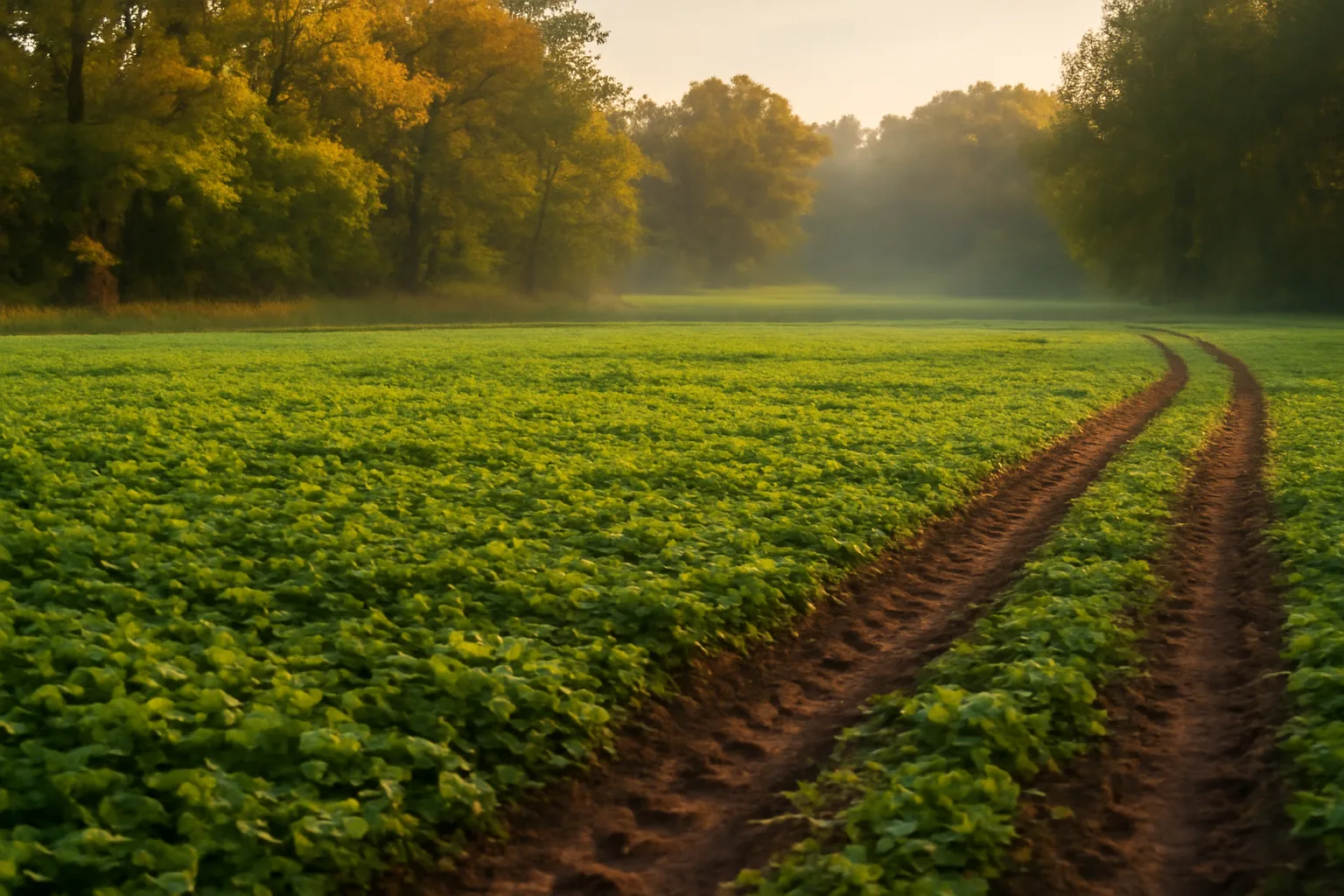
A food plot is a piece of ground, usually anywhere from a quarter acre to five acres or more, that a landowner plants specifically to feed deer. It's not a garden and it's not a crop field meant for sale. The whole point is deer nutrition and, for most hunters, deer attraction during hunting season. State wildlife agencies and university extension programs treat food plots as a legitimate wildlife management tool, distinct from baiting in most states because the forage grows in place rather than getting dumped on the ground. University extension guidance describes supplemental forage plantings as one of several tools land managers use to fill seasonal nutrition gaps, alongside prescribed fire and timber management [1]. A plot can be as simple as a half-acre patch of clover behind the house. It can also be a rotation of soybeans, brassicas, and cereal grains spread across a whole property. Size and complexity depend on your goals, your equipment, and honestly, your budget. Some hunters plant to hold deer on their ground. Some plant to improve body weight and antler growth across a herd. Some do both. Either way, the plot is doing double duty: it's food, and it's also a place deer show up predictably enough that you can hunt them.
why do hunters and land managers plant food plots?
The short answer: nutrition and visibility. Native browse in most whitetail range, especially in the Southeast and parts of the Midwest, drops way off in protein content by late summer. University extension forage research shows that natural forage quality and availability decline through the growing season, and that supplemental plantings can raise protein intake during antler growth and lactation, two of the most nutritionally demanding periods for deer [1]. The second reason is simpler: food plots pull deer into open sightlines. A soybean field edge or a clover plot next to timber gives you a stand location with predictable deer traffic, especially in the early season when deer are keying hard on food. There's a herd-health angle too. Land managers running quality deer management programs plant plots year-round, more than for the fall hunt, to support fawn survival and body weight going into winter. That's a longer game than most weekend hunters play, but it's the same principle at a bigger scale. If you're building your first plot and want a plan that accounts for your region and plot size, a food plot whitetail overview is a good next stop before you buy seed.
when to plant food plots for deer
Timing is the single biggest variable, and it's entirely dependent on your USDA plant hardiness zone and your first frost date. There is no single national planting date. Warm-season plots (soybeans, cowpeas, sunflowers, some clover blends) go in after your last frost, generally April through June depending on latitude. Cool-season plots (brassicas, cereal grains, most clover and clover-grain mixes) go in 60 to 90 days before your first fall frost so they have time to establish before growth slows. General planting-date guidance from land-grant university forage programs points to late August through September for cool-season annuals across much of the mid-South, with a caution that planting too early into hot, dry soil is one of the most common failure points for fall plots [1]. If you're in the Upper Midwest or Northeast, your fall planting window closes earlier, often by early September, because first frost can hit in late September or early October. In the Deep South, you can push cool-season plantings into October and still get a good stand. Rule of thumb: work backward from your average first frost date, then plant brassicas and cereal grains 60 to 90 days ahead of it, and clover slightly earlier if you can, since clover needs more time to establish a root system before winter.
when to plant oats for deer
Oats are a fall cereal grain, and they go in during that same late summer window: roughly 60 to 90 days before first frost, which lands most hunters somewhere between mid-August and mid-September depending on zone. Oats germinate fast, often within 5 to 10 days in warm soil, and they're one of the most palatable cereal grains for deer in the early fall, sometimes getting hit harder than wheat or rye when all three are planted side by side. That palatability drops off once a hard freeze hits, because oats aren't as cold-tolerant as winter wheat or cereal rye. USDA Natural Resources Conservation Service plant guides note that spring oats (Avena sativa) have poor winter hardiness compared to winter wheat and rye, and are generally killed by hard freezes in colder zones [2]. That makes oats a strong early-season attractant crop but a poor choice if you want green forage sitting there in January. If you want food standing all winter, blend oats with wheat or rye, or skip oats for a straight winter cereal grain in northern zones.
when to plant turnips for deer
Turnips, like other brassicas, go in on the same cool-season clock: 60 to 90 days before your first expected frost, which for most of the whitetail range in the eastern half of the country lands between late July and early September. Turnips need that lead time because the plant's value to deer comes in two stages. Early on, deer eat the leafy tops. Later, after a couple of hard frosts convert starches in the bulb to sugars, deer start digging up and eating the roots. This frost-triggered shift in palatability is well documented in wildlife forage literature: cold exposure converts stored starches in brassica roots to simple sugars, a process plant physiologists call cold-induced sweetening, and it's the same basic mechanism that makes parsnips and carrots sweeter after a frost. Plant turnips too late and you get small bulbs and thin tops going into winter. Plant them too early in hot, dry August soil and germination suffers. If your region has a short cool season, don't skip the seedbed prep. Drilling or broadcasting into a well-worked seedbed with adequate lime and fertilizer (per your soil test) makes a bigger difference with brassicas than with almost any other food plot crop, since they're heavy nitrogen feeders.
do deer eat clover, and do deer like clover?
Yes. Clover is one of the most reliably eaten food plot crops in whitetail range, and it's usually the first plant hunters try. It's a perennial legume, meaning a good stand can produce forage for three to five years before you need to replant, which makes it cheaper per season than annual plots once it's established. White clover (including ladino types) and red clover both show up constantly in university deer forage trials as high-preference, high-protein forage, often tested above 25 percent crude protein in vegetative growth stages [1]. That protein level matters most in late spring and summer, when does are lactating and bucks are growing antlers. Clover's downside is establishment. It needs decent soil pH, most extension guides recommend 6.0 to 6.5, a firm seedbed, and it's slow to get going the first year. It also can't take heavy shade or standing water. If your soil test comes back with a pH under 6.0, expect the clover stand to struggle no matter how good the seed is. Lime takes months to fully react in the soil, so get it applied well ahead of planting. Once established, clover is close to a set-it-and-forget-it plot. Mow it a few times a season to control weeds and encourage new growth, and it'll keep producing. For a broader look at seed blends built around clover and other perennials, see deer food plot seed.
do deer eat sorghum?
Yes, but sorghum is more of a supporting player than a headline crop in most food plot programs. Deer will browse young sorghum shoots and, later in the season, eat the grain heads once they mature and dry down. Sorghum also gets planted as cover and a screening crop as much as it does as forage. Grain sorghum (milo) is drought-tolerant and does well in the same warm-season window as corn and soybeans, generally planted after last frost when soil temperatures are consistently above 60 degrees F. It's a common choice in the Southern Plains and parts of Texas where corn struggles in dry years, since sorghum handles heat and low rainfall better than corn does. It's not usually anyone's first-choice deer food, though. Turkeys, quail, and other wildlife eat sorghum grain heavily too, so in a mixed-wildlife property it often gets shared out rather than hammered exclusively by deer. If your main goal is deer specifically, soybeans, cowpeas, or a brassica/clover combo will usually draw more attention than a straight sorghum plot.
what are deer's favorite foods?
| Clover (white/ladino) | Perennial, spring-fall | 25-30% [1] | Season-long attraction, herd nutrition | |
|---|---|---|---|---|
| Soybeans | Warm season | 30-35% (forage stage) | Summer tonnage, antler growth | |
| Brassicas (turnips, radish) | Cool season/fall | 15-25% (tops), higher sugar in bulbs after frost | Late fall/winter attraction | |
| Oats | Cool season/fall | 12-20% | Early fall attraction, low winter survival | |
| Cereal rye/wheat | Cool season/fall-winter | 12-18% | Winter-long green forage, cold hardy | |
| Grain sorghum | Warm season | Variable, grain-dependent | Drought areas, mixed wildlife, screening | Protein figures are approximate ranges compiled from university extension forage data and vary by soil fertility, plant maturity, and regional growing conditions. |
There's no single universal answer. Deer preference shifts by season, region, and what's available naturally, but forage trials keep coming back to a short list: soybeans and cowpeas in summer, acorns in fall wherever oaks are present, and brassicas and cereal grains after a hard frost. Acorns deserve their own mention because in years with a good mast crop, deer will often ignore planted food plots entirely in favor of white oak acorns, which are lower in tannins and more palatable than red oak acorns. This is well documented in wildlife management literature, and it's one reason experienced land managers don't panic if plot activity drops during a heavy acorn fall. It's not that the plot failed, it's that something better showed up. Among planted forages, soybeans consistently rank near the top for both tonnage and preference during the growing season, which is part of why they're a staple in Midwest deer management programs despite needing more acreage and deer-proof fencing while young to survive over-browsing. Here's a rough comparison of common plot crops and how they stack up: | Crop | Season | Crude protein (approx.) | Best use |
do deer like honey (honey locust, honeysuckle, or literal honey)?
If the question is about literal honey, no. Deer are not documented as seeking out honey as a food source in any wildlife nutrition literature, and it isn't a food plot input. It's not toxic to them in trace amounts, but it's also not part of natural deer diet or any recognized plot mix. What people usually mean is honey locust (the tree) or honeysuckle (the shrub/vine), and the answer there is yes, both get browsed. Honey locust pods, which drop in fall, are a documented deer food source, high in sugar content, and deer will actively seek them out under mature trees. Japanese honeysuckle, an invasive shrub in much of the eastern U.S., is also readily browsed by deer. That's actually part of why it spreads so well in disturbed forest edges, deer distribute the seed. Neither honey locust nor honeysuckle is something you'd plant as a food plot crop. They're more relevant if you're managing existing woods and want to know what's already feeding deer on your property outside the plot itself.
how big should a deer food plot be?
Most hunting-focused food plots run a quarter acre to two acres. Bigger isn't automatically better, it depends on your goals and your local deer density. Small plots (under a half acre) tucked into timber work well as kill plots, places you hunt directly because deer feel comfortable stepping into them right at dusk. Larger plots (one to five acres or more) function more as feeding destinations and herd nutrition sources, and they're harder to hunt directly without spooking deer, since deer often enter big fields well after legal shooting light in areas with hunting pressure. A lot of successful setups use both: a big field for tonnage and a small, tucked-away plot near bedding for the actual sit. If you're deciding between plot types for your property, the deer food plots overview breaks down sizing and layout by property type.
what do I need to check before planting a food plot?
Get a soil test first, before you buy a single bag of seed. It's the cheapest, highest-leverage step in the whole process, and skipping it is the single most common reason food plots underperform. Most state land-grant universities run soil testing labs for roughly $10 to $20 per sample, and your county extension office can walk you through collection. Your results will tell you pH and nutrient levels (phosphorus, potassium, sometimes micronutrients), and the accompanying recommendation sheet will tell you how much lime and fertilizer to apply for your specific crop. This is genuinely site-specific information that generic planting guides can't give you, so treat your soil test lab's recommendation as the final word over any blanket advice, including this article. Second, check your state's baiting and feeding regulations before you plant anything you're unsure about. Standing food plots are legal to hunt over in the overwhelming majority of states, since planted, unharvested crops in the ground are typically treated differently from bait piles, but rules on things like mineral supplementation, timing restrictions near plots, and what counts as a plot versus a bait station vary by state and change periodically. Check your state wildlife agency's current regulations before hunting season, not last year's copy. Third, think about equipment. You don't need a tractor to plant a small plot. A hand seeder, an ATV with a drag harrow, and a sprayer will get a half-acre clover plot in the ground. Bigger acreage benefits from a disc, a cultipacker, and a no-till drill if your budget allows it.
what's the difference between a food plot and just baiting deer?
The legal and practical distinction is that a food plot is a growing crop planted in the ground, while bait is typically loose feed (corn, mineral, protein pellets) placed on the ground or in a feeder. Many states regulate these very differently. Some states ban baiting outright for hunting purposes but allow food plots without restriction, since the crop is rooted and growing rather than distributed. Other states regulate both under similar rules, and a few have specific distance or timing requirements even for plots near stands. Because this varies so much and changes over time, check your specific state wildlife agency's hunting regulations guide for the current season before you plant or hunt. Practically, plots also behave differently than bait. A standing crop feeds deer over weeks or months and supports actual nutrition, where a bait pile is consumed in days and offers little beyond calories. That's part of why extension programs and biologists generally treat food plots as a wildlife management tool first and a hunting tool second, even though most hunters plant them primarily to hunt over them.
how do I decide what to plant on my property?
Start with your soil test, your zone, and your goals, in that order. A pH of 5.2 rules out clover until you lime it, no matter how much you like clover. A short growing season in northern Wisconsin rules out a lot of warm-season options that work fine in Georgia. After that, think about what you actually want the plot to do. If you want an early-season bow spot, soybeans or a clover field draws deer while they're still in summer patterns. If you want a late-season, post-rut destination, brassicas and cereal grains that get sweeter after frost are the better call. If you want season-long, low-maintenance forage, perennial clover mixed with chicory is hard to beat once it's established. Most properties end up with a mix: a perennial clover field for spring and summer, and a fall annual planting (brassica/cereal grain blend) rotated through a different section for the hunting season itself. That split covers both the herd-health goal and the hunting goal without betting everything on one crop. If you'd rather not guess at blends and rates for your specific acreage and zone, PlotSeason's $99 Custom Food Plot Plan (built through the plot-plan-builder) walks through your soil test results, property size, and region to lay out a planting plan. It's general planning guidance built off your inputs, not a substitute for your soil lab's specific lime and fertilizer recommendations, and it doesn't promise deer activity or harvest results, but it takes the guesswork out of matching crops to your dates and acreage. For seed selection once you've settled on a plan, food plot seed and domain food plot seed cover blend options by region.
Frequently asked questions
What is a food plot for deer in simple terms?
A food plot is a patch of ground, usually a quarter acre to a few acres, planted with forage crops like clover, brassicas, or cereal grains specifically to feed deer and give hunters a predictable place to hunt. It's a wildlife management tool used by both weekend hunters and professional biologists.
Do deer eat sorghum?
Yes, deer browse young sorghum shoots and eat mature grain heads, but sorghum is usually a secondary or screening crop rather than a primary deer food plot choice. It's more common in dry, warm-season regions like the Southern Plains where it outperforms corn in drought.
Do deer eat clover?
Yes, clover is one of the most consistently preferred food plot crops, often tested above 25 percent crude protein in vegetative growth. White and red clover are staples in food plot programs across whitetail range, according to university extension forage data.
When should I plant deer food plots?
Timing depends on your zone and crop type. Warm-season plots like soybeans go in after last frost, typically April through June. Cool-season plots like brassicas and cereal grains go in 60 to 90 days before your first fall frost, generally late July through September.
Do deer like clover more than other food plot crops?
Clover ranks consistently high in preference trials, especially in spring and summer when its protein content (often 25 to 30 percent) supports lactation and antler growth. It's not always the top choice in fall, when brassicas and cereal grains take over as preferred forage.
When should I plant oats for deer?
Plant oats 60 to 90 days before your area's average first fall frost, generally mid-August through mid-September depending on zone. Oats germinate fast and are highly palatable early, but they winterkill in colder regions, so blend with wheat or rye for winter-long coverage.
When is the best time to plant food plots overall?
There's no single national date. Work backward from your first frost date: cool-season crops like clover, brassicas, and cereal grains go in 60 to 90 days ahead of frost, while warm-season crops like soybeans and sorghum go in after your last spring frost.
When should I plant turnips for deer?
Plant turnips 60 to 90 days before your first fall frost, typically late July through early September in most of whitetail range. Deer eat the tops early on, then the bulbs become more attractive after repeated frosts convert starch to sugar.
What are deer's favorite foods overall?
Preference shifts by season: soybeans and cowpeas in summer, acorns (especially white oak) in fall when available, and brassicas or cereal grains after frost. Deer will often bypass planted plots entirely during a heavy acorn drop.
Do deer like honey?
Deer don't seek out literal honey; it isn't part of their documented diet or used in any food plot mix. Honey locust pods and honeysuckle foliage are different matters entirely and are both readily browsed by deer where they grow.
How big does a food plot need to be to work?
Most hunting-focused plots run a quarter acre to two acres. Smaller plots near bedding work well as kill plots you can hunt directly, while larger fields (one to five acres) function more as feeding destinations that are harder to hunt without spooking deer.
Do I need a soil test before planting a food plot?
Yes, and it's the highest-leverage step available. Most land-grant university labs test soil for roughly $10 to $20 and return pH and nutrient levels along with lime and fertilizer recommendations specific to your intended crop. Skipping this is the most common reason plots fail.
Is planting a food plot the same as baiting deer?
No, in most states a standing, rooted crop is treated differently under law than loose bait like corn piles or mineral. Rules vary by state and change over time, so check your state wildlife agency's current regulations before hunting near a plot.
What's the difference between a fall plot and a perennial plot?
A fall (annual) plot like brassicas or cereal grains is replanted every year and timed to peak during hunting season. A perennial plot like clover establishes once and produces forage for three to five years, making it cheaper long-term but slower to establish initially.
Sources
- University of Georgia Extension, Circular 1010, Food Plots for Wildlife: Supplemental forage plantings are one of the tools land managers use alongside prescribed fire and timber management to fill seasonal nutrition gaps
- USDA NRCS Plant Guide, Oat (Avena sativa): Spring oats have poor winter hardiness compared to winter wheat and rye and are generally killed by hard freezes in colder zones
- University of Georgia Extension: Recommendations for sizing and placing deer food plots on managed land
- Missouri Department of Conservation: State wildlife agency guidance on establishing food plots versus supplemental feeding for deer
- University of Georgia Extension: Clover is a preferred forage for white-tailed deer in food plot plantings