Last updated 2026-07-25
TL;DR
Walmart carries basic food plot seed (clover, oats, brassicas, some blends) mostly from brands like Whitetail Institute and Mossy Oak, priced roughly $5 to $30. The seed itself is fine for small plots if you match species to your region and soil. The bigger factors are soil pH, planting date, and seedbed prep, not which store you bought it from.
what kind of deer and turkey food plot seed does walmart sell
Walmart's selection varies by store and season, but the shelves (usually in lawn and garden or the hunting aisle) tend to carry a handful of recognizable brands: Whitetail Institute (Imperial Whitetail Clover, No-Plow), Mossy Oak BioLogic, Antler King, and sometimes store-brand or Evolved Harvest blends. You'll typically find clover blends, brassica mixes, oats or wheat, and a few "deer and turkey" combo bags aimed at generalist plots that both species will hit. Prices run cheap for cover-crop type seed, roughly $5 to $15 for a small bag of oats or wheat, up to $20 to $30 for a bag of proprietary clover or brassica blend that covers a half acre to an acre. That's actually in line with what you'd pay at a farm store or co-op for similar species, though the specialty blends carry a brand markup over buying straight clover or brassica seed by the pound. The seed quality itself is not the issue. A bag of Whitetail Institute Imperial Clover sold at Walmart is the same product sold at a farm supply store. What matters more is whether the species in the bag fits your region, your soil pH, and your planting window. A bag of seed with a great deer photo on the label will still fail if you plant clover in July in Alabama heat with no rain in the forecast, or dump brassicas in ground that's never seen lime and sits at pH 5.0.
what is a food plot
A food plot is a planted patch of forage, usually somewhere between a quarter acre and a few acres, established specifically to feed and attract deer, turkey, or other wildlife on hunted land. It's more than a wild clearing. Food plots are planted with selected seed (clover, brassicas, cereal grains, beans) chosen to be nutritious, palatable, and available at a specific time of year. Plots serve two different jobs depending on design. A food source plot (big, often a full-season clover field or a fall grain field) is meant to feed animals through a season and hold them on the property. A hunting plot (small, often a kill plot tucked near bedding) is meant to draw a deer into range at a specific time of day, usually during shooting light in fall. State wildlife agencies generally treat food plots differently from bait piles or feeders. In most states, a food plot that's planted in the ground and grows naturally is legal to hunt over, while piling corn or minerals on the ground counts as baiting and is restricted or banned. Rules vary a lot by state, so check your state wildlife agency's baiting and feeding regulations before you plant anything near a stand or assume a plot is legal to hunt. Michigan's DNR, for example, spells out specific baiting restrictions and distance rules that don't apply to standing food plots [1]. If you want a broader primer on plot design and purpose, see food plot whitetail.
what are deer's favorite foods
Deer are browsers with strong seasonal preferences, and "favorite" really means whatever is highest in protein, most digestible, and most available at that moment. In spring and summer, deer key in on clover, soybeans, and other legumes because they're rebuilding after winter and, for does, nursing fawns. Fall preference shifts hard toward carbohydrates and sugar, which is why brassicas (turnips, radishes, rape) and cereal grains like oats and wheat get hammered after the first frost sweetens them up. Acorns are probably the single most consistent natural whitetail food across most of the country in a good mast year, and deer will often walk past a planted plot to hit a hot white oak drop. That's not a food plot failure, it's just deer being deer. Native browse (forbs, woody stems, brambles) fills in the rest of the diet, especially in spring green-up and late summer before crops mature. There's no single universal "number one" food, because preference shifts by season, region, and whatever else is competing for the deer's attention that week. Legumes and brassicas are the two planted forage categories most consistently ranked high in preference once deer key onto them, with whole soybeans and standing corn also drawing heavy fall use in agricultural regions.
do deer like clover
Yes, and it's one of the most reliable food plot species across the whitetail's range. Clover (white clover, red clover, and blends like ladino) is high in protein, often 25 to 30 percent crude protein when actively growing, and deer will use it from spring green-up through fall as long as it's not buried in snow or drought-stressed. Clover's real advantage is season length. A well-maintained perennial clover plot can feed deer for three to four years off one planting, which makes it one of the better returns on seed cost even though it needs mowing and occasional herbicide to keep grass and weeds from choking it out. It does best in soil with pH between 6.0 and 7.0, so a soil test matters here more than almost any other species. Clover planted into acidic ground without lime will struggle no matter how good the seed is. Most Walmart clover blends (Imperial Whitetail Clover is the common one) are ladino-type white clover mixes bred for shade tolerance and drought resistance. They work fine as a perennial plot base. For species comparisons across your whole plot rotation, see deer food plot seed.
do deer eat sorghum
Yes, deer eat sorghum, particularly the grain heads once they mature and dry down in late summer and fall, and they'll also browse young sorghum shoots earlier in the season. Grain sorghum (milo) is more commonly grown as a wildlife food plot crop in the South and Midwest, often mixed into dove field or deer/turkey combo plantings because turkeys and other birds work the dropped grain too. Sorghum is drought-tolerant compared to corn, which is why it shows up in food plot mixes for drier regions, and it's cheaper per acre than corn in most years. It's not usually a deer's first choice forage the way clover or standing beans are, but it holds up well as a fall and winter standing grain source, especially once other soft browse is gone. If you see sorghum in a Walmart deer-and-turkey combo bag, it's there to add late-season carbs and turkey attraction, not as the headline forage.
when to plant food plots for deer (by region)
| Deep South / Gulf Coast | March-April | September-October | |
|---|---|---|---|
| Mid-South / Transition | April-May | late Aug-mid Sept | |
| Upper Midwest / North | May-June | early-mid August | These are general windows, not guarantees, and a late spring frost or an early fall cold snap can shift things by two or three weeks either direction. Your county extension office is the best local source for actual average frost dates. For a full planting calendar broken down further, check deer food plots. |
Timing depends entirely on your species and your zone, so there's no single answer, but the framework is simple. Spring/summer plots (clover, soybeans, alfalfa, chicory) go in after your last frost date, generally April through June depending on latitude. Fall plots (brassicas, cereal grains, clover overseed) go in 60 to 90 days before your first fall frost so plants have time to establish before growth slows. USDA plant hardiness zone data is a good starting proxy for frost timing even though it's built for perennial plant survival, not planting calendars specifically. County extension offices generally publish more precise last/first frost date tables for actual planting decisions. As a rough national spread: Deep South and Gulf Coast growers are often planting fall brassicas and cereal grains in September, Mid-South and transition zone in late August to mid-September, and northern tier states (Wisconsin, Minnesota, Michigan, Maine) need to be in the ground by mid-August to catch enough growing season before frost shuts things down. | Region (rough) | Spring plot window | Fall plot window |
when to plant oats for deer
Oats are a fall planting in most of the whitetail's range, going in the ground 6 to 8 weeks before your first expected frost so they can establish a few inches of growth before cold slows them down. In the Midwest and Northeast that's typically late August into early September; in the Southeast it stretches into September and even early October in the Deep South. Oats germinate fast, often within 5 to 10 days in warm, moist soil, and deer will hit young oat shoots almost immediately, which makes them a good quick-attraction plot when you're short on time before season. They're also cheap, generally $10 to $20 for enough seed to cover a half acre to an acre depending on seeding rate. University extension guides commonly recommend 60 to 110 lbs per acre drilled, more if broadcast. Oats aren't very winter-hardy on their own in cold climates; hard freezes will kill them back, which is fine if your goal is early-fall attraction but means they won't carry a plot through January the way winter wheat or rye will. A lot of successful fall plots blend oats with wheat or clover so you get fast early growth from the oats and longer season coverage from the other species.
when to plant turnips for deer
Turnips are a fall brassica, planted 90 to 100 days before your first hard frost so bulbs have time to size up and leaves get time to grow before deer season opens. That generally means late July through August in northern states and mid-August through September further south. The key thing with turnips is patience: deer often ignore the leaves and bulbs early in fall and don't switch on to them hard until after one or two frosts convert starches to sugars, making the plant sweeter. That's why turnip plots that look untouched in October can get hammered down to nubs by late November. If you're hunting an early season and expecting turnips to be the draw, you'll likely be disappointed; they're a late-season plot. Seeding rate matters more than people think. Most agronomy guides put pure turnip seeding rate around 4 to 6 lbs per acre broadcast; going heavier doesn't add more food, it just crowds bulbs and reduces size. Turnips also need decent soil fertility (moderate nitrogen, adequate potassium) to bulb up well, so a soil test before planting is worth the $10 to $20 it costs through most state extension labs.
do deer like honey
Not in the way people mean when they ask this. Deer don't eat honey directly as a food source; they're herbivores and their digestive system (a four-chamber rumen) is built around fermenting plant fiber, not processing concentrated sugar syrup. What people are usually really asking about is whether sweet scents or syrup-based attractants pull deer in, and there's genuine folklore around using sugary or sweet-smelling substances as attractants. Some commercial deer attractant products use sweet, sugary, or molasses-based scents to draw deer in, similar to how apple or acorn scent products work, but this is a scent-attraction claim, not a nutrition claim, and the actual data on effectiveness is thin. There's no meaningful body of wildlife research specifically studying honey as a deer attractant. More important: pouring out any liquid attractant, mineral, or feed pile to draw deer crosses into baiting in a lot of states, and rules differ sharply by jurisdiction. Some states allow baiting on private land with restrictions on distance from a stand, others ban it outright during hunting season. Check your state wildlife agency's regulations before using any attractant near a stand you plan to hunt.
how does walmart seed compare to specialty food plot seed
| Price per small bag | $5-$30 | similar or slightly less |
|---|---|---|
| Bulk/per-acre pricing | limited, small bags only | often better, 25-50 lb bags |
| Regional variety selection | generic, national blends | often region-specific |
| Convenience | very high | requires a trip |
The honest answer is: often the same seed, different price point and packaging. Walmart carries name-brand products like Whitetail Institute and Mossy Oak BioLogic at retail prices comparable to farm stores, and those are legitimate, tested blends. Where you'll sometimes save real money is buying straight species seed (plain ladino clover, plain oats, plain winter wheat) by the pound from a farm co-op or seed dealer instead of a proprietary bag, since you're not paying for branding or a custom blend ratio. Where Walmart (and big box stores generally) tends to fall short is selection depth and regional matching. A farm co-op or dedicated food plot seed dealer is more likely to stock region-specific clover varieties, cold-tolerant brassica blends bred for your zone, or bulk pricing on 50-lb bags that beats small retail bags on a per-acre basis. For a one- or two-acre plot, Walmart seed is a perfectly reasonable option. For someone managing several plots across a property, buying in bulk from a seed dealer usually pencils out cheaper per acre. | Factor | Walmart / big box | Farm co-op / seed dealer |
what does soil testing have to do with any of this
It's the single biggest factor most people skip, and it matters more than which brand of seed you buy. Clover, brassicas, and most legumes want soil pH in the 6.0 to 7.0 range; below that, nutrients like phosphorus become less available to the plant even if they're technically in the soil. A $200 bag of premium clover seed planted into pH 5.2 soil with no lime will underperform a $10 bag of oats planted into properly limed ground. Most land-grant university extension offices run soil tests for $10 to $20 and will send back specific lime and fertilizer recommendations based on your actual soil, not a generic chart. That report is the real authority on what your ground needs; a food plot planting guide can tell you what species generally want, but only your soil test lab knows what your specific field has and needs. Lime also takes months to fully react in the soil, so testing and liming in fall for a spring planting (or vice versa) gives it time to work before you plant. If you want help translating a soil test result and your region into an actual species and planting-date plan, that's exactly the kind of thing a Custom Food Plot Plan is built for. It's a $99 one-time product, not a subscription, and it's meant to sit alongside your soil test report, not replace it. Your lab's lime and fertilizer numbers are still the final word on your dirt.
what equipment do you actually need for a small food plot
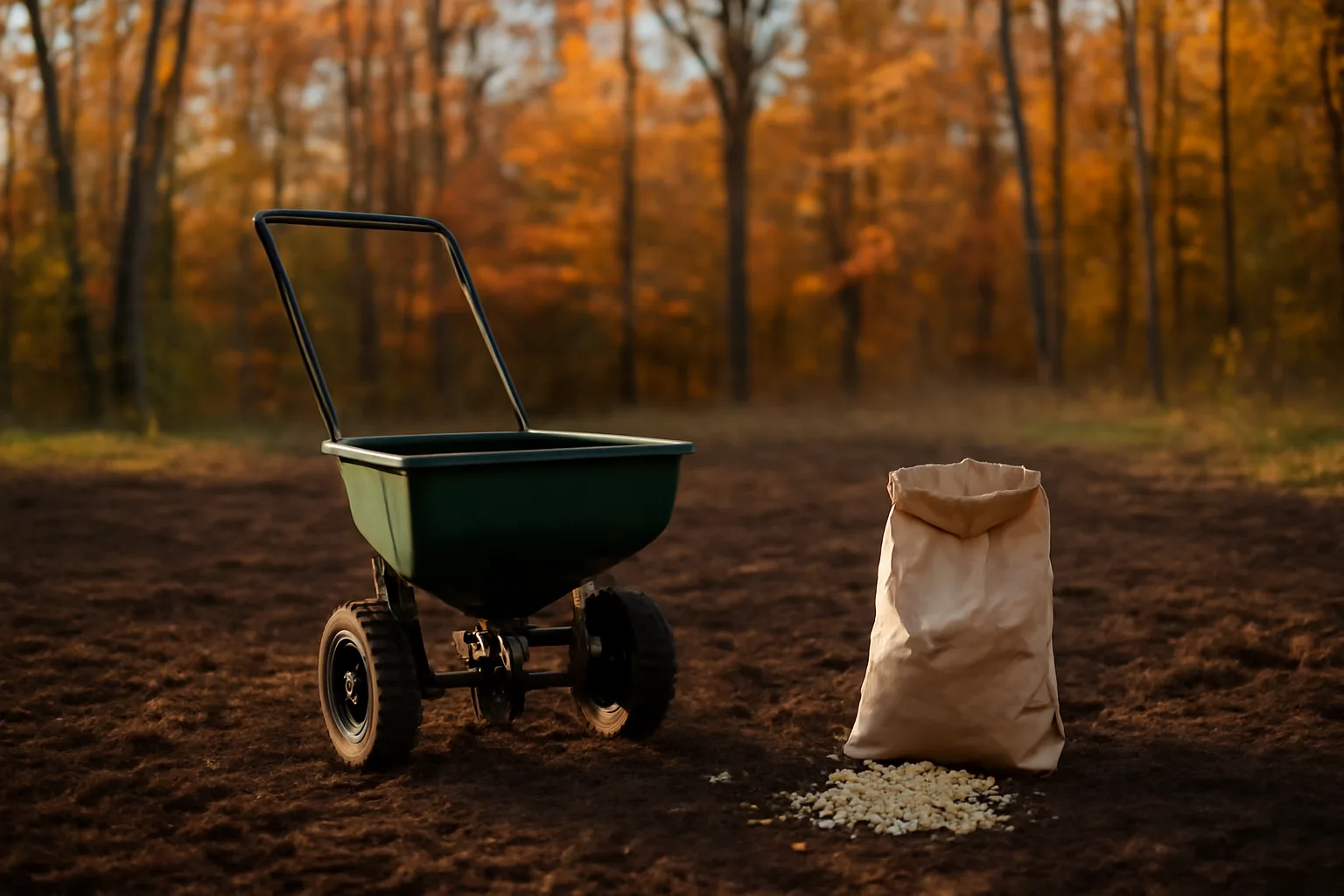
For a plot under an acre, you don't need a tractor. A hand or tow-behind broadcast spreader, a rake or drag harrow, and a way to knock down existing vegetation (mower, herbicide, or a disc if you have one) covers most small food plot jobs. A soil test kit or mail-in test, lime if your results call for it, and basic fertilizer round out the list. For larger plots (one to several acres), a tractor or ATV with an implement (disc, cultipacker, no-till drill) speeds things up a lot and improves seed-to-soil contact, which matters more for germination than almost anything else. Broadcasting seed onto bare, unpacked dirt and hoping for rain is the most common reason plots fail, not seed quality or brand. A basic checklist for a first-time small plot: soil test, lime/fertilize per test results, kill existing vegetation, work the seedbed, broadcast at the recommended rate, cultipack or drag to cover seed lightly, and time the whole thing to your regional planting window. Skipping the seedbed prep step is the number one mistake people make when they buy a bag of seed at a big box store and just toss it on top of sod.
Frequently asked questions
Is Walmart food plot seed the same quality as farm store seed?
Generally yes. Walmart carries recognized brands like Whitetail Institute and Mossy Oak BioLogic, the same products sold at farm stores. Quality issues are rare; the bigger risk is buying a species that doesn't fit your region or soil, not a bad bag of seed.
Do deer eat sorghum in food plots?
Yes. Deer eat both young sorghum shoots and the mature grain heads, and it's common in deer-and-turkey combo blends for its drought tolerance and late-season standing grain value, though it's usually secondary to clover or soybeans as a preferred forage.
Do deer like clover more than other food plot species?
Clover is one of the most consistently preferred planted forages, often 25 to 30 percent crude protein when actively growing, and deer use it spring through fall. Preference shifts seasonally though; deer often favor brassicas and grains once frost hits in fall.
When is the best time to plant food plots for deer?
Spring plots (clover, soybeans) go in after your last frost, typically April through June. Fall plots (brassicas, cereal grains) go in 60 to 100 days before your first fall frost, roughly August in northern states, September into October further south.
When should I plant oats for deer?
Plant oats 6 to 8 weeks before your first expected fall frost, typically late August to early September in the Midwest and Northeast, later into September or October in the Deep South. Oats germinate fast, often within 5 to 10 days.
When should turnips go in the ground for a deer plot?
Turnips need 90 to 100 days before your first hard frost to bulb properly, so plant late July through August up north and mid-August through September in the South. Deer often ignore turnips until after a frost sweetens them.
What exactly is a food plot?
A food plot is a planted area, usually a quarter acre to several acres, established with selected forage seed to feed and attract deer or turkey. It's different from a bait pile; it's a grown crop, and most states regulate it differently than baiting.
What is a deer's favorite food overall?
There isn't one universal favorite. Deer prefer acorns heavily in a good mast year, clover and legumes in spring/summer for protein, and brassicas or grains in fall for carbohydrates. Preference shifts by season, region, and what's available.
Do deer actually eat honey or sweet attractants?
No, deer don't eat honey as food; their digestive system is built for fermenting plant fiber, not sugar syrup. Some attractant products use sweet scents to draw deer in, but that's a scent play, not nutrition, and effectiveness data is thin.
Can I hunt over a food plot the same way I'd hunt over bait?
In most states, a planted, growing food plot is treated differently from a bait pile and is legal to hunt over, while dumping loose feed or minerals on the ground is restricted or banned. Rules vary sharply by state, so check your state wildlife agency before you plant near a stand.
How much does Walmart food plot seed cost?
Roughly $5 to $15 for a small bag of oats or wheat, and $20 to $30 for a proprietary clover or brassica blend covering a half acre to an acre. That's comparable to farm store pricing for similar species and coverage.
Do I need a soil test before planting Walmart seed?
Yes, it matters more than seed brand. Clover and brassicas want soil pH between 6.0 and 7.0. Most land-grant extension offices run a soil test for $10 to $20 and give you specific lime and fertilizer numbers for your ground.
Sources
- Michigan Compiled Laws, Natural Resources and Environmental Protection Act, baiting and feeding of deer: State wildlife agencies regulate baiting/feeding separately from planted food plots, and rules vary by state
- Mississippi State University Extension Publication 2111, Feeding and Food Plots for White-tailed Deer: Legumes, brassicas, and standing grain crops rank among the highest-preference planted forages for whitetail deer
- Oklahoma State University Extension PSS-2906, Selecting Forages for Wildlife Food Plots: Clover forage is high in crude protein and is used by deer across spring, summer, and fall
- University of Tennessee Extension PB 1769, Establishing and Managing Wildlife Food Plots: Recommended oat seeding rates and fall planting windows for wildlife food plots
- Clemson Cooperative Extension, Brassicas for Deer Food Plots (Land-Grant Press LGP 1038): Turnip seeding rates and the effect of frost on palatability and sugar content in brassica plots