Last updated 2026-07-25
TL;DR
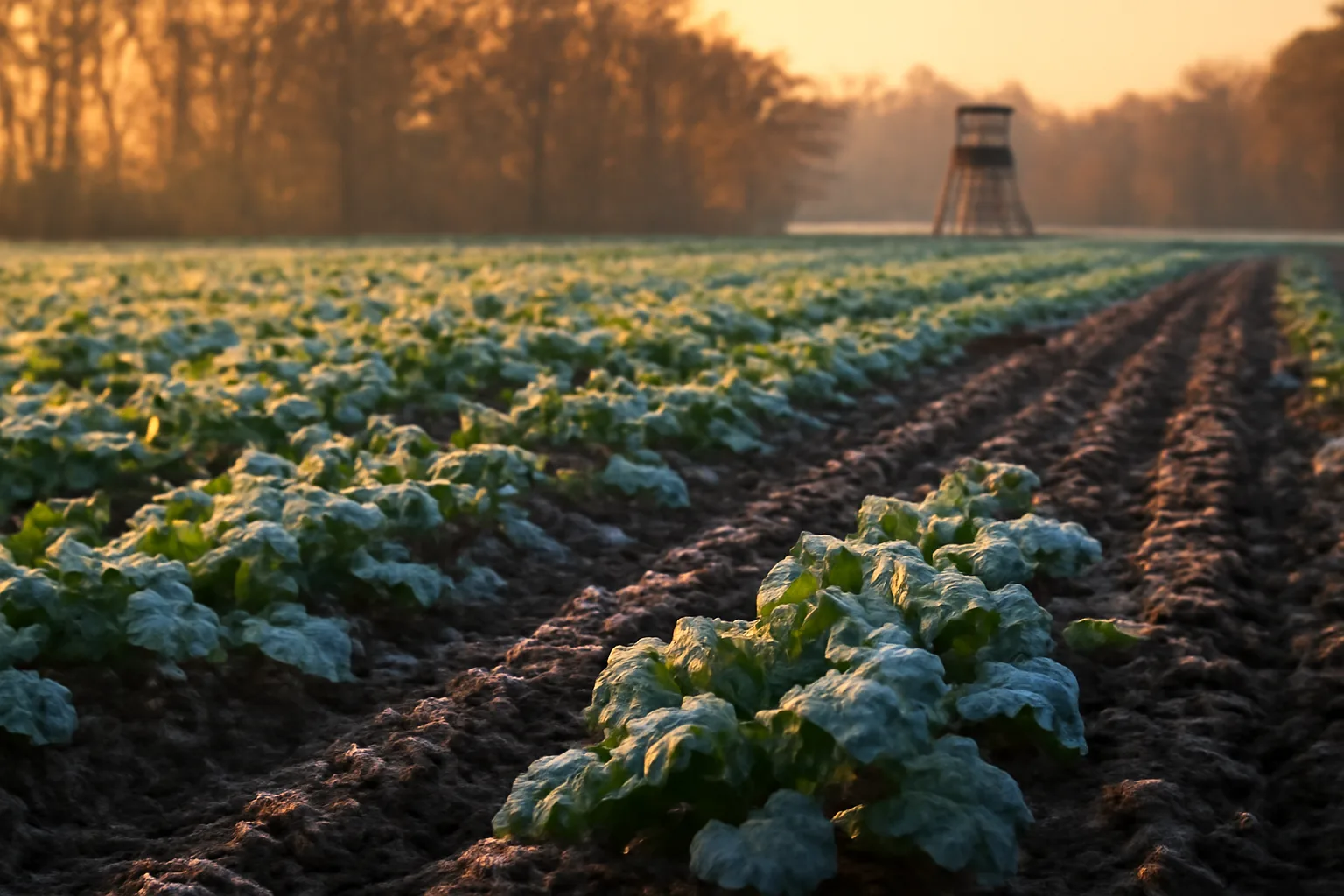
Turnips are a cheap, high-tonnage brassica that deer eat as tops first, then bulbs after a few hard frosts convert starches to sugar. Plant 60 to 90 days before your average first frost, seed at 4 to 6 lbs per acre into a firm, limed seedbed, and expect deer to mostly ignore bulbs until December in most whitetail range.
what is a food plot, and where do turnips fit in one
A food plot is a planted patch of forage on hunting land, built to feed deer (and often other wildlife) and to draw or hold animals near a stand or blind. Plots range from a quarter-acre kill plot tucked in timber to a 10-acre destination field planted for winter tonnage. USDA's Natural Resources Conservation Service supports food plot type plantings through conservation practice standards, including Conservation Practice Standard 645, Upland Wildlife Habitat Management, which covers establishing and managing plant communities for food and cover on private land [1]. Turnips fit the "late-season tonnage" role in that system. They're not a spring green-up plant and they're not a warm-season attractant. They're a fall-planted brassica that pumps out a lot of leafy growth fast, then holds a starchy bulb in the ground that becomes a sugar-rich food source after frost. Most plot builders pair turnips with something deer will eat immediately (oats, cereal rye, clover) so the plot produces food from the day it germinates through the dead of winter. If you're weighing turnips against other brassica or legume options for your specific acreage, that's a soil-and-species question worth running through a food plot whitetail planning guide before you buy seed.
when to plant turnips for deer
Plant turnips 60 to 90 days before your area's average first killing frost. That window lets the plant build a bulb and a full leaf canopy before growth slows. In much of the whitetail's range that means a planting date somewhere between late July and early September, with northern states planting earlier and the Deep South planting into September. University of Wisconsin-Extension forage agronomy guidance recommends seeding brassicas for fall grazing roughly 80 to 90 days before the first killing frost so plants have time to bulb and build leaf mass before growth stops [2]. University of Tennessee Institute of Agriculture publication SP731-I on brassicas for deer and other wildlife recommends planting in the mid-South region generally in August, and notes turnips need that lead time to bulb properly [3]. If you plant too early in hot, dry conditions, seedlings can bake out before establishing roots. Plant too late and you get leaf growth but small or no bulbs, which cuts your late-winter tonnage. A soil thermometer isn't necessary here, a calendar and a frost-date table are. NOAA's climate normals or your state extension's frost-date charts will get you within a week or two of the right target. Broadly, this same 60-to-90-day rule governs when to plant food plots for deer across brassica species, so if you're building a mixed plot the turnip component usually sets your planting calendar.
do deer like turnips, and when do they actually eat them
Deer eat turnip tops readily from the seedling stage on, but most herds largely ignore the bulbs until after several hard frosts, sometimes not until December or January. The frost matters because freezing temperatures trigger the plant to convert starches into sugars as a cold-tolerance response, and that shift makes the bulb noticeably sweeter and more palatable. This is one of the most consistent field observations among plot managers and it lines up with basic plant physiology: cold-stressed brassicas raise soluble sugar content in storage tissue. University of Tennessee's SP731-I publication on brassicas for wildlife notes that turnips and related brassicas become more palatable to deer after frost converts starches to sugars, and recommends them specifically as a late-season food source for that reason [3]. So don't panic if your turnip plot looks untouched in October. Deer are hammering the leaves in early fall, then the plot seems to go quiet, then bulbs disappear fast once temperatures drop hard. In areas with mild winters or light deer pressure, you may see bulbs never get touched at all, which is a real limitation worth knowing before you plant 3 acres of straight turnips.
how do turnips compare to clover, oats, and other plot staples
| Turnips | Late July to early Sept (60-90 days pre-frost) | Tops in fall; bulbs after hard frost | Tops around 15-20%, can run higher young [3] | Annual | |
|---|---|---|---|---|---|
| Cereal oats | Late Aug to Sept, or early spring | Immediately through fall, dies back after hard freeze in most zones | 12-20% depending on growth stage | Annual | |
| Clover (white/red) | Spring or late summer | Spring through fall, most years | 20-25% | Perennial, 3-5 yrs | |
| Sorghum (grain) | Late spring, warm-season | Standing grain into winter, waterfowl and deer both use it | 8-11% grain | Annual, warm-season | Do deer eat sorghum? Yes, deer will feed on grain sorghum heads and on the green forage, and it's used regionally as both a deer and dove food source, though it's more a warm-season, drought-tolerant grain crop than a dedicated deer plot staple in most whitetail country. It's planted in late spring after soil warms, unlike turnips or oats. Do deer eat clover? Yes, heavily. Clover is usually the single most consistently grazed plot forage through spring, summer, and fall, and its regrowth after grazing is part of why it's the default perennial choice. Do deer like clover? By tonnage of research and by plot manager consensus, clover ranks at or near the top of preferred forages, alongside soybeans, when both are available. The tradeoff is clover doesn't provide the late-December bulb tonnage a turnip plot does. When to plant oats for deer: cereal oats go in late summer to early fall for a fall/winter annual plot (same general window as turnips, late August into September in most of the whitetail's range), or in early spring for a short-lived spring plot. Oats germinate fast, often in 5 to 7 days, and get grazed almost immediately, which makes them a good "instant food" partner to slower-maturing turnips. |
Turnips, clover, and oats solve different problems, and most good plot plans use two or three of them together rather than picking one. | Species | Best planting window | Peak deer use | Protein (crude) | Lifespan |
what soil and fertility do turnips need
Turnips want a soil pH close to 6.0 to 6.5 and moderate fertility, and they respond hard to nitrogen. Kansas State University Research and Extension's brassica cover crop guidance notes that brassicas grow best in well-drained soils with pH between 6.0 and 7.5, and that lime should be applied ahead of planting when soil tests show acidic conditions, since low pH ties up nutrients brassicas need [4]. Your soil test report from your own lab is the real authority here, not a blanket internet number. Labs vary in how they express lime and fertilizer recommendations (some give lbs per acre of actual N-P-K, others give bags of a specific blend), and your lab knows your regional soil chemistry better than a general guide can. If your test comes back at pH 5.5, follow your lab's lime recommendation in tons per acre, don't guess. Generally, turnip plots do best with 40 to 60 lbs of actual nitrogen per acre at or shortly after planting, split with a second application in early fall if you want maximum bulb size, according to general brassica fertility guidance from land-grant extension programs [4]. Phosphorus and potassium should follow your soil test; brassicas are not particularly demanding on P and K compared to legumes, but they'll show it in stunted leaf growth if either is badly deficient.
how do you actually plant a turnip plot
Turnip seed is tiny, roughly 150,000 to 220,000 seeds per pound depending on variety, so seeding rate and seeding depth matter more than with a big-seeded crop like soybeans or corn. Seed at 4 to 6 lbs per acre if planting turnips alone, or 2 to 3 lbs per acre as part of a brassica blend. Plant no deeper than 1/4 to 1/2 inch; turnip seed planted too deep simply won't emerge. A cultipacker or roller after broadcasting works well to press seed into contact with soil without burying it. A firm, weed-free seedbed matters more for turnips than for most plot species because the seedlings are small and slow to compete early on. Many plot managers broadcast turnip seed into a disked and cultipacked seedbed with a hand spreader or ATV spreader rather than drilling, since drills often place brassica seed too deep. If you're using a no-till drill, back off the depth setting as far as it goes and consider broadcasting instead. For equipment specifics on spreaders, cultipackers, and no-till drilling for small-seeded plot species, a general deer food plot seed planting guide covers seedbed prep in more depth than fits here.
what are deer's favorite food plot foods, and where do turnips rank
There's no single scientific ranking of deer's single favorite food, because preference shifts by season, region, and what else is available, but the closest thing to a consensus among wildlife agencies and extension programs puts soybeans, clover, and acorns near the top for most of the year, with brassicas like turnips rising in importance specifically in late fall and winter when other forages are gone or frozen out. The National Deer Association and multiple state wildlife agencies point to acorns as the single most important natural food in fall in oak-heavy regions, simply because of the fat and carbohydrate content and because deer evolved eating them. Among planted forages, soybeans and clover show up repeatedly as the highest-preference cultivated plants in forage preference studies, largely due to protein content and palatability through the growing season. Turnips don't compete with clover or soybeans as a fall favorite. Their value is timing: they hold food in the ground through frost and snow when nearly everything else is gone or buried, which is exactly the period a lot of hunters most want deer on their property (late muzzleloader and late rifle seasons in many states). Do deer like honey? Not in any meaningful food-plot sense. Deer aren't drawn to honey as a forage; it doesn't grow in a field and it isn't a wildlife food source in the way clover or turnips are. This shows up as a search question mostly from confusion with honey locust trees (whose pods deer do eat) or products marketed as scent/attractant additives, not from any real dietary role honey plays for deer.
should you plant turnips alone or in a blend
Plant turnips in a blend with oats, cereal rye, or radish/rape rather than alone, in most cases. A straight turnip plot has a long dead zone: not much palatability in the first few weeks of growth beyond leaf browsing, and bulbs that may sit untouched until deep frost. A blend fills that gap. A common mix is turnips at 2 to 3 lbs/acre plus oats or winter wheat at 50 to 80 lbs/acre, sometimes with a small amount of forage radish or rape added for tonnage diversity. The oats or wheat germinate fast and get grazed immediately, buying you attraction through September and October while the turnip bulbs bulk up underground for the December-January push. Some plot managers add a small amount of clover to a turnip/oat blend for perennial carryover, though clover establishment can be shaded out if the annual grains and brassicas get too thick. If perennial coverage matters to you, it's often cleaner to keep a dedicated clover plot separate rather than trying to layer three plant strategies into one seed mix. A deer food plots overview covers blend ratios and plot layout in more depth if you're deciding between a single-species turnip field and a multi-species destination plot.
how much tonnage and how many acres do you actually need
Turnips are among the highest-tonnage forages you can plant for deer, with total forage production (tops plus bulbs) commonly cited in extension and plot literature in the range of 2 to 4 tons of dry matter per acre under good growing conditions, though actual yield swings hard with rainfall, soil fertility, and planting date. That tonnage is a big part of the appeal: a half-acre to one-acre turnip plot can carry meaningful winter food for a small deer herd, especially compared to the same acreage in clover, which produces less total bulk per acre even though it's grazed more steadily across the year. As a rough planning rule, many state wildlife agency food plot guides suggest total plot acreage (all plots combined) run somewhere around 1% to 5% of total property acreage for supplemental forage, scaling up in areas with heavier deer density or poorer native habitat. That's a general guideline, not a formula, and your local deer density, native forage quality, and hunting pressure all push that number around. If you want species mix and acreage numbers built around your actual soil test, property size, and region rather than a rule of thumb, that's the kind of site-specific call the $99 Custom Food Plot Plan is built to answer: you send your soil test and property basics, and get back a planting plan matched to your zone and ground, not a generic blend recommendation.
any legal or baiting rules to check before planting
Standing food plots are legal to hunt over in every U.S. state, but the line between a "food plot" and illegal "baiting" varies by state, and some states regulate things like mineral sites, feeders, and even harvested/mowed plot material differently than a standing planted crop. Most states draw the legal distinction around whether the food is in its natural growing state versus placed, piled, or processed. A standing turnip plot is almost universally legal to hunt; a truckload of turnips dumped in a pile at the same field edge may cross into baiting depending on your state's definition. Michigan defines baiting for deer and elk hunting, and separately addresses food plots, under its administrative rule at Mich. Admin. Code R 435.1 within the Wildlife Conservation Order, issued under the Natural Resources and Environmental Protection Act, 1994 PA 451 [5]. Rules on things like mowing a plot, chopping it, or disking it under can also matter in some jurisdictions, and hunting distance-from-bait restrictions differ by state as well. Check your state wildlife agency's current hunting regulations guide before assuming your plot setup is compliant, especially if you're combining a food plot with mineral or supplemental feed.
Frequently asked questions
Do deer eat sorghum?
Yes. Deer browse grain sorghum's green forage and will feed on the grain heads, and it's used in some regions as a wildlife planting for deer and dove. It's a warm-season crop planted in late spring, though, not a late-fall option like turnips, and it's less commonly used as a dedicated whitetail plot species than brassicas or legumes.
Do deer eat clover?
Yes, heavily and consistently. Clover ranks among the most preferred planted forages for whitetail deer through spring, summer, and fall, and its ability to regrow after grazing makes it a staple perennial plot choice. It doesn't provide the late-winter bulb tonnage a turnip plot does, which is why many plot plans use both.
When to plant deer food plots?
Timing depends on species. Perennials like clover typically go in spring or late summer. Annual fall plots, including turnips, oats, and cereal rye, are usually planted 60 to 90 days before your area's average first frost, generally late July through September depending on latitude. Spring annuals like soybeans or sorghum go in after soil warms, typically May or June.
Do deer like turnips?
Deer eat turnip tops from seedling stage through fall, but often ignore the bulbs until after several hard frosts convert starches to sugars, sometimes not until December or January. In mild winters or under light deer pressure, bulbs may go largely untouched, so turnips work best paired with a faster-grazed species like oats.
When to plant oats for deer?
Plant cereal oats for a fall/winter plot in late August to September in most whitetail range, the same general window as turnips. Oats germinate in about 5 to 7 days and get grazed almost immediately, which makes them a good partner planted alongside slower-maturing brassicas like turnips.
When to plant food plots for deer?
Fall annual plots (turnips, oats, cereal rye, brassica blends) go in 60 to 90 days before your first expected frost, generally late July through September. Perennials like clover can go in spring or late summer. Warm-season plots (soybeans, sorghum, cowpeas) go in after your last spring frost, typically May or June.
When to plant turnips for deer?
Plant turnips 60 to 90 days before your average first killing frost date. In most whitetail range that lands somewhere between late July and early September; northern states plant earlier, Deep South states can wait into September. That lead time lets the plant build a bulb before growth slows for winter.
What is a food plot?
A food plot is a planted area of forage on hunting or wildlife land, managed specifically to supplement natural food for deer and other wildlife and to help hunters pattern animal movement near a stand. USDA's Natural Resources Conservation Service supports these plantings under conservation practice standards for upland wildlife habitat management.
What are deer's favorite food plot foods?
There's no single official ranking, but soybeans and clover consistently show up as top-preference planted forages through the growing season, with acorns as the dominant natural food in fall in oak-heavy regions. Brassicas like turnips become especially important in late fall and winter when other forage is scarce or frozen.
Do deer like honey?
No, not in any real food-plot sense. Honey isn't a forage crop and doesn't grow in a field, so it plays no role in deer nutrition or plot planning. The question likely stems from confusion with honey locust trees, whose pods deer genuinely do eat, or from marketed scent and attractant products.
Can you plant turnips alone, or do they need a companion crop?
You can plant turnips alone, but most plot managers blend them with oats, cereal rye, or forage radish. A straight turnip plot has a slow start on palatability and bulbs deer may ignore until hard frost, so a fast-germinating grain fills the attraction gap in early fall while bulbs bulk up underground.
How much turnip seed do you need per acre?
Seed turnips at 4 to 6 lbs per acre if planting alone, or 2 to 3 lbs per acre if part of a brassica or grain blend. Plant shallow, no deeper than 1/4 to 1/2 inch, since turnip seed is tiny (roughly 150,000 to 220,000 seeds per pound) and won't emerge from depth.
Do turnip food plots need lime or fertilizer?
Usually yes. Turnips want soil pH near 6.0 to 6.5 and respond strongly to nitrogen, typically 40 to 60 lbs of actual N per acre. Follow your own soil test report for exact lime and fertilizer rates, since your lab knows your regional soil chemistry better than a general online recommendation.
Sources
- USDA Natural Resources Conservation Service, Conservation Practice Standard 645, Upland Wildlife Habitat Management: food plots are supported as a wildlife habitat management practice
- University of Wisconsin-Madison Extension, Brassica Forage Crops publication A3868: brassica planting windows timed roughly 80-90 days before first killing frost
- University of Tennessee Institute of Agriculture Extension, SP731-I, Brassicas for Deer and Other Wildlife: brassica planting timing and frost triggering starch-to-sugar conversion improving palatability
- Kansas State University Research and Extension, Brassicas: Cover Crop and Forage Considerations, MF3376: brassica soil pH, fertility, and lime requirements for food plots
- Michigan Department of Natural Resources, Wildlife Conservation Order, Mich. Admin. Code R 435.1, Baiting and Feeding of Deer and Elk: state rule defining and regulating baiting separately from standing crops