Last updated 2026-07-25
TL;DR
On rolling hills, contour your rows, pick erosion-tolerant blends like clover, chicory, and cereal grains over exposed brassicas, and plant on a schedule tied to your fall frost date. Clover and cereal grains hold soil on slopes far better than turnips or standalone brassicas planted alone on bare dirt.
What is a food plot, and does hilly ground change the plan
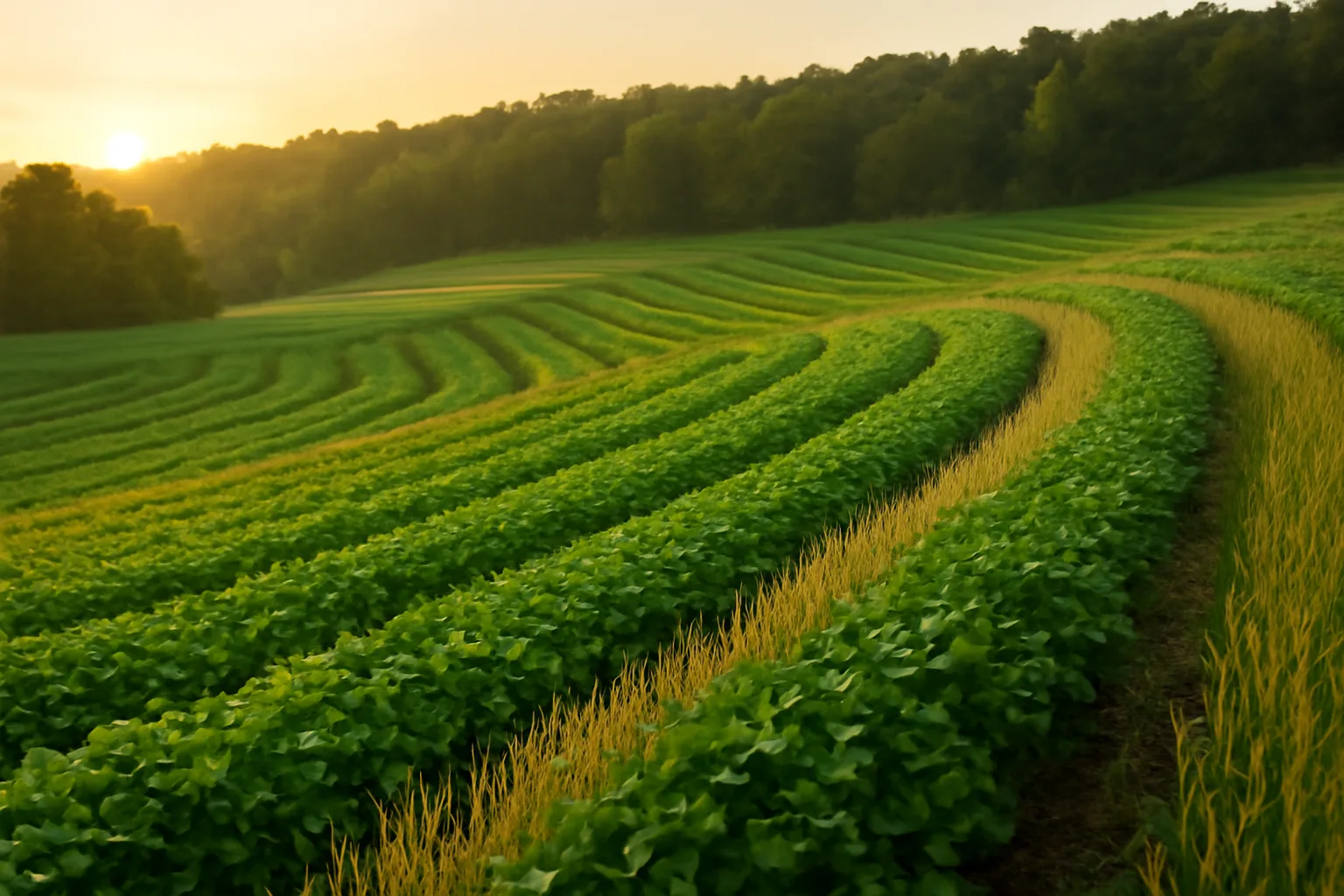
A food plot is a planted patch of forage, usually somewhere between a quarter acre and a few acres, put in specifically to feed deer and other wildlife and to give hunters a predictable place to watch or hunt. It's not a lawn and it's not a farm field in miniature, though it borrows techniques from both. Most plots run some mix of legumes (clover, alfalfa), brassicas (turnips, radish, rape), cereal grains (oats, wheat, rye), or a corn/soybean block if you have the acreage and equipment for it. Rolling hills add a wrinkle that flat-ground guides gloss over: water moves. Every seed you broadcast, every pound of lime or fertilizer you spread, wants to slide downhill the first hard rain after planting. The USDA Natural Resources Conservation Service treats slope as one of the primary inputs in its soil erosion models, because slope length and steepness directly multiply how much soil a rainfall event carries off [1]. A 2 percent grade behaves nothing like a 12 percent grade, even with identical soil type and rainfall. So on rolling ground, your plot design has two jobs at once: grow deer food, and keep your topsoil and seed where you put them. That means picking species with fast, fibrous root systems, running your equipment on the contour instead of straight up and down the hill, and sometimes accepting a smaller plot on a bench or saddle instead of a bigger one on a steep face.
What food plot seed works best on rolling hills
| White/Ladino clover | Fibrous, spreading stolons | Strong | High | |
|---|---|---|---|---|
| Cereal rye/wheat/oats | Fibrous, dense mat | Strong | Moderate to high | |
| Chicory | Taproot | Moderate | High | |
| Turnips/radish | Taproot, broad leaf | Weak alone | High (bulbs/tops) | |
| Soybeans | Taproot, moderate branching | Weak on slope | Very high | For equipment and blend ideas, see food plot seed and deer food plot seed. |
For sloped ground, prioritize forages that establish a root mat quickly and hold soil through winter, more than the ones deer prefer most. Clover, chicory, and cereal grains like winter wheat, oats, or cereal rye are the standbys, because their fibrous roots knit the top few inches of soil together within weeks of germination. Clover, particularly white clovers like Ladino, spreads by stolons that creep along the surface and choke out bare soil between plants. It's also perennial or semi-perennial depending on variety, so you're not tilling the whole slope every year, which matters a lot when tillage is exactly what starts erosion in the first place. Chicory pairs well with clover in a perennial blend and its taproot, while deep, doesn't leave the surface as bare as a brassica planting does once the leaves die back. Cereal grains are the erosion insurance policy of food plot seed. Oats and winter wheat germinate fast, often within 5 to 10 days in warm fall soil, and their dense, shallow root network is exactly what you want gripping a hillside through a wet winter. Extension agronomists commonly recommend cereal rye or wheat as a cover crop specifically for erosion control on sloped or fallow ground, separate from any wildlife value it has. Brassicas like turnips and radish are excellent deer food but they're the riskiest single-species choice for a steep plot. Their broad leaves shade out competition early, which is good for weed control but bad for surface protection once fall frost knocks the tops down and deer graze them to nubs, leaving bare dirt exposed right through the wettest months. If you want brassicas on a slope, blend them into a clover or cereal grain base rather than planting a monoculture. Here's a rough comparison for hillside suitability: | Species | Root type | Erosion control | Deer preference |
Do deer eat sorghum
Yes, deer eat sorghum, particularly grain sorghum heads in fall and winter once other food sources thin out. It's not usually a first-choice food plot species on its own, but it shows up in wildlife blends because it's drought tolerant and produces a lot of standing grain per acre. Grain sorghum's root system is more fibrous than corn's and it tolerates poorer soil and less rain, which makes it a reasonable pick for a rolling hill plot that bakes out in a dry August. It's commonly grown as a wildlife food source across the whitetail's range and university extension guides list it alongside corn as a standing grain option for fall and winter feeding [2]. On steep ground, though, treat it like corn: it's a taprooted row crop that leaves bare soil between rows early in the season, so contour planting and a cover crop understory (or planting it only on your flattest bench) matters more than the species choice itself.
Do deer eat clover, and do deer like clover
Deer eat clover heavily and readily, and it's one of the most consistently preferred food plot forages across the whitetail's range. Multiple state wildlife agencies and university extension publications rank clover among the top plantings for both nutrition and deer attraction, because it's high in protein (often 25 to 30 percent crude protein in vegetative growth) and stays palatable through most of the growing season [3]. Deer don't just tolerate clover, they actively select it when it's available, especially in spring and early summer when does need protein for lactation and bucks are growing antlers. That's also exactly the season clover is doing the most erosion-control work on a hillside, since it's actively growing and covering ground rather than sitting bare like a brassica field does mid-winter. It's a genuine win-win on sloped ground: high deer preference and strong soil holding, in the same plant. The tradeoff is that clover needs decent soil pH (most extension guides target 6.0 to 6.5) and it can get shaded out by weeds if you don't mow or spray in the establishment year. Your soil test is the actual authority here on lime rates; don't guess.
When to plant food plots for deer
Timing depends on species and your USDA hardiness zone or frost dates, not a single calendar date that works nationwide. Broadly, perennial clover and chicory go in spring (April through May in northern states, earlier in the South) or late summer (August into early September), while annual fall blends like brassicas, cereal grains, and oats go in based on your first fall frost date, typically 60 to 90 days before that frost. Cooperative extension planting guides consistently frame fall plot timing around the first frost, because brassicas need a frost to sweeten (starches convert to sugars) and cereal grains need enough fall growing season to establish before dormancy [2]. If you plant brassicas too late, you get spindly plants with no bulb. Too early in warm soil, and you can get disease pressure or bolting. On rolling hills specifically, aim to get seed down ahead of your region's heaviest rainfall pattern where you can, since bare, freshly worked soil on a slope is at its most vulnerable in the first 2 to 3 weeks after tillage, before roots knit the surface. Check your state wildlife agency's food plot or habitat page for regional guidance, since a Georgia planting window and a Minnesota one can be six weeks apart. For zone-specific timing across species, see deer food plots.
When to plant oats for deer
Plant oats for deer in late summer to early fall, generally 6 to 10 weeks before your first killing frost, so they get enough growth to be attractive before cold shuts them down. In much of the whitetail's range that lands somewhere between mid-August and mid-September, though southern states can push into October. Oats are a fall annual in most of the country, meaning they'll winterkill in harder climates once temperatures drop into the teens or lower, so don't expect them to carry a plot past December in Zone 5 or colder. In milder regions (much of the South and parts of the mid-Atlantic), oats can survive winter and provide green forage into late winter or early spring. Extension forage guides note that oats germinate quickly in warm soil, often within a week, which makes them a good nurse crop planted alongside slower-establishing clover on a fall-seeded hillside plot, since the oats hold soil and shade weeds while the clover gets its roots down. A spring oat planting is also an option in some regions as a quick, cheap cover or grazing crop, but for deer attraction most hunters plant oats as part of a fall blend.
When to plant turnips for deer
Plant turnips 60 to 90 days before your area's first fall frost, which for most of the whitetail's range means late July through early September. Turnips need that runway to bulb up and the leaves need cool fall weather and a frost or two to convert starches to sugar, which is what makes them palatable to deer late in the season. Plant too early and turnips can bolt or get eaten down to nothing before the bulbs matter. Plant too late, especially in northern states, and you'll get leafy tops but undersized bulbs, or the plants won't mature before hard frost stops growth. State agency and extension guides commonly point to the 60 to 90 day window as the standard rule of thumb for brassica planting nationwide, adjusted by your specific frost date [2]. On a rolling hill plot, turnips alone leave a lot of bare ground between plants and after deer browse the tops in early winter, so blend them with a cereal grain or clover rather than planting a pure turnip stand on any slope over roughly 5 to 8 percent grade. That blend approach also happens to be what a lot of commercial fall blends already do, for exactly this reason.
What are deer's favorite foods, and do deer like honey
Deer's food preferences shift by season and region, but agricultural crops (soybeans, corn, clover) and high-protein browse are consistently at the top of preference studies, alongside acorns in fall when they're available. There's no single universal favorite; a deer herd's top pick in Iowa soybean country looks different from a herd in the Appalachian oak-hickory belt. Acorns deserve a specific mention because they're arguably the most important natural food source across most of the whitetail's range in fall, and mast crop abundance from year to year can swing deer body condition and even hunting pressure at food plots, since deer will often bypass planted forage for a good acorn drop. State wildlife agency deer management guides frequently note that acorn availability affects how deer use supplemental food sources in a given fall [4]. As for honey: no, honey isn't a realistic deer food and it's not something you'd plant or use in a plot. Deer are herbivores built around a rumen digestive system suited to plant fiber, not concentrated sugars, and there's no wildlife agency or extension guidance recommending honey as bait or attractant. If you've seen anecdotal claims about deer and sweet substances, that's more likely referring to sugar beets, molasses-treated feed, or apples, all of which are actual, documented attractants (and some are regulated as bait, see below), not honey itself.
How do I lay out a food plot on a hillside without losing it to erosion
Run your plot's long axis and your tillage passes across the slope (on the contour), not up and down it, since straight up-and-down tillage lines act like tiny channels that funnel water and carry soil and seed away in the first heavy rain. This single change, contour tillage versus up-and-down tillage, is one of the most consistently cited erosion-reduction practices in USDA conservation guidance [1]. A few other practical moves that matter more on rolling ground than flat ground: Keep tillage shallow and limited. A light disk or cultipacker pass to prep a seedbed does far less damage than a deep plow, and no-till drilling into an existing cover crop or sod avoids exposing bare soil at all, which extension no-till guides point to as a major reason no-till adoption has grown on erosion-prone acres [5]. Use a nurse crop. Pairing a fast-germinating cereal grain with a slower legume means the grain holds soil while the clover establishes, a combination extension forage programs recommend for exactly this stabilization reason. Consider plot shape and placement. A long, narrow plot following a bench or a saddle in the terrain usually erodes less and often gets better deer use anyway, since deer favor those same terrain features for travel. Steep, wide-open hillside clearings are the worst combination: maximum sun exposure the seed catalog promised, and maximum runoff risk nobody mentions. Leave a buffer strip. A grass or unmowed strip along the downhill edge of a plot catches sediment before it reaches a creek or pond, a practice USDA conservation buffer guidance recommends broadly for cropland adjacent to water [6].
What soil test numbers matter most before planting a hillside plot
Your soil test should drive your lime and fertilizer rates, not a bag label or a forum post, and this matters even more on sloped ground where you can't afford to waste a pass of lime that runs off before it dissolves in. Most food plot forages, clover especially, want a pH in the 6.0 to 6.5 range, and university extension soil test interpretation guides are the standard reference for translating your lab's numbers into actual pounds of lime or fertilizer per acre [7]. Take your test a full season ahead of planting where you can, since lime takes months to fully react with soil and adjust pH, something extension soil fertility publications note repeatedly. On a hillside, split your soil sample by slope position (top, middle, bottom) if the plot is large or the grade is uneven, because erosion over years typically strips topsoil and organic matter from the upper slope and deposits it lower down, meaning your fertility needs can genuinely differ by 20 or 30 feet of elevation change within one plot. Your soil test lab is the actual authority on your specific lime and fertilizer rates. Nothing in this article, or in any general seed blend recommendation, replaces that report for your dirt.
What equipment and methods work best for planting rolling terrain
Match your equipment to your slope, since a tractor and disk that's perfectly safe on 3 percent grade gets genuinely dangerous on 15 percent grade, and rollover risk is a real, documented hazard in agricultural safety literature for sloped-ground tillage work. A no-till drill is often the single best equipment upgrade for hillside plots, because it places seed at a consistent depth without turning over the whole surface, cutting erosion risk dramatically compared to a conventional disk-and-drag seedbed. If you're broadcasting instead of drilling (common with smaller ATV-mounted spreaders), do it before a rain that's forecast to be light, not a downpour, and consider a light cultipacker or drag pass afterward to press seed into contact with soil rather than leaving it sitting on top where the first heavy rain washes it downhill in sheets. For a from-scratch plan on new hillside ground, a lot of hunters find it worth paying for a written plan rather than guessing at blend and timing. PlotSeason's $99 one-time Custom Food Plot Plan builds a species and timing recommendation around your soil test, region, and acreage; you can start one at /plot-plan-builder. It's general planning guidance, not site-specific agronomy, and it won't replace what your soil test lab tells you about lime and fertilizer rates for your exact dirt. For broader equipment comparisons across plot types, see equipment and methods and domain food plot seed.
Are there legal rules about baiting or feeding deer near a food plot
Yes, and they vary a lot by state, so check your state wildlife agency's regulations before you supplement a plot with corn piles, mineral, or other bait, since a planted food plot is generally legal everywhere but baiting rules for hunting over supplemental feed are not uniform. Some states draw a legal line between a growing food plot (legal to hunt over almost everywhere) and a pile of feed, corn, or mineral (restricted or banned in a growing number of states, often tied to chronic wasting disease concerns). States including Michigan and Wisconsin, among others, have specific baiting and feeding restrictions tied to CWD management zones, and those rules change periodically as CWD detections expand, so don't rely on last year's regulations [8]. Your state wildlife agency's current hunting digest or regulations page is the only reliable source here; a food plot forum post from three years ago is not.
Frequently asked questions
Frequently asked questions
Do deer eat sorghum?
Yes. Deer eat grain sorghum heads in fall and winter, and it's a recognized wildlife food plot species in university extension guides, often grouped with corn as a standing grain option. It's drought tolerant and works on poorer soil, but like corn it leaves bare ground between rows early in the season, so it's not the top pick for steep, erosion-prone slopes without a cover crop understory.
Do deer eat clover?
Yes, and heavily. Clover is one of the most consistently preferred food plot forages across the whitetail's range, running 25 to 30 percent crude protein in vegetative growth according to extension forage data. Deer select it strongly in spring and summer when protein demand is highest for lactation and antler growth.
Do deer like clover, or is it just decent forage?
Deer genuinely prefer clover, more than tolerate it. Extension and state wildlife agency food plot guides consistently rank it among the top attractant species, and it stays palatable through most of the growing season, unlike many annuals that mature past their peak palatability within weeks.
When should I plant food plots for deer?
It depends on species. Perennial clover and chicory generally go in spring or late summer. Fall annuals like brassicas, oats, and cereal grains go in 60 to 90 days before your area's first frost. Check your state extension or wildlife agency's regional planting calendar, since windows shift by 4 to 6 weeks across the whitetail's range.
When should I plant oats for deer?
Plant oats 6 to 10 weeks before your first fall frost, typically mid-August through mid-September in much of the whitetail range, later in the South. Oats germinate fast, often within a week in warm soil, and usually winterkill in colder zones, so they're a fall attractant rather than a plant that carries a plot through winter everywhere.
When should I plant turnips for deer?
Plant turnips 60 to 90 days before your first fall frost, generally late July through early September depending on region. They need that time to bulb and need a frost or two afterward to sweeten. Too late a planting in northern states often produces leafy tops with undersized, unattractive bulbs.
What is a food plot, exactly?
A food plot is a planted area, usually a quarter acre to several acres, seeded specifically to feed deer or other wildlife and to give hunters a predictable spot to hunt or observe. Common plantings include clover, brassicas, cereal grains, corn, and soybeans, chosen based on soil, region, and season.
What are deer's favorite foods?
There's no single universal favorite; it shifts by region and season. Acorns are arguably the most important fall food source across most of the whitetail's range, and agricultural crops like soybeans, corn, and clover consistently rank high in preference studies and extension guides.
Do deer like honey?
No. Honey isn't a realistic deer attractant or food, and no wildlife agency or extension source recommends it. Deer are herbivores adapted to plant fiber, not concentrated sugar. Documented attractants include sugar beets, molasses-treated feed, and apples, which are sometimes different from honey and sometimes regulated as bait depending on your state.
What's the best food plot seed for a hillside or rolling terrain?
Clover, chicory, and cereal grains like oats, wheat, or rye are the best base for sloped ground because their fibrous roots knit soil together fast. Turnips and other brassicas are fine blended in, but avoid a pure brassica stand on any slope steeper than roughly 5 to 8 percent, since they leave too much bare ground exposed.
Should I till a hillside food plot or use no-till methods?
No-till or minimal-till is generally safer on sloped ground. Deep tillage exposes bare soil that erodes fast in the weeks before roots establish. A no-till drill into existing cover or sod, or a shallow disk pass followed by a cultipacker, protects soil far better than a deep plow on any real grade.
Is it legal to hunt over a food plot, and are baiting rules different?
A planted, growing food plot is legal to hunt over in nearly every state, but baiting rules for piled feed, corn, or mineral vary widely and change often, especially in states managing chronic wasting disease. Always check your state wildlife agency's current hunting regulations before adding any supplemental feed near your plot.
How much does it cost to soil test before planting a hillside plot?
Most land-grant university extension soil testing labs charge somewhere in the range of $10 to $20 per basic sample, though exact pricing varies by state lab. It's a small cost relative to a bag of seed and lime, and it's the only reliable way to set your actual pH and fertilizer rates.
Sources
- USDA Natural Resources Conservation Service, RUSLE2 Overview: Slope steepness and length are primary factors multiplying soil erosion in USDA erosion modeling
- Mississippi State University Extension, Wildlife Food Plots: Grain sorghum is listed as a fall and winter wildlife food plot option alongside corn
- University of Tennessee Extension, Establishing Food Plots for Wildlife: Clover is ranked among top attractant food plot species and provides high crude protein forage
- Pennsylvania Game Commission, Deer Management Program: Acorn mast availability affects how deer use supplemental food sources in a given fall
- USDA Natural Resources Conservation Service, No-Till Farming: No-till practices reduce soil exposure and erosion compared to conventional tillage
- USDA Natural Resources Conservation Service, Conservation Buffers: Vegetative buffer strips reduce sediment reaching water bodies from adjacent cropland
- University of Missouri Extension, Soil Test Interpretations: Most food plot forages including clover require soil pH in the 6.0 to 6.5 range
- Wisconsin Department of Natural Resources, Baiting and Feeding Regulations: Wisconsin restricts baiting and feeding of deer in counties under chronic wasting disease management