Last updated 2026-07-25
TL;DR
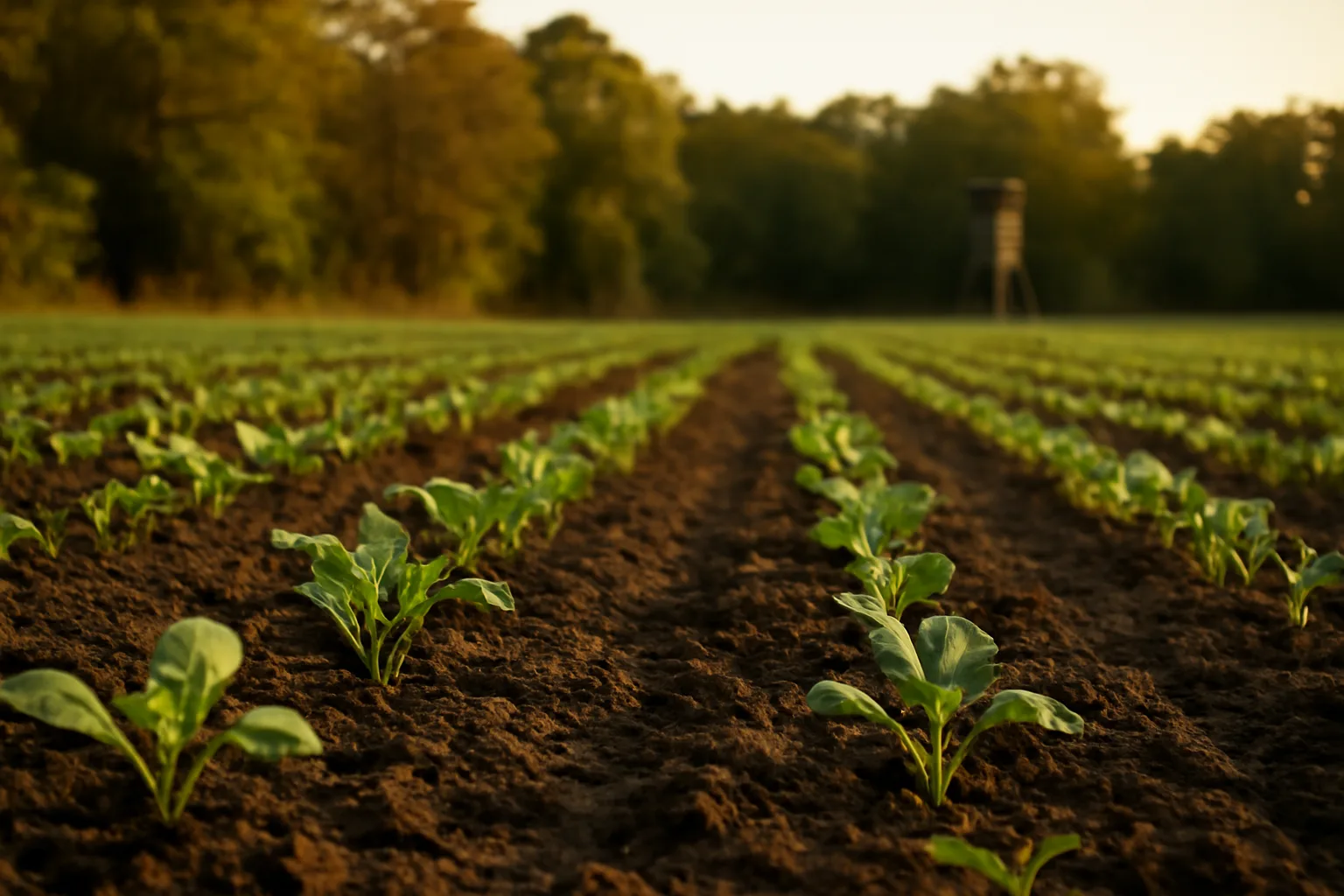
Plant fall food plots so seed goes in the ground 60 to 90 days before your area's average first frost for brassicas like turnips, and 45 to 60 days before frost for cereal grains like oats and winter wheat. Clover can go in earlier, late summer through early fall. Check your local extension frost date and county baiting rules before you plant.
what is a food plot, exactly?
A food plot is a planted patch of forage on hunting or wildlife land, usually somewhere between a quarter acre and a few acres, put in specifically to feed and attract deer or other game. It's not a farm field and it's not landscaping. Most plots run anywhere from 1/4 acre to 2 acres for a hidden or bedding-area plot, up to 3 to 5 acres or more for a destination field plot meant to hold deer through the season. Food plots serve two different jobs and a lot of guys mix them up. A nutrition plot (think clover or alfalfa) is there to build antler growth and body condition in spring and summer. An attraction or hunting plot (think brassicas, cereal grains, or a blend) is timed to be at peak palatability during hunting season, which for most of the whitetail range means late September through December. The USDA's National Agroforestry Center and most state wildlife agencies treat food plots as a wildlife habitat management tool, distinct from agricultural crop production, because the goal is deer nutrition and hunter opportunity rather than yield per acre for sale. If you're planning your first one, food plot whitetail is a good primer on the basic plot types and what each is for.
when to plant food plots for deer (the short answer)
| Zone 3-4 (northern MN, WI, ME) | mid-July to early Aug | early Aug to early Sept | late July to Aug | |
|---|---|---|---|---|
| Zone 5-6 (IA, IL, PA, southern MI) | late July to mid-Aug | mid-Aug to mid-Sept | Aug to early Sept | |
| Zone 7 (VA, NC, TN, AR) | mid-Aug to early Sept | Sept | Sept to early Oct | |
| Zone 8-9 (deep South, TX, FL) | Sept to early Oct | Oct | Oct | These are planting windows, not guarantees, since a wet fall or an early cold snap can shove the whole schedule around. For a full month-by-month breakdown by region, see our [seasonal-calendars hub], and for species-specific seed choices start with deer food plot seed. |
Work backward from your area's first fall frost date. Brassicas (turnips, radishes, rape) need 60 to 90 days before a hard frost to bulb out and hit peak sweetness. Cereal grains (oats, winter wheat, winter rye) need 45 to 60 days to establish before cold shuts down growth. Clover is more forgiving and can be seeded late summer into early fall, roughly 6 to 8 weeks before your first expected frost, so the plant has time to root before winter. That means actual calendar dates swing wildly by region. A hunter in southern Alabama might not plant brassicas until early September, while someone in northern Minnesota needs seed in the ground by late July or the first week of August. Cooperative extension frost date tables (Iowa State's is a commonly cited one) are the fastest way to find your local average first frost date and count backward from there. Here's a rough national framework, but check your own county extension office before you trust it: | Zone (approx. USDA hardiness) | Brassicas/turnips | Cereal grains (oats, wheat, rye) | Clover |
when to plant turnips for deer
Plant turnips 60 to 90 days before your area's first killing frost. Turnips need that long runway to grow a bulb and build sugar content, and a frost or two actually helps, because cold converts starches to sugars and makes the tops and bulbs more palatable to deer later in the season. Most extension guidance and seed producers recommend a seeding rate around 4 to 6 lbs per acre for turnips broadcast alone, planted at a depth of about 1/4 to 1/2 inch, into a clean, weed-free seedbed with decent soil contact. Turnips like a soil pH close to 6.0 to 6.5 and respond well to nitrogen, so a soil test matters here more than people think. A hungry brassica plot on acidic, low-fertility soil will look thin and small no matter how good the seed genetics are. One quirk worth knowing: deer often ignore turnip tops early in fall and hit them hard after a frost or two, then start digging up the bulbs once the tops are grazed down. If your plot looks untouched in October, that's often normal, not a failure. Give it until November or the first hard frost before you judge it.
when to plant oats for deer
Plant oats 45 to 60 days before your first fall frost, generally late August through September across most of the whitetail range, earlier further north. Oats are a fast-germinating cereal grain, often up in 5 to 7 days under good moisture, and they're one of the most consistently attractive fall plantings because deer hit the tender young leaves hard almost as soon as they emerge. Seeding rate for oats alone typically runs 100 to 130 lbs per acre if drilled, more if broadcast, at a planting depth around 1 to 2 inches [1]. Oats are not reliably winter-hardy in the northern half of the country, meaning a hard freeze can kill the plant outright, which is fine if your goal is a fall attraction plot rather than a plant that survives to spring. If you want something that holds through winter, winter wheat or winter rye are the better choice since both can survive snow cover and green back up in spring. A lot of blended fall plots pair oats with brassicas or with winter peas, because the oats germinate fast and give deer something to eat early while the turnips are still bulbing up underground.
do deer like clover, and do deer eat sorghum?
Yes, deer like clover, and it's one of the most consistently preferred forages in food plot research. White clover and red clover are both high in protein (often 20 to 30 percent crude protein in vegetative growth stages) and stay palatable through spring, summer, and into fall, which is why so many perennial nutrition plots are clover-based [2]. Clover is also relatively cheap per acre and, once established, can produce for 3 to 5 years or longer with proper mowing and fertility maintenance, which makes it one of the better cost-per-year options compared to annual replanting. Sorghum is a different story. Deer will eat grain sorghum (milo) and forage sorghum, especially the seed heads once they mature and dry down in late summer and fall, and it's commonly planted as part of a summer/fall blend or as a standing grain crop for late-season cover and food. But sorghum isn't a top preference forage the way clover, soybeans, or brassicas are. It's more of a secondary or supplemental food source, useful for its drought tolerance, its ability to grow tall cover, and its late-season grain value once other softer forages are gone or covered in snow. In dry regions or on poor soils sorghum can be a smart pick because it tolerates heat and low rainfall better than clover or beans do.
what's a deer's favorite food, really?
There's no single universal answer, deer preference shifts by season, region, and what's already growing wild nearby, but research and decades of plot observation point to a short list: acorns (especially white oak acorns, which are lower in tannins and more palatable than red oak), soybeans and clover during the growing season, and standing corn or brassicas late in the year when other food is scarce. Acorns are consistently ranked as one of the most preferred natural whitetail foods where they're available, largely because of their high fat content, which helps deer build fat reserves ahead of winter [3]. That's a hard thing for a food plot to compete with in a good acorn year, and it's part of why plot activity can look slow during a mast year and then pick up fast once acorns run out. Among planted forages, soybeans and clover usually top preference trials during the growing season, while brassicas, cereal grains, and standing corn take over as the preferred late-season foods once temperatures drop and deer shift toward higher-energy, higher-carb food sources. If you're picking a single species to plant and you had to bet on broad appeal, clover or soybeans in summer and a brassica/cereal grain blend in fall is about as close to a safe bet as this hobby offers.
do deer like honey? (and other things people ask that aren't quite food plot questions)
Deer aren't drawn to honey the way people sometimes assume, and there's no meaningful research or extension guidance treating honey as a deer attractant or food plot ingredient. What deer do respond to are sweet, high-sugar plant tissues, which is part of why frost-sweetened brassica tops and bulbs, and ripe soybeans, pull deer in hard in fall. If you've seen mineral or attractant products marketed with honey or molasses scent, that's a commercial additive angle, not a food plot species question, and it has nothing to do with what you'd actually plant in a field. Worth a flag here: many states regulate or ban baiting and supplemental feeding for deer hunting, and the rules differ on what counts as a legal food plot versus an illegal bait pile. A planted, rooted crop is almost universally legal because it's considered normal agricultural or habitat practice, but piled feed, mineral blocks, or scattered grain in front of a stand can cross into baiting violations depending on your state. Michigan, for example, restricts baiting statewide with some exceptions, while other states allow it with quantity or distance limits [4]. Check your state wildlife agency's current regulations before hunting over anything that isn't a standing, planted crop.
how do soil tests fit into fall planting timing?
Soil pH and fertility drive whether your fall plot actually produces tonnage, and timing your test wrong can cost you a full growing season. Ideally you pull soil samples 2 to 3 months before your planned planting date, since lime takes time to move pH, often 3 to 6 months to fully react in the soil depending on how fine it's ground and how much you apply [5]. Most food plot species want a soil pH between 6.0 and 7.0. Below that, especially under pH 5.5, phosphorus and other nutrients get locked up and plants can't use fertilizer efficiently no matter how much you spread. A basic soil test from your county extension office or a private ag lab usually costs somewhere between $10 and $25 and comes back with a specific lime and fertilizer recommendation in pounds per acre, tailored to the crop you tell them you're planting. Your soil test is the actual authority here, not a blanket recommendation from any article, including this one. Lime and fertilizer needs swing hard based on your specific soil chemistry, so treat generic pH and NPK guidance as a starting point and defer to your lab results for exact rates. For the fundamentals on reading a soil report and building a fertility plan, see [our soil-and-fertility hub], and for seed blends built around common soil conditions, deer food plot seed and food plot seed break down what's in typical bags.
what equipment do you actually need for a fall plot?
For a small plot (under an acre) a lot of hunters get by with a hand spreader, a rake or drag harrow, and a UTV or ATV to pull it. You don't need a tractor to plant a good half-acre plot, though it makes life easier on anything over 2 to 3 acres. The minimum real gear list: something to kill existing vegetation (glyphosate spray or repeated disking), something to work the seedbed (disk, tiller, or harrow), a way to spread seed (broadcast spreader, hand-crank for small plots), and a way to get seed-to-soil contact (cultipacker, drag chain, or just driving over it with an ATV). Brassica and clover seed is small and needs to be planted shallow, often just pressed into the surface, while cereal grains like oats and wheat want to be drilled or covered about 1 to 2 inches deep. A no-till drill is the single best upgrade if you plant more than a couple acres a year, since it cuts the number of trips over a field and gets more consistent seed depth than broadcasting. But for a first-year, small hidden plot, a bag of seed, a hand spreader, and a rake will get you a legitimate stand if your seedbed prep and timing are right.
should you plant a single species or a blend?
Blends are usually the safer bet for a fall attraction plot, because you're hedging against one species failing and you're giving deer more than one thing to eat as the season progresses. A common fall combo is oats plus a brassica (turnips or radishes) plus a small amount of clover or winter peas, so you get fast early growth from the oats, a mid-to-late season draw from the brassica bulbs, and a perennial base from the clover that carries into next year. Single-species plots have their place too. A dedicated clover field is a strong choice if you want a low-maintenance perennial nutrition plot that doesn't need replanting every year. A pure brassica plot can be the right call if you're specifically targeting late-season hunts in December or January, since brassica tonnage and sweetness often peaks after multiple frosts, well past when most bow seasons open. If you're not sure what to plant on a specific piece of ground, that's the exact situation a soil test and a plot-specific plan solves better than generic advice can. We built the $99 one-time Custom Food Plot Plan at PlotSeason for that reason, you enter your soil test results, region, and plot size, and get species and rate recommendations back instead of guessing off a bag label.
how much does a fall food plot cost to plant?
Rough per-acre costs for a fall plot run somewhere between $50 and $200 depending on seed choice, whether you're liming and fertilizing from scratch, and whether you're renting or already own equipment. Clover seed tends to run cheaper per acre than specialty brassica blends, and a basic oat/wheat seeding is one of the lowest-cost options if you already have decent soil fertility. Lime is often the hidden big-ticket item. Agricultural lime typically costs $30 to $60 per ton delivered and spread in most regions, and a badly acidic field can need 1 to 2 tons per acre to bring pH up to target, which adds real money fast on larger plots. That's another reason to soil test early: finding out you need 2 tons of lime per acre in September, right when you wanted seed in the ground, is a bad position to be in. If you're planning multiple plots across leased or owned ground, budgeting seed, lime, and fertilizer separately per plot (rather than one blended number) makes it a lot easier to see where the money's actually going.
common fall planting mistakes worth avoiding
The single biggest mistake is planting too early or too late relative to frost. Too early into hot, dry August ground and brassica seed can burn up or fail to germinate; too late and cereal grains don't get enough growth before cold shuts things down. Second most common mistake: skipping the soil test and guessing on lime, which routinely cuts yield in half or more on acidic ground even with good seed and good rain. Third: poor seedbed prep, especially not killing existing weed competition before planting. Small-seeded brassica and clover in particular get outcompeted fast by existing grass and weeds if you don't spray or till first. Fourth: broadcasting seed too deep or not rolling/cultipacking it in, which leaves seed sitting on top of dry soil with no germination. Last one, and it's more of a legal issue than an agronomy one: not checking your state's baiting and supplemental feeding rules before assuming a food plot is automatically fine to hunt over. Standing, planted crops are broadly legal, but definitions and exceptions vary by state, and it's worth a five-minute check of your state wildlife agency's current regulations rather than assuming.
Frequently asked questions
Do deer eat sorghum?
Yes, deer eat grain and forage sorghum, particularly the seed heads once they mature in late summer and fall. It's not a top preference forage like clover or soybeans, but it works well as a late-season grain source and drought-tolerant cover crop, especially on poor or dry soils where clover struggles.
Do deer eat clover?
Yes, clover is one of the most preferred whitetail forages available, with crude protein often between 20 and 30 percent in vegetative growth. Both white and red clover are common perennial food plot choices and deer typically hit them hard from spring through fall whenever the plant is actively growing.
When should I plant food plots for deer?
Time fall plots backward from your local first frost date: brassicas need 60 to 90 days before frost, cereal grains need 45 to 60 days, and clover should go in roughly 6 to 8 weeks before frost. Check your county cooperative extension office for your area's average first frost date before setting a calendar date.
When should I plant turnips for deer?
Plant turnips 60 to 90 days before your area's first hard frost, usually mid-summer to early fall depending on region. Turnips need that time to bulb and sweeten, and a frost or two actually improves palatability by converting starches to sugar in the tops and bulbs.
When should I plant oats for deer?
Plant oats 45 to 60 days before your first fall frost, generally late August through September in most of the whitetail range. Oats germinate fast, often within 5 to 7 days, and provide an early, highly attractive food source, though they typically winterkill in colder climates.
What is a food plot?
A food plot is a planted area, usually a quarter acre to a few acres, seeded specifically to provide deer or other wildlife with forage and to give hunters a predictable place to see or hunt animals. It's distinct from a commercial crop field because the goal is wildlife nutrition and hunting opportunity, not yield for sale.
What is a deer's favorite food?
White oak acorns are widely considered one of the most preferred natural whitetail foods due to their high fat content and lower tannin levels compared to red oak acorns. Among planted forages, soybeans and clover top preference during the growing season, while brassicas and standing corn take over as favorites in late fall and winter.
Do deer like clover more than other food plot species?
Clover ranks near the top of most preference studies and field observations, especially during spring and summer growth. It's not always the single top choice; soybeans often compete closely, and in late fall deer frequently shift preference toward brassicas and cereal grains as clover growth slows with cold weather.
Do deer like honey?
There's no research or extension guidance supporting honey as a deer attractant or food plot input. Deer respond to sugar-rich plant tissue, like frost-sweetened brassica bulbs, not honey itself. If you've seen honey-scented attractant products, that's a separate commercial mineral/attractant category, not a food plot planting question.
How far apart should you plant fall food plots from each other?
There's no fixed legal spacing requirement in most states; spacing is a hunting strategy decision, not a regulation. Many hunters spread plots a few hundred yards to a half mile apart to spread out deer use across a property, but check your state wildlife agency for any local rules on plot placement near property lines or public land.
Can you plant a fall food plot without tilling the soil?
Yes, no-till planting works well for fall plots, especially with a no-till drill or by spraying existing vegetation, letting it die, and broadcasting seed into the residue followed by a cultipacker pass. No-till reduces erosion and soil moisture loss and is increasingly the preferred method recommended by extension no-till programs.
How long does it take a fall food plot to grow in?
Cereal grains like oats often show visible growth within 5 to 10 days under good moisture; brassicas take longer to bulb, generally 60 to 90 days to full maturity. Clover germinates in about a week but takes a full growing season to establish a strong perennial stand.
Sources
- University of Tennessee Extension, Wildlife Food Plots: Oat seeding rate and planting depth for fall wildlife food plots
- NRCS Plant Guide, White Clover (Trifolium repens): Clover crude protein content and its role as a preferred perennial forage
- Mississippi State University Extension, Deer Nutrition and Food Habits: Acorns, particularly white oak, are a high-preference, high-fat natural whitetail food
- Michigan Department of Natural Resources, Baiting and Feeding Regulations: State-level restrictions on baiting and supplemental feeding for deer hunting
- University of Missouri Extension, Soil Testing and Liming: Lime takes several months to react and adjust soil pH after application