Last updated 2026-07-24
TL;DR
Liquid food plot fertilizer works best as a starter boost or foliar feed on small plots, not as a full-season nutrient replacement. Granular fertilizer, matched to your soil test, still carries most of the N-P-K load on plots over an acre. Use liquid for quick green-up, spot correction, or spray-tank convenience when you already have a sprayer running herbicide.
what is liquid food plot fertilizer, exactly?
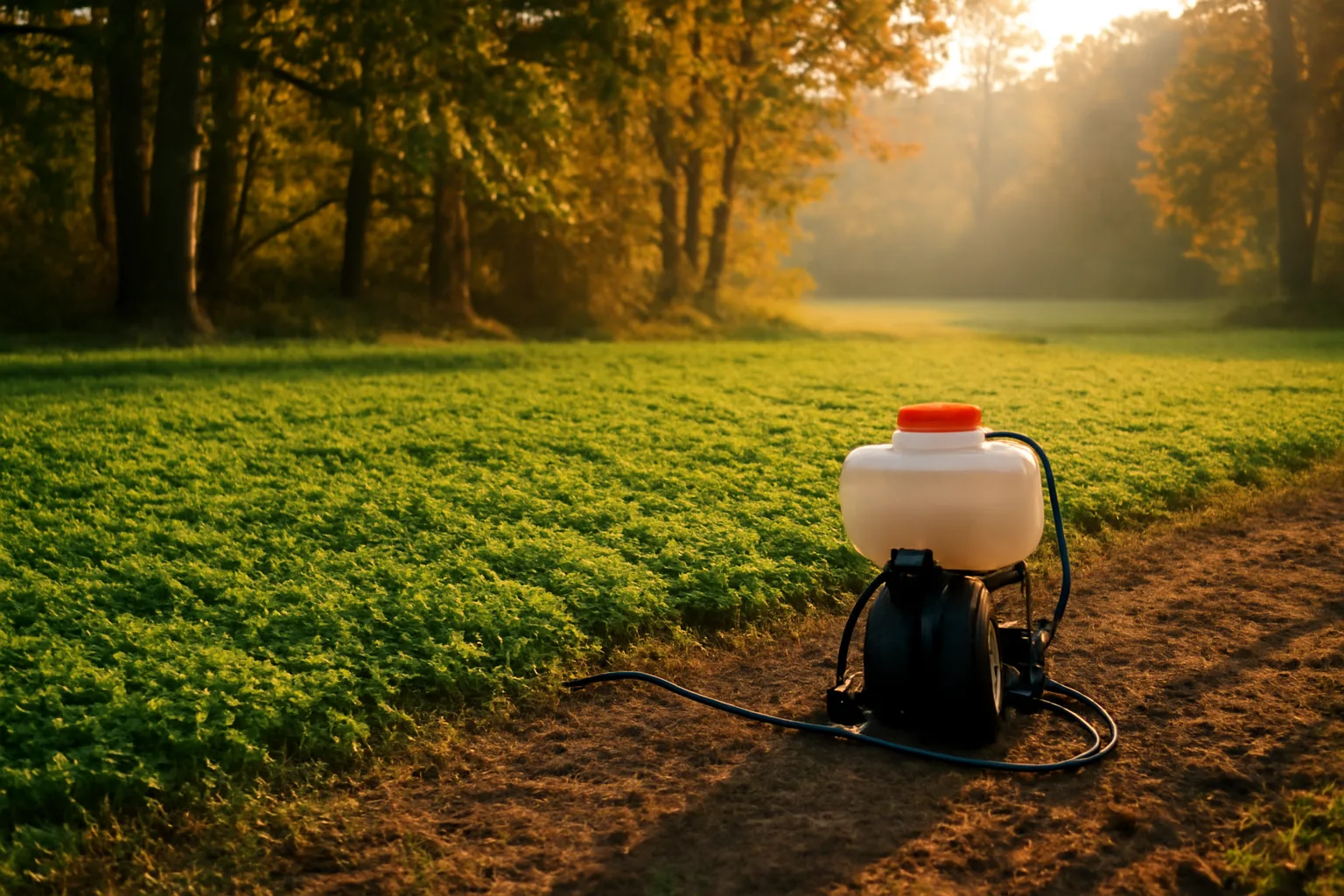
Liquid food plot fertilizer is a nutrient solution (usually nitrogen, phosphorus, potassium, plus micronutrients like boron, manganese, or sulfur) that you mix with water and spray on soil or foliage instead of broadcasting dry granules. Concentrations are typically labeled like 9-18-9 or 6-24-6, same N-P-K numbering as bagged fertilizer, just delivered in a jug instead of a bag. Most liquid products fall into two camps: starter fertilizers meant to go down at or right after planting, and foliar feeds meant to be sprayed on established plants during the season. Some are synthetic, some are fish-based or kelp-based organic blends that also claim to feed soil biology. The appeal is simple. A backpack sprayer or ATV boom sprayer can cover a half-acre plot in the time it takes to load and calibrate a broadcast spreader, and liquid gets absorbed fast through leaf tissue, which matters if you're trying to green up a stressed plot in a hurry. The catch is volume. Liquid fertilizers are diluted, so hitting real per-acre N-P-K targets on a big plot takes a lot of gallons and a lot of tank refills. For context on what a food plot even needs agronomically, see food plot whitetail for a full planning rundown.
does liquid fertilizer actually beat granular for food plots?
For plots under an acre, liquid can be competitive on convenience and speed of green-up. For plots over an acre, granular almost always wins on cost per pound of actual nutrient delivered. University extension nutrient management guidance treats liquid and granular (dry) fertilizers as agronomically equivalent once you account for the actual pounds of N-P-K applied per acre. University of Nebraska-Lincoln Extension fertilizer guidance notes that plant response depends on nutrient availability and rate, not on whether the source is liquid or granular [1]. A pound of nitrogen is a pound of nitrogen whether it comes out of a jug or a bag. Where liquid genuinely helps: foliar micronutrient correction (boron deficiency in brassicas, for example), quick starter boosts on tiny plots, and convenience when you're already running a sprayer for herbicide and don't want to make a second pass with a spreader. Where granular wins: cost per unit of nitrogen is almost always lower with dry urea, ammonium sulfate, or a balanced blend like 19-19-19 versus a comparable liquid concentrate. Iowa State University Extension fertilizer economics guidance notes that dry bulk fertilizer typically runs cheaper per pound of nutrient than liquid formulations for row-crop-scale application, largely because liquid products carry the cost of water weight and packaging [2]. A 5-acre clover plot fertilized entirely with liquid product gets expensive fast.
when should I use liquid fertilizer on a food plot?
Use liquid fertilizer when you need a fast fix, not when you're trying to build a plot's whole season of nutrition from scratch. Good uses: a foliar boost on clover or brassicas that look pale or stunted mid-season, a starter shot mixed into your sprayer tank at planting for small plots, correcting a specific micronutrient deficiency your soil test flagged (boron for turnips, sulfur for clover), or fertilizing tight or oddly shaped plots where a spreader throw pattern is wasteful. Bad uses: trying to replace your full granular application on a plot over an acre, skipping the soil test because the liquid label says it has everything, or spraying liquid nitrogen heavy on legumes like clover, which fix their own nitrogen once inoculated and rhizobia are established. Clover actually needs very little supplemental nitrogen. Heavy N application can push grass and weed competition instead of clover growth. That's a real trap, and it's an easy one to fall into if you're just following a bag or bottle label instead of your soil report. Your soil test is still the authority here, not the fertilizer label. A $99 Custom Food Plot Plan can turn your soil test numbers into a straightforward planting and fertility schedule, but the lab report itself, and any recommendations your county extension agronomist gives on top of it, should drive your lime and fertilizer decisions on your specific dirt.
what does a soil test actually tell you before you spray anything?
A soil test gives you pH, and estimated levels of phosphorus, potassium, and sometimes secondary nutrients like calcium, magnesium, and sulfur, all specific to your dirt. Without it you're guessing. Mississippi State University Extension's soil testing guidance recommends testing every 2 to 3 years and notes that soil pH below about 6.0 significantly limits phosphorus availability to plants regardless of how much fertilizer you apply [3]. That's the trap a lot of plotters fall into: they spray or spread fertilizer on acidic soil and wonder why nothing happens. Lime, not fertilizer, is usually the first fix. A basic soil test costs $10 to $20 through most university extension labs, and turnaround is typically 1 to 2 weeks. That's cheap insurance against wasting money on fertilizer your soil can't even use yet. For picking species and seed based on what your ground and soil test support, check food plot seed and deer food plot seed.
when to plant food plots for deer, by region?
Timing depends on whether you're planting a spring/summer annual, a fall annual, or a perennial, and where you are in the country. Spring plots (soybeans, cowpeas, clover establishment) generally go in after your last frost date, typically April through May in northern states and March in the South. Fall plots (brassicas, cereal grains, clover overseed) go in 60 to 90 days before your first hard frost so plants mature before deer season and before growth stops. Roughly:
- Zone 3-4 (northern Midwest, upper Great Lakes): fall plots by early-to-mid August
- Zone 5-6 (mid-Midwest, mid-Atlantic): fall plots late August into early September
- Zone 7-8 (South, lower Southeast): fall plots September into early October General rule of thumb, not a guarantee: plant so your plot peaks in growth right as hunting season opens, since most fall annuals are most attractive to deer 30 to 60 days after emergence.
when to plant oats for deer?
Oats go in as a fall annual, typically 4 to 8 weeks before your average first frost date so they establish before cold shuts down growth. In most of the Midwest that's late August through mid-September; in the Southeast it can run into early October. Oats germinate fast, often within 5 to 10 days in warm soil, and are highly palatable to deer while young and tender, which is exactly why a lot of plotters blend oats with brassicas or cereal rye. Oats winterkill in colder zones (typically below 10 to 20°F sustained), so in the far north they act as a fall-only forage, while in milder regions they can persist and regrow into winter. A light starter fertilizer application at planting, whether liquid or granular, helps oats establish quickly, but oats aren't heavy feeders compared to brassicas, so don't over-apply nitrogen.
when to plant turnips for deer?
Turnips are a fall brassica and go in the ground roughly 80 to 90 days before your first expected hard frost, since they need that long to bulb out and reach peak palatability. Plant too late and you get leafy tops but no bulb development; plant too early in hot weather and germination and early growth can suffer. In much of the Midwest that puts turnip planting in late July through mid-August. In the Deep South, late August into September works. Turnips actually get sweeter and more attractive to deer after a hard frost, because cold triggers the plant to convert starches to sugars. That's why turnip plots often see the heaviest deer use in December and January rather than October. Turnips are moderate-to-heavy nitrogen and boron feeders. This is one spot where a foliar liquid application with boron mid-season can genuinely help bulb development if your soil test showed a boron deficiency, a common gap in brassica-heavy rotations.
what is a food plot, and what's it actually for?
A food plot is a planted area, usually somewhere between a quarter-acre and several acres, seeded with forage crops specifically to provide supplemental nutrition and, for hunters, a predictable place deer show up. It's not the same as broadcast baiting; it's an agricultural planting, not a pile of feed. That distinction matters legally. Baiting and supplemental feeding rules vary heavily by state, and some states regulate feeding but explicitly exempt normal agricultural food plot plantings, while others have specific rules about what counts as a plot versus a bait pile. Check your state wildlife agency's regulations before you plant or feed. Rules differ enough between neighboring states that you can't assume what's legal at home travels with you. Food plots typically serve one of three purposes: attraction (drawing deer to a huntable spot during season), nutrition (building body condition, antler growth, and fawn health across spring and summer), or both. See deer food plots for a full breakdown of plot design and purpose.
do deer eat sorghum?
Yes, deer eat sorghum, particularly the grain heads once they mature and dry down, and they'll also browse young sorghum foliage, though it's not typically their first choice compared to soybeans or clover. Grain sorghum is more commonly planted as a standing grain crop for late-season food and cover than as a primary attractant forage. Sorghum's real value in a food plot mix is often structural. It grows tall (often 4 to 6 feet) and provides screening cover and winter food simultaneously, and it tolerates drought and poor soil better than corn, which makes it a reasonable substitute on marginal ground. Deer will hit the grain heads hard in late winter when other food sources are picked over. It's not a nitrogen-light crop though. Grain sorghum has fertility needs similar to corn, so if you're going the liquid or granular route, budget for a real nitrogen program, not a token starter dose.
do deer eat clover, and do they actually like it?
Yes, deer eat clover readily, and it's consistently one of the most preferred forages in food plot research and practical use. Clover is a legume, so it fixes atmospheric nitrogen through root nodule bacteria once established, which is part of why it needs comparatively little nitrogen fertilizer versus grasses or brassicas. Do deer like clover? By most field observations and extension forage-preference data, yes, clover ranks near the top of preferred food plot forages alongside soybeans, largely because of its high crude protein content, often 25 to 30% in well-managed stands, and its long growing window from spring through fall. Clover also regrows after grazing, unlike a lot of annuals that get mowed down once and don't recover. That's a big part of why it's the default perennial choice for a lot of plotters. The fertility catch with clover: too much nitrogen actually works against you. It can stimulate weed and grass competition that outcompetes the clover stand itself, per University of Wisconsin-Madison Extension forage fertility guidance [4]. Focus fertilizer on phosphorus, potassium, and pH correction (clover wants soil pH in the 6.0 to 7.0 range) rather than heavy nitrogen.
what are deer's favorite foods overall?
There's no single universal answer, because deer preference shifts by region, season, and what's locally available, but across food plot research and wildlife agency forage studies, a consistent short list shows up: soybeans and other legumes, clover, acorns (especially white oak acorns, which are lower in tannins and more palatable than red oak), and, in season, standing corn or brassicas after a frost. Acorns deserve a specific mention because in a lot of whitetail range, they're the single biggest natural food driver in fall, and their preference and availability can pull deer off food plots entirely in a heavy mast year. Within planted forages, soybeans generally top preference rankings during the growing season because of protein content, while brassicas and cereal grains take over as the preferred food source in late fall and winter once frost sweetens them and soybean pods are gone or picked clean.
do deer like honey, or is that a myth?
There's no solid wildlife research showing deer specifically seek out honey, and it isn't a recommended or legal attractant in most states anyway since it functions more like bait than a planted forage. Deer are drawn to sugar and carbohydrate-dense foods generally, which is part of why frosted brassicas and mast crops pull them in, but that's different from deer having a documented preference for raw honey specifically. Much of the "deer like honey" claim circulating online traces back to commercial deer attractant products (sprays, syrups) that use sugar, molasses, or honey-scented additives as a base, not to peer-reviewed feeding studies. If you're considering any liquid attractant product, check your state's baiting laws first. Many states classify sugar-based attractants the same as bait piles, with specific distance and timing restrictions from where you hunt, and rules differ sharply from state to state.
how do you actually apply liquid fertilizer on a food plot?
Match the application method to the product label rate, since liquid concentrates vary widely and overapplying can burn foliage, especially on young seedlings. For foliar feeding, spray during cooler parts of the day (early morning or evening) to reduce leaf burn risk and improve absorption, and avoid spraying right before rain that would just wash the product off before uptake. For starter applications at planting, liquid can go down with a boom sprayer just ahead of or right after seeding, though incorporation (a light drag or cultipacking pass) helps get it into the root zone rather than sitting on the surface. Calibrate your sprayer before you guess at coverage. A simple test, spraying a known volume of water over a measured area and checking output against the label's per-acre rate, takes 15 minutes and prevents both waste and crop damage. Most university extension sprayer calibration guides walk through this exact method, and it's worth doing once per season per nozzle set, since wear changes output over time. If you're mixing liquid fertilizer with an herbicide in the same tank pass, check the herbicide label for compatibility first. Some fertilizer-herbicide tank mixes are fine; others reduce herbicide efficacy or increase crop injury risk.
is liquid fertilizer worth the money for a typical food plot?
For most plots over half an acre, granular fertilizer sized to your soil test is the better dollar-for-dollar choice, and liquid is a supplement, not a replacement. Rough cost math: a bag of balanced granular fertilizer (like 19-19-19) typically runs $15 to $25 per 50-pound bag depending on your region and current fertilizer market prices, covering roughly a quarter to half acre at standard rates. Liquid concentrates covering the same nutrient load, once diluted to label rate, often cost noticeably more per pound of actual N-P-K delivered, largely because you're paying to ship and store water weight. Iowa State University Extension's fertilizer economics guidance backs this general pattern for dry versus liquid bulk products [2]. Where liquid earns its cost: convenience on tiny or awkward plots, foliar correction of a specific deficiency your soil test flagged, and situations where you're already running a sprayer and don't want to haul a spreader out for a half-acre patch. Buy liquid for those jobs. Buy granular, sized off your soil test, for the bulk of your season's fertility program. If you want a full breakdown of species, timing, and fertility recommendations built around your specific soil test, a Custom Food Plot Plan runs $99 one-time and turns your soil numbers into a straightforward planting and fertilizer schedule, though your soil lab and any local extension agronomist remain the final word on lime and rate decisions for your ground specifically.
Frequently asked questions
Do deer eat sorghum?
Yes. Deer eat both the grain heads and young foliage of sorghum, though it's typically a secondary choice behind soybeans or clover. Sorghum's biggest food plot value is often as a tall, drought-tolerant late-season grain source combined with screening cover, not as a primary attractant crop.
Do deer eat clover?
Yes, and clover is consistently one of the most preferred food plot forages available. It offers high crude protein, often 25 to 30%, regrows after grazing unlike most annuals, and fixes its own nitrogen once established, which lowers its fertilizer needs compared to grasses or brassicas.
Do deer like clover more than other food plot options?
Clover ranks near the top of preference alongside soybeans in most field observations and extension forage guidance, largely due to protein content and season-long availability. Preference still shifts regionally and seasonally, so acorns or standing beans can outcompete clover in a heavy mast year.
When to plant food plots for deer?
Spring/summer annuals like soybeans go in after your last frost, typically March through May depending on region. Fall annuals like brassicas and cereal grains go in 60 to 90 days before your first hard frost, so timing runs from late July in the north to early October in the South.
When to plant oats for deer?
Plant oats 4 to 8 weeks before your average first frost date, typically late August through mid-September in the Midwest and into early October in the Southeast. Oats germinate fast, often in 5 to 10 days, and winterkill in colder zones below roughly 10 to 20°F sustained.
When to plant turnips for deer?
Plant turnips 80 to 90 days before your first hard frost, generally late July through mid-August in the Midwest and late August into September farther south. Turnips need that full window to bulb properly, and cold weather actually sweetens them, so deer use often peaks in December and January.
What is a food plot?
A food plot is a planted area, usually a quarter-acre to several acres, seeded with forage crops to provide deer nutrition and a predictable spot for hunters. It's an agricultural planting, distinct from bait piles, though states regulate feeding and baiting differently, so check your state wildlife agency's rules before planting or supplementing.
What are deer's favorite foods?
Preference shifts by region and season, but soybeans, clover, white oak acorns, and frost-sweetened brassicas consistently rank highest across food plot research. Acorns often override planted forages entirely in a heavy mast year, which is why food plot use can drop off hard in years with strong natural mast.
Do deer like honey?
There's no solid wildlife research showing a specific deer preference for honey. Deer respond to sugar and carbohydrate density generally, which some commercial attractant products exploit using honey or molasses bases, but that's different from documented feeding preference, and many states regulate such attractants as bait.
Is liquid fertilizer better than granular for food plots?
Not generally. University of Nebraska-Lincoln extension guidance treats liquid and granular sources as agronomically equivalent per pound of actual nutrient delivered, and granular usually costs less per pound of N-P-K. Liquid earns its keep on small plots, foliar micronutrient fixes, and sprayer convenience.
How much does a food plot soil test cost?
Most university extension soil labs charge $10 to $20 per sample for a basic test covering pH, phosphorus, and potassium, with results typically back in 1 to 2 weeks. It's the cheapest step in the whole process and should happen before you buy any fertilizer, liquid or granular.
Can I mix liquid fertilizer with herbicide in one spray pass?
Sometimes, but check the herbicide label for tank-mix compatibility first. Some combinations are fine and save a pass; others reduce herbicide performance or increase crop injury risk, so don't assume compatibility without confirming it on the specific product labels you're using.
Does clover need nitrogen fertilizer?
Very little, once established. Clover is a legume that fixes its own atmospheric nitrogen through root nodule bacteria, and University of Wisconsin-Madison Extension guidance notes that heavy nitrogen application can actually encourage weed and grass competition against the clover stand rather than helping it.
Sources
- University of Nebraska-Lincoln Extension, nutrient management for agronomic crops in Nebraska: plant response depends on nutrient rate and availability, not on whether fertilizer source is liquid or granular
- Iowa State University Extension, Ag Decision Maker fertilizer economics guidance: dry bulk fertilizer typically costs less per pound of nutrient than liquid formulations
- University of Wisconsin-Madison Extension, Nutrient Application Guidelines for Field, Vegetable, and Fruit Crops in Wisconsin (A2809): clover requires minimal supplemental nitrogen and excess nitrogen can favor weed/grass competition
- Noble Research Institute, Establishing Fall Food Plots for Deer: fall brassica blends should be planted 6 to 10 weeks before first killing frost
- Michigan Department of Natural Resources, Wildlife Conservation Order, Deer Baiting and Feeding (Part 2): baiting and feeding rules for deer vary by region and are actively regulated