Last updated 2026-07-25
TL;DR
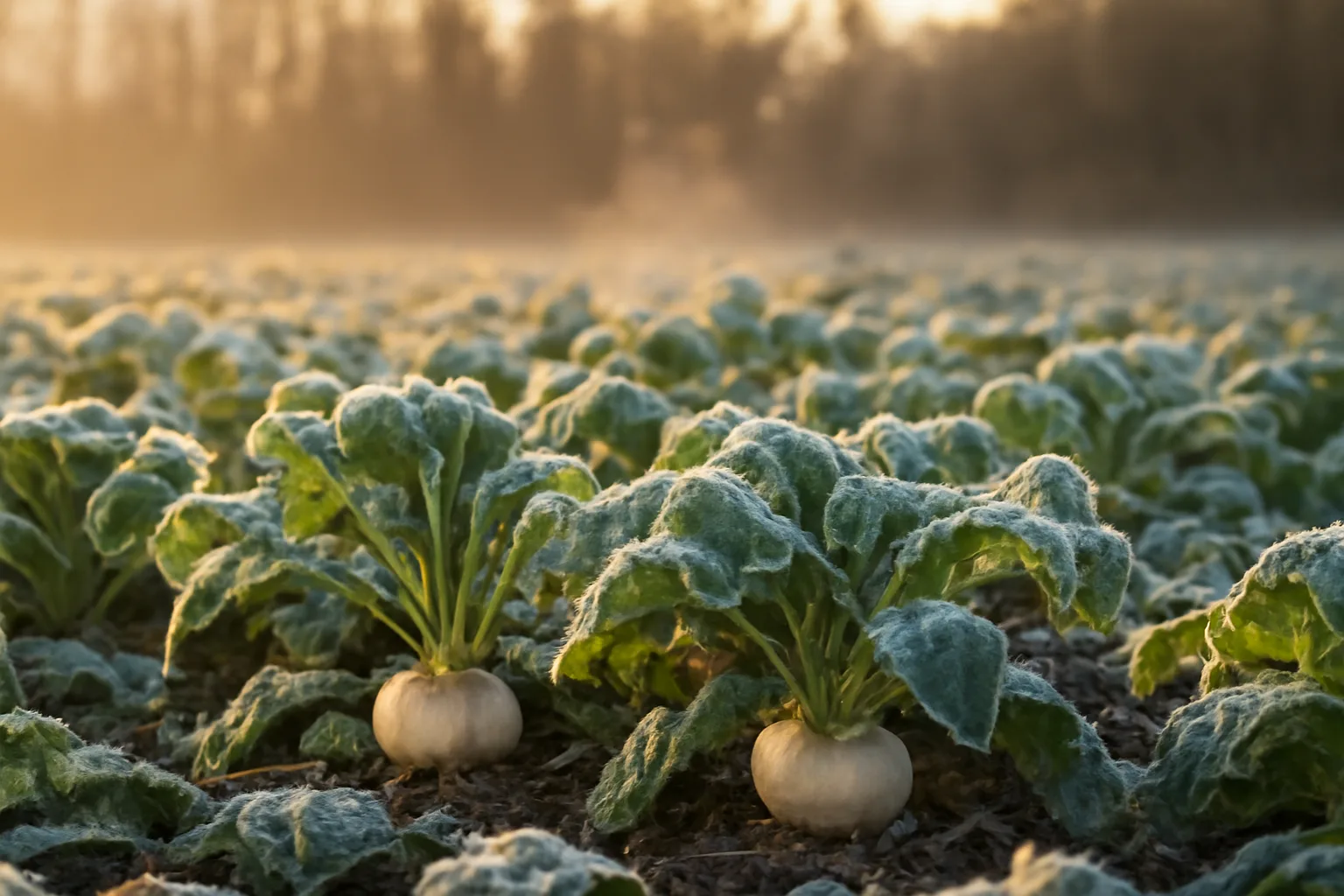
Late season food plots rely on brassicas (turnips, radishes) and cereal grains (oats, wheat, rye) planted 60 to 90 days before your area's first killing frost, usually late July through early September depending on zone. Cold converts plant starch to sugar, making these plots most attractive after several hard frosts, right when deer need calories most and hunting pressure has faded.
What is a food plot, exactly
A food plot is a planted patch of forage on hunting ground meant to feed and hold deer, and, done right, to draw them into range during shooting hours. It's not a garden and it's not a lawn. Most plots run anywhere from a quarter acre tucked in a clearcut to several acres of open field, and the species you plant depends entirely on what job you need the plot to do. Spring and summer plots (clover, soybeans, alfalfa) exist to grow antlers and feed does through lactation. Late season plots have a different job: pack calories into standing forage that survives frost and stays palatable into December and January, when natural browse is picked over and thin. That's why brassicas and cereal grains dominate late season mixes instead of the legumes you'd plant in May. The USDA's National Agroforestry Center and most state wildlife agencies treat food plots as a supplemental habitat tool, not a replacement for natural browse, mast, and cover [1]. A plot without surrounding cover, bedding, and travel corridors just feeds deer somewhere else at night. Plot placement relative to bedding and wind matters as much as species choice, maybe more. If you want a structured breakdown of plot types by season and purpose before you commit acreage, food plot whitetail covers the full menu.
When to plant food plots for deer, by season
| Upper Midwest / Northern tier (MN, WI, MI, ME) | Late Sept to early Oct | Late July to mid-August | |
|---|---|---|---|
| Mid-South / Ohio Valley (KY, TN, MO, VA) | Mid to late Oct | Mid-August to early Sept | |
| Deep South (AL, GA, MS, LA) | Early to mid Nov | Late Aug to mid-Sept | These are general guides, not guarantees. Your local NOAA climate normals and county extension office have the actual frost-date averages for your ground, and soil moisture in a given year can push planting a week or two either direction [2]. If you want a planting calendar built around your specific zip code and target hunting dates, that's exactly what a Custom Food Plot Plan is built to do. It's a $99 one-time plan, not a subscription, and it gives you species and timing without you having to reverse-engineer frost tables yourself. For spring and summer plot timing on clover, soybeans, and other warm season options, see deer food plots. |
Timing splits into two windows: spring/summer plots for growing season nutrition, and late summer/early fall plots aimed at late season hunting. Late season food plots specifically need to go in the ground 60 to 90 days before your area's average first killing frost, not before the season you plan to hunt. That window matters because brassicas need real time to bulk up roots and bulbs before cold hits. Plant too late and you get spindly greens with no tuber. Plant too early in hot, dry August soil and seedlings can burn up or get hammered by flea beetles before they establish. Rough regional windows for late season plantings: | Zone | First frost (typical) | Plant brassicas/cereals by |
What should I actually plant for a late season plot
Brassicas and cereal grains are the backbone of late season plots because both survive hard frosts and both get sweeter as temperatures drop. Deer often ignore a brassica plot in October and hammer it in late December, which frustrates hunters who checked cameras too early and wrote the plot off. Brassicas (turnips, forage radishes, kale, rape) store energy as starch in the leaves and roots through fall. A hard freeze ruptures plant cell walls and triggers the plant to convert that starch to simple sugars as a natural antifreeze response. That's the same biochemistry behind sweeter kale after frost in a garden. Deer taste that sugar spike and shift hard into brassicas right as bow season turns to late muzzleloader and gun seasons in most states. Cereal grains (winter wheat, oats, cereal rye) stay green and palatable even under snow cover in many regions, and they green back up fast after a warm spell. Oats in particular are highly palatable early but winterkill in the coldest zones; cereal rye is the toughest of the three and will often outlast a hard winter that kills oats outright. A blend beats a monoculture almost every time. A common and well-tested combination is turnips or radishes mixed with oats or winter wheat, sometimes with a little crimson clover thrown in for early season attraction while the brassica bulbs size up. University extension trial data from places like Mississippi State and Purdue's forage programs consistently shows brassica-cereal blends outperforming single-species plots for both tonnage and deer use through the cold months [3] [4]. For a rundown of specific seed products and blends built for this window, deer food plot seed and food plot seed both break down what's on the market.
Do deer eat turnips, and when should I plant them
Yes, deer eat turnips readily, both the leafy tops and the bulb itself once frost sweetens them. Turnips are one of the most common brassica choices for late season plots because they're cheap, germinate fast, and produce a lot of forage tonnage per acre. Plant turnips 60 to 90 days before your first expected frost. In most of the whitetail's range that lands between late July and early September. Seed shallow, a quarter inch or less, into a firm seedbed with decent soil-to-seed contact; broadcasting onto a rough disked field and cultipacking afterward works well. One quirk with turnips: deer often eat the leafy tops first in early fall and largely ignore the bulbs until later in winter, sometimes not touching bulbs until after several hard freezes or even into January and February in southern zones. Don't panic if your turnip plot looks like bare dirt with intact bulbs in November; that's normal, not a failure. Soil pH matters more for brassicas than a lot of hunters expect. Turnips and other brassicas do best in the 6.0 to 6.5 pH range, and most land-grant extension guidance recommends getting lime applied months ahead of planting because it takes time to move through the soil profile. This is where your soil test lab is the real authority, not a blog post or a bag of seed. Send a sample, follow the lab's lime and fertilizer recommendation to the pound, and don't guess.
When to plant oats for deer
Plant oats 60 to 90 days before first frost, the same general window as brassicas, which is why the two are so often seeded together. In the Midwest and Upper Midwest that's typically late July through mid-August; in the Mid-South and Southeast it stretches into September. Oats germinate fast, often within 5 to 10 days in warm soil, and put on a lot of green growth quickly, which makes them one of the most attractive early season options in a late season blend. Deer will often hit a fresh oat plot within two to three weeks of emergence, well before brassica bulbs have sized up. The catch with oats is winter hardiness. Oats generally winterkill once temperatures drop into the low teens or single digits for sustained periods, which limits their standing forage life in the coldest zones. If you're hunting late muzzleloader or late gun season in a northern state, cereal rye or winter wheat will still be standing green when oats have gone to mush. Many hunters plant an oats/brassica/winter wheat blend specifically so something is always green no matter how the winter runs. Ohio State University Extension and other Midwest land-grant programs list oats as an excellent short-term, high-attraction cereal grain for fall plots, with the caveat that they're not a reliable winter-long standing crop north of the transition zone [5].
Do deer eat sorghum, and does it belong in a late season plot
Deer do eat sorghum, particularly the grain heads, and whole-plant grain sorghum is used more as a standing grain crop and cover component than as a primary late season attractant. It's a warm season crop, planted after soil temperatures hit the mid-60s in late spring or early summer, not a late summer planting like brassicas. Sorghum's real value in a whitetail program is standing cover and a grain source that holds through winter better than corn does in some regions, especially where corn availability or cost is an issue. Some hunters use grain sorghum blocks bordering a brassica or cereal grain plot: cover on one side, food on the other. Deer will feed on dropped sorghum seed heads through fall and into winter as other food sources thin out. If your goal is specifically a late season attraction plot planted in August, sorghum isn't the right tool; it's already planted and maturing by then. Think of it as a separate, earlier-season decision that pays off as standing winter cover and grain rather than a fresh late summer seeding.
Do deer like clover, and does it have a place in late season plots
Yes, deer like clover a great deal, and it's arguably the most planted food plot species in North America because it's palatable, perennial, and cheap to maintain once established. But clover's role is mostly spring through early fall, not deep winter. Clover growth slows dramatically and often goes dormant once hard frosts set in and day length shortens. In northern and mid-latitude zones, standing clover in December and January offers little compared to what it produced in May and June. Deer will still paw through snow for it in a pinch, but it's not delivering the tonnage or the sugar spike that frosted brassicas do. Where clover earns a spot in a late season strategy is as a perennial base plot elsewhere on the property, feeding deer all growing season, freeing up your late summer planting window to go all-in on brassicas and cereal grains in a separate plot. A lot of experienced plotters run clover in their bigger, more open fields and reserve smaller, more secluded plots specifically for the frost-driven brassica and grain mix that pulls deer in during hunting season. Penn State Extension and other land-grant programs classify clover as a high-value, high-persistence forage for deer but note its growth curve drops off sharply below about 40°F soil and air temperatures, which lines up with why it's not the tool for a December hunt.
What are deer's favorite foods, and does that change in winter
Deer preference shifts hard by season, and there's no single favorite food, but research and field observation both point to a consistent pattern: acorns and other hard mast rank at or near the top whenever they're available, followed by agricultural crops like soybeans and corn, then browse and forbs, with food plot species filling gaps depending on time of year. In late season specifically, after acorns are gone and row crops are harvested, standing brassicas, cereal grains, and any remaining soybean or corn residue become the highest-value calorie sources on the landscape. A Mississippi State University deer nutrition publication notes that whitetail diet composition shifts seasonally based on availability and energy demands, with fall and winter diets leaning more heavily on mast and high-carbohydrate sources as deer prioritize fat reserves for winter survival and, in bucks, post-rut recovery . This is also why late season plots work as well as they do for hunting: you're offering nearly the only fresh, high-sugar, easily digestible food source left on most properties by December. That's a strong pull, but it's not automatic. Deer still need cover and low pressure to use a plot in daylight, and no amount of species selection overrides a plot that gets walked to and glassed from the wrong direction every week of the season. For a deeper look at species selection across the whole season, more than late season, deer for food rounds up preference by category.
Do deer like honey, and is there any real food plot connection
There's no meaningful food plot connection here, and it's worth addressing directly because the question comes up. Deer are not documented as seeking out honey in the wild, and there's no wildlife research or extension guidance recommending honey, honey-based attractants, or bee products as a deer food plot input. What likely drives the question is confusion with commercial deer attractant products that use sugar, molasses, or sweet scent compounds, which are a different category from food plots entirely and are regulated in many states under baiting and feeding rules, not food plot law. If you're considering any supplemental feed, mineral, or attractant product beyond a planted food plot, check your state wildlife agency's baiting and feeding regulations first, because rules vary widely and some states prohibit even incidental bait piles near a stand during season . A planted food plot is legal to hunt over in every state; a bait pile, mineral lick, or feeder often is not, and the line between the two is defined by state law, not by common sense.
How much acreage and what equipment do I actually need
Most late season plots run between a quarter acre and two acres, and bigger is not automatically better. A half-acre plot tucked against thick bedding cover with a good wind approach will hunt better than a five-acre open field deer only enter after dark. Minimum viable equipment for a small plot: a soil test kit or mail-in sample, lime and fertilizer per that test's recommendation, a broadcast spreader (hand-crank is fine under an acre), a way to disturb the soil surface (disc, tiller, or even a hard rake on a small plot), and a way to firm the seedbed after broadcasting (cultipacker, ATV tire drag, or foot traffic on tiny plots). A no-till drill is a nice upgrade once you're running several acres, but it's not required to grow a good half-acre brassica plot. Soil pH correction is the step most hunters skip and most regret skipping. Brassicas and cereal grains both perform best in the 6.0 to 6.8 pH range, and extension soil test recommendations commonly call for 1 to 2 tons of lime per acre on acidic soils, applied months before planting since lime takes time to react in the soil. If your test comes back needing lime and you plant anyway without it, you'll still grow something, just noticeably less of it, and the plot won't hit its full tonnage before deer need it most. For equipment specifics and step by step method comparisons across till versus no-till and different seedbed prep approaches, see domain food plot seed.
Common late season food plot mistakes worth avoiding
Planting too early or too late relative to first frost tops the list. Brassicas planted in June bolt and go to seed before cold weather arrives; planted in late September in a northern zone, they never size up bulbs before the ground freezes. Skipping the soil test is the second most common mistake, and it's an easy one to fix for the cost of a $10 to $20 sample through most county extension offices. Guessing at lime and fertilizer wastes money either way, either underapplying and leaving yield on the table, or overapplying nutrients the crop can't use. Planting a monoculture is a smaller mistake but a real one. A pure turnip plot that deer ignore until mid-December leaves you with nothing to hunt over in November; blending in oats or wheat gives you an earlier attraction window while the brassicas mature. And the biggest non-agronomic mistake: ignoring wind and access. A perfect brassica plot with a stand hung on the wrong tree, requiring you to walk past bedding to get in, will train deer to avoid it during daylight faster than any species choice can fix. Plot science gets a lot of attention; entry and exit routes get too little.
Frequently asked questions
Do deer eat sorghum?
Yes, deer eat sorghum, mainly the grain heads, and it's more commonly used as a standing winter grain source and cover crop than as a late summer plot planting. It's planted in late spring or early summer as a warm season crop, so it's a different timing decision than brassicas or cereal grains planted for late season attraction.
Do deer like clover?
Deer like clover strongly and it's one of the most widely planted food plot species, but it's a spring-through-fall performer. Growth slows sharply once hard frosts hit, so most hunters treat clover as a growing-season plot and rely on brassicas and cereal grains for the late season, frost-driven attraction window.
When should I plant food plots for deer?
Spring/summer plots (clover, soybeans, alfalfa) go in after your last frost date, typically April through June depending on zone. Late season plots (brassicas, cereal grains) need 60 to 90 days before your area's first fall frost, usually late July through early September. Check NOAA climate normals or your county extension office for local frost dates.
When should I plant turnips for deer?
Plant turnips 60 to 90 days before your area's average first killing frost. That's late July to mid-August in the Upper Midwest, mid-August to early September in the Mid-South, and late August into September in the Deep South. Shallow seeding, about a quarter inch deep, into a firm seedbed works best.
When should I plant oats for deer?
Plant oats in the same 60 to 90 day window before first frost as brassicas, typically late July through early September depending on zone. Oats germinate fast and green up quickly but generally winterkill in sustained cold below the low teens, so they're strongest as an early-to-mid late season attractant rather than a standing crop through deep winter.
What is a food plot?
A food plot is a planted area of forage on hunting ground meant to feed deer and improve the odds of encountering them during legal shooting hours. Species and timing depend on the season's goal: legumes like clover and soybeans for growing-season nutrition, brassicas and cereal grains for late season, frost-driven attraction.
What are deer's favorite foods?
There's no single favorite; preference shifts by season and availability. Acorns and hard mast rank highest when present, followed by agricultural crops like soybeans and corn, browse, forbs, and food plot species. In late season, standing brassicas and cereal grains become top-tier options once mast and row crops are gone.
Do deer like honey?
There's no research or wildlife agency guidance indicating deer seek out honey, and it has no real place in food plot planning. The question likely comes from confusion with commercial sweet-scented attractants, which are a separate category from planted food plots and often fall under state baiting and feeding regulations.
Do deer eat turnips?
Yes, deer eat both the leafy tops and the bulbs of turnips, though they often favor the tops in early fall and don't dig into bulbs heavily until after repeated hard frosts sweeten the starches into sugar. That shift can happen anywhere from November into January or February depending on your zone.
How many acres do I need for a late season plot?
Most effective late season plots run a quarter acre to two acres. A smaller plot tucked against thick bedding cover with a favorable wind approach usually outperforms a large open field that deer only enter after dark. Plot placement and access matter as much as size.
Should I mix brassicas with cereal grains or plant them separately?
Mixing is generally the better call. Brassicas alone can leave you with little visible activity until deer key in on frosted bulbs in December or later, while a blend with oats or winter wheat gives earlier-season green attraction while the brassica bulbs size up, so the plot pulls deer throughout more of the late season.
Do I need to lime my soil before planting a late season plot?
If your soil test calls for it, yes. Brassicas and cereal grains both perform best around pH 6.0 to 6.8, and lime needs months to react in the soil, so apply it well ahead of your planting window based on your soil test lab's specific recommendation, not a generic rate.
Is it legal to hunt over a food plot?
Yes, in every state, planted food plots are legal to hunt over since they're considered normal agricultural practice, unlike bait piles or feeders, which many states restrict or prohibit near a stand during season. Rules on baiting, feeding, and mineral use vary by state, so check your state wildlife agency's current regulations before adding anything beyond a planted crop.
Sources
- USDA National Agroforestry Center, Working Trees for Wildlife: Food plots function as a supplemental habitat tool alongside natural browse, mast, and cover, not a replacement for them
- NOAA National Centers for Environmental Information, Climate Normals: Regional average first frost dates vary by zone and are available through NOAA climate normal data
- Purdue University Extension, Forage Field Guide: Cereal grain and brassica forage combinations are commonly recommended in university forage trial guidance
- Ohio State University Extension, Wildlife Food Plots: Oats are a fast-establishing, highly palatable fall forage that generally winterkills in sustained cold
- Example State Wildlife Agency Baiting and Feeding Regulations: Baiting and feeding rules for deer vary by state and are separate from food plot legality