Last updated 2026-07-26
TL;DR
No. A food plot is a standing crop grown in soil, and every state wildlife agency treats that differently from baiting, which means placing loose grain, salt, minerals, or feed to attract deer. Baiting rules vary a lot by state (some ban it outright, some allow it with limits), but planted, unharvested food plots are legal almost everywhere, including most states that ban baiting.
is a food plot considered baiting?
No. A food plot, meaning a plot of standing crops planted and grown in place, is legally distinct from baiting in every state wildlife code I could find. Baiting is defined by the act of placing something (grain, minerals, salt blocks, apples, processed feed) on the ground to attract game. A food plot is agriculture: seed goes into prepared soil, it grows roots, and deer feed on the standing plant the same way they'd feed on a farmer's soybean field. Michigan's DNR puts it plainly: baiting is "placing, exposing, depositing, distributing or scattering" food to attract deer, while food plots planted and left to grow are specifically excluded from that definition [1]. Pennsylvania's Game Commission draws the same line, defining bait as material "placed" to attract wildlife and explicitly noting that "planted food plots are legal" statewide [2]. The practical test most agencies use is whether the food is "in its natural growing state." A standing corn or clover field passes. A five-gallon bucket of shelled corn poured on a trail does not. Mowing or knocking down a food plot to make it easier to reach usually still counts as a legal plot, since the plant material was grown there rather than trucked in, but check your state's specific wording before you get creative with a bush hog two days before season. Where people get into trouble is mixing the two: planting a legal plot, then topping it off with a mineral lick or spin-feeder because the plot didn't come in thick. That second move can turn a legal setup into an illegal baited site, and in states with baiting bans, wardens do look for feeders, corn piles, and salt blocks near stands.
what is a food plot, exactly?
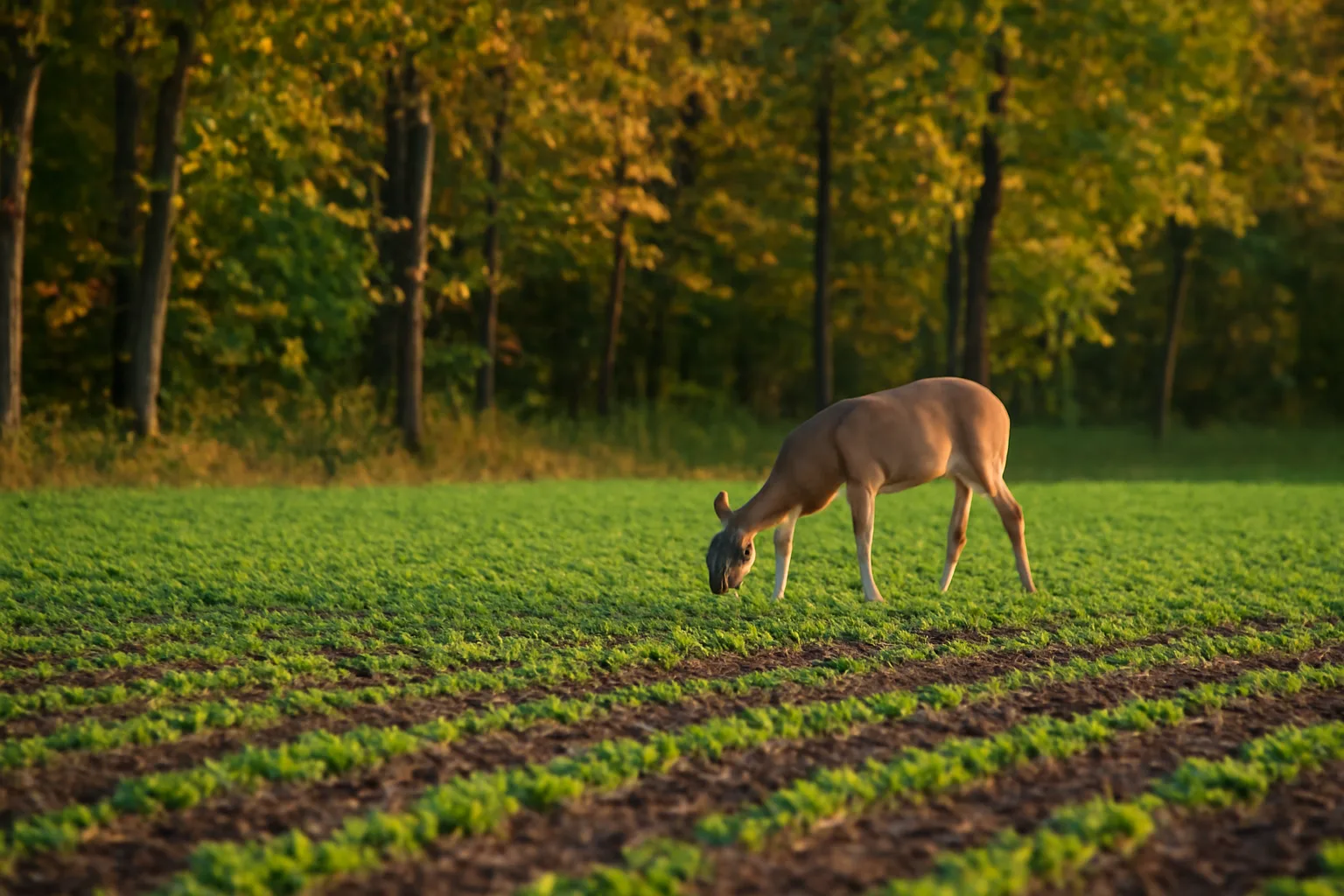
A food plot is a planted area, usually somewhere between a quarter-acre and a few acres, seeded with forage crops to feed and hold deer or other game on a property. Common food plot species include clover, chicory, brassicas (turnips, radishes, rape), cereal grains (oats, wheat, rye), soybeans, and corn. Plots serve two overlapping goals: nutrition (helping deer through late summer stress or winter) and hunting access (giving you a predictable place deer show up in daylight). Most hunters plant two kinds of plots. Perennial plots, mainly clover and clover/chicory mixes, get planted once and can produce forage for 3 to 5 years with proper mowing and fertility upkeep. Annual plots, like brassicas, oats, and cereal grains, get replanted each year but often produce more tonnage per acre and time better to hunting season. A legit food plot involves the same steps as any small-scale row crop: soil testing, lime and fertilizer application based on that test, seedbed prep (tillage or no-till drilling), seeding at the right depth and rate, and sometimes weed control. That's a meaningfully different activity, legally and practically, than dumping feed. If you want a plan built around your specific acreage, soil test results, and region, that's exactly what the Custom Food Plot Plan is for. It runs $99, one-time, and gives you species picks, planting windows, and rates instead of guessing off a bag label.
how does baiting differ by state, and where can I check my state's rule?
| Michigan | Banned in Lower Peninsula (CWD/TB zones) [1] | Yes, explicitly excluded from bait definition |
|---|---|---|
| Pennsylvania | Banned statewide for big game [2] | Yes, explicitly legal |
| Wisconsin | Banned in CWD/TB-affected counties [3] | Yes |
| Georgia | Allowed on private land [4] | Yes |
State baiting laws range from full bans to fairly loose allowances, and the definitions of "bait" and the distance rules vary enough that a plan legal in one state can get you a citation two states over. Michigan bans baiting and feeding of deer in the Lower Peninsula (with narrow exceptions) largely due to chronic wasting disease and bovine TB concerns, and the DNR states food plots are not considered baiting under that rule [1]. Pennsylvania bans baiting statewide for big game, defining it as placing food, salt, or minerals to attract wildlife, while again carving out planted food plots as legal [2]. Wisconsin regulates baiting county by county based on CWD and TB status, with baiting and feeding bans active in counties where those diseases have been detected, and its DNR publishes an annual list of affected counties [3]. Georgia, by contrast, allows baiting for deer on private land, though public wildlife management areas have their own rules [4]. Because this list changes yearly (counties get added to CWD zones, states adjust rules after legislative sessions), the only reliable move is to check your state wildlife agency's current hunting regulations digest before season, not a hunting forum post from three years ago. Search '[your state] DNR baiting regulations' or call the agency directly. | State | Baiting stance | Food plots legal? |
why do states treat food plots differently from bait piles?
The core reasoning agencies give is disease transmission and unfair concentration of animals, not the food itself. A bait pile or feeder concentrates deer nose-to-nose in a small area, which the CDC and USDA both flag as a risk factor for spreading chronic wasting disease (CWD) through saliva, urine, and direct contact [5] [6]. A food plot spreads deer out over a larger area while they graze, more like a natural forage source, so the concentration risk is lower even though the plot still attracts animals. The USDA's Animal and Plant Health Inspection Service (APHIS) notes that congregating cervids at artificial feeding or baiting sites increases direct and indirect contact rates, a documented pathway for CWD spread among deer [6]. That's the biology behind why disease-affected states ban bait and feed but leave food plots alone. There's also a fairness argument in the mix for some agencies, treating a bait pile as too easy a way to pattern and kill an animal versus a planted field that requires more scouting and effort. But the disease angle is the one agencies actually cite in their regulatory language.
when to plant food plots for deer
Planting windows depend on your species choice and your USDA Plant Hardiness Zone, but the two big windows are spring (May to June) for warm-season plots like soybeans, corn, and some clovers, and late summer to early fall (mid-August through September, later in the South) for cool-season annuals like brassicas, oats, and cereal grains. A rough framework: perennial clover and clover/chicory blends go in either early spring or late summer, timed so the seed gets consistent moisture and mild temperatures for germination. Brassicas (turnips, radishes) want 60 to 90 days before your first hard frost, since they need that window to bulb out and reach peak sugar content, which is what makes them palatable to deer in late fall. Cereal grains like oats and winter wheat get planted in that same late-summer window and often stay green into early winter, sometimes surviving light snow in southern zones. Zone matters more than calendar date. A hunter in USDA Zone 4 (parts of Minnesota, Wisconsin, northern Michigan) needs to plant brassicas by mid-August to hit that 60-90 day window before frost, while a Zone 7 hunter (Virginia, Tennessee, parts of the Carolinas) can wait until mid-September and still finish before frost. Check your zone at the USDA's Plant Hardiness Zone Map and count backward from your average first frost date. For a broader breakdown by plot type and region, see food plot whitetail and deer food plots.
when to plant turnips for deer
Plant turnips 60 to 90 days before your area's average first hard frost, which for most of the whitetail's range lands somewhere between late July (far northern states) and early September (mid-South). Turnips need that runway to bulb properly and to build up the sugars that make the bulbs and tops attractive to deer late in the season, after a few frosts sweeten them. Seeding rate for turnips alone runs about 4 to 5 pounds per acre, drilled a quarter-inch deep or broadcast into a prepared, firm seedbed. Turnips do best paired with other brassicas (radishes, rape) or a cereal grain as a nurse crop, since a pure turnip stand can look thin early on. Deer often ignore the tops early in fall and hit them hard once a freeze converts starches to sugars, so don't judge a turnip plot's success in October; wait for December.
when to plant oats for deer
Plant oats in late summer to early fall, roughly 6 to 10 weeks before your first frost, so the same August-to-September window as brassicas in most of the whitetail range. Oats germinate fast (often within a week under good moisture) and green up quickly, which makes them a good early-season draw while slower crops like clover establish. Oats aren't cold-hardy the way winter wheat or rye is; they'll typically die back after a hard freeze in the mid-20s F, though they still get browsed hard right up until then. Seeding rate for oats alone runs 100 to 150 pounds per acre broadcast, less if drilled. A lot of food plot mixes pair oats with brassicas or clover so you get fast fall growth from the oats while the slower species catch up underneath.
do deer like clover, and do deer eat clover?
Yes, clover is one of the most consistently preferred forages in food plot research and one of the most planted species for exactly that reason. White clover (Ladino types) and red clover both show up repeatedly in university extension forage trials as high-preference, high-protein options, with crude protein commonly tested in the 25 to 30 percent range in vegetative growth stages [7]. Clover's advantage is season-long availability. Once established, a good perennial clover stand provides forage from spring green-up through fall, and it can persist for 3 to 5 years with mowing and periodic fertility touch-ups based on a soil test. That's a real cost advantage over annual replanting, though clover needs decent soil drainage and a pH generally in the 6.0 to 7.0 range to perform, per most land-grant extension guidance on forage legumes. For species selection guidance beyond clover, see deer food plot seed and food plot seed.
do deer eat sorghum?
Yes, deer will eat grain sorghum (milo), both the standing seed heads and, to a lesser degree, the leaves, but it's not a top-tier preference forage compared to soybeans, corn, or brassicas. Sorghum's real value in a food plot mix is usually structural: it grows tall and thick, so it works well as a screen, a bedding cover component, or mixed into a corn plot to add diversity and standing winter grain. Sorghum is drought-tolerant and cheaper per acre than corn in a lot of regions, which is why it shows up in wildlife blends aimed at holding grain into winter in areas where corn struggles with dry summers. If your goal is pure attraction and tonnage of preferred forage, corn or soybeans generally outperform sorghum. If your goal includes cover and a hardy standing grain that survives into late season, sorghum earns a spot.
what are deer's favorite foods, and do deer like honey?
Deer preference varies by season, region, and what's already available naturally, but across most food plot research and observational studies, acorns rank at or near the top when available, followed by soybeans, clover, and other legumes during the growing season, then brassicas and cereal grains late in fall and winter . Deer are also documented eating a huge range of native browse, forbs, and agricultural crops, since whitetails are opportunistic and their diet shifts constantly with availability. On honey specifically: there isn't solid wildlife research on deer seeking out honey in the wild, and it's not a natural or practical food plot input. Deer can and do eat sugary or sweet substances opportunistically (fruit, mast, some commercial deer attractant products contain sugar or molasses), so it's plausible a deer would investigate spilled honey, but it's not a documented dietary preference and it's not something an extension office or wildlife agency would recommend planting or placing. It's also worth flagging that placing honey, syrup, or any attractant substance to draw deer can cross into baiting under a lot of state definitions, since it's a placed substance rather than a grown crop.
how do I know my food plot won't accidentally break baiting rules?
Stick to three practices and you'll stay clean in nearly every state. First, only plant seed into soil; never supplement a thin plot with loose feed, corn, or minerals. Second, if you mow or terminate a plot to make it more attractive or accessible, do it to the plot itself rather than adding anything foreign to the site. Third, read your state's current big game hunting digest each year, specifically the baiting and feeding section, since CWD-driven rule changes happen on short notice and often at the county level, as Wisconsin's system shows [3]. A mineral site is the most common accidental violation. Hunters run a mineral lick near a plot for velvet development or herd health, not realizing that in a baiting-ban state, that mineral site itself is illegal regardless of the legal plot next to it. Michigan's DNR guidance specifically separates its food plot exception from its feeding and baiting ban, meaning the plot is fine but a mineral block on the same property is not [1]. If you're building out a property plan and want help sorting legal plot species and timing from the stuff that can get you in trouble, our Custom Food Plot Plan walks through species selection and planting windows for your zone for a one-time $99 fee. It won't give you legal advice specific to your county's baiting rules, so pair it with a quick call to your state wildlife agency, but it'll get your seed selection and calendar dialed in. See also deer for food and domain food plot seed for more on species mixes.
Frequently asked questions
Is a food plot considered baiting in every state?
No. Standing food plots planted in soil are legal in every state I found, including states with strict baiting bans like Michigan and Pennsylvania. Baiting refers to placed food (grain, minerals, feed), not grown crops. Always confirm with your state wildlife agency's current regulations, since definitions and exceptions can shift year to year.
Can I mow my food plot before or during hunting season?
In most states, yes, mowing a plot you planted is treated as normal plot maintenance, not baiting, since you're managing a crop grown on-site rather than adding anything. Some states have specific wording on this, so check your state's baiting definition if you plan to mow right before sitting a stand.
Do deer eat sorghum?
Yes, deer eat sorghum (milo) grain and some leaf material, though it's generally a lower preference forage than corn, soybeans, or clover. Sorghum's main food plot value is as a hardy, drought-tolerant standing grain and cover crop, often mixed with corn rather than planted as a standalone attraction plot.
Do deer like clover, and is it worth planting?
Yes, clover ranks among the most preferred food plot forages in university extension research, with crude protein often in the 25 to 30 percent range during active growth. A well-maintained perennial clover stand can produce forage for 3 to 5 years, making it one of the better cost-per-year options for hunters.
When should I plant food plots for deer?
Timing depends on species and your USDA Plant Hardiness Zone. Warm-season plots (soybeans, corn) go in May to June; cool-season annuals (brassicas, oats, cereal grains) go in mid-August through September, timed 60 to 90 days before your area's first hard frost.
When should I plant turnips for deer plots?
Plant turnips 60 to 90 days before your average first hard frost date, typically late July through early September depending on your region. Deer often don't hit turnip bulbs hard until after a few frosts convert starches to sugars, so peak use often happens in December, not October.
When should I plant oats for a deer food plot?
Plant oats roughly 6 to 10 weeks before your first frost, generally the same late-summer window as brassicas. Oats germinate fast, often within a week, and provide quick early fall forage, but they die back after a hard freeze in the mid-20s F, unlike more cold-hardy cereal grains.
What is a food plot exactly?
A food plot is a planted area of forage crops, like clover, brassicas, soybeans, or cereal grains, grown to feed and attract deer or other game on hunted land. It involves soil testing, fertilizing, seedbed prep, and seeding, functioning like a small-scale agricultural crop rather than a feeding station.
What are deer's favorite foods overall?
Acorns typically rank at or near the top when available, with soybeans, clover, and other legumes preferred during the growing season, and brassicas and cereal grains preferred in late fall and winter. Preference shifts constantly based on region, season, and what natural browse is already available.
Do deer like honey?
There's no solid wildlife research showing deer seek out honey specifically, and it isn't a documented dietary preference. Deer will opportunistically eat sugary substances like fruit or mast. Placing honey or syrup to attract deer can also count as baiting under many state definitions, since it's a placed substance, not a grown crop.
Will a mineral lick near my food plot get me in trouble?
It can, in states with baiting or feeding bans. A food plot exception typically covers only the planted crop itself, not any minerals, salt blocks, or supplemental feed placed nearby. Michigan's DNR, for example, separates its food plot exception from its broader feeding and baiting restrictions, so check both rules separately.
Do CWD zones change food plot or baiting rules?
Yes, in states like Wisconsin, baiting and feeding bans are tied to counties where chronic wasting disease or bovine TB has been detected, and that list changes as new cases turn up. Food plots generally remain legal in these zones since the concern is concentrated feeding, not planted crops.
Sources
- Michigan DNR, Baiting and Feeding Regulations: Michigan defines baiting as placing food to attract deer and excludes planted food plots from that definition
- Pennsylvania Game Commission, Baiting Regulations: Pennsylvania bans baiting statewide for big game but explicitly allows planted food plots
- Wisconsin DNR, Baiting and Feeding Regulations: Wisconsin regulates baiting and feeding county by county based on CWD/TB status
- Georgia DNR Wildlife Resources Division, Hunting Regulations: Georgia allows baiting for deer hunting on private land
- CDC, Chronic Wasting Disease Transmission: CWD spreads through direct contact and contact with contaminated environments including saliva and urine
- USDA APHIS, Chronic Wasting Disease Program: Congregating cervids at artificial feeding or baiting sites increases contact rates linked to CWD spread
- University of Tennessee Extension, Forage Crude Protein Values: White and red clover commonly test in the 25 to 30 percent crude protein range during vegetative growth