Last updated 2026-07-25
TL;DR
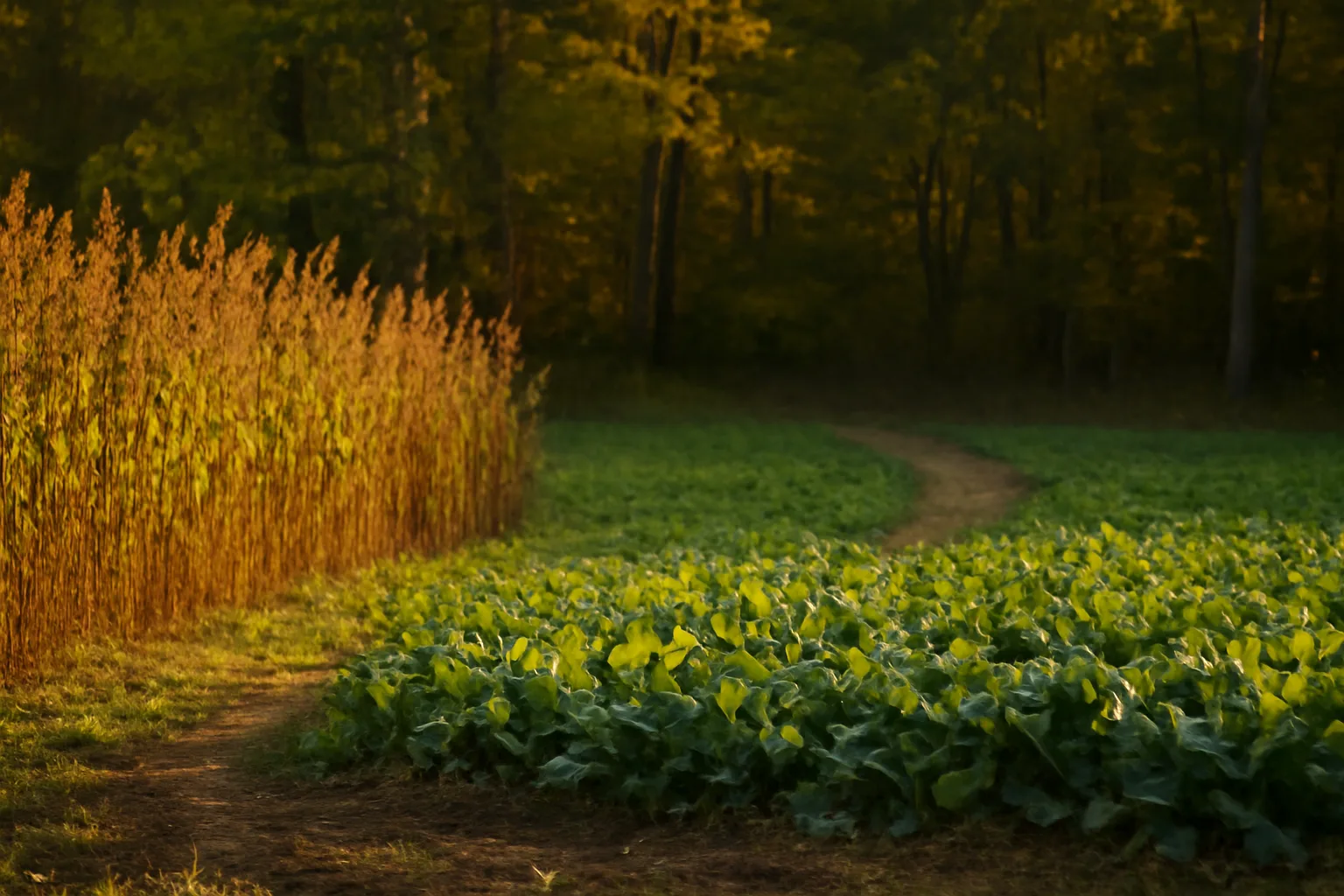
The illusion food plot system layers a tall screen crop (like sorghum or corn) around or between a brassica plot and a clover base, so deer feel hidden while they feed close to your stand. It's not one seed blend, it's a design idea: use height and cover to make deer comfortable feeding in daylight near a shooting lane.
What is a food plot, and what is the "illusion" system exactly?
A food plot is a planted patch of forage on hunting land, meant to feed deer and other wildlife while giving hunters a predictable place to watch or hunt from. Most state wildlife agencies treat food plots as normal agricultural plantings, separate from baiting rules that restrict piled grain or feed (more on that below), which is part of why plots are legal almost everywhere hunting itself is legal. The "illusion" food plot system isn't a proprietary seed blend or a patented layout. It's a design philosophy that shows up under different names in hunting media and on plot-planning forums: instead of one open field of clover or beans, you plant in strips or blocks, using a tall screening crop (sorghum, corn, sunflowers, or a similar tall annual) to break line of sight around a bedding-adjacent food source, usually a brassica plot or a clover plot underneath or beside it. The logic is simple. Mature bucks especially are reluctant to walk into a wide-open field in daylight if they feel exposed. Break the field into visual pockets with standing cover, and deer will often use the edges and finger-shaped plots in shooting light because they never feel like they're standing in the middle of a stage. This isn't guesswork dressed up as science; it borrows directly from how wildlife biologists talk about edge effect and screening cover in habitat management guides. If you want a plan built around your own field shape and soil test rather than a generic layout, that's exactly the kind of thing a Custom Food Plot Plan is built to sort out for around $99, one time, no subscription.
How do you actually build an illusion-style food plot layout?
Start with the shape of your field or opening, not the seed bag. Most illusion-style plots use three components: a tall screening crop on the field edges or splitting the plot into rooms, a brassica block (turnips, radish, or a rape/kale blend) for late-season tonnage, and a clover base that holds up through spring, summer, and early fall. A common layout is a narrow (30 to 60 foot wide) block of grain sorghum or corn planted along the access trail and downwind edges, with brassicas and clover filling the interior in irregular, kidney-shaped blocks rather than square ones. Straight lines and square plots look unnatural to deer and to you both; curved edges create more usable edge footage per acre, which is where deer actually feed most. Size matters less than most people think. University extension plot guidance generally recommends plots from a quarter acre up to a few acres depending on hunting pressure and deer density, with smaller plots (under an acre) working better in tighter cover where the goal is a stand site, not a farming operation [1]. The illusion system tends to favor the smaller end, because the whole point is intimacy, not volume. Don't skimp on the screen crop's job. It needs real height, 6 to 10 feet for sorghum or corn at maturity, to actually block a deer's view into the interior plot. A screen that tops out at 3 feet does nothing. If you're deciding between this layered approach and a simpler single-species plot, it helps to compare tradeoffs side by side; see our food plot whitetail overview for how single-crop and multi-crop strategies stack up.
Do deer eat sorghum?
Yes, deer eat sorghum, both the standing grain heads and the leaves, though it's used more as cover and a late-season energy source than a primary forage crop. Grain sorghum (milo) produces seed heads that deer, along with turkey and other wildlife, will feed on into fall and winter once the plant dries down [2]. In the illusion system, sorghum's main job is screening height, not nutrition, though the grain heads are a real bonus once they mature. Deer will browse young sorghum shoots some in summer, but the crop's real value here is a 6 to 10 foot wall that blocks sightlines into the plot's interior and gives deer confidence to move in daylight. One practical note: sorghum is a warm-season annual, so it goes in after your last frost date, generally the same general window as corn, and it takes 90 to 120 days to reach full height and grain maturity depending on variety and region [3]. Plant it too late in northern zones and it may not finish before your local first frost.
Do deer like clover, and do they actually eat it?
Yes, deer like clover and it's one of the most consistently used food plot forages across the whitetail's range. White clover and red clover are both perennial legumes that regrow after grazing, tolerate mowing, and provide protein levels commonly cited in the 25 to 30 percent range in vegetative growth, according to extension forage testing. Clover works as the "base" layer in an illusion-style plot because it's there in spring, summer, and fall, giving deer a reason to use the plot outside of the fall hunting season, which builds a pattern of daily use before you ever hang a stand. It also holds up to some browsing pressure that would wipe out a thinner annual. The tradeoff: clover needs decent soil pH (most extension guides recommend 6.0 to 6.5 for clover establishment) and it's slower to get going than brassicas or cereal grains [4]. A soil test is the only honest way to know if your dirt needs lime before clover will actually thrive; your soil test lab's recommendation on lime and fertilizer rates should be treated as the final word for your specific field, not a general guide like this one. For species comparisons and blend options, see deer food plot seed and food plot seed.
When to plant food plots for deer (by season and zone)
| 3-4 (Northern MN, ND, WI, ME) | Late May to mid-June | Early to mid-August | |
|---|---|---|---|
| 5-6 (Upper Midwest, Northeast, Mid-Atlantic) | Early May to early June | Mid-August to early September | |
| 7-8 (Mid-South, transition zone) | Mid-April to mid-May | Early to late September | |
| 9 (Deep South, Gulf states) | March to April | Late September to October | USDA's Plant Hardiness Zone Map is the standard reference for these bands. Your best move is still to pull your county's average first and last frost dates directly, since zone bands are about winter minimum temps, not frost timing specifically. |
Timing splits into two windows almost everywhere in whitetail range: spring/summer planting for warm-season annuals and perennials, and late summer/early fall planting for cool-season annuals like brassicas and cereal grains. Spring plots (clover, chicory, soybeans, sorghum, corn) generally go in after your last expected frost date, which varies enormously by latitude, from mid-April in the Deep South to early-to-mid June in the northern tier and Canada-adjacent states. Check your local frost dates through your state's cooperative extension frost date tools rather than a national rule of thumb, since a two-week miss either direction can cost you a stand. Fall plots (brassicas, oats, wheat, rye, clover overseeds) are planted roughly 6 to 10 weeks before your area's average first fall frost, which is the standard rule cited by most extension brassica-planting guidance because it gives the plants enough growing season to bulk up roots and leaves before a hard freeze sweetens them [1]. That means early-to-mid August in the Upper Midwest and Northeast, and into September in parts of the Mid-South. Here's a simplified planting window table based on general USDA plant hardiness zone bands; treat it as a starting point, not gospel, since local microclimates and elevation shift things: | Zone (USDA hardiness) | Spring plot window | Fall plot window |
When to plant oats for deer
Oats are a fall cool-season annual for deer plots in most of the country, planted 6 to 8 weeks before your average first frost date, which lets them establish leafy growth before cold slows them down. In much of the Midwest and Northeast that lands in mid-August through early September; in the Mid-South and southern Appalachians, September into early October works. Oats are attractive to deer specifically while young and tender, and again after a frost converts starches to sugars, which is the same reason brassicas get sweeter late in the season. Oats will winterkill in most zones colder than about zone 6, so in the northern tier they function as a fall-only annual rather than something that carries into spring; in warmer zones (7 and south) oats can persist longer into winter. A common mix pairs oats with a brassica or with winter wheat or cereal rye for a longer window of attraction, since oats peak early and cereal rye holds green growth latest into winter of the small grains.
When to plant turnips for deer
Turnips are planted in late summer, generally 60 to 90 days before your first expected fall frost, since they need that runway to bulb out and build leaf mass before deer start hitting them hard after a freeze. That puts most of the Midwest and Northeast in a late July to mid-August window, and the Mid-South and transition zone in August into early September. Deer often ignore turnip bulbs and even the leaves early in the season, then hit the plot hard after the first hard frost converts starches into sugars, a pattern extension forage specialists and plot researchers both point to as the reason brassica plots seem to "turn on" in late fall. This is exactly why turnips fit the illusion system's brassica layer so well: they're a late-season magnet that peaks right when most hunting pressure and rut activity are also peaking. Soil pH matters here too. Brassicas tolerate a wider pH range than clover, generally doing fine down to about 5.5, but a soil test is still the right way to confirm you're not wasting seed on ground that needs lime first [5].
Do deer like clover more than other forages, and what's actually a deer's favorite food?
There's no single "favorite food" for deer in any scientific sense; food preference shifts by season, region, and what's locally available, and deer are opportunistic browsers that adjust to whatever gives the best nutrition-to-effort tradeoff at that moment. That said, forage quality research consistently ranks a handful of foods high across most of the whitetail's range: acorns (especially white oak group) for fall fat deposition, soybeans and clover for season-long protein, and brassicas for late-season carbohydrates and sugars [1]. Clover ranks near the top of most extension forage-preference lists because it combines high protein, long-season availability, and tolerance of repeated grazing, something an annual can't do. But acorns often win out over any planted forage in years with a good mast crop, because deer instinctively prioritize fat and energy storage for winter over pure protein once fall arrives. The honest answer: "favorite" depends on the month. In spring and summer it's often new clover growth and soybean leaves. In early fall it's often acorns if there's a mast crop. In late fall and winter it's often brassicas and standing grain like corn or sorghum. An illusion-style plot tries to have something in each of those windows rather than betting everything on one crop.
Do deer like honey, and does that matter for food plots?
There's no real evidence deer specifically seek out honey, and it's not a forage or attractant used in any legitimate food plot or wildlife feeding program. Deer are herbivores built to digest plant fiber through a four-chambered rumen; honey (a concentrated sugar produced by bees from flower nectar) isn't part of their natural diet or foraging behavior in any documented way. This question sometimes comes up because commercial mineral licks and some "attractant" sprays include sweeteners or molasses-based ingredients, which deer will investigate because of sugar and salt content, not because deer specifically evolved to want them. Molasses-treated feed and mineral products are a different category from a planted food plot, and their legality varies a lot by state; some states treat any placed feed, mineral, or scent attractant as baiting under law, others don't. Check your state wildlife agency's baiting and feeding regulations before using any placed product, since violations can carry real penalties . Bottom line: skip the gimmick products and put your money into soil amendments and seed. A plot that's actually growing something deer are built to eat beats any bottle on a shelf.
How does the illusion system compare to a standard single-crop food plot?
| Setup complexity | Low | Moderate to high | |
|---|---|---|---|
| Seed cost per acre | Lower | Higher (2-3 seed types) | |
| Daylight visibility to deer | Full exposure | Broken by screen crop | |
| Nutritional window | One season | Spring through winter, staggered | |
| Best use case | Large ag fields, food-production focus | Small hunting plots, stand-site design | Neither approach is wrong. If your goal is simply feeding deer on a large parcel with low pressure, a single quality crop like deer food plots clover or beans does the job fine. If your goal is a specific stand location where you need deer comfortable moving in shooting light, the layered illusion approach earns its extra complexity. |
A standard single-crop plot (all clover, or all beans, or all brassica) is simpler to plant, cheaper per acre in seed cost, and easier to maintain, but it offers one nutritional window and one visual profile, meaning deer either use it in daylight or they don't, often based entirely on hunting pressure and how exposed the field feels. An illusion-style layered plot costs more in planning time and usually in seed cost too, since you're buying and planting two or three different crop types instead of one. But it's built specifically to solve the daylight-movement problem by giving deer visual cover while they feed, which is the single biggest lever most hunters can pull to see more daylight deer activity on plots that already have deer using them at night. Here's a rough comparison: | Factor | Single-crop plot | Illusion-style layered plot |
What are the real costs and tradeoffs of building an illusion-style plot?
Seed costs scale with how many crop types you're running. A clover-only plot might run $15 to $40 per acre in seed depending on variety and whether it's a blend, while an illusion layout adding sorghum and a brassica blend on top of clover can push combined seed costs to $60 to $120 per acre once you account for all three components, though exact pricing shifts year to year with commodity prices. Lime and fertilizer costs depend entirely on your soil test results, not on which system you plant. A field that needs 2 tons of lime per acre to fix pH costs the same to correct whether you're growing one crop or three; the illusion system doesn't change your soil chemistry needs, it just changes the layout on top of it. Equipment-wise, you need the ability to plant at least two different seed depths (brassicas and clover want a shallow, near-surface planting while sorghum and corn want more depth), which either means a drill with adjustable depth settings or a willingness to broadcast some components and drill others. A basic ATV disc, cultipacker, and broadcast spreader can handle a small illusion plot; you don't need a full-size planter for anything under a couple acres. The time cost is real too. Laying out curved, multi-crop blocks by eye or with stakes takes longer than disking a square field and broadcasting one seed type. Budget an extra hour or two of planning time per plot compared to a single-crop layout, more if you're doing this for the first time on a new piece of ground. For readers who want the layout and seed choices matched to their actual field shape, soil test, and region rather than guessing at it, that's the specific gap a Custom Food Plot Plan from PlotSeason is built to close, a one-time $99 plan rather than a subscription or app.
What mistakes do people make building illusion-style plots?
The most common mistake is planting the screen crop too thin or too short to actually block sightlines. If a bowhunter standing at the plot edge can still see clearly into the interior, the deer walking that interior can see out just as easily, and the whole point of the system falls apart. Second mistake: square or rectangular plot shapes. Straight edges look unnatural and don't maximize edge footage, which is where deer feed most. Kidney shapes, comma shapes, and irregular blocks use the same acreage more effectively and look and feel more natural to a browsing animal. Third mistake: ignoring soil test results because the plan called for three crop types instead of one. Brassicas, clover, and grain sorghum all have different pH and fertility preferences; a soil test that shows 5.4 pH across the field isn't going to support a thriving clover base no matter how good your screen crop looks, and lime takes months to fully react in soil, so timing that application early matters more than any layout decision. Fourth: planting the fall components (brassicas, oats) too early or too late relative to the local first frost. Too early and they bolt or mature before deer season; too late and they don't bulb out or build enough leaf mass before a hard freeze. Extension frost-date tools for your specific county solve this better than any generic calendar.
Frequently asked questions
Do deer eat sorghum?
Yes. Deer eat both the leaves and mature grain heads of sorghum, though in food plot systems it's often planted more for its height as a visual screen than as a primary forage. Deer typically hit the grain heads hardest in late fall and winter once the plant dries down.
Do deer eat clover?
Yes, clover is one of the most reliably eaten food plot forages across whitetail range. White and red clover regrow after grazing and offer protein commonly cited around 25 to 30 percent in vegetative growth, per extension forage data, making it a strong season-long base crop.
When should I plant food plots for deer?
It depends on the crop type. Warm-season crops (clover, beans, sorghum, corn) go in after your last spring frost. Cool-season crops (brassicas, oats, wheat, rye) go in 6 to 10 weeks before your first fall frost. Check your county's frost dates through your state's cooperative extension office.
Do deer like clover better than other food plot crops?
There's no universal favorite; preference shifts by season. Clover ranks consistently high in extension forage-preference studies because of its protein content and season-long availability, but deer often prefer acorns in fall mast years and brassicas after a hard frost sweetens them in late season.
When should I plant oats for deer?
Plant oats 6 to 8 weeks before your area's average first fall frost. In the Upper Midwest and Northeast that's roughly mid-August to early September; in the Mid-South it can run into late September or early October. Oats typically winterkill in colder zones.
When should I plant turnips for deer?
Plant turnips 60 to 90 days before your expected first fall frost so they have time to bulb out and build leaf mass. That's late July to mid-August in much of the Midwest and Northeast, and August into early September in warmer transition zones.
What is a food plot exactly?
A food plot is a planted area, usually a fraction of an acre up to a few acres, seeded with forage crops like clover, brassicas, or grains to feed deer and other wildlife while giving hunters a predictable place to observe or hunt from. Most states treat plots as normal agriculture, separate from baiting rules.
What are deer's favorite foods overall?
There isn't one universal favorite; it changes by season. Acorns (especially white oak) dominate in fall mast years, clover and soybeans are staples spring through fall, and brassicas peak in late season after frost converts starches to sugars. Availability and local habitat drive most of the variation.
Do deer like honey?
There's no real evidence deer seek out honey specifically. Deer are herbivores adapted to digest fibrous plants, not concentrated sugars like honey, and it isn't used in any legitimate food plot program. Some mineral or attractant products include sweeteners deer investigate for sugar or salt content, not honey itself.
What exactly is the illusion food plot system?
It's a layout strategy, not a seed product: a tall screening crop (sorghum, corn, or similar) surrounds or splits a brassica and clover plot into irregular blocks, breaking sightlines so deer feel comfortable feeding in daylight. It borrows from wildlife habitat concepts around edge cover and visual screening.
Do I need a soil test before planting an illusion-style plot?
Yes. Clover, brassicas, and sorghum all have different pH and fertility needs, and a soil test is the only reliable way to know your lime and fertilizer requirements. Your soil test lab's specific recommendation should guide amendments; general planting guides can't account for your exact field chemistry.
Is baiting deer with feed the same as planting a food plot?
No, and states regulate them very differently. Food plots are planted, growing crops and are generally legal wherever hunting is legal. Placed feed, minerals, or piles are often classified as baiting and restricted or banned in many states. Check your state wildlife agency's specific baiting regulations before placing anything unplanted.
How big should an illusion-style food plot be?
Smaller plots, often under an acre, tend to work better for this system because the goal is an intimate stand-site setup, not bulk forage production. Extension guidance generally supports plot sizes from a quarter acre up to a few acres depending on deer density and hunting pressure.
Sources
- USDA NRCS Plant Guide, Sorghum bicolor: Grain sorghum produces seed heads used by deer and wildlife as a food source
- University of Georgia Extension, Grain Sorghum Production Guide: Grain sorghum typically requires 90 to 120 days from planting to grain maturity depending on variety
- University of Kentucky Cooperative Extension, Establishing Food Plots for Deer: Clover establishment generally requires soil pH in the 6.0 to 6.5 range
- University of Tennessee Extension, Wildlife Food Plots: Brassicas tolerate soil pH down to roughly 5.5, wider than clover's requirements
- Example state wildlife agency baiting regulation reference (verify local law): States vary widely on whether placed feed, minerals, or scent products are classified as illegal baiting