Last updated 2026-07-25
TL;DR
A hunting food plot is a planted field or clearing designed to feed and hold deer near a stand site. Success depends on soil pH, planting date, and species choice: clover and oats go in spring to late summer, brassicas like turnips need 60-90 frost-free days before a hard freeze. Test your soil first; it drives every other decision.
What is a food plot, exactly?
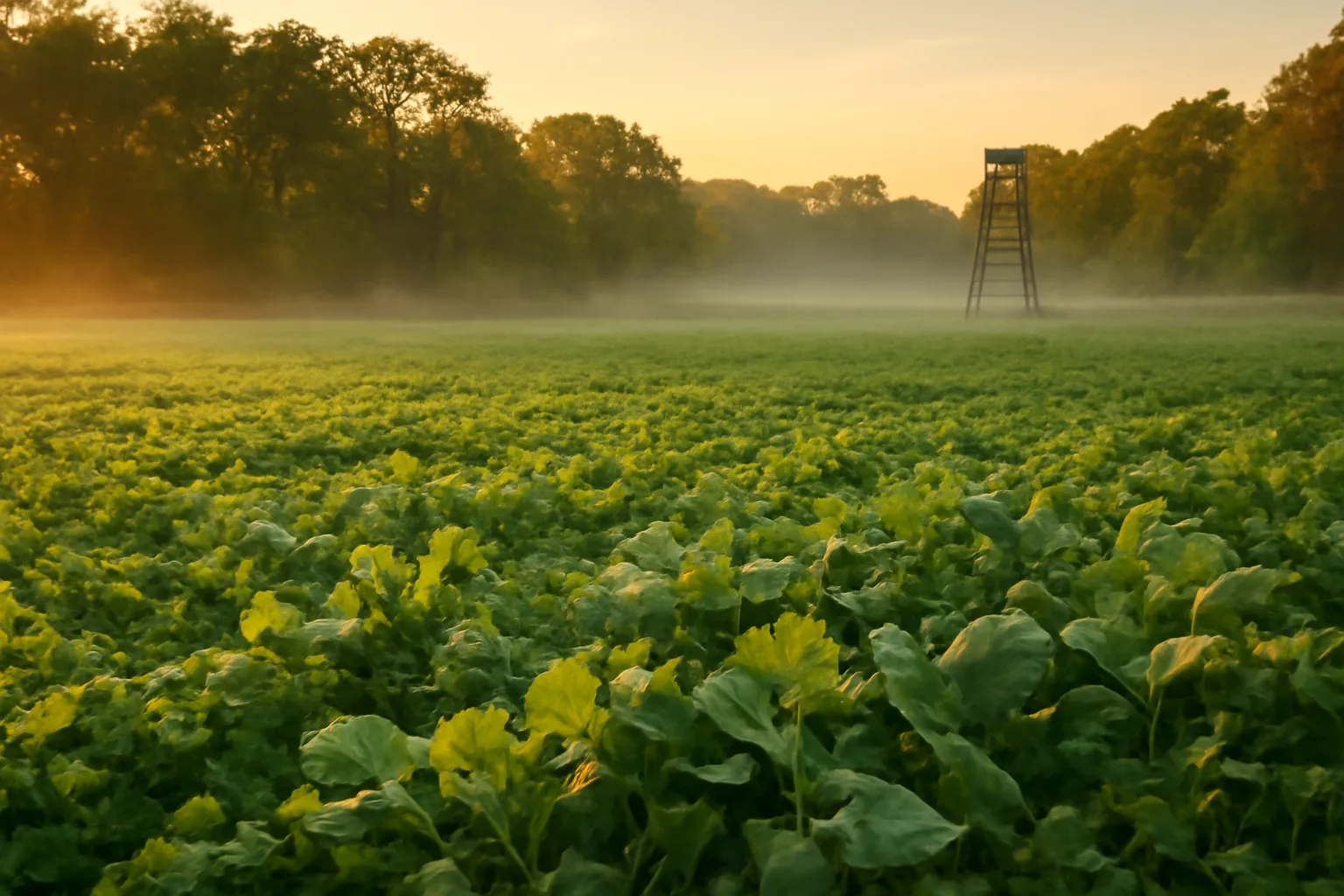
A food plot is a planted patch of ground, usually somewhere between a quarter acre and a few acres, put in specifically to feed deer (or turkey, or both) and give a hunter a reason to build a stand nearby. That's the whole concept. It's not a garden, it's not a farm field, and it doesn't need to look pretty. It needs to grow something deer want to eat, at the time of year you want them eating it. Most plots fall into two rough categories. Annual plots get replanted every year, things like oats, brassicas, soybeans, or corn. Perennial plots, mostly clover and chicory blends, can run three to five years before you need to rip them up and start over. A lot of serious plotters run both: a perennial clover field for spring and summer, plus annual brassica or cereal grain plots timed to peak right as gun season opens. The USDA's National Agroforestry Center and most state wildlife agencies treat food plots as one tool inside a bigger habitat picture, not a replacement for natural browse. The Quality Deer Management Association (now the National Deer Association) has long pushed the same point: plots supplement native forage, they don't substitute for it. If your property has zero native browse and cover, a plot alone won't fix your deer numbers. If you want a plan built around your specific soil test and property, that's a paid service worth considering rather than guessing. Our Custom Food Plot Plan runs $99 one-time and turns your soil test numbers into a species and fertilizer plan, but everything in this article works fine if you'd rather build the plan yourself.
When to plant food plots for deer (by region and season)
| 3-4 | Northern MN, ND, WI | Late May-early June | Late July-mid August | |
|---|---|---|---|---|
| 5-6 | Southern WI, IA, PA, KY | Mid-April-May | Mid-August-early September | |
| 7-8 | TN, AR, NC, GA | March-April | September-early October | |
| 9 | South GA, FL, southern LA | February-March | October-November | These are starting points, not gospel. Your local extension office (search '[your state] cooperative extension food plot planting dates') has county-level frost data that beats any national chart. Penn State Extension, for instance, publishes specific fall brassica planting windows for Pennsylvania that run tighter than a national zone map would suggest. If you're mixing species like a clover/chicory perennial blend with wheat, you're aiming for one main planting event, usually late summer into early fall for that combination, so the wheat gives fast fall cover while the clover establishes underneath for the following spring. |
There's no single planting date. It depends on your USDA Plant Hardiness Zone, your first and last frost dates, and what you're planting. Cool-season plots (clover, oats, wheat, brassicas) go in during a spring window or a late-summer window. Warm-season plots (soybeans, corn, sorghum) go in after your last spring frost. The general rule extension agronomists use: count backward from your average first fall frost date. Brassicas need roughly 80 to 100 days from planting to maturity depending on variety, though they're browsable well before full maturity [1]. Cereal grains like oats need less, often 45 to 60 days to become attractive forage, though they mature faster in cooler weather. Here's a rough framework by USDA zone: | Zone | Example states | Spring planting window | Late-summer/fall window |
When to plant oats for deer
Oats go in either in early spring (as soon as soil can be worked) or in late summer for a fall food source, and the fall planting is what most deer hunters actually want. Oats are a cool-season annual cereal grain. They germinate fast, tolerate light frost, and deer hit them hard in September and October when the leaves are still tender. For a fall plot timed to hunting season, aim to plant 6 to 10 weeks before your first hard frost. In the Midwest and mid-South that's usually late August through mid-September. Oats planted too early in hot, dry August soil can struggle; planted too late, they won't put on enough leaf mass before frost kills them back. One quirk: oats will keep growing and stay palatable right up until temperatures drop into the low 20s Fahrenheit for an extended stretch, at which point the plant dies back and quits regrowing. That's different from wheat or rye, which survive winter and regrow in spring. If you want a plot that produces again in spring without replanting, blend oats with winter wheat or cereal rye rather than planting oats alone. Soil pH matters here as much as timing. Oats tolerate a wider pH range than clover, generally growing fine down to about 5.5, but they still respond to lime and nitrogen. A soil test from your county extension lab (often $10-20) tells you exactly how much lime and N to add rather than guessing.
When to plant turnips for deer
Turnips go in during late summer, roughly 80 to 100 days before your first hard frost, because the whole point of a turnip plot is timing the bulb's sugar conversion to line up with hunting season. Turnips (and other brassicas like radishes and rape) are cool-season annuals that deer often ignore in September, then hammer in November and December. That delay isn't deer being picky for no reason. Frost triggers the plant to convert starches to sugars as a natural antifreeze response, which makes the leaves and bulbs sweeter and more palatable right as temperatures drop. This is well documented in brassica forage research from land-grant universities studying forage quality for livestock, and it applies the same way to deer forage plots [2]. Practical planting math: if your first hard frost usually hits around October 25, count back 80-100 days and you land in late July to early August. Plant much later than that and the plants won't have enough leaf mass or root development before growth slows. Plant much earlier and you risk the plot bolting or getting hammered by deer too early, before the sugar conversion that makes late-season hunting over turnips worthwhile. Turnips need a fairly fine, firm seedbed since the seed is tiny, and they're heavy nitrogen feeders. Extension guidance commonly recommends 40-60 lbs of actual nitrogen per acre for brassica plots, but again, your soil test is the real authority on your specific field, not a blanket number from an article.
Do deer eat clover, and do they actually like it?
Yes, deer eat clover readily, and it's one of the most reliable food plot species across the entire whitetail range. Clover is a perennial legume, meaning it comes back year after year without replanting, and it produces high-protein forage (often 25-30% crude protein in good stands) through spring, summer, and into fall. White clover (including Ladino types) and red clover are the two most common food plot species. Ladino white clover tends to handle grazing pressure better and stays lower to the ground; red clover grows taller and can take more drought but doesn't always persist as long in heavy-traffic plots. Most food plot seed blends mix the two, sometimes with chicory added for drought tolerance and mineral content. Clover's real strength is the growing season. While a brassica plot is a one-shot fall event, a well-maintained clover field feeds deer from spring green-up through summer stress (a genuinely important nutritional window for antler growth and lactating does) and into fall. University research on deer nutrition consistently ranks clover among top forage choices, and the National Deer Association's habitat guidance treats clover as a foundational perennial plot species for exactly that reason. The catch: clover needs a soil pH of 6.0-7.0 to really perform, and it's the species most punished by skipping lime. Extension soil test recommendations for clover establishment routinely call for pH correction before planting, not after. If your soil test comes back at 5.2, plant oats or brassicas this year and lime heavy for a clover planting next season, rather than fighting an uphill battle in acidic dirt. For species comparisons and blend options, deer food plot seed and food plot seed go deeper into specific product lines and mixes.
Do deer eat sorghum?
Yes, deer eat sorghum, both the grain heads and the young leaves, though it's used more often as a screening and cover crop than a primary attractant plot in most whitetail programs. Grain sorghum (milo) produces a seed head deer and turkey both feed on once it matures and dries down in fall. Where sorghum earns its keep is height and cover. A block of sorghum planted thick can grow 5 to 8 feet tall, giving you a visual screen along a property line or a travel corridor into a bedding area, something clover or brassicas can't do. Some plotters plant a sorghum or corn screen strip specifically to block a road or a neighbor's sightline into a plot, then hunt the field it's protecting. As a straight food source, sorghum doesn't draw deer the way soybeans or standing corn does in most research and field observation, but deer will absolutely browse the leaves early and hit the grain heads later in fall and winter, especially once softer food sources thin out. It also tolerates drought and poor soil better than corn, which is part of why it shows up in food plot mixes for sandy or marginal ground. If your goal is pure nutrition and attraction, sorghum is a supporting player, not the headliner. If your goal includes cover, screening, or late-winter standing forage in a tough climate, it's worth a strip.
What are deer's favorite foods, really?
There's no single 'favorite' food deer universally prefer; preference shifts by season, region, and what's locally available, but agricultural crops like soybeans and corn, along with clover, generally top the list where they grow well. Deer are opportunistic browsers, and studies on whitetail diet composition consistently show huge regional and seasonal variation. That said, some patterns hold up across most of the whitetail's range. Soybeans, when deer can get to them in the vegetative stage, get hit hard, sometimes hard enough to wipe out a small plot before it matures. Acorns, when there's a good mast year, will pull deer off a food plot entirely, no plot can compete with a hillside of dropping white oak acorns. Clover ranks consistently high for season-long use. Brassicas and turnips become favorites specifically after a hard frost, for the sugar-conversion reason covered above. Regional forage studies, including long-running work out of state wildlife agencies and university deer research programs, generally agree deer diets shift with whatever's most nutritious and available at that moment, agriculture, mast, forbs, browse, whatever's on the menu locally. That's why a 'best' food plot species question doesn't have one universal answer. It depends on your region, your soil, and what's already growing wild around your plot. For species and strategy breakdowns tied to specific goals, food plot whitetail and deer food plots cover regional species selection in more depth.
Do deer like honey (as in honeysuckle, honey locust, or literal honey)?
Deer don't seek out literal honey, but they browse honeysuckle vines and honey locust pods heavily, and the naming confusion trips up a lot of new hunters searching this topic. There's no meaningful deer forage connection to honey itself; deer aren't drawn to sugar syrup or honeybee products in any documented feeding behavior. Japanese honeysuckle (Lonicera japonica) is browsed year-round by whitetails and is actually considered an invasive species in much of the eastern US precisely because deer browsing pressure doesn't control its spread; it just keeps growing back. Extension and forestry agencies in the Southeast list it as both a deer food source and a management headache for exactly that reason. Honey locust (Gleditsia triacanthos) trees drop long seed pods in fall that deer eat readily, pod and all, and some food plot property owners plant honey locust as a mast tree specifically for that late-season pod drop, similar to how others plant crabapple or persimmon. It's a slower long-term investment (these trees take years to produce), not a plot species you plant and hunt the same season. So if someone told you deer 'like honey,' they were probably talking about one of these two plants, not the jar in your kitchen cabinet.
How much does a food plot actually cost to plant?
A basic half-acre to one-acre food plot, done with rented or borrowed equipment and a straightforward annual seed blend, typically runs somewhere between $150 and $400 depending on lime needs, seed choice, and whether you're renting equipment or already own it. Lime is usually the single biggest line item if your soil test comes back low. Breaking down a rough one-acre budget: soil test ($10-20 through most county extension offices), lime if needed (a ton of ag lime often costs $30-60 delivered locally, and low-pH ground can need 1-2 tons per acre), seed ($30-80 per acre depending on species and whether it's a proprietary blend or generic ag seed), and fertilizer ($40-100 per acre depending on your soil test's phosphorus and potassium recommendations). Equipment rental, if you don't own a disc, drill, or sprayer, adds another $75-150 per day at most rural rental centers. Clover and other perennials cost more up front (better seed, sometimes a herbicide pass for weed control) but spread that cost over three to five years of production, so the annualized cost often ends up cheaper than replanting an annual plot every single year. The honest range is wide because lime need varies so much by region. Southeastern coastal plain soils are often naturally acidic and need real lime tonnage; some Midwestern till soils need very little. Your soil test tells you which situation you're in. Nobody can give you an accurate number without it.
What soil prep actually matters before planting?
Soil pH correction and a firm, weed-free seedbed matter more than any other single factor in food plot success, and both get skipped constantly by first-time plotters who go straight to seed. A soil test is the starting point for everything else. Most state extension services and land-grant universities recommend testing soil at least every 2-3 years for food plots, more often if you're actively correcting a pH problem. The test tells you your pH, plus phosphorus, potassium, and sometimes organic matter percentage. Clover and brassicas want pH in the 6.0-7.0 range; most cereal grains tolerate slightly more acidic soil down to about 5.5-5.8. Lime takes time to work. Broadcasting lime the same week you plant does very little for that season's crop; agricultural lime typically needs several months to fully react with acidic soil and raise pH, which is why extension guidance generally recommends applying lime in fall for a spring planting, or early summer for a fall planting, whenever your schedule allows that lead time. Weed control before planting matters almost as much as fertility. A field disced once and planted into existing weed pressure often gets outcompeted before the food plot seed even germinates. A burndown herbicide application (glyphosate is the common, cheap option on most plots) 2-3 weeks before planting, followed by a light disc or drag, gives new seed a real shot at establishing without fighting established weeds for light and moisture. Our $99 Custom Food Plot Plan takes your specific soil test numbers and turns them into a lime, fertilizer, and species plan for your property, but the concepts above work whether you build that plan yourself or have someone else run the numbers. Either way, your soil test lab is the actual authority on lime and fertilizer rates for your dirt, not a general article.
What equipment do you actually need to plant a food plot?
At minimum you need something to break up the soil, something to spread seed, and something to pack the seed in, though a lot of small plots get planted successfully with a UTV, a pull-behind disc or cultipacker, and a hand-crank broadcast spreader that costs under $50. For plots under an acre, a lot of hunters skip the tractor entirely. A UTV or ATV with a small pull-behind disc harrow ($300-800 used) or a no-till drill attachment handles the ground-breaking. A broadcast spreader, either handheld or towed, gets seed down. A cultipacker or a drag made from chain-link fence and cinder blocks presses seed into contact with soil, which matters a lot for small-seeded species like clover and brassicas that fail if they're planted too deep or left exposed on the surface. Bigger operations (multiple acres, annual rotation between species) start to justify an actual tractor, a real disc, and a cultipacker, often bought used through farm auctions rather than new. That's a few thousand dollars of equipment that pays for itself over years if you're planting several plots a season. Herbicide application needs a sprayer, even a $40 pump sprayer on a UTV hitch works fine for small plots. Complexity of equipment should scale with plot size and how many years you plan to keep planting, not the other way around. A guy with one half-acre plot and a five-year plan doesn't need a drill.
Do I need to check state rules before planting a food plot?
Yes, and this gets missed constantly. Food plots are legal planting activity in every state, but the line between a 'food plot' and 'baiting' gets blurry in a lot of state regulations, and rules on baiting and supplemental feeding vary a lot state to state and sometimes county to county. Most states draw a clear legal distinction: a planted, rooted crop in the ground counts as a food plot and is legal to hunt over. Piling up corn, minerals, or other bait on the ground is a separate, often prohibited, activity in many states, especially where chronic wasting disease (CWD) concerns have pushed agencies toward tighter feeding restrictions. Michigan, for example, has statewide baiting and feeding restrictions tied directly to CWD management, administered through the Michigan DNR [3]. Pennsylvania's Game Commission maintains its own baiting regulations that differ by Wildlife Management Unit in CWD-affected zones [4]. A planted brassica or clover field is not baiting anywhere as far as we're aware, since the plant is rooted and growing rather than placed. But if you're supplementing a plot with a mineral station, a timed feeder, or piled feed to extend the plot's draw, check your state wildlife agency's current regulations before you do it. Rules change year to year, especially in states actively managing CWD zones, and a violation can cost you a hunting privilege for a season or more depending on the state. Your state wildlife agency's website is the only reliable source here, not a hunting forum and not this article. Search your state name plus 'wildlife agency baiting regulations' and read the current year's version directly.
What's the difference between an annual plot and a perennial plot, and which should I plant?
An annual plot gets replanted every year (oats, brassicas, soybeans, corn); a perennial plot (mostly clover, chicory, and alfalfa blends) keeps producing for three to five years off a single planting. Most experienced plotters run both, because they solve different problems. Annuals let you time a plot precisely to hunting season. Plant brassicas in August, they peak in palatability right after the first frost in October or November, exactly when gun season opens across most of the whitetail range. That precision is annual plots' whole advantage. Perennials solve the spring and summer nutrition gap instead. A clover field feeding does through lactation in May and June, and bucks through antler growth in July and August, does more for herd health over a season than any fall annual plot does, even though you're probably not hunting over it much in summer. The tradeoff is perennials need more patience: a full season of establishment before they're really productive, plus periodic mowing and occasional herbicide spot-treatment to keep grass and weeds from taking over. If you can only plant one plot and you're deciding which type, think about what's missing on your property already. If neighbors have ag fields providing summer forage, lean annual and time it to hunting season. If your area is mostly timber with little spring green-up, a perennial clover plot fills a real nutritional gap most of the season, more than during hunting season.
Frequently asked questions
Do deer eat sorghum?
Yes, deer browse sorghum leaves and eat the grain heads once they mature and dry in fall. It's more commonly used as a screening/cover crop (growing 5-8 feet tall) than a primary attractant, since deer generally prefer soybeans, corn, or clover when those options are available nearby.
Do deer eat clover?
Yes, clover is one of the most reliable food plot species across the whitetail range. It's a perennial legume producing 25-30% crude protein forage through spring, summer, and fall. White (Ladino) clover and red clover are the two most common types planted, often blended together with chicory.
When should I plant food plots for deer?
Timing depends on species and your USDA hardiness zone. Cool-season plots like clover, oats, and brassicas go in during spring or late-summer windows (roughly March-May or July-September depending on region). Warm-season plots like soybeans and corn go in after your last spring frost. Check your local extension office for county-specific frost dates.
Do deer like clover?
Yes, clover ranks among the top food plot species deer use consistently across seasons. It provides high-protein forage during spring green-up, summer nutritional stress, and into fall, and it regrows for three to five years without replanting if soil pH stays in the 6.0-7.0 range.
When should I plant oats for deer?
Plant oats 6 to 10 weeks before your first expected hard frost for a fall hunting plot, usually late August through mid-September in most of the whitetail range. Oats die back once temperatures drop into the low 20s Fahrenheit for extended periods and won't regrow in spring, unlike wheat or cereal rye.
When do I plant food plots for deer season specifically?
For a plot timed to gun season, count backward from your expected first hard frost date. Brassicas need 80-100 days to reach peak palatability after that frost hits; oats need only 45-60 days of growth. Most fall hunting plots go in the ground between late July and mid-September depending on latitude.
When should I plant turnips for deer?
Plant turnips 80 to 100 days before your area's first hard frost, typically late July through early August in much of the whitetail range. The delay matters because frost triggers a starch-to-sugar conversion in the leaves and bulbs that makes turnips far more palatable in November and December than they were in September.
What is a food plot?
A food plot is a planted area of ground, usually a quarter acre to a few acres, designed to feed deer and give hunters a predictable spot to build a stand nearby. Plots are either annual (replanted yearly, like oats or brassicas) or perennial (lasting three to five years, like clover).
What is deer's favorite food?
There's no single universal favorite; it shifts by season and region. Soybeans and standing corn get hit hard where available, acorns during a good mast year can pull deer off any plot entirely, and clover stays consistently attractive most of the growing season. Brassicas become favorites specifically after a hard frost.
Do deer like honey?
Deer show no documented preference for literal honey. The confusion usually comes from honeysuckle (which deer browse heavily year-round) or honey locust (whose seed pods deer eat readily in fall). Neither has any real connection to honey itself; it's a naming coincidence, not a feeding behavior.
Is it legal to hunt over a food plot?
Yes, in every state, a planted, rooted crop counts as a food plot and is legal to hunt over. The legal gray area is supplemental feeding or piled bait added to a plot, which many states restrict, especially in CWD management zones. Check your state wildlife agency's current baiting regulations before adding feeders or minerals.
How big should a hunting food plot be?
There's no required size; plots range from a quarter acre 'kill plot' tucked near a bedding area to multi-acre destination fields. Smaller plots (under half an acre) work well close to stands for archery hunting; larger plots serve more as nutrition sources and hold deer through the season regardless of hunting pressure.
Do I need a soil test before planting a food plot?
Yes. A soil test (usually $10-20 through your county extension office) tells you your exact pH and nutrient levels, which determines how much lime and fertilizer you actually need. Skipping this step means guessing, and clover especially fails in acidic soil below pH 6.0 without correction.
Sources
- USDA NRCS, Plant Fact Sheet: Forage Brassicas: Brassica maturity and growth timing for forage use
- University of Kentucky Cooperative Extension, Brassicas for Supplemental Forage: Frost triggers starch-to-sugar conversion in brassica leaves and bulbs, increasing palatability
- Michigan Department of Natural Resources, Baiting and Feeding Regulations: Michigan statewide baiting and feeding restrictions tied to CWD management
- Pennsylvania Game Commission, Baiting Regulations: Pennsylvania baiting regulations differ by Wildlife Management Unit in CWD-affected zones
- National Deer Association, Food Plot Guidance: Food plots supplement rather than replace native forage and habitat
- University of Tennessee Extension, Soil Testing for Wildlife Food Plots: Recommended soil test frequency and pH targets for food plot establishment
- Mississippi State University Extension, Establishing Wildlife Food Plots: Clover pH requirements and nitrogen recommendations for brassica plots