Last updated 2026-07-24
TL;DR
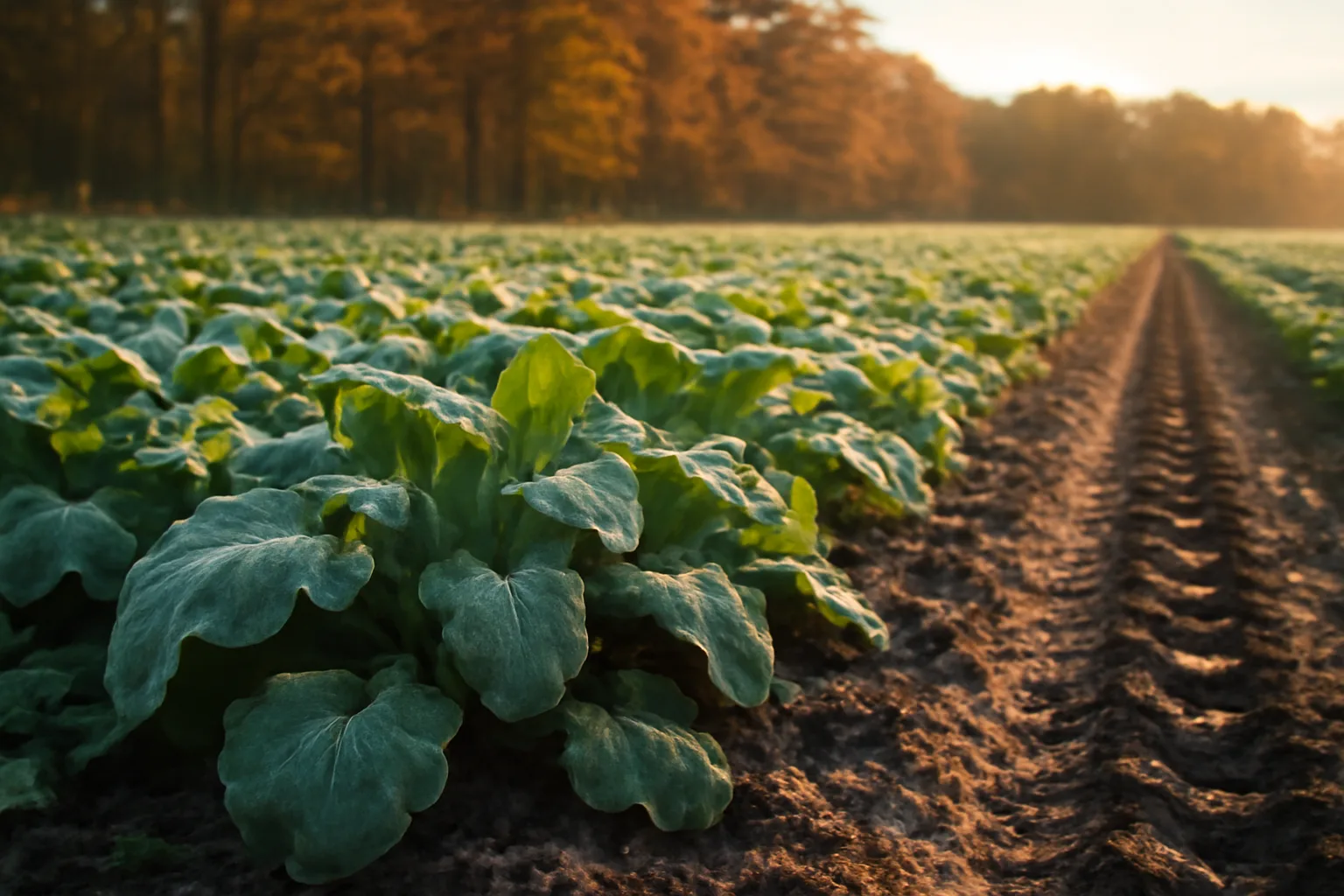
Brassica food plot seed (turnips, radishes, rape, and canola) is planted 60 to 90 days before your first killing frost, usually mid-July through early September depending on zone. Deer often ignore brassicas until a hard frost converts starch to sugar, then hammer the tops and dig for roots. Soil pH of 6.0 to 6.5 and 50 to 90 lbs of nitrogen per acre matter more than the seed bag you pick.
What is a food plot, and where do brassicas fit in?
A food plot is a planted area on hunting land, usually somewhere between a quarter acre and a few acres, grown specifically to feed and attract deer or other wildlife rather than for human harvest. Landowners plant them to supplement natural browse, hold deer on a property through fall and winter, and create a spot to hunt over with a stand or blind. Brassicas are one plant family used in these plots, alongside cereal grains like oats and legumes like clover. The brassica family (Brassicaceae) includes turnips, forage radishes (often sold as tillage radish or Daikon types), rape, canola, and kale. Most commercial deer plot blends labeled as brassica mixes are one or more of these species combined with a cereal grain as a nurse crop. Brassicas earn their spot in a rotation because they do something clover and beans can't: they keep growing and stay palatable well into December and January in many regions, right when natural food is thinning out. That's the whole pitch. For a broader look at how brassicas stack up against other plot types, see food plot whitetail and deer food plots.
When to plant food plots for deer, in general terms?
| 3-4 (northern MN, ND, WI, ME) | early-mid Sept | mid-July to early Aug | |
|---|---|---|---|
| 5-6 (IA, IL, IN, OH, PA, most of NY) | late Sept-mid Oct | late July to mid Aug | |
| 7 (VA, NC, TN, AR) | mid-late Oct | mid Aug to early Sept | |
| 8-9 (deep South, TX Hill Country) | Nov or later | early Sept to early Oct | If you're building a full-season plot calendar, planning both a spring legume plot and a late-summer brassica plot pays off more than trying to make one plot do everything year round. |
Timing splits into two windows: spring/summer plots (clover, chicory, warm-season annuals) and late-summer plots (brassicas, cereal grains) aimed at fall and winter feeding. Brassica-specific planting almost always falls in that second window. The rule of thumb most extension agronomists and seed companies use is to plant brassicas 60 to 90 days before your area's average first killing frost, so the plants have time to bulb up (for turnips and radishes) or build leaf mass (for rape and kale) before growth slows. Penn State Extension notes that brassica forage crops for deer are typically seeded in late July through August in the Northeast to allow adequate growing time before frost. Here's a rough planting window by USDA cold hardiness zone. These are generalized; always cross-check against your local frost date data, since elevation and microclimate shift things by a couple of weeks either direction. | Zone | Typical first frost | Brassica planting window |
When to plant turnips for deer specifically?
Turnips need roughly 80 to 90 days from seeding to full maturity for the bulb to size up properly, so back-time your planting from your first hard frost, more than the first light frost. A light frost barely touches them; it takes a hard freeze (upper 20s or colder) to convert the starches in the bulb and leaves to sugars, which is when deer use jumps. Most seed tag and extension guidance says to plant turnips at 4 to 6 lbs of seed per acre if drilled, or up to 8 lbs per acre if broadcast, since broadcast seeding has lower seed-to-soil contact and more loss. Seeding depth should be shallow, no more than a quarter to half inch; turnip seed is tiny and easily buried too deep with a standard grain drill unless you back off the depth setting or use a seed box attachment. A practical target date: if your first hard frost lands around October 15, aim to have turnips in the ground by July 20 to August 10. Wait too long and you get small, leafy plants with no bulb development, which is a common complaint from first-time brassica growers who plant in September thinking it's still "food plot season."
When to plant oats for deer, and how do they pair with brassicas?
Oats are a cereal grain, not a brassica, but they're planted in the same late-summer window and often blended into brassica mixes as a nurse crop. Oats germinate fast (5 to 10 days) and give quick green cover while slower brassicas establish, plus deer will hit young oats hard in September and October before the brassica bulbs mature. Plant oats 6 to 8 weeks before your first frost date, similar timing to brassicas, at a rate of 60 to 100 lbs per acre if oats are the main crop, or 30 to 50 lbs per acre when blended with turnips or radish. University of Tennessee Extension recommends oats as a strong cool-season cereal option for deer plots because of rapid growth and high palatability in fall [1]. One real limitation: oats winterkill in most of the country once temperatures drop into the low 20s or below for sustained periods, so in zones 3-5 they're a fall-only food source, not a winter one. That's exactly why they're paired with brassicas, which keep producing food after the oats are done.
Do deer like clover, and how does it compare to brassicas?
Yes. Clover is consistently one of the most preferred and most planted food plot forages, and for good reason: it's high in protein (often 25 to 30% crude protein when actively growing), regrows after grazing, and can persist for 3 to 5 years in a properly maintained perennial stand. The difference is timing and growth habit. Clover is a spring-through-fall workhorse, especially valuable during antler growth and lactation in late spring and summer when protein demand is highest. It goes dormant or slows dramatically once hard frosts hit and days shorten. Brassicas do the opposite: they're mediocre food in September but become a magnet after the first hard freezes of late fall, exactly when clover has stalled out. The smart move on a property with more than one plot is running both: a perennial clover plot for spring and summer, and an annual brassica/cereal grain plot for late fall and winter. They're not competitors, they're complementary. For seed selection across both categories, deer food plot seed and food plot seed break down blends by season.
Do deer eat sorghum, and does it belong in a brassica rotation?
Yes, deer eat grain sorghum, both the standing grain heads and the plant itself as browse, though it's used more as a summer/fall standing crop and a cover/screening plant than as a primary attractant like brassicas. Sorghum is drought-tolerant and often planted in warm-season blends for wildlife food plots in the South and Midwest, sometimes alongside cowpeas or soybeans. It's not a brassica and doesn't fill the same late-season role. Sorghum matures in summer to early fall and doesn't have the frost-triggered sugar conversion that makes turnips and radish so attractive in December. Some hunters plant grain sorghum as a standing corn alternative for screening and as a late-season grain source if the heads are left standing, since deer and turkey will work matured sorghum heads through winter in areas where snow cover isn't heavy. If your goal is specifically late-season deer nutrition after a hard freeze, sorghum isn't the tool. Brassicas or a cereal grain like winter wheat do that job better.
What are deer's favorite foods, and where do brassicas rank?
There's no single scientifically ranked "favorite food" list, because deer preference shifts by season, region, and what's available naturally. That said, wildlife research and extension data consistently point to a few patterns worth knowing. Acorns are frequently cited as a top natural preferred food where oaks are present, because of the fat and carbohydrate content, and deer will often bypass planted plots entirely during a heavy acorn drop. Among planted forages, clover, soybeans, and cowpeas rank high in preference during the growing season because of protein content, while brassicas and cereal grains take over as preferred foods after frost converts the sugars. A common on-the-ground pattern with brassicas specifically: deer often ignore a brassica plot in September and early October, leading new planters to think the plot "failed." Then a hard freeze hits, and the same plot gets hammered within days. This isn't a myth, it's a documented response to the frost-driven change in carbohydrate structure in brassica tissue, and it's the single most common brassica question hunters have every fall.
Do deer like honey, or is that a myth about brassica plots?
No, deer don't eat honey, and this isn't something that comes up in any credible food plot or deer nutrition literature. It's likely a confusion with "honey hole" (hunter slang for a great stand location) or with sweet-smelling attractant products, some of which use sugar or molasses-based scents, not honey itself. If you're looking for a real sugar connection to deer feeding behavior, it's the frost-triggered starch-to-sugar conversion in brassica bulbs and leaves discussed above, not any honey product. Deer are herbivores with a rumen adapted to browse, forbs, mast, and grasses; nothing in their natural diet or in tested attractant science points to honey as a preference driver.
What soil pH and fertility do brassicas actually need?
Brassicas grow best in soil with a pH between 6.0 and 6.5, though they'll tolerate a bit more acidity than clover or alfalfa. Below pH 5.5, nutrient availability (especially phosphorus) drops enough that yields suffer even with fertilizer applied. A soil test is the only reliable way to know where your plot stands; guessing on lime rates wastes money and time, since lime can take months to fully react in the soil. On nitrogen: brassicas are heavier nitrogen feeders than clover (which fixes its own nitrogen) and lighter than corn. Most extension guidance lands in the 50 to 100 lbs of actual nitrogen per acre range, often split between a starter application at planting and a top-dress 4 to 6 weeks later to push leaf and bulb growth going into fall. Mississippi State University Extension guidance on brassica forage crops for deer notes fertilization based on soil test results is recommended, with nitrogen typically applied at planting and again as a top-dress application [2]. Phosphorus and potassium needs vary by what your specific soil test shows, since existing soil reserves differ a lot by region and field history. This is exactly why the soil test lab's recommendation should be the final word on your lime and fertilizer rates, not a generic bag-label number. Your test accounts for your actual soil chemistry; a bag label is written for an "average" field that may not be yours.
What seeding rates and depth work best for brassica blends?
| Turnip | 6-8 | 4-6 | 1/4 to 1/2 in | |
|---|---|---|---|---|
| Forage/tillage radish | 8-10 | 5-8 | 1/4 to 1/2 in | |
| Rape/kale | 4-6 | 3-4 | 1/4 to 1/2 in | |
| Oats (nurse crop) | 60-100 | 60-90 | 1 to 1.5 in | |
| Brassica blend (mixed) | 8-12 total | 6-10 total | 1/4 to 1/2 in | Because brassica seed is so small, the biggest planting mistake is burying it too deep. A cultipacker or roller after broadcasting helps press seed into contact with soil without covering it too much. If you're using a drill, back the depth setting off from where you'd run soybeans or corn; brassica seed wants to sit near the surface, not deep in the row. |
Seeding rate depends heavily on whether you're broadcasting or drilling, and whether you're planting a single species or a blend. Here's a general reference table pulled from common extension and seed industry guidance: | Species | Broadcast rate (lbs/acre) | Drilled rate (lbs/acre) | Seeding depth |
How do I plant brassicas without dedicated food plot equipment?
You don't need a tractor and drill to grow a decent brassica plot, though it does limit your acreage and consistency. A common low-equipment approach: mow or spray existing vegetation, broadcast seed with a hand-crank or ATV-mounted spreader, then drag a section of chain-link fence, a piece of carpet, or a homemade drag behind an ATV to work seed into the top quarter inch of soil. A cultipacker (even a small pull-behind unit) genuinely improves germination on broadcast plots because it firms the seedbed and improves seed-to-soil contact, which matters more for tiny brassica seed than for large-seeded crops like corn or beans. If you're going to buy one piece of equipment for a brassica-only rotation, a cultipacker or drag is a better investment than a bigger tractor. Herbicide burndown before planting (glyphosate on existing weeds and grass, applied 1 to 2 weeks ahead) usually beats tilling for brassica establishment, since it leaves organic matter on the surface and reduces erosion, though tilling is still common on smaller hand-tool plots where a sprayer isn't practical.
How do brassicas compare to other fall plot options?
| Forage | Best use window | Frost tolerance | Protein (approx.) | Typical cost per acre* | |
|---|---|---|---|---|---|
| Brassica (turnip/radish blend) | Late fall-winter | Very high, improves after frost | 15-20% | $25-45 seed | |
| Cereal grain (oats/wheat) | Fall, early winter | Moderate (wheat > oats) | 15-20% | $20-35 seed | |
| Clover (perennial) | Spring-fall | Low, dormant after hard freeze | 25-30% | $30-50 seed (multi-year) | |
| Soybeans/cowpeas | Summer-early fall | Low, killed by first frost | 25-30% | $40-70 seed | *Seed cost ranges are rough estimates based on typical retail bag pricing and vary by supplier, blend, and year; always check current pricing before budgeting. The practical takeaway: no single species covers the whole calendar. A rotation using clover or beans in warm months and brassicas or cereal grains from late summer into winter gives deer something useful nearly year round, and gives you multiple stand opportunities across the season instead of one narrow window. |
What's a simple planning approach if I'm not sure what to plant where?
Start with the soil test, not the seed bag. Pull samples from each plot area, send them to your state extension lab or a private ag lab, and let the results tell you your pH and baseline fertility before you buy anything. Then match species to your realistic planting window based on your zone's first frost date, not the calendar date on a seed bag. If you're juggling multiple plots, different soil types, and a planting calendar that has to account for your specific frost dates, region, and equipment, it helps to have it laid out for you rather than piecing it together from six different seed bag labels. That's the gap PlotSeason's $99 one-time Custom Food Plot Plan is built to fill, a plan built around your zone, your soil test numbers, and your equipment, delivered through the plot plan builder. Your soil test lab remains the authority on your actual lime and fertilizer rates; the plan gives you the planting calendar and species strategy around it. Whatever you plant, check your state wildlife agency's rules before setting up near a plot for hunting season. Some states classify certain plot practices or nearby feeding as baiting, and rules vary significantly by state, so confirm with your state agency's current regulations before you hunt over or near a plot.
Frequently asked questions
Do deer eat sorghum?
Yes, deer eat grain sorghum, both as browse on the growing plant and as grain from mature heads. It's more common as a summer/fall standing crop or screening plant than a primary late-season attractant, since it lacks the frost-triggered sugar conversion that makes brassicas so attractive after a hard freeze.
Do deer eat clover?
Yes, clover is one of the most preferred and widely planted food plot forages, valued for its high protein content (often 25-30%) and its ability to regrow after grazing. It's strongest as a spring-through-fall food source and slows down or goes dormant after hard frosts hit.
When should I plant food plots for deer?
It depends on the plot type. Perennial clover and chicory go in during spring (April-May) in most zones. Brassicas and cereal grains for fall/winter feeding go in 60-90 days before your area's first killing frost, typically mid-July through early September depending on your zone.
Do deer like clover more than brassicas?
Preference shifts by season, not a fixed ranking. Deer generally favor clover during the growing season for its higher protein, then shift to brassicas once a hard frost converts bulb and leaf starches to sugars, often making frost-hit brassica plots more attractive than clover in November and December.
When should I plant oats for deer?
Plant oats 6-8 weeks before your area's first frost date, the same general window as brassicas. Oats germinate in 5-10 days and give fast fall cover and forage, but they typically winterkill once sustained temperatures drop into the low 20s, so they're a fall-only food source in colder zones.
When should I plant turnips for deer?
Plant turnips 80-90 days before your first hard frost (more than first light frost), since bulbs need that time to size up. In most of the Midwest and Northeast that means late July to mid-August; in the Deep South, early September into early October works.
What is a food plot?
A food plot is a planted area, usually a quarter acre to a few acres, grown specifically to feed and attract deer or other wildlife rather than for human crop harvest. Common plot types include perennial clover, annual brassicas, cereal grains, and warm-season legume blends like soybeans or cowpeas.
What are deer's favorite foods?
There's no single ranked list, since preference shifts by season and region. Acorns are frequently the top natural preference where oaks are present. Among planted forages, clover, soybeans, and cowpeas rank high during the growing season, while brassicas and cereal grains take over as top choices after fall frosts.
Do deer like honey?
No, honey isn't part of deer diet or preference research. Deer are herbivores adapted to browse, forbs, mast, and planted forages; there's no credible data showing any honey preference. The idea likely comes from confusion with hunter slang like "honey hole" or sugar-based attractant scents.
Why won't deer touch my brassica plot until late fall?
This is normal, not a failed plot. Brassica leaves and bulbs contain glucosinolates and starches that taste better to deer after a hard frost converts starches to sugars. Many plots get little use in September and October, then see heavy pressure within days of the first hard freeze in November or December.
Can I plant brassicas and clover together?
Generally no, not as a long-term mix. Clover is a perennial that needs consistent mowing and light competition; brassicas grow tall and shade out clover fast. Most plot builders keep them as separate plots or rotate a field between a clover phase and an annual brassica/grain phase over a few years.
How much brassica seed do I need per acre?
For a straight turnip or radish planting, plan on 6-8 lbs per acre broadcast or 4-6 lbs per acre drilled. Blended brassica mixes (turnip, radish, rape, sometimes oats) typically run 8-12 lbs per acre total broadcast. Always check the specific product's tag, since blend ratios vary by brand.
Do I need to till before planting brassicas?
Not necessarily. A herbicide burndown (like glyphosate) 1-2 weeks before planting, followed by broadcast seeding and a light drag or cultipacker pass, often works as well as tilling and reduces erosion. Tilling is still common on small plots worked with hand tools where spraying isn't practical.
Sources
- University of Tennessee Extension, Wildlife Food Plots: Oats are recommended as a fall cereal grain for deer plots due to rapid establishment and high palatability
- Mississippi State University Extension, Brassica Forages for White-tailed Deer: Fertilization of brassica food plots should be based on soil test results, with nitrogen applied at planting and again as a top-dress
- USDA NRCS Plant Guide, Forage Turnip: Forage turnip growth and use characteristics for wildlife and livestock plantings
- Purdue University Extension, Food Plots for White-tailed Deer: Soil pH targets and fertility recommendations for common deer food plot forages
- University of Georgia Extension, Wildlife Food Plots: Grain sorghum use as a summer wildlife planting and standing winter grain source