Last updated 2026-07-25
TL;DR
You can't fully keep deer out of a food plot, and often you don't want to. To protect a plot while it establishes, use temporary electric fencing or poly mesh exclosures, plant larger acreage (1+ acre), choose fast-germinating species like oats or brassicas, and time planting so growth outpaces browse pressure. Full deer-proof fencing (7-8 ft woven wire) works but costs $1-3+ per linear foot.
why would you want to keep deer out of a food plot in the first place
This sounds backwards for a hunting property, and honestly it usually is. Most guys planting food plots want deer in the plot, not out of it. But there's a real problem that shows up almost every spring and fall: young plants get grazed down to nothing before they ever establish a root system, and the whole planting fails. A newly seeded plot of clover, brassicas, or beans is basically a salad bar with no defenses. Deer will hammer a 1/4-acre plot hard enough in the first two to three weeks that it never recovers, especially on properties with high deer density and limited other food around. That's the scenario where "keeping deer out" for a short window, just until the plants get some size on them, makes total sense. The other version of this question is about crop damage on ag ground next to deer habitat, which is a different problem with different tools (state agencies often have deer damage permits for that situation, separate from food plot management). This article is about protecting a food plot planting long enough for it to establish, then opening it back up. If you're building out a full plot system on your property, it helps to think about this at the planning stage rather than after you've already lost a planting. The food plot whitetail approach of matching plot size and species to your actual deer density solves a lot of this before it starts.
how do you physically keep deer out of a young food plot
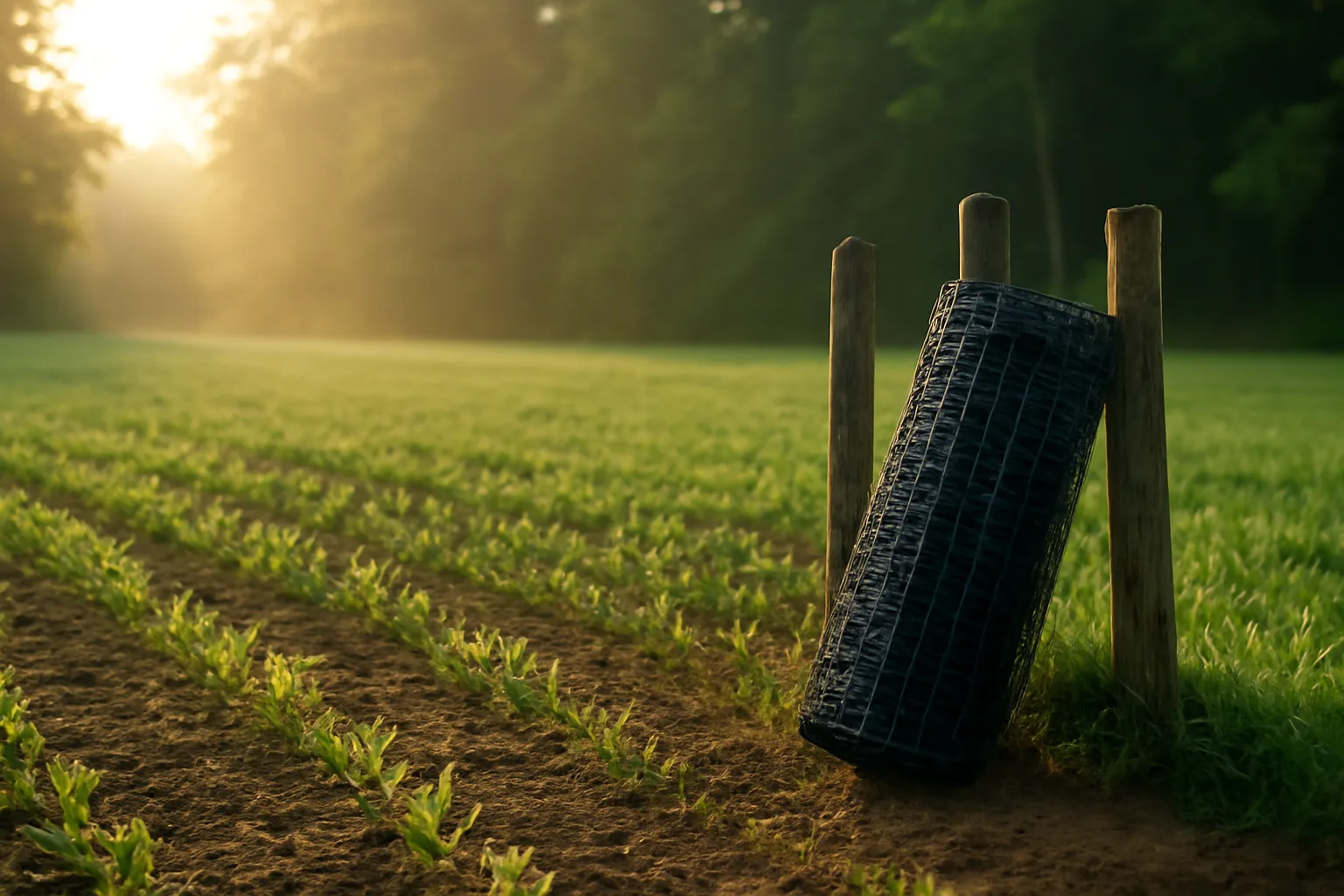
Temporary electric fencing is the most common answer, and it works better than most people expect for the cost. A single or double-strand polytape or poly-wire fence, baited with peanut butter, feed pellets, or an attractant tab, teaches deer that touching the fence hurts. Deer have poor depth perception on flat plane obstacles, so a well-baited electric fence at 30 inches high can keep them out even though they could easily jump it if they tried. Poly mesh exclosure fencing (7 to 7.5 ft plastic mesh, sold in rolls) is the step up from electric tape. It's a physical barrier deer can't push through, and it doesn't need power. Cost runs roughly $0.15 to $0.40 per linear foot for the mesh itself depending on height and mesh weight, plus posts, so a quarter-acre plot exclosure might run $150 to $400 in materials. It's meant to come down once the crop is established, usually 4 to 8 weeks after germination depending on species and growing conditions. Permanent woven wire deer fence (7 to 8 feet tall, the height needed to reliably stop whitetail deer, according to Penn State Extension's wildlife damage guidance) is the real deer-proof option, but it's expensive: budget $1 to $3+ per linear foot for materials alone on a woven wire high-tensile fence, more with professional installation. For most food plotters, that cost only makes sense around a garden, orchard, or a small nursery plot, not a whole field. A cheap trick a lot of plotters use: fishing line or monofilament strung at deer eye level (about 30 inches) around the plot perimeter. Deer can't see it well, walk into it, and spook. It's not bulletproof, but it's nearly free and buys a plot a couple extra weeks during the vulnerable germination window.
what is a food plot and why does establishment timing matter so much
A food plot is a planted area on hunting or wildlife land, usually somewhere between a few tenths of an acre and several acres, seeded with forage or grain specifically to attract and feed deer or other game. Unlike a farm field grown for harvest and sale, a food plot's whole purpose is standing forage that deer eat directly, on the property, ideally within bow or gun range of a stand. The establishment window is the danger zone. Seeds germinate, push up a first set of tender leaves, and that's exactly the stage deer find most attractive and least able to survive being eaten. A mature clover stand can handle heavy grazing indefinitely because it regrows from a crown below cutting height. A clover seedling with two leaves can't. Same story with brassicas and cereal grains: once they get 6 to 8 inches tall with real root reserves, grazing pressure barely slows them down. Before that, it's a coin flip. That's why plot size matters more than almost anything else on high-deer-density ground. University extension guidance on food plots consistently notes that smaller plots (under a half acre) get browsed disproportionately harder per square foot than larger plots, because the same number of deer concentrate their pressure on less area. A one to two acre plot spreads that same herd's browsing pressure thin enough that most of the plot still reaches maturity.
when to plant food plots for deer
Timing splits into two seasons: spring/summer plantings for warm-season forage (soybeans, cowpeas, corn, some clover establishment) and late summer/fall plantings for cool-season forage (brassicas, cereal grains, clover, chicory). Spring plantings generally go in after your last frost date, since warm-season legumes and corn are frost-sensitive. That's late April through May across most of the Midwest and Upper South, and into June in the northern tier. Check your state's average last frost date through your local land-grant extension office; it varies by 4 to 6 weeks across a single state depending on latitude and elevation. Fall plantings are timed backward from your first fall frost, targeting 60 to 90 days of growing season before hard frost for brassicas, and less for cereal grains. In much of the whitetail's range, that puts fall plot planting in the August to early September window. Wait too long and brassicas won't bulb up; plant too early in hot, dry August soil and germination struggles. The honest answer to "when to plant food plots for deer" is: it depends entirely on your zone and the species. There's no single national date. A zone-based planting calendar matched to your county is worth building before you buy seed, not after.
when to plant oats for deer
Oats are a fall-planting cereal grain in almost every whitetail region, planted 45 to 60 days before your average first fall frost so they establish before cold shuts down growth. That typically lands in August in northern states and into September in the mid-South. Oats germinate fast, often within 5 to 7 days in warm, moist soil, and put on visible growth within two weeks, which is one reason they're a go-to for fall plots: they outrun a lot of the early browse pressure just by growing quickly. They also winterkill in most of the northern half of the whitetail range once temperatures drop into the low teens or single digits for sustained periods, so oats are usually planted as an annual, not something you expect to hold into late winter up north. In the South, oats can survive milder winters and provide green forage through much of the season. Either way, oats are commonly mixed with brassicas or clover, since the oats provide quick cover and early tonnage while the slower species catch up.
when to plant turnips for deer
Turnips go in the ground in late summer, generally 80 to 90 days before your first hard frost, because they need that runway to bulb up and reach peak sugar content. Frost actually helps turnips: cold temperatures trigger a starch-to-sugar conversion in the bulb and leaves that makes them noticeably more attractive to deer in November and December than they were in September. That 80 to 90 day window means most of the whitetail range plants turnips sometime between late July and mid-August. Wait past that window in northern states and you risk a small, immature bulb that never gets to the sweet stage before killing frost. Turnip seed is small and needs shallow planting, about 1/4 to 1/2 inch deep, with good seed-to-soil contact. A common mistake is planting too deep or broadcasting into unprepared ground with no seedbed, which cuts germination hard. Turnips are also one of the crops most likely to get hit hard by early browse pressure right at emergence, since the tender young leaves are highly palatable before the plant has any bulb reserve to fall back on, so this is exactly the species where a temporary exclosure or larger plot footprint earns its cost.
do deer eat clover, and do deer like clover
Yes, and clover is one of the most consistently preferred food plot forages across whitetail range. White clover and red clover both show up repeatedly in deer forage preference studies and in state wildlife agency food plot guidance as high-protein, high-palatability choices [1]. Clover's crude protein content commonly runs 25 to 30% in vegetative growth stages, which rivals or beats soybeans and most other plot forages, and it stays available spring through fall once established, unlike annuals that finish their cycle. That's why clover is often the backbone perennial in a multi-plot rotation. The tradeoff: because deer like clover so much, a new clover seeding is extremely vulnerable to overgrazing in its first year. Clover seedlings are slow to establish (often 60 to 90 days to a full stand) and a concentrated deer herd can keep a new clover plot mowed to the dirt indefinitely, never letting it get ahead. This is one of the strongest cases for a temporary exclosure fence around a first-year clover plot: get it through one full growing season ungrazed or lightly grazed, and the established root crowns can handle real pressure in year two and beyond. If you're deciding what to put in the ground, deer food plot seed mixes built around clover blends are usually a safer bet for beginners than a straight monoculture, since a blend spreads out the risk if one component struggles.
do deer eat sorghum
Yes, deer eat sorghum, both the standing grain heads and the leaves, though it's generally considered a secondary or supplemental food plot crop rather than a primary attractant like clover or beans. Grain sorghum (milo) produces a seed head deer and other wildlife will feed on into fall and winter, and it's drought-tolerant, which makes it a useful option in areas with sandy or dry soils where corn struggles. Sorghum also has value as standing cover and a screening crop even where deer use is moderate, and some plotters use it in a mix specifically for that cover function around a more attractive food source. It's not usually the plant deer hit first in a mixed plot; they'll generally work clover, beans, or brassicas harder if those are also available. Extension forage guides list sorghum among wildlife food plot options mainly for its drought tolerance and grain yield rather than top-tier palatability [2].
what are deer's favorite foods
There's no single universal answer because it shifts by season, region, and what's locally available, but a few categories consistently rank at the top across whitetail research and state agency guidance. Acorns (especially white oak family acorns, which are lower in tannins than red oak acorns) are frequently cited as a preferred natural fall food, often pulling deer off planted plots entirely in a heavy mast year. Among planted crops, soybeans (both forage and grain stage), clover, and standing corn consistently rank as top preference in state agency and extension food plot literature. Brassicas (turnips, radishes, rape) rank very high in late fall and winter after frost sweetens them, but lower earlier in the season before that conversion happens. A practical point worth remembering: "favorite" changes with what else is on the landscape. A plot that gets hammered on a low-mast-year property might see much lighter pressure the next fall if the woods are loaded with acorns. That's part of why year-to-year plot performance varies even when you plant the exact same seed the exact same way.
do deer like honey (and does honey attract deer)
There's no credible research or state agency guidance suggesting honey is a meaningful deer attractant or food source, and it's not something you'll find in food plot literature from USDA or land-grant extension programs. Deer aren't drawn to honey the way bears are; their diet is built around browse, forbs, mast, and agricultural forage, not sugars in that form. What probably drives this question is confusion with commercial deer attractant products that use sugar, molasses, or apple/persimmon scent bases, some of which are marketed with names that reference sweetness. Those products are real and deer do respond to sugar and mineral licks in general, but plain honey isn't a documented or recommended food plot additive. Before using any bait, mineral, or scent attractant, check your state wildlife agency's baiting and feeding regulations. Many states restrict or fully prohibit baiting for hunting purposes even though the same substance might be legal to use outside a hunting context, and rules differ by state and sometimes by county or specific season (rifle vs. archery). Your state fish and wildlife agency's hunting regulations page is the authoritative source, not a seed catalog or forum post.
what other methods reduce deer pressure on a young plot without a fence
Fencing isn't the only lever. A few field-tested approaches cut browse pressure without a dollar spent on wire or mesh. Plant bigger. This is the single most effective non-fence tool. Extension guidance and practical plot experience both point the same direction: a one-acre-plus plot spreads herd pressure thin enough that most of it reaches maturity, while a quarter-acre plot in the same deer density gets hit disproportionately hard. Stagger plantings. Put in a decoy plot of something deer like less (or plant it a week or two earlier so it's already established and drawing pressure) next to your prized plot, so the pressure splits. Use fast-germinating species. Oats, winter wheat, and forage soybeans in warm soil all get above-ground growth quickly, shrinking the vulnerable window. Time planting around rainfall and soil temperature rather than a calendar date alone. A seed sitting in dry, cold soil for two extra weeks before germinating is two extra weeks of exposure once it finally pokes through. Repellents (capsaicin or putrescent egg-based sprays) have some research support for reducing browse on ornamentals and can help on small plots, but they need reapplication after rain and aren't practical at plot scale beyond a fraction of an acre. Getting the species mix and plot size right for your specific deer density and soil is exactly the kind of decision a $99 one-time Custom Food Plot Plan from PlotSeason is built to help with (see the plot plan builder); it's general regional guidance based on your inputs, not a site visit, and your soil test lab is still the final word on lime and fertilizer rates for your ground.
Frequently asked questions
Do deer eat sorghum?
Yes. Deer eat both the leaves and grain heads of sorghum, but most extension and agency guidance treats it as a secondary food plot crop, valued for drought tolerance and cover more than top-tier palatability compared to clover, beans, or brassicas.
Do deer eat clover and do deer like clover?
Yes, clover is one of the most preferred food plot forages for whitetail deer, commonly running 25 to 30% crude protein in vegetative growth. That same appeal makes new clover seedings vulnerable to overgrazing before the stand establishes, often in the first 60 to 90 days.
When should I plant food plots for deer?
It depends on species and your zone. Warm-season crops (beans, corn) go in after your last spring frost; cool-season crops (brassicas, cereal grains, clover) go in 45 to 90 days before your first fall frost. Check your land-grant extension's frost date data for your county.
When should I plant oats for deer?
Plant oats 45 to 60 days before your average first fall frost, typically August in northern states and into September farther south. Oats germinate fast (5 to 7 days in warm soil) and are usually killed by hard winter cold, so treat them as a fall annual.
When should I plant turnips for deer?
Plant turnips 80 to 90 days before your first hard frost, generally late July through mid-August across most whitetail range. Frost converts starch to sugar in the bulb and leaves, which is why turnips get more attractive to deer after the first hard freeze.
What is a food plot?
A food plot is a planted area, usually a fraction of an acre to several acres, seeded specifically to feed and attract deer or other wildlife on hunting or managed land. It's distinct from a farm crop grown for harvest and sale.
What are deer's favorite foods?
Acorns, especially white oak family acorns with lower tannin content, rank high as a natural food. Among planted crops, soybeans, clover, and standing corn consistently rank at the top in state agency and extension food plot guidance, with brassicas rising in preference after a hard frost.
Do deer like honey?
No credible evidence or agency guidance supports honey as a deer attractant. Deer's diet is built around browse, mast, and forage, not sugar sources like honey. Some commercial attractants use sugar or molasses bases, which is a different product category entirely.
How do I keep deer from eating a new food plot before it establishes?
Use temporary electric poly-tape fencing baited with an attractant, or a physical poly mesh exclosure, for the first 4 to 8 weeks after planting. Planting a larger plot (1 acre or more) and choosing fast-germinating species like oats also reduces per-plant browse pressure significantly.
How tall does a fence need to be to keep deer out permanently?
Penn State Extension's wildlife damage management guidance identifies 7 to 8 feet as the height typically needed for woven wire fencing to reliably exclude whitetail deer. Shorter fences (30 to 42 inches) work as psychological deterrents when electrified and baited, but deer can jump them if motivated.
Is it legal to bait deer near a food plot?
It depends entirely on your state and sometimes your county or hunting season. Many states restrict or ban baiting for hunting purposes even where feeding wildlife generally is legal. Check your state wildlife agency's current hunting regulations before placing any bait or mineral near a plot you plan to hunt.
What's the cheapest way to protect a small food plot from deer?
Monofilament fishing line strung at about 30 inches around the plot perimeter is nearly free and can buy a couple extra weeks during germination, since deer can't see it well and spook when they walk into it. It's not as reliable as electric fencing or mesh, but it costs almost nothing.
Sources
- Oklahoma State University Extension, "Food Plots for Wildlife": Sorghum is listed among wildlife food plot options valued for drought tolerance and grain production
- USDA NRCS, "Wildlife Habitat Management, Food Plots": Federal guidance on food plot planning as a wildlife habitat management practice
- University of Tennessee Extension, "Establishing Fall Food Plots for Deer": Fall food plot planting windows for brassicas and cereal grains relative to first frost date
- University of Georgia Extension: Clover is a highly preferred forage for white-tailed deer and is commonly used in food plots
- University of Missouri Extension: Oats and other cool-season grains are commonly planted in fall food plots for deer