Last updated 2026-07-25
TL;DR
A woods plot needs 4-6 hours of usable sunlight, acidic-tolerant species, and often a chainsaw before a drill. Clover, oats, and brassicas handle partial shade better than corn or soybeans. Test soil first, thin the canopy if you can, and plant on the same regional calendar as open-field plots, usually late summer for perennials and fall annuals, spring for warm-season plots.
what is a food plot, and why is a woods plot different
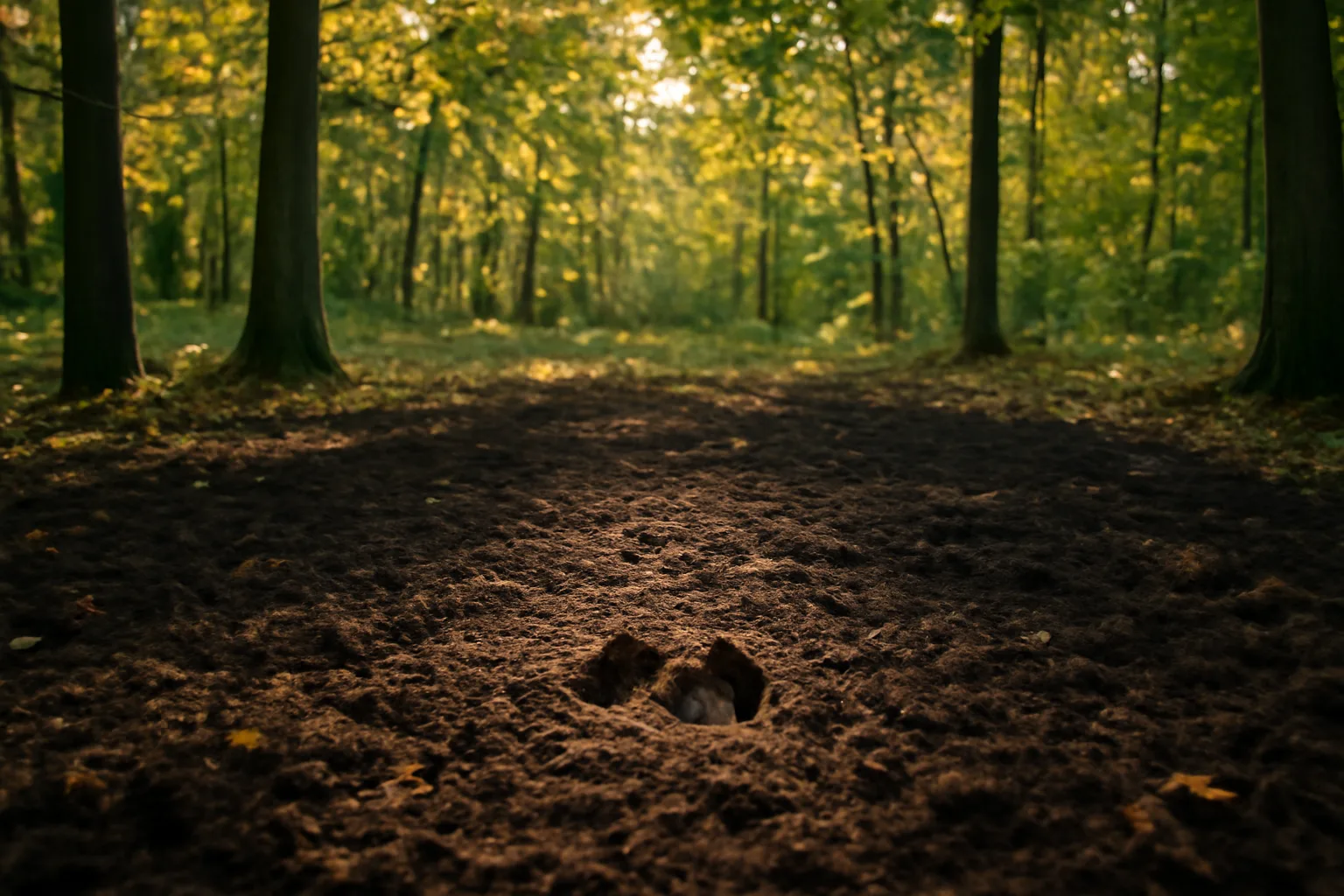
A food plot is a planted patch of forage or grain on deer ground, built to feed and hold deer through part or all of the year. Most food plot advice online assumes you've got an open field, full sun, decent soil, and a tractor. Woods plots break every one of those assumptions. A plot cut into timber usually has acidic soil built up from decades of leaf litter, partial shade for most of the day, root competition from surrounding trees, and no square corners to run equipment through. None of that means you can't grow anything. It means you pick species that tolerate shade and low pH, and you accept smaller plots done with a lot more hand labor or small equipment. The upside is real too. Interior timber plots, sometimes called kill plots, sit deer down close to bedding and out of the wind. They don't need to produce huge tonnage. A quarter-acre clover or brassica plot in the right pocket of woods can outperform a five-acre field plot for actual hunting purposes, because deer feel safe walking to it in daylight. If you want a broader primer on food plot basics before getting into the shade-specific stuff, food plot whitetail covers the fundamentals.
how much sunlight does a woods food plot actually need
Most food plot species need a minimum of 4 to 6 hours of direct or filtered sunlight a day to produce usable forage. Full-sun species like corn, soybeans, and most sorghum varieties want 6+ hours and will sulk or fail in deep shade. Clover, brassicas, oats, and cereal rye tolerate partial shade down to roughly 4 hours and still put on decent growth, though yield drops as light drops. Before you plant anything, walk the site at midday in the growing season and actually watch the light. A gap that looks bright in March, before leaf-out, can go nearly dark by June once the canopy closes. This is the single most common mistake in woods plots: planting based on late-winter light and getting shaded out by summer. If natural light is under 4 hours, your options are limited to almost nothing that produces real tonnage. At that point the honest move is to hinge-cut or fell a few trees around the plot edge to open the canopy, rather than fight physics with seed selection. University extension foresters generally recommend opening the canopy to 50 percent or better crown closure removed over a plot if you want small-grain or brassica-level production in timber.
how do you prep soil for a food plot cut into timber
Start with a soil test, not a guess. Woods soil is almost always more acidic than open-field soil because of decades of oak and pine leaf litter breaking down, and low pH locks up phosphorus and other nutrients no matter how much fertilizer you dump on. A pH under 5.5 is common under mature hardwoods and conifers, and most food plot species want something closer to 6.0 to 7.0 [1]. Your soil test report, from a university or state ag lab, is the actual authority here on how much lime and fertilizer to apply. Rates vary by soil type, current pH, and what you're planting, and no article can replace a site-specific test result. Extension offices in most states run this for $10 to $20 a sample [2]. Once you know your numbers, the physical prep in the woods looks different than a field. You're clearing stumps, raking duff, and dealing with tree roots that will eat a disc blade. A lot of woods-plot growers skip tillage entirely and go with a burn-down herbicide plus a no-till drill or hand broadcast, because dragging a disc harrow through root-choked dirt is miserable and hard on equipment. Lime takes months to fully react in soil, so if your test calls for a big correction, get it down as early as you can, ideally the season before you plant, not the week before.
what should you plant in a shaded woods plot
| White/Ladino clover | 4-5 hrs | Good | Perennial, reseed every 3-5 yrs | |
|---|---|---|---|---|
| Oats | 4-5 hrs | Good | Annual, fast germination | |
| Winter rye/cereal rye | 4 hrs | Good | Most cold and shade tolerant cereal | |
| Brassicas (turnip/radish) | 4-6 hrs | Moderate | Best in slightly more open pockets | |
| Soybeans | 6+ hrs | Poor | Full sun crop, avoid deep timber | |
| Corn | 6+ hrs | Poor | Full sun crop, needs fertility too | |
| Sorghum | 6+ hrs | Poor | Warm-season, wants open ground | For seed blends built around mixed shade and light conditions, deer food plot seed and food plot seed break down specific product options. |
Clover is the standard answer for a reason. White clover (Ladino types especially) tolerates partial shade better than almost anything else in the food plot world, it's a perennial so you're not replanting every year, and deer hit it hard spring through fall. Extension trial work on shade-tolerant forages consistently ranks clover among the better options for reduced-light plantings [3]. Brassicas (turnips, radishes, kale mixes) do reasonably well with 4 to 6 hours of light and add tonnage late in the season when deer key in on them after a frost sweetens the sugars in the leaves and bulbs. Cereal grains, oats and winter rye specifically, are workhorse shade-tolerant annuals too, and both germinate fast and cheap. What doesn't work well in real shade: corn, soybeans, most sorghum and sorghum-sudangrass types, and most warm-season annuals that need full sun to bulk up. These crops can survive dappled light but won't produce anything close to their open-field yield, and in deep shade they'll thin out and get outcompeted by weeds. Here's a rough shade-tolerance comparison for common species: | Species | Minimum sunlight needed | Shade tolerance | Notes |
do deer eat sorghum
Yes, deer do eat sorghum, both the grain and the young leafy growth, and it's used in food plot mixes and as a standing grain crop in a lot of Southern and Midwestern programs. But sorghum is a full-sun, warm-season crop that needs real heat and open ground to make grain heads. It's a poor pick for a shaded woods plot specifically; it'll germinate in partial shade but rarely bulks up into a useful standing crop there. If you've got an open field alongside your timber plots, sorghum (including grain sorghum and sorghum-sudangrass types) works well as a summer annual and as cover that holds up into winter for browse and screening. In the woods interior, though, stick with the shade-tolerant list above.
do deer eat clover, and do deer like clover
Deer eat clover readily, and most whitetail managers consider it one of the highest-value food plot forages available, both for tonnage and for protein content. Clover regrowth after grazing or mowing runs 20 to 30 percent crude protein in good conditions, which is high compared to most native browse [4]. Do deer like clover specifically, as in prefer it over other options? Generally yes, especially in spring and early summer when it's the most digestible green forage on the landscape and does are trying to recover from winter and feed fawns. Clover use tends to drop off some in late summer when it's less palatable and other food sources (mast, ag crops, browse) come into play, then it picks back up in fall. The practical case for clover in a woods plot is that it's a perennial. Get a stand established and, with mowing and a little maintenance, it can produce for 3 to 5 years before needing to be reseeded, which matters a lot when hauling equipment into timber is a pain.
when to plant food plots for deer (by region and species)
| Northern (MN, WI, ME, upper MI) | Late July - mid August | Mid May - early June | |
|---|---|---|---|
| Mid (OH, IN, PA, VA, KS) | Mid August - mid September | Late April - mid May | |
| Southern (AL, GA, TX, FL) | September - October | March - April | Check your local extension office or state wildlife agency's food plot guidance for exact dates, since microclimate, elevation, and first-frost averages shift these windows by a couple weeks even within one state. |
Timing depends on your zone and what you're planting, but the underlying logic is the same everywhere: perennials and cool-season annuals go in when soil temps are falling in late summer to early fall, and warm-season annuals go in after your last frost in spring. General fall planting windows run from late July in far northern states down to October in the Deep South, timed so seed germinates with 45 to 60 days of growth before a hard frost stops things (for brassicas especially, which need that window to bulb up). Spring plantings for warm-season crops go in after soil warms past roughly 50-55°F and frost risk has passed, which is anywhere from April in the South to early June in the North. Here's a rough breakdown: | Region (approx.) | Fall planting window | Spring planting window |
when to plant oats for deer
Oats are almost always planted in late summer to early fall as a cool-season annual, typically 6 to 8 weeks before your area's first expected hard frost. That puts most fall oat plantings somewhere in the August to mid-September window depending on region, matching the fall table above. Oats germinate fast, often within 5 to 10 days in good soil moisture, and put on a lot of green growth quickly, which makes them a good nurse crop mixed with clover or brassicas. Deer tend to hit fresh oats hard right out of the ground, sometimes hard enough to need a bigger plot or a mix to spread the browse pressure out. Spring oat plantings are possible too, mainly as a quick cover crop or early-season attractant, but oats planted in spring will usually head out and die back with summer heat, so they're not a season-long plan the way fall oats can be (oats can survive into early winter and sometimes overwinter in milder Southern zones).
when to plant turnips for deer
Turnips go in as a late-summer to early-fall planting, generally 80 to 90 days before your first expected hard frost, since they need that runway to grow leaf mass and bulb size before deer start hitting them hard post-frost. That timing lands most turnip plantings in the same window as the rest of your fall brassica mix, roughly late July through early September depending on region. The frost matters more for turnips than almost any other food plot crop. A hard frost converts starches in the turnip's leaves and bulb to sugars, which is when deer use noticeably jumps, often described by managers as flipping a switch in early winter. Plant too late and you get small bulbs and thin leaf mass with no time to bulk up before that frost hits. In shaded woods plots, turnips can work in the brighter pockets (4-6 hours) but expect smaller bulbs than a full-sun field planting. If your interior plot is genuinely dark most of the day, oats or cereal rye are a safer bet than brassicas.
what are deer's favorite foods
There's no single universal answer, because deer preference shifts by season, region, and what's available, but research on whitetail diet composition consistently shows a few patterns. Deer are highly selective browsers, not grazers, and they favor whatever is highest in protein and easiest to digest at that moment. In spring and summer, that's usually new clover growth, forbs, and soft mast. In fall, acorns and other hard mast often outcompete planted food plots entirely when they're on the ground, which is well documented in deer diet studies across the whitetail's range [5]. In winter, deer shift to browse, woody stems, and whatever standing crop (brassicas, cereal grains) is left. Among planted food plot species specifically, clover, soybeans, and brassicas post-frost tend to rank as top draws in most managed programs, with corn and standing grain crops pulling deer hard in late winter when the calorie need is highest. For more on species selection across a whole property, deer food plots and deer for food go deeper on picking a mix that covers multiple seasons.
do deer like honey
Not in any meaningful food plot sense. Deer are herbivores and don't seek out honey as a food source the way, say, bears do. Where this question usually comes from is honeysuckle or honey locust, or confusion with mineral/attractant products that sometimes use a honey or molasses-based scent to draw deer to a mineral site. If you're trying to build attraction into a food plot, molasses-based mineral licks and commercial attractant products are legal to use in a lot of states as part of a mineral site, but many states classify placing feed, including some mineral and scent products, as baiting once deer season opens, with restrictions on distance from a stand or blind and whether it's legal at all during hunting season. This varies hard by state; check your state wildlife agency's baiting and feeding regulations before using any attractant, mineral, or feed product near a stand [6].
how do you get equipment or seed into a woods plot
Woods plots rarely fit a tractor and a 7-foot disc. Most guys running interior timber plots use one of a few approaches: hand tools and a backpack sprayer for a small plot (under a quarter acre), a UTV with a small pull-behind disc, cultipacker, or no-till drill for anything bigger, or a walk-behind tiller for medium plots with decent access. The honest tradeoff is labor versus plot size. A half-acre interior plot done entirely by hand (rake, hand seeder, cultipacker roller) is very doable over a weekend or two but it's real work. If you've got any kind of trail wide enough for a UTV, a small pull-type implement changes everything and lets you treat a woods plot almost like a mini field. Herbicide burn-down before planting matters more in the woods than in an open field, because woods plots often carry a heavier seed bank of woody sprouts, briars, and shade-tolerant weeds that will outcompete a slow-germinating clover stand if you don't knock them back first.
putting together a plan for your specific plot
Everything above is general guidance. Your actual pH, your actual canopy cover, your actual frost dates, and your actual equipment access all change the right call for your specific spot in the woods. A soil test from your local extension lab is still the final word on lime and fertilizer rates; no article, including this one, replaces that number. If you want help turning a soil test and a description of your site into an actual species list and planting calendar, that's exactly the kind of thing PlotSeason's $99 one-time Custom Food Plot Plan is built for. You upload your test results and describe the plot (light, size, region, equipment on hand), and get back a specific plan rather than a general one. It's guidance, not a guarantee of deer activity or a promise on harvest, but it takes a lot of the guesswork out of matching species to a real shaded, root-choked patch of timber.
Frequently asked questions
Do deer eat sorghum?
Yes, deer eat both grain sorghum and the leafy growth, and it's used in food plot mixes in Southern and Midwestern programs. It's a full-sun, warm-season crop though, so it performs poorly in shaded woods plots and works much better in open fields with 6+ hours of direct light.
Do deer eat clover?
Deer eat clover heavily and it's one of the highest-protein food plot forages available, running 20-30% crude protein in good regrowth conditions according to extension forage data. It's especially popular with does and fawns in spring and early summer when green forage quality matters most.
When should you plant food plots for deer?
Cool-season perennials and fall annuals (clover, brassicas, cereal grains) go in roughly 60-90 days before your area's first hard frost, generally late July through September depending on region. Warm-season annuals like corn or soybeans go in spring, after soil warms past about 50-55°F and frost risk has passed.
Do deer like clover?
Generally yes. Clover ranks among the top preferred forages in most managed food plot programs, especially in spring and early summer when it's the most digestible green option available. Preference drops some in late summer heat and picks back up again in fall.
When should you plant oats for deer?
Plant oats 6 to 8 weeks before your area's first expected hard frost, which lands in the August to mid-September window for most regions. Oats germinate in 5-10 days and work well as a fast nurse crop mixed with clover or brassica seed.
When should you plant turnips for deer?
Turnips need 80-90 days before your first hard frost to build enough leaf mass and bulb size, so plant in late July through early September depending on your region. Deer use jumps noticeably after the first hard frost sweetens the sugars in the leaves and bulb.
What is a food plot?
A food plot is a planted patch of forage, grain, or browse crop on deer ground, established to provide nutrition and, for hunters, to concentrate deer activity in a specific location. Plots range from small interior kill plots under an acre to large field plantings of several acres or more.
What are deer's favorite foods?
There's no single answer since it shifts by season and region, but acorns and other hard mast often outcompete planted food entirely in fall, clover and soft mast dominate spring/summer preference, and browse plus standing crops matter most in winter. Among plot species, clover, soybeans, and post-frost brassicas rank consistently high.
Do deer like honey?
No, not meaningfully. Deer are herbivores and don't seek out honey the way bears do. This question usually comes from confusion with honeysuckle, honey locust, or molasses-based mineral attractant products, some of which carry baiting restrictions depending on your state's wildlife regulations.
How much sunlight does a food plot in the woods need?
Most food plot species need a minimum of 4-6 hours of usable daily sunlight to produce meaningful forage. Clover, oats, and cereal rye tolerate the lower end of that range; corn, soybeans, and sorghum need 6+ hours and generally fail or produce poorly in real timber shade.
Can you use a tractor in a woods food plot?
Usually not, unless you've cleared a wide enough access trail. Most woods plots are worked with hand tools for small plots, or a UTV pulling a small disc, cultipacker, or no-till drill for medium-sized plots where trail access allows it.
Why is soil in the woods usually more acidic?
Decades of leaf litter and pine needle breakdown under a mature canopy naturally lowers soil pH over time, often down to 5.5 or below under hardwoods or conifers. Since most food plot species want pH closer to 6.0-7.0, lime correction based on a soil test is almost always needed before planting.
Sources
- University of Tennessee Extension, Soil pH and Nutrient Availability: Typical soil pH ranges under mature timber and target pH for forage crops
- University of Missouri Extension, Soil Testing: Typical cost range for a university soil test sample
- Mississippi State University Extension, Shade Tolerance of Food Plot Forages: Comparative shade tolerance ranking of clover versus other common food plot species
- USDA NRCS Plant Guide, White Clover: Crude protein content range of white clover forage
- USDA Forest Service, White-tailed Deer Habitat and Diet: Seasonal shift in whitetail diet toward hard mast in fall
- Pennsylvania Game Commission, Feeding Wildlife Regulations: State-level baiting and feeding restrictions that vary by state and hunting season