Last updated 2026-07-25
TL;DR
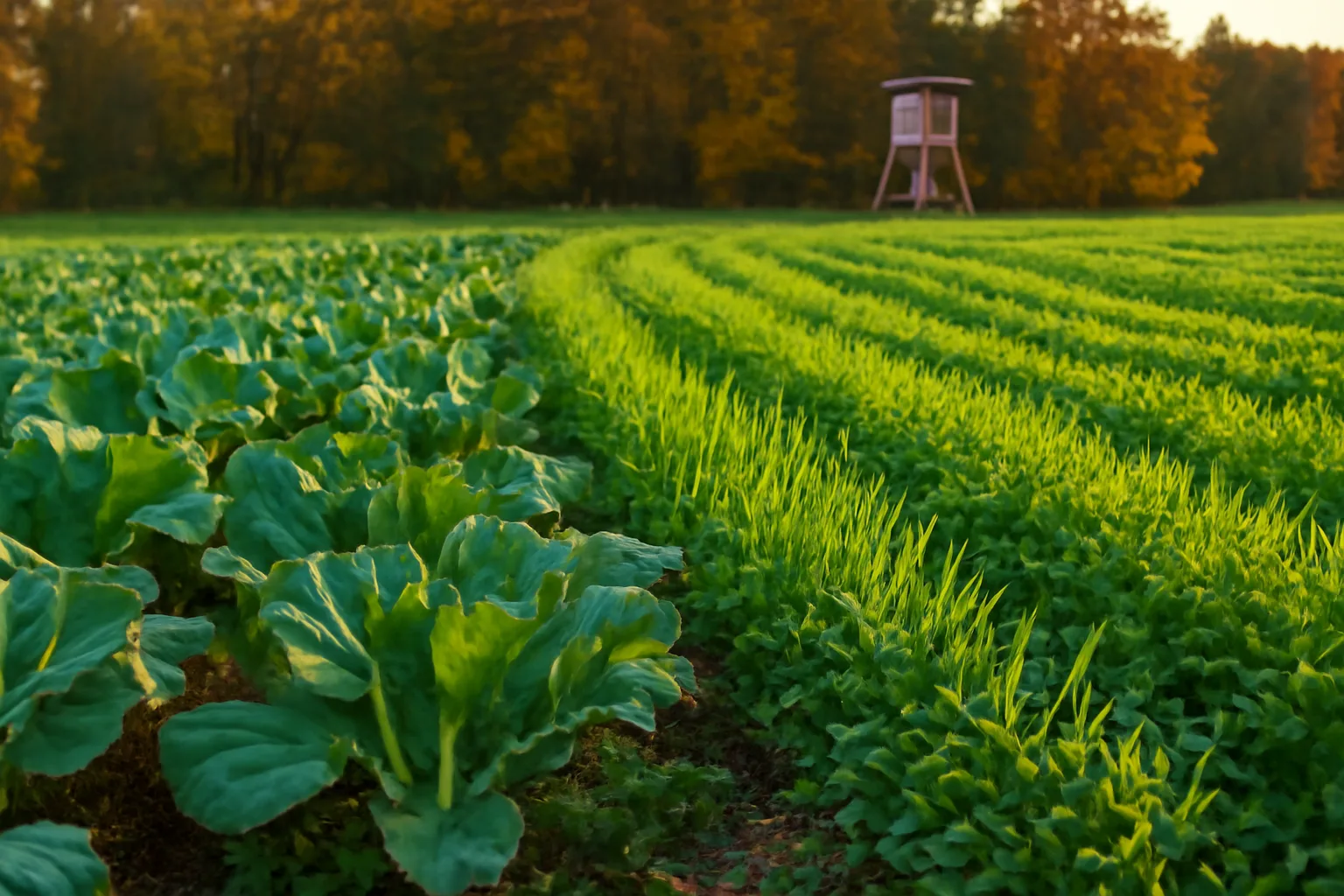
A green cover food plot combines multiple plant types, usually clover, brassicas, cereal grains, and a legume, so something stays green and palatable across seasons. Plant cool-season blends 60-90 days before your first fall frost, or in early spring for perennials. Soil test first; pH and fertility drive results more than seed choice does.
What is a food plot, exactly?
A food plot is a planted area on hunting land, usually somewhere between a quarter acre and a few acres, seeded with forage that deer and other wildlife will eat. It's not a garden and it's not landscaping. The goal is nutrition and attraction, sometimes both, depending on whether you're planting a spring soybean field to grow big-bodied deer through summer or a small fall plot to pull deer past a stand during rifle season. The USDA Natural Resources Conservation Service treats food plots as a wildlife habitat practice. NRCS Conservation Practice Standard 645, Upland Wildlife Habitat Management, describes planted forage and other habitat improvements as tools for increasing food and cover on private land [1]. State wildlife agencies generally echo that framing: a food plot supplements natural browse, it doesn't replace it. A "green cover" food plot specifically refers to a blend planted to stay green and growing across a longer window than any single species could manage alone. Instead of a monoculture of just clover or just brassicas, you plant a mix, often cereal grains like oats or wheat, a brassica like turnips or radish, a legume like clover or peas, sometimes chicory. The idea is redundancy. If drought stunts the clover, the oats might still pull through. If a hard freeze kills the oats, the turnips are just getting sweet. Most commercial "green cover" or perennial/annual combo blends are built this way on purpose. It's less about one magic species and more about layering root depths, growth habits, and cold tolerances so the plot produces usable forage from late summer through winter. If you're deciding between a single-species plot and a blend, our guide on food plot whitetail planning breaks down when each approach makes sense.
When to plant food plots for deer?
| Upper Midwest / New England | Aug 1-25 | May 10-Jun 10 | |
|---|---|---|---|
| Mid-Atlantic / Ohio Valley | Aug 15-Sep 15 | Apr 20-May 20 | |
| Deep South / Gulf Coast | Sep 15-Oct 15 | Mar 15-Apr 15 | |
| Texas / Southern Plains | Sep 1-Oct 1 | Mar 1-Apr 1 | Those numbers are general guidance, not a guarantee your local frost will cooperate. Check your county extension office's frost date data before you commit to a planting day. NOAA's climate normals include average first and last frost dates for stations across the country [4]. |
Timing splits into two windows: spring planting for warm-season and perennial plots, and late summer planting for cool-season annual plots. Get this wrong and you'll be replanting, or worse, staring at bare dirt in November. Spring plots (soybeans, cowpeas, perennial clover, chicory) generally go in after your last frost date, once soil temperatures hit about 50-55°F. For most of the whitetail range that's late April through May, though the Deep South can push into early June and the northern tier sometimes waits until early June too [2]. Perennial clover can also be frost-seeded in very early spring, broadcast onto frozen or thawing ground so freeze-thaw cycles work the seed into the soil. Fall/cool-season plots (oats, wheat, rye, brassicas, clover) are planted in late summer, timed backward from your area's average first frost date. A common rule of thumb from extension agronomists is to plant 60 to 90 days before the first killing frost, giving brassicas time to bulb and cereal grains time to establish tillers before growth slows [3]. In the Upper Midwest and Northeast that often means mid-August. In the Mid-South and Southeast, you can wait until September or even early October. Here's a rough planting window by region, understanding that microclimates and elevation shift these dates: | Region | Fall plot window | Spring plot window |
When to plant oats for deer?
Oats go in the ground in late summer, roughly 60-75 days before your first fall frost, so they've got time to establish before cold slows growth. In much of the whitetail range that lands between mid-August and mid-September. Oats are a cool-season annual grain and one of the most palatable cereal grains you can plant for deer, at least while they're young and leafy. Deer tend to hammer oats hard in the first six to eight weeks after emergence, then interest can taper once the plant matures and gets fibrous, unless a frost sweetens it back up by converting starches to sugars. That frost-sweetening effect is real, and it's why oats often see a second wave of deer use after the first hard freeze. Cold temperatures trigger cool-season grasses and small grains to convert stored starches into simple sugars, which is part of why hunters see renewed activity on oat plots in late fall [5]. Oats winterkill in most of the northern half of the country once temperatures drop into the teens for extended periods. So in colder zones, oats function as a fall-only annual, not a plot that carries through winter. Pairing oats with a brassica or winter-hardy cereal like wheat or rye extends the plot's usable window past the point oats give out.
When to plant turnips for deer?
Turnips go in 80 to 100 days before your area's first hard frost, because they need that time to grow both the leafy top and the bulb before cold weather locks in. Plant too late and you'll get leaves but no bulb development, which cuts the plot's late-season value. For most of the Midwest and Northeast, that means late July through mid-August. In the Southeast, growers can wait until late August or September. Turnips (and other brassicas like radish, rape, and swede) are cold-tolerant enough to survive light frosts and actually improve in palatability afterward, similar to oats. The plant converts starch to sugar as a natural antifreeze response, and deer key in on that sweeter forage once temperatures drop [5]. One quirk of turnips: deer often ignore the leafy tops early in the season and focus on other food sources first, then switch over hard once other browse gets scarce and the plant has sweetened from frost. That means a turnip plot can look untouched in October and get hammered in December and January, which is exactly the point if you're managing a late-season plot. Don't panic if deer aren't in the turnips on opening weekend. Brassicas also need decent fertility to bulb out properly. A soil test is the starting point here, not an afterthought; brassicas are heavy nitrogen users and underfed plots will grow spindly tops with small or no bulbs [3].
Do deer eat sorghum?
Yes, deer will eat sorghum, particularly grain sorghum heads once they mature, but it's rarely anyone's first-choice food plot species. It's more of a screening/structure crop or a supplemental grain than a primary attractant. Deer browse young sorghum shoots some, and they'll feed on the grain heads in fall, but preference studies and practical field experience consistently rank sorghum below soybeans, clover, and brassicas for pure attraction. Sorghum's real value in a food plot program is usually as cover or as a component in a wildlife blend rather than a standalone deer food plot. It's drought-tolerant, it grows tall enough to provide screening between a plot and a road or property line, and turkeys and other wildlife use the grain heavily. Some hunters plant sorghum specifically to break up sightlines and create a staging area adjacent to a more palatable plot. If your goal is pure deer nutrition and attraction, sorghum shouldn't be your main species. If you need a tall screen or want to diversify a wildlife plot for a broader range of species, it's a reasonable add.
Do deer eat clover?
Yes, and it's one of their preferred food plot forages across most of the year. White clover and red clover both rank consistently high in deer preference trials and in forage quality analysis, largely because clover delivers high crude protein. USDA's plant guide for white clover describes it as a highly palatable, high-protein forage widely used in wildlife and livestock systems, with crude protein commonly falling in the 25-30% range on a dry matter basis when the plant is actively growing and well fertilized [6]. Clover's advantage over annuals is longevity. A well-maintained perennial clover plot can produce for three to five years before needing to be reseeded, provided you mow it to prevent weed competition and maintain soil fertility. That makes it a strong base for spring and summer nutrition, when does are lactating and bucks are growing antlers, both periods with elevated protein demand. Clover does have limits. It goes dormant or gets buried under snow in the northern half of the whitetail range during winter, so a pure clover plot loses value exactly when hunters most want food on the ground. That's the practical argument for green cover blends: clover for spring and summer, paired with brassicas or cereal grains for late-season punch. Land-grant extension programs, including University of Missouri Extension, list ladino/white clover among the most reliable and cost-effective food plot species for deer, citing its persistence and protein content as reasons it shows up in nearly every food plot seed catalog [7].
Do deer like clover more than other plants?
Deer show strong preference for clover in most forage trials, but "favorite" depends heavily on season, availability, and what else is growing nearby. In spring and summer, clover often wins head-to-head comparisons against grasses and many broadleaf plants because of its protein content and consistent regrowth after grazing. In fall, preference studies and field observation both suggest deer will often switch to brassicas, soybeans, and acorns over clover if those are available, particularly once clover's growth slows with cooler temperatures. So clover isn't universally the top choice; it's the top choice for a specific window, generally April through September in most of the whitetail range. This seasonal shift in preference is exactly why single-species plots underperform compared to diverse blends across a full year. A plot planted only in clover will draw deer hard in June and get walked past in November if better options exist elsewhere on the property or on a neighbor's land.
What are deer's favorite foods overall?
Ranked broadly by preference and use across the whitetail's range, the food list generally runs: acorns (especially white oak group acorns), soybeans, clover, cowpeas, corn, and brassicas. Local availability and regional habitat shift this order constantly. Acorns in particular are a heavyweight. They're calorie-dense and deer will often abandon planted food plots entirely during a good acorn drop. Agricultural crops like soybeans and corn rank high in preference work partly because deer evolved alongside farmland forage in much of their range, and partly because these crops offer high energy density during critical growth and fat-storage periods. Mississippi State University's Deer Lab program, which studies deer nutrition and food plot forage, has noted that soybeans are among the most preferred and most heavily browsed food plot crops available, sometimes browsed so hard as seedlings that the plot fails before it establishes [8]. No food plot forage beats a natural mast crop in a good acorn year. That's not a reason to skip food plots, it's a reason to think of them as one part of a bigger habitat picture rather than the whole plan. If you want help sorting through deer food plot seed options by region and goal, that's a good next stop.
Do deer like honey (honey-treated or sweetened attractants)?
There's no real evidence deer specifically seek out honey, and it's not a standard food plot or attractant ingredient in any serious wildlife forage research. Some commercial deer attractant sprays and mineral products include sugar, molasses, or other sweeteners because deer, like most mammals, respond to sugar and salt cues, but that's a different claim than "deer like honey" specifically. What does have research support is deer's strong attraction to sugar content generally, which is part of why frost-sweetened brassicas and cereal grains see a late-season use spike, as covered above [5]. If a product markets itself around honey or sweeteners, treat it as a mineral lick or attractant, not a food source, and check your state's baiting and feeding regulations before using it. Baiting rules vary widely: some states allow supplemental feeding and attractants freely, others restrict or ban them outright, especially in areas managing chronic wasting disease. Your state wildlife agency's hunting regulations guide is the source to check, not a product label.
How do you build a green cover blend that actually works?
Start with a soil test, not a seed bag. Pull soil samples 4-6 inches deep from several spots in the plot, mix them, and send them to your state land-grant extension lab or a private ag lab. Most run $10-20 and take one to two weeks to come back. Your results will tell you pH and nutrient levels, specifically phosphorus and potassium, and give lime and fertilizer recommendations calibrated to what you intend to plant. Most food plot species, clover and brassicas especially, want soil pH between 6.0 and 7.0. Below that, lime is non-negotiable; brassicas and legumes both struggle to take up nutrients in acidic soil no matter how much fertilizer you add. University of Tennessee Extension's food plot publication notes that food plot failures traced back to soil problems are overwhelmingly a pH and fertility issue, not a seed quality issue [3]. A basic green cover blend for most of the whitetail range looks something like: 40% cereal grain (oats or winter wheat), 30% brassica (turnip or radish blend), 20% clover, 10% forage pea or another legume. Adjust ratios based on your soil test, your region's frost timing, and how much grazing pressure you expect early. Heavy deer density areas sometimes need a higher cereal grain ratio just so something survives past the seedling stage. Your soil test lab is the actual authority on lime and fertilizer rates for your dirt; anything you read online, including this article, is general guidance until it's checked against your specific results. If you want a starting point tailored to your region, soil test numbers, and equipment, a $99 one-time Custom Food Plot Plan gives you a species mix and planting calendar built around what you've actually got, rather than a generic bag-of-seed recommendation.
What equipment do you need for a green cover plot?
At minimum: a way to till or disturb the soil, a way to broadcast or drill seed, a way to pack the seed in, and a way to spray fertilizer or lime if you're not using pelletized lime you can broadcast directly. A lot of small plots (under an acre) get done with an ATV/UTV, a pull-behind disc or tiller, a broadcast spreader, and a cultipacker or drag harrow. For larger acreage, a tractor with a disc harrow, a no-till drill, and a boom sprayer speeds things up considerably and improves seed-to-soil contact, which matters more for small-seeded species like clover and brassica than it does for larger seeds like beans or peas. No-till drills are worth the rental or co-op cost if you're planting into existing sod or a cover crop residue. Broadcasting small seed onto undisturbed ground and hoping for rain is a gamble. Don't overspend on equipment before you've got a soil test and a species plan. A $40,000 tractor doesn't fix a 5.2 pH plot. Get the dirt right first, then match equipment to the scale of ground you're actually planting.
How big should a green cover food plot be?
Most hunting-property food plots run between a quarter acre and two acres, with smaller "kill plots" tucked near stands running as small as a tenth of an acre and larger destination/nutrition plots running three to five acres or more on bigger tracts. Size depends on your goal: a small, hidden plot close to a stand favors bow hunting encounters, while a larger open plot favors nutrition and holding capacity across a bigger property. There's no single rule from wildlife agencies mandating plot size. General habitat guidance under NRCS's upland wildlife habitat practice treats food plots as one part of a broader habitat mix rather than the dominant land use, alongside bedding cover, natural browse, and edge habitat [1]. A half-acre green cover blend, properly limed and fertilized, will outperform a two-acre plot planted on bad dirt with no soil test. Get the fertility right before you worry about scaling up acreage.
Frequently asked questions
What is a food plot in simple terms?
A food plot is a planted patch of forage, usually somewhere between a quarter acre and a few acres, seeded specifically to feed and attract deer or other wildlife on hunting land. It supplements natural browse rather than replacing it, and species choice depends on season, soil, and whether the goal is spring nutrition or fall/winter hunting attraction.
When is the best time to plant food plots for deer?
Cool-season fall plots (oats, brassicas, clover, wheat) go in 60-90 days before your area's first frost, often mid-August in the North and September into October in the South. Spring plots (soybeans, cowpeas, perennial clover) go in after your last frost, generally late April through May depending on region. Check your county extension frost dates before committing.
Do deer eat sorghum?
Yes, deer browse young sorghum shoots and eat mature grain sorghum heads, but sorghum ranks below soybeans, clover, and brassicas in most preference comparisons. It's more valuable as a tall screening crop or a component in a wildlife blend than as a primary standalone deer food plot species.
Do deer eat clover, and is it worth planting?
Deer eat clover readily and it's one of the most preferred food plot forages available, with crude protein often in the 25-30% range when well fertilized. It's worth planting as a spring/summer perennial base, but it goes dormant in cold weather, so pairing it with fall annuals covers the gaps.
When should you plant oats for deer food plots?
Plant oats 60-75 days before your first fall frost, which lands between mid-August and mid-September across most of the whitetail range. Oats grow fast, draw heavy early deer use, and get an extra palatability boost after the first hard frost converts starches to sugar, though they generally winterkill in colder northern zones.
When should you plant turnips for deer?
Plant turnips 80-100 days before your area's first hard frost, typically late July through mid-August in the Midwest and Northeast, later in the Southeast. That window gives the plant time to grow both leaves and bulb before cold weather, and deer use often spikes after frost sweetens the plant, even if they ignored it earlier in fall.
Do deer prefer clover over other food plot plants?
Deer often prefer clover during spring and summer due to its high protein content and steady regrowth, but preference shifts seasonally. In fall, deer frequently favor brassicas, soybeans, or natural acorns over clover, especially once cooler weather slows clover's growth. No single species holds the top spot year-round.
What are deer's overall favorite foods?
Broadly, in rough order of preference across most of the whitetail range: acorns (white oak group especially), soybeans, clover, cowpeas, corn, and brassicas. Local habitat and season shift this constantly, and a good acorn drop will often pull deer off food plots entirely regardless of what's planted.
Do deer like honey or honey-based attractants?
There's no solid research showing deer specifically seek honey. Some attractant products use sugar or molasses because deer respond to sweetness generally, which is the same mechanism behind frost-sweetened brassicas and oats. Treat sweetened attractant products as supplemental, not a food source, and check state baiting rules first, since they vary widely.
What is a green cover food plot exactly?
A green cover food plot is a mixed-species planting, typically combining a cereal grain, a brassica, and a legume like clover, designed to stay green and palatable across a longer window than any single species manages alone. It spreads risk against weather, frost timing, and deer browsing pressure by layering different growth habits together.
How do I know what to plant based on my soil test?
Your soil test report will show pH, phosphorus, and potassium levels along with lime and fertilizer recommendations calibrated to your target crop. Most food plot species want pH between 6.0 and 7.0; below that, lime first. Your testing lab's recommendation is the specific guidance to follow, since regional soil chemistry varies significantly.
Do I need special equipment to plant a green cover blend?
At minimum you need a way to work the soil, broadcast or drill seed, and pack it in, which for small plots often means an ATV, a disc or tiller, a spreader, and a cultipacker. A no-till drill helps a lot with small-seeded species like clover and brassica if you're planting into existing sod.
Sources
- USDA NRCS Conservation Practice Standard, Upland Wildlife Habitat Management (Code 645): Food plots and planted wildlife forage are treated as one habitat improvement practice within broader NRCS conservation standards, not a replacement for natural habitat.
- NOAA National Weather Service, average frost/freeze dates (Flagstaff office example): Regional last-frost and first-frost dates vary widely by latitude and elevation and should be checked locally before planting.
- University of Tennessee Extension, Establishing Wildlife Food Plots (SP731-C): Cool-season food plot species are generally planted 60-90 days ahead of the first killing frost to allow establishment before growth slows.
- NOAA National Centers for Environmental Information, U.S. Climate Normals: County-level average frost date data used to time fall and spring food plot planting.
- University of Georgia Extension, Cold Tolerance and Quality of Winter Annual Forages: Cool-season forages including brassicas and cereal grains increase sugar content and palatability after frost exposure.
- USDA NRCS Plant Guide, White Clover (Trifolium repens): White clover forage is high in crude protein and widely used in wildlife and livestock forage systems.
- University of Missouri Extension, Food Plots for Wildlife (G9421): Ladino/white clover is listed among the most reliable and persistent food plot species for deer in the region.
- Mississippi State University Extension, Establishing Wildlife Food Plots (Publication 2111): Soybeans rank among the most preferred food plot forages for deer and can be browsed heavily as seedlings before establishment.
- USDA APHIS, Chronic Wasting Disease Program Standards (2019): Baiting and supplemental feeding regulations for deer vary by state and are often restricted in areas managing chronic wasting disease.