Last updated 2026-07-25
TL;DR
A no-till deer food plot means killing existing vegetation with herbicide, then drilling or broadcasting seed into the dead residue without turning soil. It saves time and fuel, holds moisture, and works well for clover, oats, and brassicas. It's not truly "no work," it's no tillage. You still need a soil test, the right herbicide timing, and good seed-to-soil contact.
What is a food plot, and how does no-till fit in?
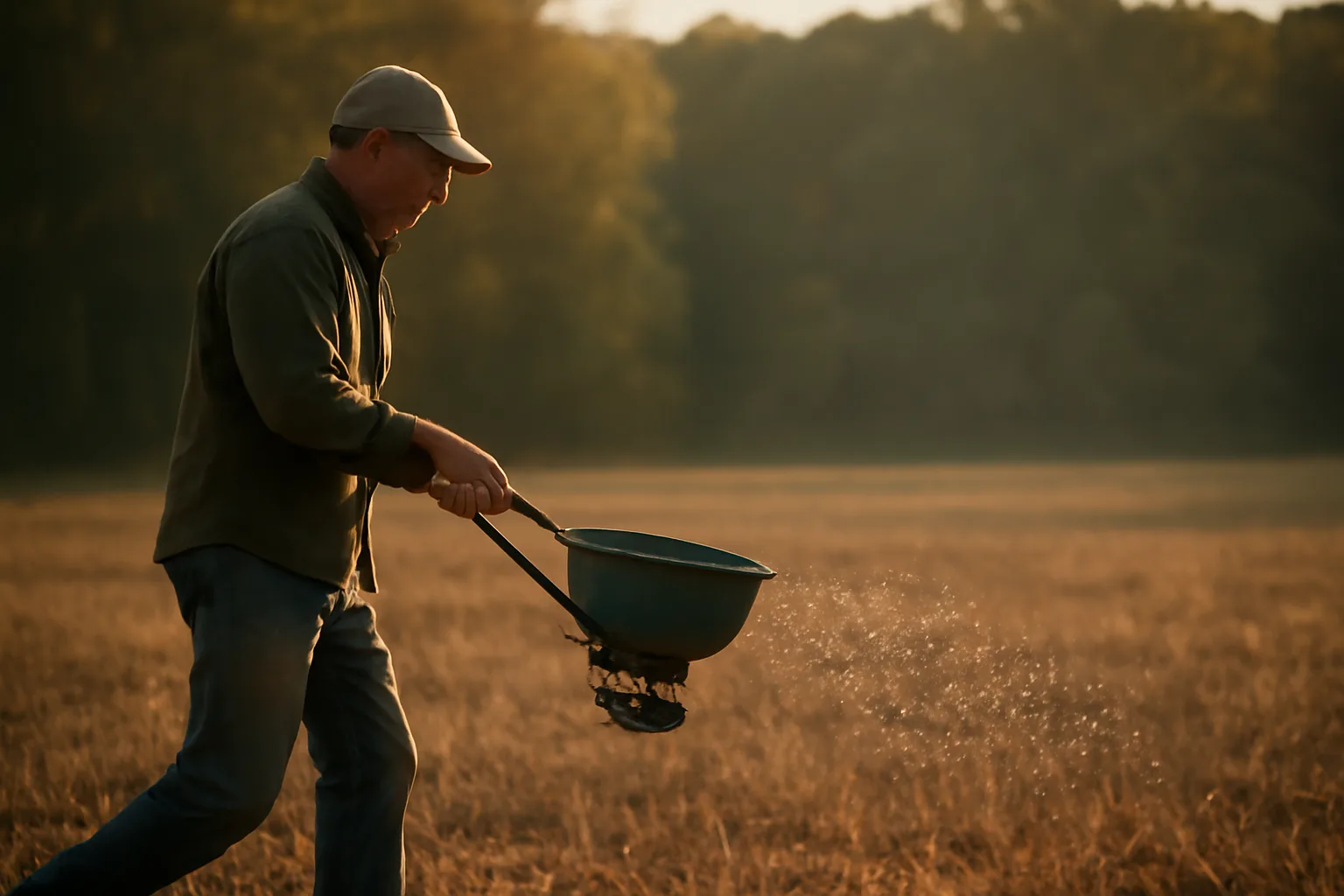
A food plot is a planted patch of forage or grain on hunting land meant to feed deer and other wildlife, and to give hunters a place to watch and hunt over. Plots range from quarter-acre kill plots tucked in timber to multi-acre field plantings meant to feed a herd through winter. Most state wildlife agencies and university extension programs treat food plots as a habitat management tool, not a magic bullet, and the research backs that up: plots supplement natural browse, they don't replace it [1]. No-till is a planting method, not a plot type. Instead of plowing, disking, or tilling soil to prepare a seedbed, you kill existing vegetation with herbicide (usually glyphosate), let it die down, then plant directly into the dead thatch using a no-till drill or by broadcasting seed and dragging or rolling it in. The old roots and residue stay in the ground. That residue matters more than people think: it holds soil moisture, feeds soil microbes as it breaks down, and cuts erosion on any plot with slope [2]. Why hunters like it: less equipment, less time, less disturbance. You don't need a tractor with a disk or tiller, though a UTV-mounted no-till drill or even a hand-crank spreader and some ATV work can get seed in the ground. For small food plots on leased ground where you can't justify a $30,000 tractor, no-till is often the only realistic option. The tradeoff: no-till depends completely on killing the existing vegetation first. Skip that step, or use the wrong herbicide timing, and your new seed competes with whatever was already growing there. That's the number one reason no-till plots fail.
How does no-till food plot planting actually work, step by step?
The process has four stages: soil test, kill, plant, and manage. Skip any of them and results suffer. Start with a soil test, ideally 60 to 90 days before planting. Your state land-grant extension office runs cheap tests, often $10 to $20 per sample, and they'll tell you pH and nutrient levels specific to your soil. Your soil test lab is the authority here, not a blog post. Lime takes months to adjust pH, so if your test comes back at 5.5 and your clover wants 6.5 to 7.0, you need to get lime down early. Fall soil tests for spring plots, spring tests for fall plots, roughly. Next, kill the existing vegetation. Glyphosate (Roundup and generic equivalents) is the standard choice because it kills grasses and broadleaf weeds without leaving soil residue that blocks new germination. Spray when weeds are actively growing, usually 2 to 3 weeks before you plan to plant, and wait for a full kill (everything brown, more than wilted) before you drill or broadcast. Spraying into a drought or right before a hard frost gives you a weak kill and you'll fight regrowth all summer. Then plant. If you have a no-till drill, run it at the depth the seed tag calls for; most clover and brassica seed only needs 1/4 to 1/2 inch of depth, oats and cereal grains a bit deeper, around 1 to 1.5 inches. If you're broadcasting by hand or spreader, drag a section of chain-link fence, a piece of carpet, or a cultipacker over the seed afterward to press it into the dead thatch. Seed sitting on top of thick residue with no soil contact just dries out and dies. Last, manage it. Mow clover a few times a season to keep it from going to seed and getting stemmy. Spot-spray perennial weeds. If it's an annual plot (oats, brassicas), plan your next kill-and-plant cycle for the following season.
When should you plant food plots for deer?
Timing depends on your zone and what you're planting, but the two general windows are late summer to early fall for cool-season plots, and spring after last frost for warm-season plots. Cool-season plots (clover, oats, wheat, brassicas) are usually planted 6 to 8 weeks before your area's first fall frost, which lets brassicas and turnips bulb up and lets clover establish before winter. Warm-season plots (soybeans, cowpeas, sorghum) go in after soil temps hit 60 degrees F and frost risk has passed, similar to corn planting windows. A rough national guide: Deep South (zone 8-9), plant fall plots September through October. Mid-South and transition zone (zone 6-7), late August through mid-September. Upper Midwest and North (zone 3-5), early August through early September, because season length is shorter and brassicas need time to bulb before hard frost locks the ground. Spring plots in all zones generally go in April through May once soil is workable and frost risk has passed. Your own state extension office publishes planting date charts for exactly your county, and those beat any generic national chart, because they're based on local frost data [3]. If you're planning a plot around hunting season specifically, remember most brassicas and turnips need a hard frost to sweeten up and become attractive, so timing the planting so that frost hits 60 to 90 days after emergence often matters more than hitting a specific calendar date.
When should you plant oats for deer?
Plant oats for deer 6 to 10 weeks before your first fall frost date, which puts most of the Midwest and Southeast planting oats from late August through mid-September. Oats are a cool-season annual cereal grain, and deer hit them hard in early fall when the plants are young and tender, then again in late fall and winter if temperatures stay mild enough that the oats don't die out completely. Oats winterkill in most of the northern U.S. once temperatures drop into the teens for extended periods, so in zone 3-5 country you're mainly planting a fall attractant, not a plot that survives to spring. Further south, oats can persist through a mild winter and offer forage into late winter or even early spring. Seeding rate for oats alone typically runs 2 to 3 bushels per acre (roughly 64 to 96 pounds), though most food plot mixes cut that rate and blend oats with clover or brassicas to extend the plot's attraction window. Drill depth is about 1 to 1.5 inches; oats germinate fast, often within 5 to 10 days given decent soil moisture.
When should you plant turnips for deer?
Plant turnips 90 to 100 days before your area's first hard frost, which for most of the country lines up with late July through mid-August. Turnips need that runway to grow leaves, bulb up, and sweeten with frost before deer really key in on them. Plant too late and you get leafy growth with small, undeveloped bulbs that deer mostly ignore. Deer usually eat the leaves first, starting in early fall, then switch to the bulbs later in the season once frost converts starches to sugars, which is why turnip plots often look untouched in October and get hammered in December. This is one of the most consistent patterns extension wildlife biologists and deer researchers describe, and it's worth planning your hunting season around it rather than expecting activity the day the plot comes up [4]. Seeding rate for turnips alone is light, around 2 to 4 pounds per acre broadcast, because turnip seed is tiny and a heavy rate just creates overcrowded, stunted bulbs. Most hunters plant turnips as part of a brassica blend with radishes and rape rather than as a monoculture, which spreads out the leaf-to-bulb ratio and gives a longer attraction window.
Do deer eat clover, and do they actually like it?
Yes, deer eat clover readily and it's one of the most reliable food plot forages available, both white clover (ladino types) and red clover. Clover is a perennial legume, meaning a single planting can produce forage for 3 to 5 years with good management, unlike annuals you replant every season. It's also high in protein, commonly tested at 20 to 30 percent crude protein in vegetative growth stages, which matters most in spring and summer when does are lactating and bucks are growing antlers [5]. Do deer like clover? Every whitetail research summary and state agency food plot guide lists clover among the top perennial plot choices, largely because deer return to it repeatedly through the growing season, unlike an annual grain plot that gets hit hard for a few weeks and then declines. Clover also fixes nitrogen in the soil through its root nodules, which is a real agronomic benefit if you rotate a field to corn or brassicas later. The catch with clover in a no-till setting: it's a small, shallow-planted seed (1/4 inch or less), so seed-to-soil contact after a herbicide kill is critical. Broadcast clover onto dead thatch without pressing it in with a cultipacker or roller and you'll get spotty, disappointing germination. Clover also needs pH in the 6.0 to 7.0 range to really perform, so if your soil test comes back acidic, get lime down well before planting, since lime takes months to move through soil profile.
Do deer eat sorghum, and is it worth planting?
Yes, deer eat sorghum, particularly the grain heads in fall and winter, and the standing stalks provide cover as a bonus. Grain sorghum (milo) and forage sorghums are warm-season annuals, planted after soil temps hit 60 to 65 degrees F, similar timing to corn. Deer use is generally secondary to species like soybeans or corn in terms of preference, but sorghum tolerates drought and poor soil better than corn, which makes it a practical choice on marginal ground where corn would struggle. Sorghum's biggest food plot value is often as a screening and thermal cover component mixed with other species, standing tall through winter and holding grain heads that deer and turkey both work over as other food sources get scarce. It's not usually anyone's first-choice attractant on good soil, but on a dry hillside or sandy field where corn yields poorly, sorghum can outperform it. Birds (particularly blackbirds and doves) can hit sorghum heads hard before deer season even starts, which is a real complaint from plotters in bird-heavy areas. If that's a known problem on your ground, some hunters plant bird-resistant sorghum varieties or accept the loss and treat it as a mixed-species plot rather than a monoculture.
What are deer's favorite foods, and how should that shape plot species choice?
Deer preference shifts by season, region, and what's naturally available, so there's no single universal favorite. That said, agricultural crops like soybeans and corn, along with clover, are consistently near the top of preference studies and hunter-reported plot performance across most of the whitetail's range [1] [5]. Acorns often beat any planted food plot species outright in years with a strong mast crop, which is one reason plots get hit inconsistently in big acorn years and hard in years when oaks fail. A rough seasonal breakdown: spring and summer, deer favor high-protein forage like clover, soybeans, and cowpeas, which support antler growth and lactation. Early fall, standing beans, corn, and fresh brassica leaves draw attention. Late fall into winter, brassica bulbs (turnips, radishes), cereal grains (oats, wheat), and any remaining soybean pods or acorns become the priority as deer shift toward energy-dense food to build fat reserves. The practical takeaway for plot planning: match species to season of use. A single-species clover plot is a good spring-summer draw but won't do much in December if it's been grazed down or gone dormant. Most well-planned properties run a mix, perennial clover for growing season, brassicas or cereal grains for late season, so there's something available across more of the year. If you want species matched to your specific region and hunting goals rather than a generic list, that's exactly what a Custom Food Plot Plan is built to sort out for $99, though the plan gives general species and timing guidance, not a guarantee of deer activity or a site visit.
Do deer like honey, and does that matter for food plots?
Deer don't have a documented preference for honey, and it's not a food plot input or attractant with any research or extension backing. This question likely comes from confusion with commercial deer attractant products, many of which use sugar, molasses, or apple/acorn scent bases, not honey specifically. There's no wildlife agency or extension guidance recommending honey as bait or attractant, and in most states, using any food-based bait or attractant to hunt over is regulated or banned outright. That regulatory point matters more than the honey question itself. States vary widely on baiting and supplemental feeding rules for deer, and some ban baiting entirely (often tied to chronic wasting disease concerns), some allow it with restrictions on distance from a stand or timing, and some allow it freely outside CWD zones. Before you put out any mineral lick, feeder, or scent-based product, check your state wildlife agency's current regulations, since rules change year to year and CWD detections have pushed several states toward tighter restrictions recently [6]. A planted food plot is generally treated differently than bait piles under most state law, but the line varies enough that it's worth reading your state's actual regulation text rather than assuming.
What equipment do you actually need for a no-till food plot?
| Backpack sprayer + hand spreader + drag | $150 to $300 | Plots under 1 acre | |
|---|---|---|---|
| ATV sprayer + tow spreader + cultipacker | $800 to $2,500 | Plots 1 to 5 acres | |
| Pull-behind no-till drill (owned or rented) | $150 to $400/day rental, $3,000+ to own | Larger acreage, grain crops | Whatever tier you're at, the sprayer matters more than the drill. A perfect seedbed planted into live competing weeds still fails. A mediocre broadcast job into a clean, fully-killed field usually still produces a decent stand. |
You don't need much, and that's the whole point of no-till. At minimum: a sprayer (backpack, ATV-mounted, or tow-behind) for the herbicide kill, a way to broadcast or drill seed, and something to press seed into soil afterward. Budget setups run a hand-pump backpack sprayer ($30 to $80), a hand-crank or ATV-tow broadcast spreader ($40 to $150), and a homemade drag made from a chain-link fence section or piece of carpet weighted down and towed behind an ATV. This setup handles plots under an acre reasonably well and costs under $300 total if you're starting from nothing. Mid-tier setups add a no-till drill, either a small pull-behind unit sized for ATV or UTV use, or renting one from a local conservation district or farm co-op, which many offer specifically for food plot and cover crop use at modest day rates. A drill gets you more consistent depth control and better stand establishment than broadcasting, especially for larger seed like oats, soybeans, or sorghum that needs 1 to 1.5 inches of coverage. |Equipment tier|Typical cost range|Best for|
No-till vs conventional tillage: which is actually better for a food plot?
Neither method is universally better; it depends on your soil, your equipment, and how much time you have. No-till wins on erosion control, soil moisture retention, and labor, since you skip the disking and tilling passes entirely. Conventional tillage wins on breaking up compacted soil, burying lime and fertilizer for faster incorporation, and giving very fine seed a cleaner, looser seedbed. USDA soil health guidance generally favors reduced tillage and no-till approaches for long-term soil structure and organic matter, noting that repeated tillage breaks down soil aggregates and accelerates organic matter loss over time [2]. For a food plot you might replant every year or two, that long-term soil health argument matters less than it does for a row-crop farmer, but it's still a real factor if you're managing the same small plots for a decade or more. Practically: if your plot has any slope, sits on erodible soil, or you're planting a small acreage with limited equipment, no-till makes sense. If you're breaking new ground for the first time (converting a fallow field or thick sod to a food plot), a single tillage pass or two, followed by no-till in following years, often gives the fastest, cleanest first-year result, since thick perennial sod can be tough for even a solid herbicide kill to fully clear.
What mistakes ruin most no-till food plots?
The recurring mistakes, in rough order of how often they wreck a plot: incomplete herbicide kill, poor seed-to-soil contact, wrong planting date for the zone, and skipping the soil test entirely. An incomplete kill happens when you spray too early (weeds not actively growing, cold snap, drought stress) or don't wait long enough before planting. Glyphosate needs active growth to translocate through the plant and kill the root system; spraying dormant or drought-stressed weeds gives you a partial burn-down that regrows within weeks. Wait for full brown-out, typically 10 to 14 days after a good spray under decent growing conditions, before you plant. Poor seed-to-soil contact is the number two killer, especially with small seeds like clover and brassicas broadcast onto thick dead thatch. If you can't run a drill, you need to drag, roll, or cultipack after broadcasting. Skipping that step is probably the single most common reason a no-till broadcast plot comes up thin and patchy. Wrong planting date usually means planting brassicas too late for bulbs to develop, or planting cool-season perennials so late in fall that they don't establish enough root mass before winter dormancy. And skipping the soil test means you're guessing at lime and fertilizer, which either wastes money (over-applying) or leaves your plot underperforming for years (under-applying, especially on pH). A $10 to $20 soil test is the cheapest insurance in the entire process.
How do you build a full no-till planting plan for your property?
Work backward from your hunting season and your soil test results, then pick species and dates that fit your specific zone rather than a generic national calendar. Start with the soil test 60 to 90 days out, get lime down if pH needs correcting, choose species based on how the plot will be used (early season draw, late-season energy source, spring growing-season plot), then set your spray and plant dates based on your area's first frost date. A few starting points to sanity check any plan: perennial clover plots want pH 6.0 to 7.0 and a spring or late-summer planting window. Brassicas and turnips want 90 to 100 days before frost and a fall planting window in most zones. Oats want 6 to 10 weeks before frost, also a fall window. Warm-season plots (soybeans, sorghum, cowpeas) want soil temps above 60 degrees F and a spring planting window after frost risk passes. If sorting through species, timing, and soil corrections for your specific property feels like more than you want to figure out alone, that's the exact gap a Custom Food Plot Plan fills for a $99 one-time cost, built around your zone, your soil test numbers, and what you're trying to accomplish with the plot. It's general guidance based on the inputs you give it, not a site visit or a guarantee of results, and your soil test lab's specific lime and fertilizer recommendations always take priority over any generic plan. For more on matching species to your specific goals, see food plot whitetail, deer food plot seed, and food plot seed selection guidance.
Frequently asked questions
Do deer eat sorghum?
Yes. Deer eat sorghum grain heads, especially in fall and winter, and the standing stalks double as cover. It's usually a secondary choice behind corn or soybeans for pure attraction, but it handles drought and poor soil better, making it a solid option on marginal ground.
Do deer eat clover?
Yes, clover is one of the most reliable food plot forages for whitetails. Both white (ladino) and red clover get heavy use through spring and summer, testing at roughly 20 to 30 percent crude protein in vegetative stages, which supports antler growth and lactation.
When should I plant deer food plots?
Cool-season plots (clover, oats, brassicas) go in 6 to 10 weeks before your area's first fall frost, roughly late July through mid-September depending on zone. Warm-season plots (soybeans, sorghum) go in spring after soil hits 60 degrees F and frost risk has passed. Check your state extension's local planting date chart for exact timing.
Do deer like clover more than other food plot options?
Deer show strong, consistent preference for clover, and it's a perennial that can produce forage for 3 to 5 years from one planting, unlike annuals you replant each year. It's a top pick in nearly every state extension and university food plot guide, though it's strongest in growing season, not as a late-winter energy source.
When should I plant oats for deer?
Plant oats 6 to 10 weeks before your first fall frost, generally late August through mid-September across most of the Midwest and Southeast. Oats germinate fast (5 to 10 days) and draw heavy early-fall use; they winterkill in colder zones but can persist into winter in milder climates.
When should I plant turnips for deer?
Plant turnips 90 to 100 days before your first hard frost, typically late July through mid-August. Deer eat the leaves first in early fall, then switch to bulbs after frost sweetens the starches into sugar, usually in late fall or winter.
What is a food plot?
A food plot is a planted area on hunting or wildlife land, usually a fraction of an acre to several acres, seeded with forage or grain to feed deer and other wildlife and give hunters a place to hunt over. Extension and wildlife agencies treat plots as a supplement to natural browse, not a replacement for it.
What are deer's favorite foods?
There's no single universal favorite; it shifts by season and region. Soybeans, corn, and clover consistently rank high in preference research and hunter results, but acorns often outcompete any planted crop in strong mast years. Late season, brassica bulbs and cereal grains become priority foods as deer shift toward fat reserves.
Do deer like honey?
There's no research or extension guidance showing deer have a specific preference for honey, and it's not a recognized food plot input. This question likely stems from confusion with commercial attractant products using sugar or molasses bases. Check your state's baiting and feeding regulations before using any attractant, since rules vary and many states restrict or ban baiting.
What's the difference between no-till and conventional food plot planting?
No-till kills existing vegetation with herbicide, then plants directly into the dead residue without disking or tilling. Conventional tillage turns the soil to bury weeds and create a loose seedbed. No-till saves time, fuel, and reduces erosion; conventional tillage handles compacted soil and thick sod better on first-year ground.
Do I need a no-till drill to plant a food plot without tilling?
No. A no-till drill gives the most consistent results, especially for grain crops, but you can broadcast seed by hand or spreader and press it into dead thatch with a drag, roller, or cultipacker. Many small food plots under an acre are successfully planted this way for under $300 in equipment.
How do I kill existing vegetation before a no-till planting?
Spray glyphosate when weeds are actively growing, then wait 10 to 14 days for a complete brown-out before planting. Spraying dormant, drought-stressed, or frost-damaged weeds gives an incomplete kill and the old vegetation regrows and competes with your new seed.
Is no-till food plot planting cheaper than conventional tillage?
Generally yes, mainly in equipment and fuel costs. You skip the disk, tiller, and extra tractor passes; a basic no-till setup (sprayer, spreader, drag) can run under $300, versus thousands for tillage equipment. Herbicide cost is the main added expense, typically modest for plot-sized acreage.
Sources
- USDA Forest Service, Wildlife Habitat Management - Food Plots: Food plots function as a supplement to natural browse rather than a replacement for habitat management
- USDA Natural Resources Conservation Service, Soil Health - No-till: Reduced tillage and no-till practices support long-term soil structure and reduce erosion compared to repeated tillage
- Mississippi State University Extension, Establishing Wildlife Food Plots: Regional planting date guidance for cool-season and warm-season food plot species
- University of Tennessee Extension, Brassicas for Deer Food Plots: Deer preference shifts from brassica leaves to bulbs after frost converts starches to sugars
- University of Georgia Extension, Food Plots for Wildlife: Clover crude protein content ranges roughly 20 to 30 percent in vegetative growth stages, supporting antler growth and lactation
- Quality Deer Management Association / National Deer Association, Chronic Wasting Disease and state feeding/baiting regulation summaries: States vary widely on baiting and supplemental feeding regulations, often influenced by CWD management concerns