Last updated 2026-07-25
TL;DR
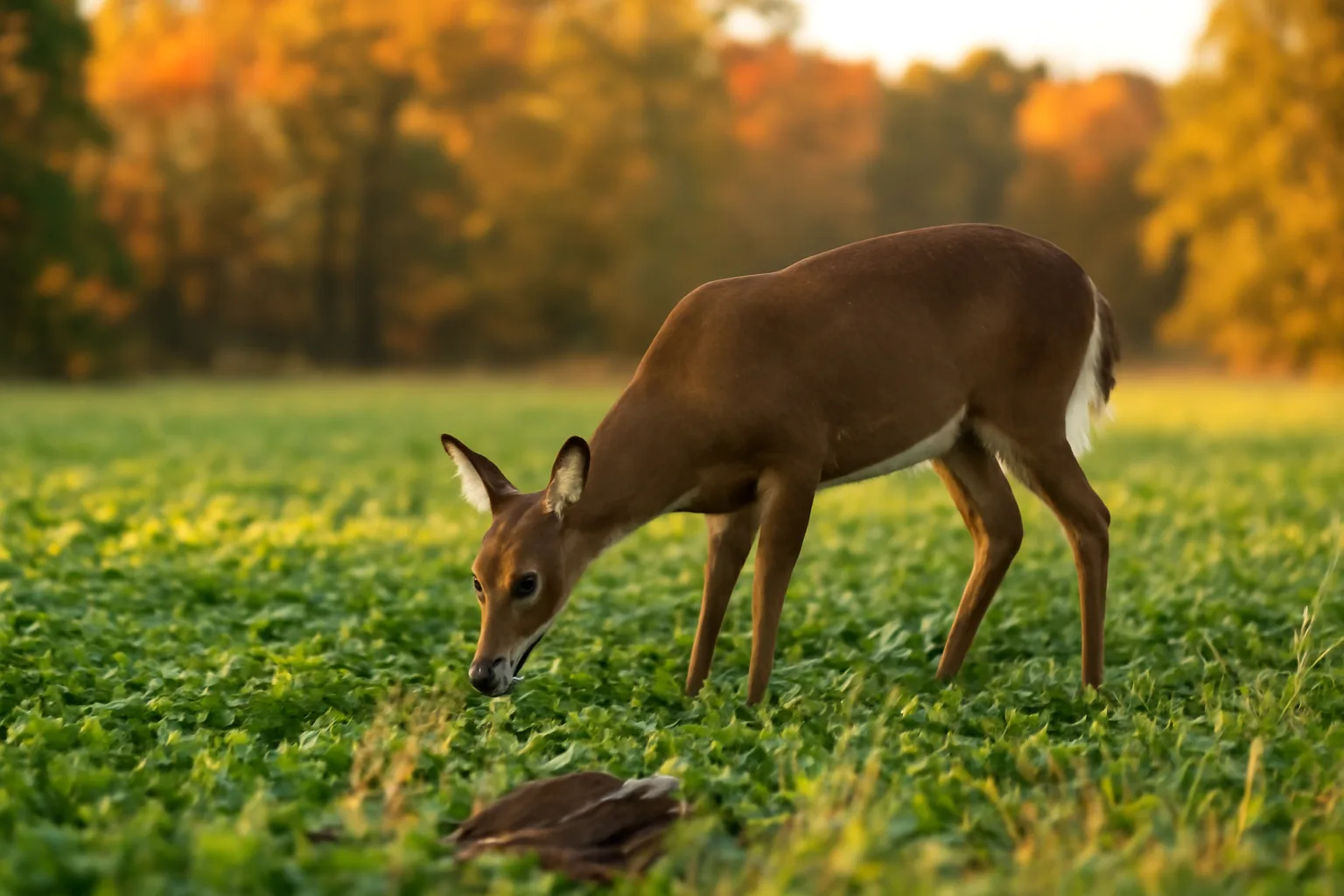
A food plot is a planted patch of forage or grain, usually a quarter acre to several acres, meant to feed deer and turkey and hold them on your ground. Clover and brassicas work for deer, chufa and clover work for turkey. Planting dates run from March through September depending on your zone and species. A soil test decides the rest.
What is a food plot, exactly?
A food plot is a cleared and planted patch of ground, usually anywhere from a quarter acre to several acres, seeded with forage crops that deer or turkey want to eat. That is the whole definition. It is not a garden, and it is not a wildlife refuge. It is agriculture, done on a small scale, for a specific animal. Most hunters plant one of two broad types. Annual plots get replanted every year, things like brassicas, oats, or grain sorghum, and they usually produce more tonnage per acre in a short window. Perennial plots like clover or chicory get planted once and then mowed and maintained for three to five years before they need to be reseeded. The USDA Natural Resources Conservation Service runs the Environmental Quality Incentives Program (EQIP), which funds wildlife habitat practices including plantings that benefit species like deer and turkey, under the authority of the Food Security Act as amended (16 U.S.C. 3839aa) [1]. That tells you something: food plots are recognized as a legitimate habitat tool, more than a hunting gimmick, and they work best when treated as one piece of a bigger plan that includes native browse, cover, and water. If you're planning your first plot or your fifth, it helps to see how plot type fits into an overall property plan. Our food plot whitetail guide covers layout and sizing in more depth.
When to plant food plots for deer?
| Upper Midwest / Northern tier | Aug 1 to Sept 1 | May 15 to June 15 | |
|---|---|---|---|
| Transition zone (Ohio Valley, Mid-South) | Aug 15 to Sept 20 | Apr 20 to June 1 | |
| Deep South | Sept 15 to Nov 1 | Apr 1 to May 15 | Mississippi State University Extension publishes forage variety guidance recommending that cool-season annuals like wheat, oats, and brassicas in the Deep South go in during the fall window so plants establish before the first expected frost [2]. That 60-day rule before frost is the single most useful planting-date heuristic in this whole business. Count backward from your average first frost date, and you'll rarely go wrong. |
Planting windows depend entirely on your zone, but the short answer is: cool-season plots (clover, brassicas, oats, wheat) go in from mid-August to early October in the North and Midwest, and September through October in the South. Warm-season plots (soybeans, corn, sorghum, cowpeas) go in from April through June almost everywhere. The real driver is soil temperature and rainfall, not the calendar. Brassicas need 45 to 60 days of growth before a hard frost to bulb out and sweeten up. Clover germinates best when soil temps sit between 50 and 85 degrees Fahrenheit. If you plant clover into hot, dry August ground in Georgia, it will sit there doing nothing until the first real rain. Here is a rough planting window by region, adapted from land-grant extension planting guides for forage crops: | Zone | Cool-season plot window | Warm-season plot window |
Do deer like clover, and is it worth planting?
Yes. Clover is consistently one of the highest-preference forages in whitetail research and one of the most planted food plot species in North America, and for good reason. It is high in protein, often 20 to 30 percent crude protein in vegetative growth. It regrows after grazing. It comes back every spring for three to five years if you maintain it. White clover (Ladino types) and red clover are the two most common choices. Ladino spreads by stolons and tolerates closer grazing, which makes it a good fit for high-deer-density properties. Red clover grows more upright, handles drier and less fertile soil better, but doesn't persist as long, usually two to three years before it thins out. Clemson Cooperative Extension's forage guidance on clover establishment notes that clover stands need a soil pH in the 6.0 to 7.0 range for good nodulation and nitrogen fixation, and recommends applying lime well ahead of planting since it takes months to react with the soil [3]. This is the number one reason clover plots fail: growers skip the soil test, skip the lime, and wonder why their clover looks yellow and thin by July. Clover is not a turkey favorite in the way deer key on it, but turkeys will use clover fields heavily in spring and summer to hunt insects in the canopy, which is arguably more important to poult survival than the clover itself.
What are deer's favorite foods, really?
There is no single favorite. Deer preference shifts by season, by region, and by what's already available naturally. That said, food plot research and browse surveys point to a consistent short list: soybeans and cowpeas in summer, acorns in fall where available, clover almost year-round, and brassicas and cereal grains in late fall and winter after a frost sweetens them. Whitetail forage preference research generally ranks legumes (soybeans, cowpeas, clover) and acorns near the top of preferred foods by digestible energy and crude protein content. Brassicas like turnips and radishes rank lower in summer palatability but jump way up after a hard frost converts starches to sugars, which is why late-season brassica plots often get hit hardest in November and December rather than October. If you're picking one plot to plant and want the broadest appeal across species and season, a clover and chicory blend, paired with a fall brassica plot, covers most of the calendar. For species selection details by region, see deer food plot seed and deer for food.
Do deer eat sorghum?
Yes, deer eat grain sorghum, but it's more of a fall and winter standing-grain food than a summer attractant crop. Deer will browse the leaves some in summer, but the real value comes when the seed heads mature and dry down, giving you a standing grain source from October through winter, similar to standing corn but on a smaller scale and cheaper per acre. Grain sorghum (milo) is a solid choice on drought-prone ground because it tolerates dry conditions far better than corn. Oklahoma State University Extension's food plot guidance for deer and turkey lists grain sorghum among recommended warm-season options, noting it holds up well in dry conditions where corn often fails [4]. It's also a strong turkey food once it matures and shatters onto the ground, and it draws dove in early fall in a lot of regions, which is a nice side benefit if you hunt doves too. One caution: sorghum can accumulate prussic acid (cyanide compounds) under drought stress or frost damage, a known risk in forage sorghums fed to livestock. It's rarely a practical concern for deer browsing standing grain in small food plot acreage, but if you're baling or feeding sorghum forage to livestock nearby, that's a documented risk worth knowing about from state extension livestock guidance.
When to plant oats for deer?
Plant oats 45 to 60 days before your area's first killing frost, which in most of the Midwest and upper South lands in the window of late August through mid-September. Oats are a fast-germinating, cool-season cereal grain that deer hit hard in the first six to eight weeks after emergence, then again after frost when the leaves sweeten. Oats aren't as winter-hardy as wheat or rye. In the Deep South and mid-South, a hard freeze can kill oats back to the ground by January, while wheat and cereal rye keep producing through winter. That makes oats a great early-season and mid-fall draw but a weaker choice if you want a plot standing strong in February. A lot of experienced plotters blend oats with wheat or rye for exactly this reason: fast early growth from the oats, winter durability from the wheat or rye. Spring-planted oats also work in the North as a quick summer cover crop or turkey brood-rearing plot, planted as soon as soil is workable, typically April, though this is less common than fall plantings.
When to plant turnips for deer?
Plant turnips 60 to 90 days before your first expected frost date, which usually means late July through August in the North, and August into early September in the transition zone and mid-South. Turnips need that long runway to bulb out properly and to build up the sugar content that makes them attractive after frost. Turnips are a classic late-season food plot crop precisely because deer often ignore the tops and bulbs until frost converts starches into sugars, a well-documented phenomenon in brassica forage agronomy research. Before frost, deer may nibble the leaves some but largely pass on the plot. After two or three hard frosts, that same plot can get hammered daily through December and January, especially in the Midwest and North where little else is green. If your season closes before your first hard frost, turnips may look great and never get touched while you're still hunting. In that case, oats, wheat, or clover give you a more reliable in-season draw, and you save the brassicas for the post-season nutritional boost instead.
Do deer eat honey, or is that a myth?
No, deer do not eat honey, and this isn't really a food plot question at all, it's a bait and mineral supplement mix-up. What people usually mean is one of two things: molasses-based mineral licks marketed with names that reference sweetness, or the practice of using sugar-based attractants to draw deer to a spot. Deer are drawn to sugar and salt, which is why molasses tubs and mineral blocks work as attractants, but honey itself isn't a natural or practical food plot input. It's expensive. It's not scalable across acres. There's no research showing deer seek it out the way they seek clover, acorns, or standing corn. More relevant: many states restrict baiting and supplemental feeding of deer, especially where chronic wasting disease has been detected. Wisconsin state law prohibits feeding and baiting of wild deer statewide outside of narrow exceptions, under Wis. Stat. 29.885, with additional restrictions layered on in counties with CWD detections [5]. Before you put out any mineral, molasses, or bait product, check your state wildlife agency's current baiting and feeding regulations, since they vary a lot and change from year to year depending on CWD detections.
What food plots work best for turkey?
Turkeys key on a mix of insects, seeds, and green forage, so the best turkey plots aren't a single crop, they're an ecosystem in miniature. Clover fields draw grasshoppers and other insects that poults need for protein in their first weeks of life. Chufa, a sedge that produces underground tubers, is arguably the single best dedicated turkey food plot crop, since turkeys will scratch up chufa tubers through fall and winter and few other animals compete for it as heavily. Clover and chicory blends do double duty for deer and turkey both, which makes them a smart choice if you're managing for both species on the same acreage, a very common setup on leased and owned deer ground. Grain plots like corn, milo, and soybeans also draw turkeys once the grain matures and drops or gets knocked down by weather and deer feeding. Turkeys don't need dedicated acreage the way deer sometimes do. A half-acre chufa patch or a shared clover field usually does the job. If you're planning food plots for both species on the same property, the deer food plots guide walks through layout choices that work for mixed-species ground.
How does soil testing fit into planting a food plot?
Soil testing is the step almost everyone skips, and it's the single biggest predictor of whether a plot succeeds or fails. A soil test tells you your pH and your phosphorus and potassium levels, and from that, your test lab or extension office gives you a lime and fertilizer recommendation specific to the crop you're planting. University soil testing labs, run through land-grant universities in most states, charge modest per-sample fees. The University of Missouri Soil and Plant Testing Laboratory, for example, lists a standard soil test fee in the range of roughly $7 to $20 per sample depending on the panel, with results typically turned around within one to two weeks. That's cheap insurance against wasting $150 in clover seed on ground with a pH of 5.0, where clover will never nodulate properly no matter how much fertilizer you throw at it. Your soil test lab is the authority on how much lime and fertilizer your specific plot needs, since regional soil chemistry varies enough that generic advice can be off by a lot. A general plan can point you toward the right species and rough rates, but the lab report from your own dirt is what should set your final lime and fertilizer numbers. This is exactly the gap our $99 Custom Food Plot Plan is built to fill: hand us your soil test results and property basics, and we build a planting plan around your actual ground rather than a generic bag-label rate. It's general guidance built from your data, not a substitute for your lab's specific lime and fertilizer numbers. For general species and blend research, deer food plot seed and food plot seed both go deeper into rate and blend selection.
What equipment do you actually need to plant a food plot?
The honest answer: less than most seed catalogs want you to believe. A soil test, a way to kill existing vegetation (herbicide or tillage), a way to work the seedbed, a way to spread seed, and a way to pack it in. That's it. For small plots (under 2 acres), a lot of hunters get by with an ATV or UTV, a pull-behind disc or cultipacker, and a hand-crank or ATV-mounted broadcast spreader. For larger acreage, a compact tractor with a disc, a drag harrow, and a broadcast or drill attachment speeds things up considerably and lets you plant more consistently at depth, which matters a lot for small-seeded crops like clover and brassicas that only want to go down a quarter inch or less. Corn and beans need a planter or drill for consistent spacing and depth, four to six weeks earlier than food plot season sends most people shopping. If you're renting or borrowing equipment, book it early, since the same three-week planting window gets a lot of competition from every other plotter in the county.
Frequently asked questions
Do deer eat sorghum?
Yes. Deer browse young sorghum leaves in summer and eat the mature grain heads heavily from fall through winter. It's especially useful on dry, poor soils where corn struggles, according to Oklahoma State University Extension food plot guidance [4]. It also draws turkey and dove once seed heads mature and shatter.
Do deer like clover?
Yes, clover is one of the most consistently preferred food plot forages for whitetail deer, offering 20 to 30 percent crude protein in vegetative growth and regrowing after grazing for three to five years. It needs a soil pH of 6.0 to 7.0 for good nitrogen fixation, per Clemson Cooperative Extension forage guidance [3].
When should I plant food plots for deer?
Cool-season plots (clover, brassicas, oats, wheat) go in mid-August to early October in the North and Midwest, and September through October in the South. Warm-season plots (beans, corn, sorghum) go in April through June almost everywhere. Count 45 to 90 days back from your first frost date depending on the crop.
When should I plant turnips for deer?
Plant turnips 60 to 90 days before your area's first hard frost, typically late July through August in the North and August into early September in the mid-South. Turnips need that runway to bulb out, and deer usually ignore them until frost sweetens the leaves and bulbs, making them a late-season draw.
When should I plant oats for deer?
Plant oats 45 to 60 days before your first expected frost, usually late August through mid-September in the Midwest and upper South. Oats germinate fast and get hit hard early, but they aren't as winter-hardy as wheat or rye, so many hunters blend the two for early growth plus winter durability.
What is a food plot?
A food plot is a planted patch of forage or grain, usually a quarter acre to several acres, established specifically to feed deer, turkey, or other wildlife and to hold them on a property. Common species include clover, brassicas, cereal grains, soybeans, and chufa. USDA's EQIP program recognizes plantings like this as a wildlife habitat practice eligible for cost-share in some cases [1].
What are deer's favorite foods?
There's no single favorite; preference shifts by season. Legumes like soybeans, cowpeas, and clover rank consistently high year-round, acorns are heavily preferred where available in fall, and brassicas jump in preference after a hard frost sweetens them, typically becoming a late-season rather than early-season draw.
Do deer like honey?
No. Deer aren't drawn to honey specifically; the confusion usually comes from molasses-based mineral products marketed with sweet names. Deer are drawn to sugar and salt generally, which is why mineral and molasses attractants work, but honey itself has no research support as a deer food or attractant.
Is clover better for deer or turkey?
Clover is a stronger direct food source for deer, offering high protein forage most of the growing season. For turkey, clover fields matter more as insect habitat, since poults need bugs for protein, not the clover leaves themselves. A clover and chicory blend serves both species reasonably well on shared acreage.
How big should a food plot be?
There's no fixed rule; quarter-acre kill plots tucked near bedding work for bowhunting setups, while half-acre to multi-acre fields work better as destination feeding plots visible from a distance. Property size, deer density, and hunting pressure all factor in more than any single acreage recommendation.
Do I need a soil test before planting a food plot?
You should, yes. A soil test through a land-grant university extension lab typically costs a modest per-sample fee and tells you pH and nutrient levels, which determines how much lime and fertilizer your plot actually needs [6]. Skipping it is the most common reason clover and brassica plots fail or underperform.
Can I plant food plots for both deer and turkey on the same property?
Yes, and it's common. Clover and chicory blends draw both species, chufa is turkey-specific and worth a dedicated small patch, and grain plots like corn, beans, and sorghum feed both once mature. Most owned or leased properties don't need separate dedicated turkey plots if clover and grain fields are already in the mix.
Are there rules against baiting deer with food plots?
Food plots themselves are legal everywhere as an agricultural planting, but baiting (piling loose grain or minerals) is regulated separately and varies a lot by state, especially in counties with chronic wasting disease detections. Wisconsin state law (Wis. Stat. 29.885) restricts baiting and feeding of wild deer, with extra rules in CWD-affected counties [5]. Always check your state wildlife agency's current rules.
Sources
- USDA Natural Resources Conservation Service, Environmental Quality Incentives Program authority: Food plots can be established as part of wildlife habitat conservation practices with EQIP cost-share support
- Mississippi State University Extension, Forages publications: Cool-season annuals like wheat, oats, and brassicas should be planted in the fall window in the Deep South, timed before first frost
- Clemson Cooperative Extension, Clover Establishment and Management: Clover food plots need soil pH between 6.0 and 7.0 for good nodulation and nitrogen fixation, and lime should be applied ahead of planting
- Oklahoma State University Extension, Food Plots for Wildlife (PSS-2911): Grain sorghum is a recommended warm-season food plot option that performs well in poor soils and dry summers
- Wisconsin State Legislature, Wis. Stat. 29.885, Feeding of wild animals prohibited; baiting restrictions: Wisconsin restricts feeding and baiting of wild deer statewide, with additional rules in counties affected by CWD