Last updated 2026-07-25
TL;DR
The best food plot plants for deer are clover, chicory, brassicas (turnips, radish, rape), cereal grains (oats, wheat, rye), and soybeans, chosen by season and soil. Perennials like clover go in spring or late summer; annuals like brassicas and oats go in late summer for fall hunting. Soil test first, since pH drives everything else.
What is a food plot, exactly?
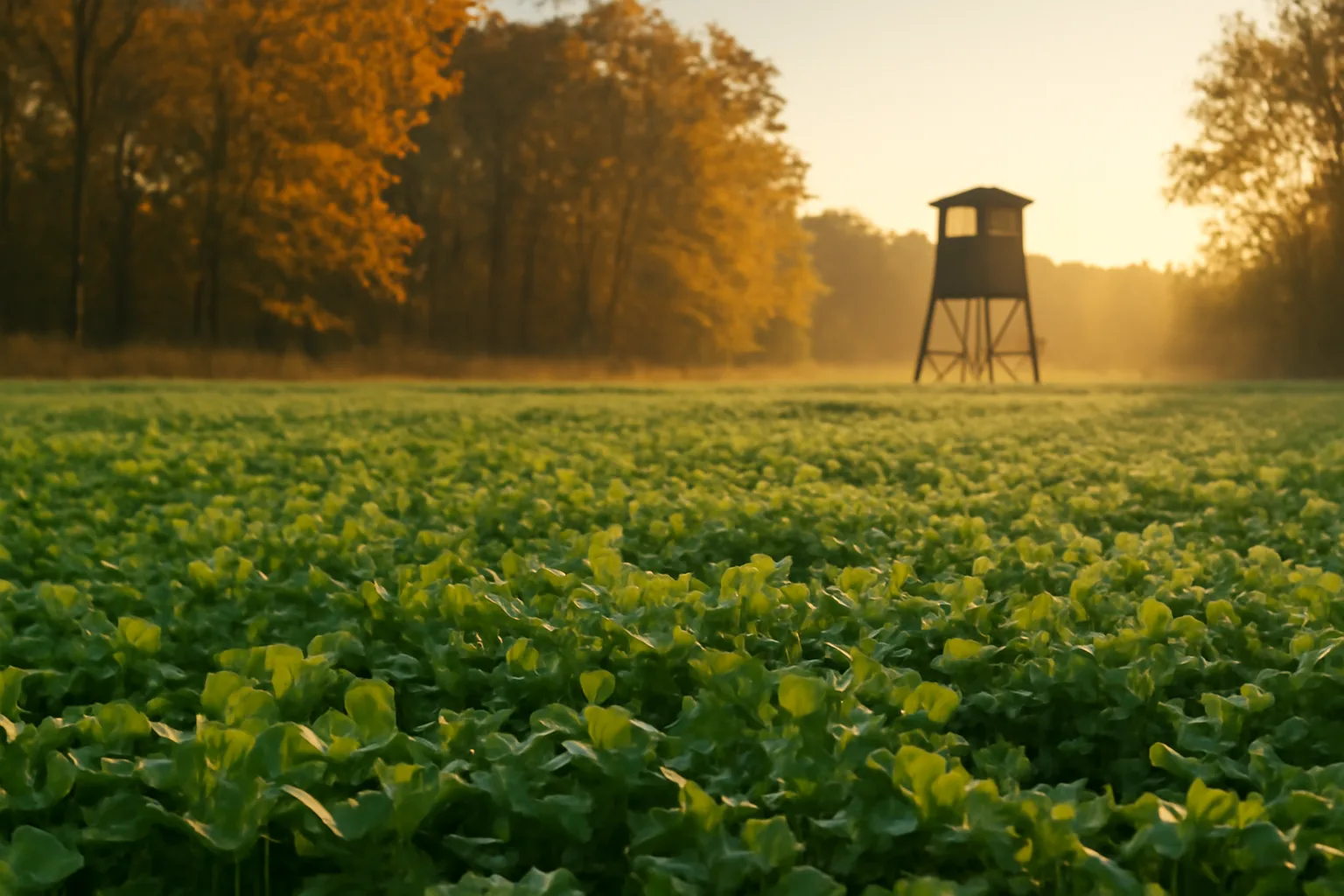
A food plot is a planted patch of ground, usually somewhere between a quarter acre and several acres, seeded with forage that deer and other wildlife will eat. That's it. No mystery. Most hunters plant food plots for two reasons: to add nutrition to the deer herd's diet through stress periods (late summer drought, post-rut recovery, hard winters up north), and to create a spot where deer show up predictably enough to hunt over. Those two goals sometimes pull in different directions. A plot meant to feed deer through August heat looks different from a plot meant to hold a buck's attention on November 10th. State wildlife agencies generally treat food plots as normal agricultural or habitat practice, not baiting, as long as the seed is broadcast and grown in place rather than piled up. That said, baiting and supplemental feeding rules vary hard by state, and some states regulate minerals, spin-feeders, and even standing crops differently depending on whether you're hunting over them. Check your state wildlife agency's regulations before you assume a food plot is legal to hunt over in your situation [1]. If you want a plan built around your specific soil test, zone, and acreage instead of general advice, that's exactly what a food plot whitetail plan is for.
What are deer's favorite foods?
Deer are opportunistic browsers, and their favorite food changes by season, region, and what's available. In spring and summer they lean hard on forbs, soft browse, and high-protein plants. In fall they shift toward carbohydrate-dense foods like acorns, corn, and soybeans to pack on fat for winter. Acorns are probably the single most consistent whitetail favorite where oaks are present. White oak acorns are lower in tannins and preferred over red oak acorns when both are dropping at once, which is well documented in wildlife management literature [2]. After acorns, agricultural crops like soybeans and corn, plus food-plot staples like clover, brassicas, and cereal grains, round out the list. Clover shows up near the top of nearly every food plot preference list. It's high in protein (often 20-25% crude protein in good stands), stays palatable most of the growing season, and tolerates grazing pressure better than almost anything else you can plant. Brassicas like turnips and radish become a favorite specifically after the first hard frost, when cold temperatures convert starches to sugars and make the leaves and bulbs taste sweeter to deer [3]. There's no universal ranked list, because a plot preference depends heavily on what else is available nearby. A soybean field surrounded by nothing but pasture gets hit hard. A soybean field next to a hundred acres of standing corn might get ignored until the corn comes down.
Do deer like clover, and is it worth planting?
Yes. Clover is one of the most reliably preferred food plot plants for whitetail deer, and it's a smart default choice for most plots. Ladino and red clover varieties both test high in crude protein and digestibility, and deer will hit a well-established clover stand from spring green-up through late fall in most regions. Clover's real advantage is that it's a perennial. Once established, a good clover stand can produce forage for three to five years with proper mowing and fertility maintenance, based on typical stand longevity reported by university extension forage programs [4]. That means less annual tillage, less seed cost, and a food source that's already up and growing early in spring when deer need it most. The downside: clover needs decent soil pH (extension guides generally recommend 6.0 to 6.5 for clover) and it struggles in heavy shade, poor drainage, or drought-prone sandy soil without irrigation [4]. It also can't handle extreme grazing pressure on small plots. If you've got three deer per acre hammering a half-acre clover plot all summer, it may get grazed into the ground before it can recover. Bigger plots, or a rotation with other forage, solves that.
Do deer eat sorghum?
Yes, deer eat sorghum, particularly grain sorghum (milo) heads and the young leaves of forage sorghum, though it's rarely their first choice compared to corn or soybeans. Sorghum is more commonly planted as a summer annual for its drought tolerance and as a standing winter food source, or as a screening/cover crop mixed with other plot species, rather than as a primary attractant. Grain sorghum has real value in food plot mixes because it tolerates heat and poor soil better than corn, needs less nitrogen, and the grain heads persist into winter as a food source after other annuals are gone [5]. Deer will browse young sorghum shoots in summer and clean up dropped grain in winter, but if you're choosing one summer annual and want deer to hammer it, soybeans or a good forage mix will usually outperform sorghum for pure attraction. Where sorghum earns its keep is on marginal ground. If you've got sandy, low-fertility soil that struggles to grow corn, milo is a legitimate substitute that still delivers standing grain into deer season.
When to plant food plots for deer
| Spring clover/chicory | March (South) to May (North) | Move 4-6 weeks later per zone north |
|---|---|---|
| Summer annuals (beans, cowpeas) | May, after last frost | Delay 2-3 weeks in northern zones |
| Fall brassicas | Late July to early September | Plant earlier (July) in the far North |
| Cereal grains (oats, wheat, rye) | August to September | Rye can go later than oats, tolerates cold better |
| Fall clover (late-summer seeding) | Mid-August to mid-September | Southern zones can wait into October |
Timing depends on your USDA plant hardiness zone, your region's first frost date, and whether you're planting a spring/summer plot or a fall plot. There's no single national planting date, and "plant in September" advice from a hunter in Georgia will get someone in Minnesota killed on timing. As a general framework: perennial clover and chicory plots go in during spring (April to May in northern zones, March to April in the South) or in late summer (mid-August to early September) so the plants establish before winter dormancy. Summer annual plots (soybeans, cowpeas, sorghum) go in after the last frost date in spring, typically May in most whitetail range. Fall annual plots (brassicas, cereal grains, annual clovers) go in roughly 60 to 90 days before your first expected fall frost, so the plants mature right as hunting season opens [6]. Your state land-grant extension office publishes frost date tables and regional planting windows specific to your county, and that's a far better source than a national blog average. The USDA Plant Hardiness Zone Map is the standard reference most extension planting calendars are built around. Here's a rough national planting window by species group. Treat this as a starting point, not gospel, and confirm against your local extension's frost dates. | Plot type | Typical planting window (US average) | Region shifts this window |
When to plant oats for deer
Oats are a fall annual, and most hunters plant them roughly 6 to 8 weeks before the first killing frost so the plants reach a leafy, palatable growth stage right as season opens. In much of the whitetail's range that lands somewhere between mid-August and mid-September. Oats are a fast-growing cereal grain, often emerging in 5 to 10 days under good moisture, and deer will hit young oat shoots hard, sometimes before the plant even reaches six inches tall [7]. That fast palatability is oats' biggest advantage over wheat or rye: deer often prefer oats' softer, sweeter leaf texture early in growth. The tradeoff is cold tolerance. Oats are less winter-hardy than wheat or rye and will usually die out after a hard freeze in northern climates, which is fine if your goal is early-fall attraction but means you won't get spring regrowth like you would from a winter rye plot. If you want a grain that survives into late winter and greens back up in spring, rye or wheat is the better call; if you want something deer will be on in October and November, oats planted in that 6-8 week pre-frost window is hard to beat.
When to plant turnips for deer
Turnips, along with other brassicas like radish and rape, should go in roughly 80 to 100 days before your area's first expected fall frost. For most of the whitetail range that means a planting window from mid-July through early September, with northern states planting earlier in that range and southern states later. Brassicas need that long runway because the real payoff comes after a hard frost converts starches in the leaves and bulbs to sugars, making the plant noticeably sweeter and more attractive to deer [3]. Plant too late and you get small, spindly plants with no bulb development by the time cold weather hits. Plant too early in hot climates and seedlings can burn out or get hammered by early-summer weed competition before they establish. A common mistake: planting turnips alone on new ground where deer have never seen brassicas before. Turnip tops often get eaten readily, but deer sometimes ignore the bulbs the first year, especially in areas with no history of brassica plots nearby. It typically takes a season or two for deer to key in on bulb foraging, according to observations from multiple state wildlife agency food plot guides [8]. Don't panic if bulbs sit untouched in year one; keep the plot going and attraction usually improves.
How do I choose between clover, brassicas, grains, and beans?
| Clover (ladino, red) | Perennial, 3-5 years | Spring through fall | Needs pH 6.0-6.5, regular mowing [4] | |
|---|---|---|---|---|
| Chicory | Perennial | Summer, drought-tolerant | Similar to clover, deep taproot | |
| Brassicas (turnip, radish, rape) | Annual | Late fall, post-frost | High nitrogen demand, plant by mid-Aug in North | |
| Cereal grains (oats, wheat, rye) | Annual (rye is winter-hardy) | Early fall through winter | Fast establishment, low input | |
| Soybeans | Annual | Summer through early fall | Needs deer exclusion fencing on small plots to establish | |
| Corn | Annual | Fall/winter standing grain | High fertility and acreage needs, expensive | Most experienced plot managers run a combination: a perennial clover plot for spring/summer nutrition and season-long hunting, plus a fall annual plot (brassica or cereal grain blend) timed to peak right when firearms season opens. If you can only manage one plot, clover is the safest all-around choice because it feeds deer for most of the year instead of one season. If you're hunting late season in the North, a brassica plot timed for post-frost sweetness is hard to beat. A lot of this decision really comes down to your specific soil test results, your region's frost timing, and how much acreage and equipment you've got. That's the exact gap a $99 one-time Custom Food Plot Plan is built to fill: it takes your zone, your soil test numbers, and your acreage and turns them into a specific species and planting-date recommendation instead of generic advice. Your soil test lab is still the authority on exact lime and fertilizer rates; the plan works from those numbers rather than replacing them. |
The honest answer is that it depends on your goal, your season, and how much labor you want to put in every year. There's no single best species. Here's how the major categories stack up against each other. | Species type | Life cycle | Best season to hunt over it | Soil/effort demands |
Do deer like honey, or does honey work as a plot attractant?
No, honey isn't a meaningful part of deer diet or a legitimate food plot ingredient, and there's no research support for using it as an attractant. Deer are herbivores built around fermenting plant fiber in a four-chambered stomach; they have no biological drive toward honey the way, say, a bear does. The honey idea shows up in hunting forums mostly tied to commercial "deer candy" or molasses-based mineral and attractant products, which do use sugar and molasses as carriers because deer will lick sugary, salty mixes readily. But that's a mineral-lick behavior, not a food plot strategy, and several states restrict or ban feeding/attractant products entirely during parts of hunting season, particularly where chronic wasting disease concerns have led to feeding bans [9]. If you're tempted by a honey-based or molasses-based attractant, check your state wildlife agency's current feeding and baiting regulations first, since rules on this have gotten stricter in a lot of states over the past decade.
How does soil testing change what I should plant?
Soil pH and nutrient levels determine which species will actually thrive on your specific ground, and skipping a soil test is the single most common reason food plots fail. Clover and alfalfa want pH 6.0 to 6.5 and struggle badly below 5.5. Brassicas tolerate slightly more acidic soil but still perform best above 6.0. Most cereal grains are more forgiving of lower pH but still respond strongly to correct fertility [4]. A basic soil test runs $10 to $20 through most state land-grant university extension labs and tells you your current pH, phosphorus, potassium, and organic matter, along with a lime and fertilizer recommendation calibrated to whatever crop you tell them you're planting [10]. That's the cheapest input in the entire food plot process and the one most likely to get skipped. Your soil test report, and the lab that generated it, is the real authority on how much lime and fertilizer your specific field needs. General planting guides (including this one) can tell you what species want, but only a test of your actual dirt tells you what your dirt has and what it's missing.
What equipment do I need to plant these species?
Equipment needs scale with plot size and species choice, and you genuinely don't need a tractor to plant a good half-acre clover plot. For small plots (under an acre), a hand-crank broadcast spreader, a rake or drag harrow, and a hand or backpack sprayer for weed control before planting will get you there. For plots over an acre, an ATV or UTV towing a disc harrow and a broadcast spreader (either PTO-driven or a tow-behind spinner spreader) speeds things up considerably and lets you cover several acres in an afternoon. Brassicas and clover have tiny seeds that need shallow planting depth (often just pressed into the surface, not buried), while cereal grains and beans generally want to be drilled or covered at a half-inch to inch and a half depth depending on species, which is where a no-till drill or a simple cultipacker earns its cost on bigger operations [7]. Seed cost and equipment cost both scale down fast for perennials versus annuals. A clover plot planted once might run three to five years before you need to reseed, while an annual brassica or grain plot needs full replanting every single year. Factor that into whether you buy equipment or borrow/rent it.
Frequently asked questions
Do deer eat sorghum?
Yes. Deer browse young sorghum leaves in summer and eat dropped grain heads in winter, though sorghum usually ranks below corn and soybeans in preference. It's most useful on drought-prone or low-fertility soil where corn struggles, or as a standing winter grain source mixed into a larger plot rotation.
Do deer like clover?
Yes, clover is one of the most consistently preferred food plot forages. Ladino and red clover both test high in crude protein (often 20-25%) and stay palatable from spring through fall. It needs pH 6.0-6.5 and regular mowing to perform its best over its typical 3-5 year stand life.
When should I plant food plots for deer?
Timing depends on species and your region's frost dates. Perennials like clover go in spring or mid-to-late summer. Summer annuals like soybeans go in after last frost, usually May. Fall annuals like brassicas and cereal grains go in 60-100 days before first fall frost, generally mid-July through September depending on latitude.
When should I plant oats for deer?
Plant oats roughly 6 to 8 weeks before your area's first fall frost, usually mid-August to mid-September in most whitetail range. Oats grow fast, often emerging in 5-10 days, and deer will browse young shoots quickly, but oats aren't winter-hardy like rye and typically die after a hard freeze.
When should I plant turnips for deer?
Plant turnips 80 to 100 days before your first expected fall frost, typically mid-July through early September depending on your zone. Turnips need that long runway because their sweetness peaks after a hard frost converts starches to sugar, and deer often don't key into the bulbs until the plant has fully matured.
What is a food plot?
A food plot is a planted area, usually a quarter acre to several acres, seeded with forage crops like clover, brassicas, or cereal grains to provide nutrition for deer and other wildlife and to create a predictable spot to hunt. It's standard wildlife habitat management, not baiting, when grown in place.
What are deer's favorite foods overall?
Acorns, especially white oak, are among the most consistently preferred whitetail foods where available. Among planted forages, clover, soybeans, and post-frost brassicas like turnips rank highest for palatability and consistent use, though actual preference shifts based on season and what other food sources are nearby.
Do deer like honey?
No. Deer have no dietary drive toward honey; it's not a meaningful food source or a legitimate plot attractant. Confusion often comes from molasses-based mineral licks, which use sugar as a carrier for a mineral product, not honey itself, and many states restrict feeding/attractant use during parts of hunting season.
Can I plant a food plot without a soil test?
You can, but you're guessing. A soil test costs $10-$20 through most university extension labs and tells you exact pH and nutrient levels so you know how much lime and fertilizer to apply. Skipping it is the most common reason plots underperform or fail outright.
What's the easiest food plot plant for a beginner?
Clover is generally the most forgiving choice for a first-time plot. It's a perennial, so you're not replanting every year, it tolerates moderate soil conditions once pH is corrected, and deer use it heavily across most of the growing season rather than just one hunting window.
Do I need a tractor to plant a food plot?
No, not for small plots. A hand-crank broadcast spreader, a rake or drag harrow, and a hand sprayer are enough for plots under an acre. Larger plots benefit from an ATV/UTV with a disc harrow and spinner spreader, but a tractor isn't required for most hunting-property-scale plots.
Is it legal to hunt over a food plot?
In most states, yes, since a planted and grown food plot is treated differently from baiting or dumped feed. But baiting, feeding, and standing-crop rules vary significantly by state and some restrict mineral or supplemental feeding separately from plots. Always check your state wildlife agency's current regulations before hunting over any planted or fed area.
Sources
- Michigan DNR, Baiting and Feeding Regulations: Baiting and feeding rules for deer vary by state and food plots are generally treated differently from baiting
- Mississippi State University Extension, White-tailed Deer Food Habits: White oak acorns are preferred over red oak acorns due to lower tannin content
- University of Tennessee Extension, Brassicas for Deer Food Plots: Frost converts starches in brassica leaves and bulbs to sugars, increasing palatability to deer
- Mississippi State University Extension, Soil Testing for Food Plots: Clover and other perennial forages require pH 6.0 to 6.5 and regular fertility maintenance for multi-year stand longevity
- NRCS/USDA, Plant Fact Sheet: Grain Sorghum: Grain sorghum tolerates drought and low fertility better than corn and provides standing winter forage
- USDA NRCS, Plant Hardiness Zone Map: Regional planting windows for food plots are based on USDA plant hardiness zones and frost date variation
- University of Kentucky Extension, Small Grains for Forage: Oats establish quickly, often emerging within 5 to 10 days, and are less winter-hardy than wheat or rye
- Pennsylvania Game Commission, Food Plot Guidance: Deer may take a season or more to begin readily foraging on brassica bulbs in new plots
- Wisconsin DNR, Baiting and Feeding Ban Information: Some states restrict or ban supplemental feeding and attractant use due to chronic wasting disease concerns
- University of Missouri Extension, Soil Testing for Lawns, Gardens and Wildlife Food Plots: A basic soil test through university extension labs typically costs $10 to $20 and provides pH and fertility recommendations