Last updated 2026-07-25
TL;DR
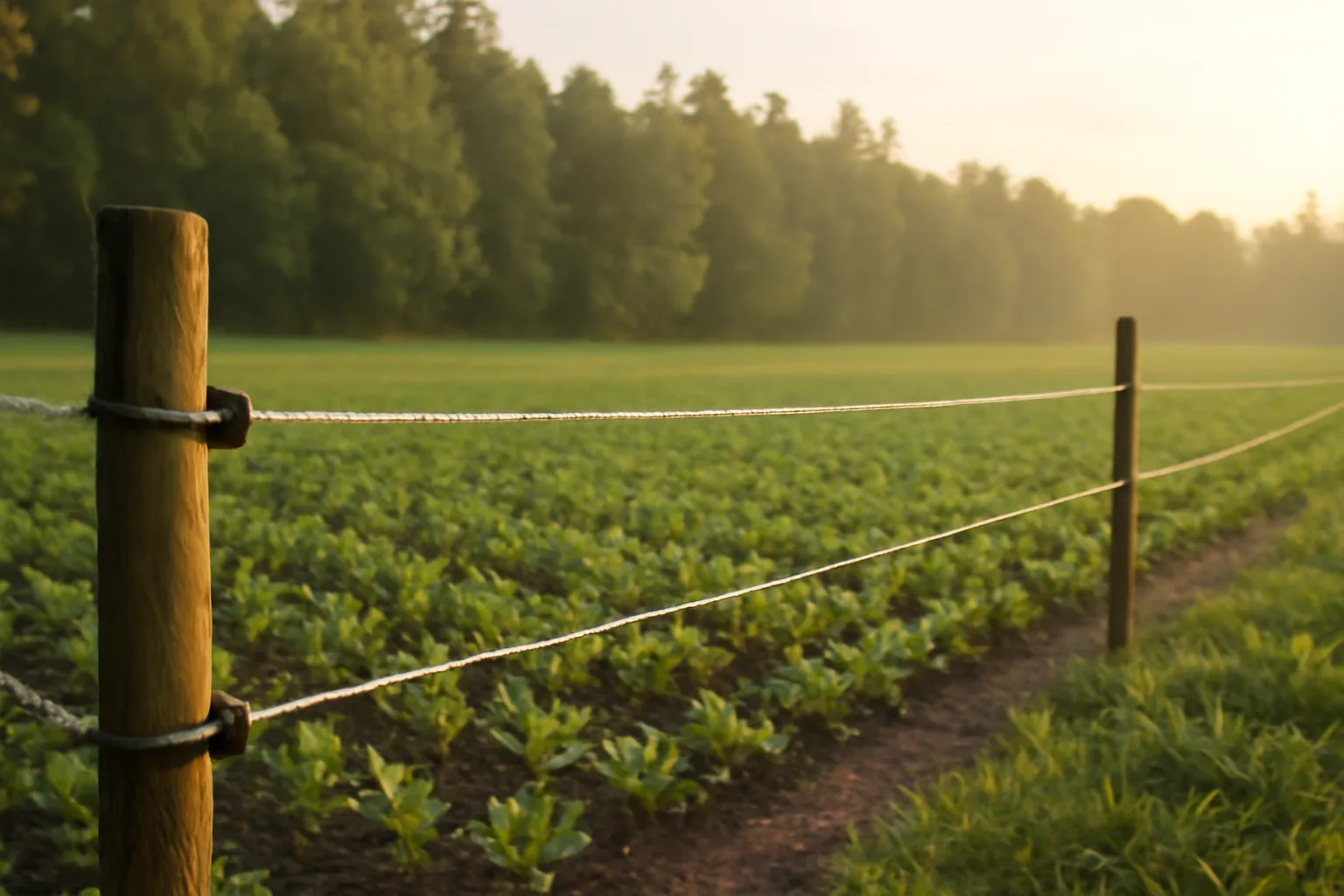
A food plot electric fence works by blocking deer from finding an opening, not by being too tall to jump. Poly-tape or high-tensile electric fencing at 4,000 to 6,000 volts, run 30 to 40 inches high, protects vulnerable brassica and soybean plots during the first 6 to 8 weeks of growth when deer pressure can wipe out a young stand.
what is a food plot, and why would you fence one
A food plot is a planted patch of forage on hunting land, usually somewhere between a quarter acre and a few acres, meant to feed deer and other wildlife while giving hunters a place to set up. Most plots run clover, brassicas, cereal grains, or soybeans. The problem with a food plot is timing. A newly planted brassica or soybean plot is basically a salad bar the moment it breaks ground, and deer will hit tender seedlings hard before the plants get any size on them. On small plots (under 2 acres) surrounded by heavy deer density, it is common for deer to browse a stand down to nothing before it ever reaches maturity. Fencing exists to buy the plant a head start. You don't need to fence every plot. Grain plots like corn or standing beans in big acreage rarely need it once established. Small brassica or clover plots on high-pressure ground, especially in the first 6 to 8 weeks after planting, are the classic case for temporary electric fence.
does a fence around a food plot actually keep deer out
Yes, but not because deer can't jump it. A whitetail can clear a fence 8 feet tall without much trouble. Electric plot fencing works because it teaches deer, through a mild shock and a psychological barrier, that the enclosed area isn't worth investigating, and because it removes the visual and physical invitation of an open edge. The practical target most fencing manufacturers recommend is a fence in the 30 to 42 inch height range using poly tape, poly wire, or electrified mesh, run with enough voltage that a deer's first contact is memorable. The USDA's National Wildlife Research Center, which studies deer damage management for agriculture, has documented that electrified fence designs work best when animals are trained to contact the wire directly, usually with an attractant like peanut butter smeared on foil tabs, in the first few days after installation, so the deer touches it nose-first rather than just brushing past it [1]. A single-strand fence trains deer fast but only protects small, low-value areas. Multi-strand or poly-mesh electric fencing protects more acreage but costs more and takes longer to set up. Full woven-wire exclusion fencing (7 to 8 feet tall) is the only fence type with near-total effectiveness, but it costs multiple dollars per linear foot and is usually reserved for research plots, orchards, or nurseries, not food plots on a hunting budget [2].
how tall does an electric fence need to be for deer
For a plot fence meant to condition deer to stay out, 30 to 40 inches is the standard height range used by most poly-tape and poly-braid systems marketed for food plots. That's short enough to install with step-in posts and no special equipment, and tall enough that a deer's nose or face makes contact when it approaches. Some trainers run a double strand, one at about 20 inches and one at about 40 inches, to catch both a deer's nose and its chest. This is closer to how orchard growers protect nursery stock, and it adds real protection without the material and labor of full exclusion fencing. Full deer-exclusion fence, the kind meant to physically block rather than train, needs to run 7 to 8 feet tall in most published deer damage management guidance, because deer can clear lower barriers without much effort [2]. That height is impractical for most food plot budgets. It's really a tool for permanent orchard or nursery protection, not a 1-acre brassica plot you're rotating every year.
how much voltage do you need to deter deer
Most deer-rated electric fence chargers are sold and rated in joules, and a low-impedance charger putting out 4,000 to 6,000 volts on the fence line is the commonly cited effective range for deer deterrence in wildlife damage and industry deer-fencing guidance [1][2]. Below that, deer with heavy hair coats (especially in late fall) may not get a strong enough jolt to associate the fence with pain. Solar chargers work fine for most plot setups since food plots are often far from grid power, but buy one rated for more fence length than you think you need. Voltage drops on longer runs, wet grass touching the bottom wire bleeds current, and a charger running at the bottom of its rated range in cold, dry conditions won't hit the same peak voltage it does in damp soil. Ground rods matter more than people expect. A fence with great voltage at the charger and poor grounding will still fail to shock an animal, because the circuit needs the deer, the wire, and a return path through the earth back to the charger. Fencing manufacturer specs commonly call for at least 3 feet of grounding rod per joule of charger output in dry or sandy soils, and more in rocky ground where conductivity is poor [2].
what type of electric fence works best for a food plot
Poly-tape is the most common choice for food plots because it's visible, cheap, and easy for a deer to see and avoid once trained. It comes in half-inch and one-inch widths, runs off step-in fiberglass or plastic posts, and a person can fence a half-acre plot in an afternoon without tools beyond a fence tester and some patience. Poly-wire is thinner and less visible than tape, which some growers like less, since a deer that doesn't see the wire at all can hit it hard, break the strand, and lose its fear of the whole setup. Poly-mesh, sold under names like electric deer netting, gives more physical presence and works well on irregular-shaped plots, though it costs more per foot and takes longer to roll out and tension correctly. High-tensile smooth wire, the kind used in permanent livestock fencing, isn't common for plots because it's overkill for a temporary application. It makes sense if you're fencing the same plot boundary every single year and want a fence that stays up through winter, but most plot hunters pull their fence once the plants outgrow the vulnerable stage.
when should you put a fence up and when should you take it down
Put the fence up at planting, or within a day or two after, before seedlings emerge and while the ground is disturbed enough that deer haven't already patterned the spot as easy pickings. Waiting until you see browse damage means you're fencing after the damage has already started. Most hunters pull the fence 6 to 8 weeks after planting for brassicas and soybeans, once the plants have enough leaf mass and root mass to tolerate some grazing without dying outright. Clover is a little different since it's a perennial forage that regrows after grazing, so some growers never fence clover at all and just accept some browse pressure as part of the plant's life cycle. A short fencing window matters for another reason: poly-tape left up through a full growing season gets brittle in UV light and loses tensile strength. Pulling it down after the vulnerable window not only saves the plant, it saves your fence material for next year's plot.
how much does it cost to fence a food plot
A basic poly-tape kit for a half-acre plot, step-in posts, tape, a solar charger, and a grounding rod, typically runs somewhere in the low hundreds of dollars depending on brand and plot perimeter length. Perimeter, not acreage, drives cost, so an oddly shaped plot with a long perimeter costs more to fence than a square plot of the same size. Compare that to what you lose without a fence. Seed, lime, and fertilizer for a half-acre brassica plot can run well past $100 once you add it all up, and a plot that gets browsed out in the first three weeks after emergence returns nothing on that investment. For small, high-value plots in heavy deer country, the fence often pays for itself the first season just by letting the crop survive to maturity. On larger plots, the math flips. Fencing the full perimeter of a 3 or 4-acre plot gets expensive fast, and it's often cheaper to plant extra acreage as a buffer and accept that deer will eat some percentage of it. Deer pressure gets diluted across more plants, and the marginal cost of a few extra pounds of seed is usually less than the marginal cost of fence material.
when to plant food plots for deer
Fence timing only matters if your plant timing is right in the first place. Spring plantings, clover, chicory, soybeans, generally go in after your last frost date, which lands roughly in the April through June window depending on your zone. These are the forages most likely to face grazing pressure early, since they're planted into a landscape where deer haven't had fresh green browse in months. Fall plantings, brassicas, cereal grains, winter wheat, go in 60 to 90 days before your first hard frost so the plants have time to mature before deer season and cold weather hit. Brassicas specifically benefit from a light frost, which converts starches to sugars and makes the leaves and bulbs sweeter and more attractive right when hunting season opens. Both planting windows are exactly when fencing matters most, since seedlings are most vulnerable in their first several weeks regardless of season.
Frequently asked questions
do deer eat sorghum
Yes. Deer will browse grain sorghum, especially the leaves and heads once they fill, and it's used both as a food plot grain and a screening/cover crop. It's more drought-tolerant than corn, which makes it a common substitute on sandy or low-rainfall ground, though whitetails generally prefer corn or soybeans when both are available.
do deer eat clover
Clover is one of the most consistently preferred food plot forages for whitetail deer. Extension forage trials repeatedly rank clover among the top-utilized plantings, and it regrows after grazing, which makes it more resilient to heavy browse pressure than a single-season crop like brassica or beans.
when to plant deer food plots
Timing depends on species and region. Spring plantings (clover, chicory, soybeans) generally go in after last frost, roughly April through June depending on zone. Fall plantings (brassicas, cereal grains, winter wheat) go in 60 to 90 days before your first hard frost so plants mature before deer season and cold weather hit.
do deer like clover
Yes, clover is a top-choice forage for whitetail deer through spring, summer, and fall, and its regrowth after grazing makes it more durable under heavy pressure than annual plantings. It's also relatively easy to establish and maintain compared to brassicas or grain plots.
when to plant oats for deer
Oats are typically planted as a fall food plot crop, usually 6 to 8 weeks before your average first frost date, so they establish before cold weather slows growth. In many whitetail regions that puts oat planting in the August to September window, though southern zones can plant later into fall.
when to plant food plots for deer
Spring/summer forages (clover, soybeans, chicory) go in after your last frost date, generally April to June depending on latitude. Fall forages (brassicas, oats, wheat, rye) go in late summer to early fall, 60 to 90 days ahead of your first killing frost, so they mature before hunting season.
when to plant turnips for deer
Turnips are a fall brassica and should go in roughly 80 to 100 days before your first hard frost, which lands most northern and mid-latitude plots in a late July through early September window. Turnips need cool weather to sweeten their bulbs and leaves, which is what draws deer to them later in fall.
what is a food plot
A food plot is a planted area, typically a fraction of an acre up to several acres, established on hunting land to provide supplemental forage for deer and other wildlife. Plots commonly use clover, brassicas, cereal grains, or soybeans, and serve both as a nutrition source and a hunting setup near travel corridors or bedding areas.
what are deer's favorite foods
Whitetail deer preferences shift by season, but extension forage studies and browse surveys consistently show clover, soybeans, and acorns rank among the most preferred foods, along with agricultural crops like corn when available. Preference also depends heavily on local availability, since deer default to whatever nutritious forage is easiest to reach.
do deer like honey
Deer don't naturally forage on honey in the wild, but some hunters use it diluted in water or mixed into mineral sites as an attractant scent, similar to molasses-based products. There's no established wildlife research showing honey as a meaningful food source or attractant compared to actual forage crops or mineral supplementation.
is an electric fence around a food plot legal everywhere
Fence construction itself is generally legal, but using an electric fence in combination with feed, minerals, or attractants can run into state baiting and feeding regulations. Rules vary significantly by state and sometimes by county, so check your state wildlife agency's baiting and feeding regulations before combining a fence with any attractant.
how long do you need to keep a fence up around a food plot
Most hunters pull temporary poly-tape fencing once plants get past the vulnerable seedling stage, typically 6 to 8 weeks after planting for brassicas and soybeans. Once plants have enough leaf mass and root structure to tolerate browsing without dying, the fence has done its job and can come down or move to the next plot.
what's cheaper, electric fence or just planting more acres
For small plots (under an acre) in high deer density areas, electric fence materials often cost less than the seed, lime, and fertilizer wasted on a plot that gets browsed out before maturity. On larger plots (2+ acres), planting extra acreage as a buffer is often cheaper than fencing the whole perimeter, since deer pressure gets diluted across more plants.
Sources
- USDA NRCS, Conservation Practice Standard: Wildlife Habitat Planting (Code 420): Food plots and wildlife habitat plantings are treated as a conservation and habitat management practice, not a standard agricultural crop.
- USDA National Wildlife Research Center, Deer-Resistant Fencing research summary: Electric fence effectiveness against deer depends on training deer to contact the fence with an attractant early in installation.
- Purdue University Extension, Controlling Deer Damage in Indiana (FNR-503): Full deer-exclusion fencing needs to be 7 to 8 feet tall, and chargers in the 4,000 to 6,000 volt range are recommended for deer deterrent fencing.
- University of Georgia Extension, Deer Damage Control (Bulletin 1204): Small food plots surrounded by high deer density commonly experience total browse loss before plants reach maturity without protective fencing.
- Cornell Cooperative Extension, Wildlife Damage Management Fact Sheet Series: White-tailed Deer: Attractants applied to fence lines during installation help train deer to associate the fence with a negative stimulus rather than ignore it.