Last updated 2026-07-25
TL;DR
Food plot deer seed generally falls into three buckets: cereal grains (oats, wheat), brassicas (turnips, radish), and legumes (clover, chicory). Deer eat all of them readily once established. Timing depends on your zone: clover and warm-season plots go in spring, brassicas and cereal grains go in late summer, roughly 60 to 90 days before your first frost.
what is a food plot, exactly
A food plot is a planted area, usually somewhere between a quarter acre and several acres, seeded specifically to feed and attract deer or other wildlife. It's not a lawn and it's not a crop field in the farming sense, though it uses a lot of the same equipment and agronomy. Landowners plant them on private or leased ground to supplement natural browse, hold deer through hunting season, and in a lot of cases, just to watch deer do their thing from a blind or stand. The USDA Farm Service Agency and state wildlife agencies both recognize food plots as a legitimate wildlife habitat practice, and some states even offer cost-share programs for pollinator or wildlife plantings that overlap with food plot seed mixes [1]. That said, a food plot is different from baiting. Baiting means placing loose feed, usually corn or minerals, to attract animals for a shot. A food plot is a rooted, growing planting. Some states treat them identically under baiting law, some don't. Check your state agency's current hunting regulations before you assume a plot is automatically legal to hunt over, since the line between "plot" and "bait" gets drawn differently depending on where you hunt [2]. Most food plots fall into two categories: annual plots (replanted every year, higher yield, more work) and perennial plots (clover, alfalfa, chicory blends that last two to five years with maintenance). A lot of serious plotters run both, using annuals for fall attraction and perennials as a spring-through-fall protein base.
what do deer actually prefer to eat in a food plot
| White/red clover | Spring or late summer | High, especially spring/summer | Perennial protein base | |
|---|---|---|---|---|
| Soybeans (forage type) | Late spring | Very high | Summer annual, high protein | |
| Brassicas (turnips, radish) | Late summer | Moderate to high, rises after frost | Fall/winter carb source | |
| Oats | Late summer/fall | High in fall | Fall attraction, easy establishment | |
| Winter wheat | Fall | Moderate to high | Fall/winter attraction, cold tolerant | |
| Grain sorghum (milo) | Late spring | Moderate | Summer cover plus fall/winter seedhead | |
| Chicory | Spring | High | Drought-tolerant perennial component | None of this guarantees deer will show up on your ground on a given evening. Deer activity depends on pressure, weather, and the surrounding ag and mast conditions that year, more than what you planted. |
Deer are ruminants with a strong preference for high-protein, high-digestibility forage, and research consistently shows clover and other legumes rank at or near the top of preferred food plot species. University plot trials and forage preference research rank white clover, alfalfa, and soybeans among the highest-preference plantings, with brassicas and cereal grains close behind, especially after a frost sweetens them up [3]. In practical terms, deer don't have one single "favorite." It shifts by season and by what's locally available. In spring and summer, deer key in on clover, soybeans, and alfalfa for protein during antler growth and lactation. In fall, they shift toward carbohydrate-dense foods like acorns, corn, and brassicas as they build fat reserves for winter. A plot that offers both a legume and a brassica or cereal grain component tends to get hit harder across more of the season than a single-species plot. Here's a rough comparison of common food plot species and how deer typically respond to them: | Species | Season planted | Deer preference | Typical use |
do deer like clover
Yes, and it's one of the most reliable food plot plantings available. White clover and red clover both rank high in deer preference studies and provide protein levels commonly in the 20 to 30 percent range on a dry matter basis once established, according to forage quality data summarized by university extension programs. Clover's real advantage isn't just preference, it's duration. A well-maintained perennial clover stand can produce quality forage for three to five years before it needs to be reseeded, provided you mow it a few times a season to knock back weeds and keep the plant in a vegetative, protein-rich state. Clover does go semi-dormant in the coldest part of winter and during summer drought, so it's rarely your best late-season option. Pair it with a fall annual for a plot that pulls double duty. Penn State Extension notes that clover and other perennial plots are among the more cost-effective wildlife plantings once soil pH and fertility are corrected [4].
do deer eat sorghum
Yes, deer eat grain sorghum, commonly called milo, though it's usually a secondary or standing-cover component rather than a primary attractant crop. Deer browse young sorghum plants in summer and will hit the seedheads in fall and winter, particularly once other food sources thin out. It's more common in food plot mixes as a cover crop or a component of a wildlife blend than as a standalone planting. Sorghum's biggest strength is drought tolerance and standing structure. It handles heat and poor soil better than corn, and the standing stalks provide bedding cover and screening into late winter, which matters as much for deer holding on your property as the food itself does. If your goal is maximum deer preference, clover, soybeans, or brassicas will out-perform sorghum. If your goal is a tough, low-input planting that still puts food in front of deer through winter, sorghum earns a spot in the mix.
do deer like honey
Deer aren't drawn to honey the way people sometimes assume from marketing around "honey hole" plot names or scented attractants. Deer are herbivores and their preference is driven by protein, sugar content in forage, and fiber digestibility, not honey itself. There's no field research showing deer seek out honey as a food source. Wild deer diets are documented by state wildlife agencies as browse, forbs, mast, and agricultural crops, not sweeteners. Where the confusion usually comes from: some commercial mineral licks and attractant sprays use molasses or sugar-based scent carriers, and deer will investigate those. That's a scent and sugar-crave response similar to what draws them to apples or persimmons, not evidence of a honey preference specifically. If you're picking food plot seed for real nutritional value, skip novelty attractants and put your budget into clover, brassicas, or beans.
when to plant food plots for deer
| Deep South (zones 8-9) | March-April | September-October | |
|---|---|---|---|
| Mid-South/Transition (zones 7) | March-May | August-September | |
| Midwest/Mid-Atlantic (zones 5-6) | April-May | late July-August | |
| Northern tier (zones 3-4) | May-June | late July-mid August | If you want a planting calendar built around your actual coordinates rather than a broad regional guess, that's the kind of detail a soil-test-backed plan handles better than a generic calendar ever will. |
Timing splits into two windows almost everywhere in whitetail range: a spring/early summer window for warm-season and perennial plantings, and a late summer window for fall annuals. The exact dates shift by 3 to 6 weeks from the Gulf Coast to the northern Midwest, so your local frost dates matter more than any national calendar. As a rough framework: spring plots (clover, soybeans, chicory, sorghum) go in after your last frost date, generally April through early June depending on latitude. Fall plots (brassicas, oats, wheat, cereal rye) go in 60 to 90 days before your first fall frost, which for most of the whitetail's range falls between late July and early September. The USDA Plant Hardiness Zone map and your state's cooperative extension frost date tables are the two references worth bookmarking for your specific county [5]. Here's a general zone breakdown: | Region (USDA zone approx.) | Spring plot window | Fall plot window |
when to plant oats for deer
Plant oats 6 to 10 weeks before your area's average first fall frost so the plants have time to establish a leafy canopy before growth slows. For most of the whitetail's range that means a window from mid-July in the far north down to mid-September in the Deep South. Oats are one of the fastest-establishing cereal grains, often showing green growth within 5 to 7 days of planting given decent soil moisture, which makes them a favorite for hunters seeding close to opening day. They're also one of the more cold-sensitive cereal grains. Oats generally winterkill somewhere in the low 20s Fahrenheit, noticeably less hardy than winter wheat or cereal rye, so in far northern zones oats function as an early-fall attraction crop rather than a food source that lasts into deep winter [6]. If you want fall attraction plus food that survives into January, pair oats with wheat or a brassica so something's still standing after the first hard freeze takes the oats out.
when to plant turnips for deer (and other brassicas)
Plant turnips and other brassicas (radish, rape, kale) 60 to 90 days before your first expected fall frost. That translates to roughly late July through mid-August across most of the Midwest and Northeast, and into early September in the Deep South. Brassicas need that long runway to bulb out and build the sugar content that makes them attractive later in the season. Here's the part a lot of first-time planters miss: brassicas often get ignored by deer for the first several weeks after they come up, then get hammered hard after the first hard frost. Cold temperatures convert starches in the plant to sugars, which is why a turnip plot that deer walked past in October can get eaten to nubs by December. Extension research on brassica forage quality backs this up, noting improved palatability and digestibility following frost exposure . Don't panic and assume the plot failed if deer aren't hitting it hard before the first freeze. That's often exactly on schedule. For a deeper species-by-species breakdown of brassica options and blend ratios, see food plot whitetail and deer food plot seed.
how do you pick the right seed mix for your ground
Start with a soil test, not a seed bag. Your local cooperative extension office or a private ag lab can run a soil test for somewhere between $10 and $20 in most states, and it'll tell you pH and baseline nutrient levels, the two things that determine whether any seed you plant actually thrives . A $40 bag of premium clover seed planted into soil at pH 5.0 will underperform a $15 bag of cheap clover planted into corrected, limed ground at pH 6.5 to 7.0, which is the range most legumes want according to university extension guidance [4]. After the soil test, match species to your goals and your season. If you're building a plot for spring and summer nutrition, lean legume: clover, soybeans, alfalfa. If you're building for fall hunting season attraction, lean brassica and cereal grain: turnips, radish, oats, wheat. Most experienced plotters run a mix of both, either as separate plots or as a blended planting with a legume component and a fall annual overseeded into it later in the season. Your soil test lab is the actual authority on how much lime and fertilizer your specific ground needs. Recommendations vary by soil type, region, and existing nutrient levels, and no generic article, including this one, can replace that number. If you want a planting plan built from your test results and coordinates rather than a one-size-fits-all seed bag label, that's exactly what a Custom Food Plot Plan is for. It's a $99 one-time report, not a subscription, and it's built around your soil test and your zone rather than a national average.
what equipment do you actually need to plant a food plot
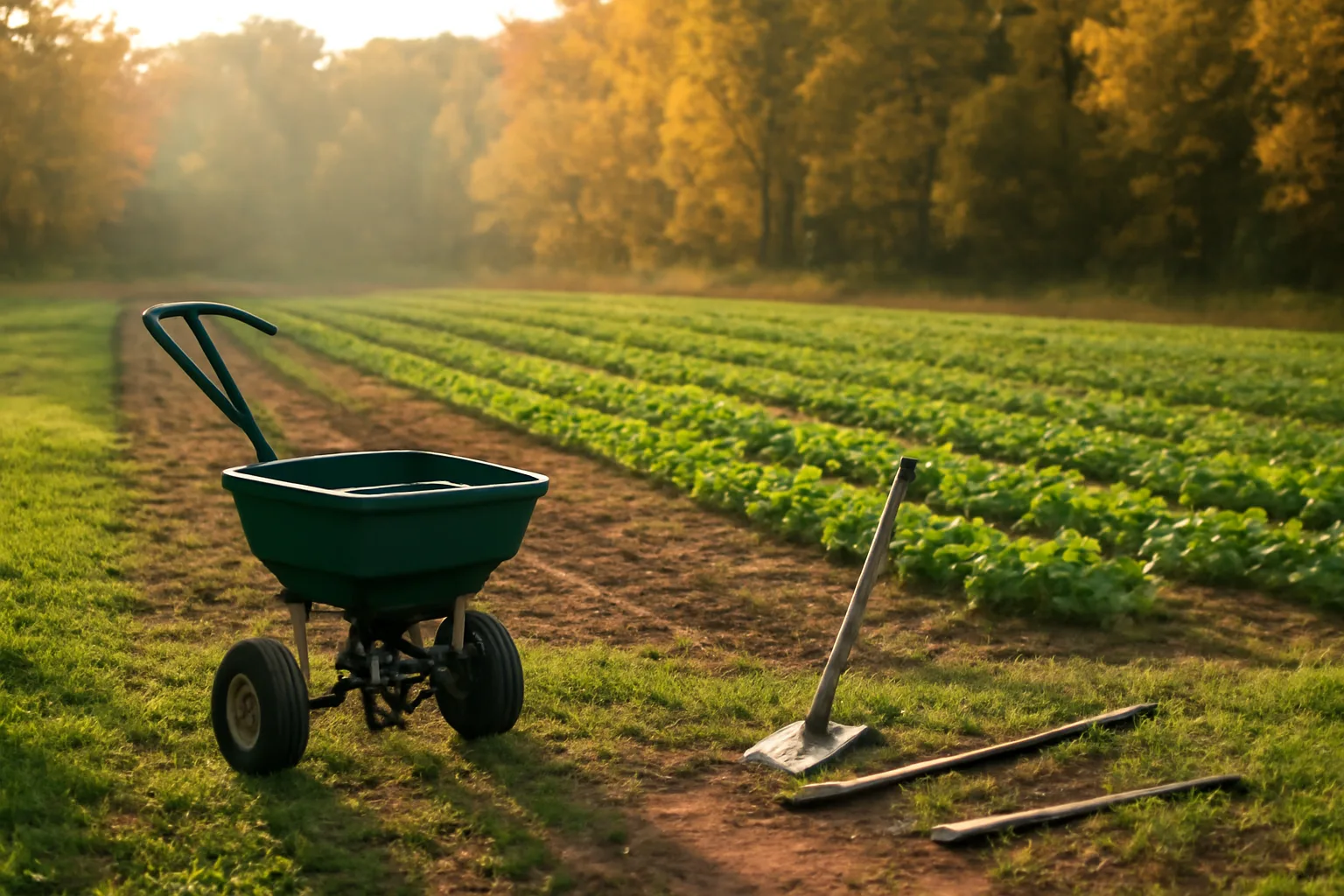
At minimum, you need something to kill or suppress existing vegetation, something to work or scratch the soil, a way to spread seed, and a way to get seed-to-soil contact. That can mean a full tractor and disc setup, or it can mean a UTV, a hand spreader, and a chain drag for a half-acre plot. Neither approach is wrong. It depends on plot size and budget. For plots under an acre, a lot of hunters get by with a broadcast spreader, a roller or cultipacker (or a homemade drag made from chain-link fence and cinder blocks), and glyphosate or a similar herbicide to knock down existing sod before planting. For plots over 2 to 3 acres, a tractor with a disc, a drill or no-till drill, and a sprayer boom start paying for themselves in time saved. Depth matters more than most people think. Clover and brassica seed is planted at 1/4 inch or shallower, while oats, wheat, and sorghum need 1 to 1.5 inches of coverage. Planting cereal grains too shallow or legume seed too deep is one of the most common reasons a plot fails to establish . See deer food plots and food plot seed for equipment-specific breakdowns by plot size.
do you need to worry about baiting laws when planting a food plot
In most states, a properly planted, rooted food plot is legal to hunt over and is not considered baiting, but the definitions and exceptions vary enough that you should check your specific state wildlife agency's regulations before hunting a new plot, especially if it's small, thin, or recently disturbed. Some states draw a hard line based on whether the planting follows generally accepted agricultural practices, and a poorly established or obviously supplemented plot can get reclassified as bait in an enforcement dispute [2]. A few states also restrict or ban supplemental feeding and mineral use separately from food plot rules, sometimes tied to Chronic Wasting Disease management zones. Several states have specific feeding bans in CWD-affected counties that are worth checking even if your food plot itself is fully legal. The short version: a real, established food plot is almost always fine, but "almost always" isn't "always," and a five-minute look at your state agency's hunting regulations page before season is cheap insurance.
how much does it cost to plant a food plot
Seed costs run anywhere from about $15 to $20 per acre for cheap annual cereal grains like oats, up to $40 to $60 per acre or more for premium perennial clover blends, with brassica and multi-species mixes usually landing in the $20 to $35 per acre range depending on brand and blend . Lime and fertilizer, driven by your soil test results, often cost as much as or more than the seed itself, particularly if your pH needs significant correction. Ag lime commonly runs $30 to $60 per ton delivered and spread, and a legume plot needing a full ton per acre to correct pH isn't unusual on acidic ground . Add equipment costs (or rental/custom work if you don't own a tractor) and herbicide, and a realistic all-in cost for a well-prepared acre often lands between $100 and $250 depending on how much lime correction you need and whether you're renting equipment. Skimping on lime to save money is one of the most common mistakes. Extension data consistently shows uncorrected soil pH suppresses nutrient uptake regardless of how good the seed or fertilizer program is [4].
Frequently asked questions
Do deer eat sorghum in food plots?
Yes. Deer browse young grain sorghum (milo) in summer and eat the seedheads in fall and winter. It's more often used as a drought-tolerant cover and standing-grain component in a mix than as a primary standalone attractant, since clover, soybeans, and brassicas generally rank higher in deer preference studies.
Do deer like clover food plots?
Yes, clover is one of the highest-preference food plot species, offering roughly 20 to 30 percent protein on a dry matter basis once established. A well-maintained perennial clover stand can last three to five years, though it goes semi-dormant in deep winter and drought, so pairing it with a fall annual covers more of the calendar.
When should you plant food plots for deer?
Spring plots (clover, beans, chicory) go in after your last frost, generally April through early June depending on latitude. Fall plots (brassicas, oats, wheat) go in 60 to 90 days before your first fall frost, roughly late July through early September across most of whitetail range. Check your local extension frost-date tables for exact timing.
When should you plant oats for deer?
Plant oats 6 to 10 weeks before your area's average first fall frost, generally mid-July in northern zones to mid-September in the Deep South. Oats establish fast, often showing growth within a week, but winterkill in the low 20s Fahrenheit, so they work best as early fall attraction rather than a food source that lasts through deep winter.
When should you plant turnips for deer?
Plant turnips and other brassicas 60 to 90 days before your first expected fall frost, roughly late July through mid-August in most of the Midwest and Northeast, later into early September further south. Brassicas often get ignored until after the first hard frost, when cold converts plant starches to sugar and palatability jumps.
What is a food plot exactly?
A food plot is a planted area, usually a quarter acre to several acres, seeded specifically to feed and attract deer or other wildlife. It's different from baiting (placing loose feed), since a food plot is a rooted, growing planting, though some states regulate poorly established plots similarly to bait, so check your state wildlife agency's rules.
What are deer's favorite foods overall?
There's no single favorite; preference shifts by season. In spring and summer deer favor high-protein forage like clover, soybeans, and alfalfa. In fall they shift toward carbohydrate-dense foods like acorns, corn, and brassicas as they build fat for winter. Local availability of natural mast also strongly affects what shows up as "preferred" on any given property.
Do deer like honey?
No good evidence supports deer specifically seeking out honey. Wild deer diets documented by wildlife agencies consist of browse, forbs, mast, and crops, not sweeteners. Some commercial attractants use molasses or sugar carriers that draw a sugar-crave response similar to apples, but that's not evidence of a honey preference.
What's the difference between annual and perennial food plot seed?
Annual seed (oats, wheat, brassicas, soybeans in most climates) is replanted every year and often produces higher tonnage per acre. Perennial seed (clover, alfalfa, chicory blends) establishes once and can produce forage for three to five years with mowing and maintenance, generally at lower cost per year but with less peak yield than annuals.
Is a small food plot, like a half acre, worth planting?
Yes, a half-acre plot can still hold and attract deer, particularly in wooded terrain where it functions as a hidden feeding pocket rather than an open field. Smaller plots take more browse pressure relative to their size though, so a hardy species like brassicas or a thick clover stand tends to hold up better than thin cereal grain on tiny plots.
Do I need to test my soil before planting a deer food plot?
Yes, strongly recommended. A soil test, usually $10 to $20 through your local cooperative extension office, tells you pH and nutrient levels, which determine whether lime or fertilizer is needed before seed even goes in the ground. Planting good seed into uncorrected acidic soil is one of the most common reasons food plots fail to perform.
Are food plots legal to hunt over, or are they considered baiting?
In most states a properly planted, rooted food plot is legal to hunt over and isn't classified as baiting. Definitions vary by state though, and some tie the exception to generally accepted agricultural practices. Check your state wildlife agency's current regulations, especially in Chronic Wasting Disease management zones where supplemental feeding may be separately restricted.
Sources
- USDA Farm Service Agency, Conservation Reserve Program overview: Food plots and wildlife plantings overlap with federally recognized conservation and wildlife habitat programs
- Noble Research Institute, forage and wildlife management publications: Clover, alfalfa, and soybeans rank among the highest-preference food plot forages for whitetail deer
- Pennsylvania Game Commission, white-tailed deer natural history and diet: Wild deer diets consist of browse, forbs, mast and agricultural crops rather than sweeteners like honey
- University of Missouri Extension, G9111 Soil Testing for Lawns, Gardens and Wildlife Plots: Basic soil test costs and the role of soil pH correction (liming) in food plot establishment
- Wisconsin Administrative Code NR 19, Wildlife and Feeding Restrictions in CWD Management Zones: Some states restrict supplemental feeding separately from food plot rules in CWD-affected counties
- Iowa State University Extension, Ag Decision Maker A1-70, Wildlife Food Plot Establishment Costs: Per-acre seed cost ranges for common food plot species including cereal grains, brassicas, and perennial legumes