Last updated 2026-07-25
TL;DR
A dedicated corn planter isn't required for most food plots. A drill or even a broadcast-and-cultipack setup can grow usable corn plots, though a planter gives better singulation and stand uniformity. Corn wants 30-36 inch rows, roughly 24,000-32,000 seeds per acre, planted when soil hits 50°F, and it needs real fertility to yield anything worth hunting over [1][2].
do you actually need a corn planter for a food plot?
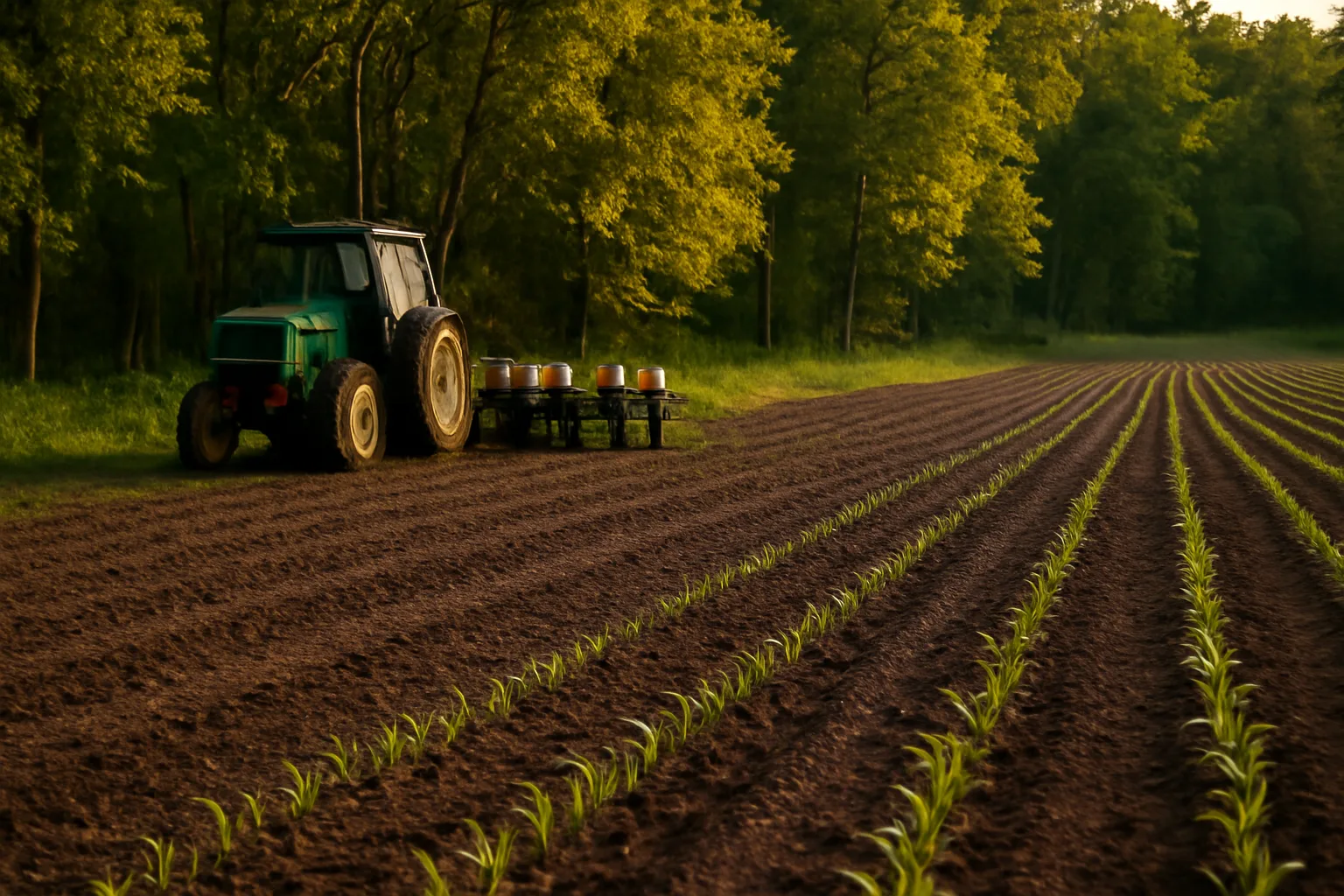
No, not strictly. A row-crop corn planter (the kind that singulates seed and drops it at a set depth and spacing) gives you the most even stand and the best seed-to-soil contact, which matters a lot for corn specifically because it doesn't tiller and fill gaps the way a grass or a brassica will. But plenty of food plotters grow decent corn with a grain drill set on wide row spacing, or even by broadcasting seed and dragging a cultipacker behind an ATV. The honest tradeoff is stand uniformity versus cost and hassle. A used 2-row or 4-row corn planter runs anywhere from a few hundred dollars for an old ground-driven John Deere 71 or Allis-Chalmers unit at an auction, up into the thousands for something newer with seed monitors. If you're only planting an acre or two a year, that expense is hard to justify next to a $1,500-$3,000 disc harrow and cultipacker combo you're probably already using for everything else. What you lose without a planter is precision. Broadcast corn tends to come up patchy, with some seed too deep, some sitting on the surface where turkeys and crows clean it up. University extension corn guidance consistently points to planting depth of 1.5 to 2 inches as the target for good germination and root development [1]. A planter nails that every time. A drag or a disc-and-cultipack setup gets you in the ballpark, not a guarantee. If you're food plotting on a budget and corn is just one piece of a bigger rotation, a used planter borrowed or rented for a weekend, or a no-till drill dropped to a wide row spacing, is a completely reasonable call. If corn is your main destination plot and you're planting several acres every year, owning or renting a real planter starts paying for itself in stand quality pretty fast.
what row spacing and seeding rate does corn actually need?
| Row spacing | 30 in | 30-36 in | |
|---|---|---|---|
| Seeding rate | 30,000-35,000 seeds/ac [2] | 24,000-32,000 seeds/ac | |
| Planting depth | 1.5-2 in [1] | 1.5-2 in | |
| Soil temp to plant | 50°F and rising [1] | 50°F and rising | If you're broadcasting instead of drilling or planting in rows, bump your seeding rate up by roughly 15-20% to account for uneven depth and germination loss, and expect a rougher-looking stand regardless. |
Standard row-crop corn is planted in 30-inch rows, though 36 and even 38-inch rows show up on older equipment and in some plot situations. Land-grant agronomy guidance centers commercial grain corn seeding rates around 30,000 to 35,000 seeds per acre for optimum yield, with the exact number depending on soil productivity and hybrid [2]. Food plot corn doesn't need to chase max bushel yield. Most food plot mixes and standalone corn plantings run a bit lower, often 24,000 to 32,000 seeds per acre, because the goal is standing forage and grain into winter, not a combine yield check. Dropping the rate slightly also helps stalks stay a little sturdier and the ears fill out more per plant when fertility is limited. Here's a quick reference for what that looks like on the ground. | Metric | Typical commercial corn | Typical food plot corn |
when to plant food plots for deer, and where corn fits
Timing splits into two seasons: spring/summer plots (corn, soybeans, sorghum, some clovers) and fall plots (brassicas, cereal grains, clover establishment). Corn is strictly a spring planting. You want soil temperature at or above 50°F and climbing before you drop seed, which mirrors standard row-crop agronomy guidance from state extension corn programs [1]. In practical terms that means late April into May across most of the whitetail's range, sliding into early June in the northern tier (Wisconsin, Minnesota, Michigan, southern Canada border states) and possible as early as late March in the Deep South. Your local NRCS or extension frost-date and soil-temperature data is the actual authority here; a soil thermometer costs about $10 and removes the guesswork. Because corn needs 90 to 120+ frost-free days depending on the hybrid's maturity rating, planting late is riskier than planting a touch early into cool soil, especially in northern zones where an early frost can catch immature ears. Choose a shorter-season hybrid (rated in relative maturity days, something in the 85-100 day range) if you're gambling on a late planting window or a short growing season. For a full breakdown of what to plant and when across the rest of the calendar, when to plant food plots for deer covers the fall side of the equation in more depth, and food plot whitetail walks through season-long plot planning.
when should you plant oats for deer food plots?
Oats are a fall (and sometimes early spring) cool-season cereal grain, and they're one of the easiest, most forgiving plots you can plant. Extension and wildlife agency guidance generally recommends planting oats roughly 45 to 60 days before your area's first killing frost, which lands most plotters somewhere in the August-to-September window depending on latitude, consistent with general cool-season forage establishment timing from land-grant extension programs [3]. Oats germinate fast, often in 5 to 7 days under decent moisture, and deer hit them hard as soon as they're a few inches tall. They don't overwinter reliably north of the transition zone though; hard freezes kill oats outright in much of the whitetail's northern range, so they function as an attractant plot through fall and early winter rather than a year-round stand like winter wheat or cereal rye. A lot of plotters blend oats with brassicas or with a cereal rye/wheat mix specifically because oats come up fast and pull deer to the plot early, while the slower brassicas and winter-hardy grains take over as the oats die back with cold weather.
when to plant turnips for deer food plots
Turnips go in mid to late summer, generally 90 to 100 days before your first expected frost, so most of the country is looking at a July or August planting window, following the same lead-time logic extension programs use for other fall brassica plantings [3]. Turnips need that lead time to bulb out and build sugar content; a frost or two actually improves palatability because it converts starches to sugars, which is part of why deer often ignore turnip plots early in the fall and hammer them in December and January. Seeding rate for turnips alone runs around 4-5 lbs per acre broadcast, planted no deeper than a quarter inch, which is shallow enough that a cultipacker after broadcasting works better than trying to drill them. Turnips are frequently blended with radish and rape in a brassica mix rather than planted solo, since a mono-stand of turnips can look thin if germination is spotty. One real caution: turnip bulbs are a late-season food source, and deer often eat the tops first, then switch to digging up bulbs only once the ground softens or once easier browse is gone. Don't judge a turnip plot's success in October. Judge it in January.
what is a food plot?
A food plot is a planted patch of forage, grain, or browse specifically established to feed and attract wildlife, most commonly whitetail deer, on land the planter owns, leases, or manages. Food plots range from quarter-acre kill plots tucked into timber to multi-acre destination fields of corn, soybeans, or clover meant to hold deer through a season. State wildlife agencies generally treat food plots differently from baiting or supplemental feeding under law, because the food is grown in place rather than trucked in and piled, but the legal line varies a lot by state. Some states classify standing food plots as legal hunting-over even where baiting is banned; others regulate plot size, distance from stands, or require the crop to be planted using normal agricultural practice rather than just scattered. Check your specific state wildlife agency's regulations before you plant and before you hunt over a plot, since baiting and feeding definitions differ meaningfully state to state, as Michigan's own baiting and feeding order makes clear when it distinguishes standing crops from placed feed [4]. Agronomically, a food plot is just farming at a small scale: soil test, lime and fertilize to that test, pick a species suited to your season and soil, plant at the right depth and rate, and manage weeds and browse pressure. The wildlife goal doesn't change the plant science.
do deer eat sorghum?
Yes, deer eat sorghum, both the grain heads and the green forage, and it's a legitimate warm-season food plot option, especially in the South and in drier regions where corn struggles. Grain sorghum (milo) tolerates drought and poor soil better than corn does, which is a big reason extension programs promote it as a wildlife planting option on marginal ground in dry regions like the Southern Plains [5]. Deer use is generally considered moderate rather than a top preference; sorghum isn't usually deer's first choice next to soybeans, clover, or standing corn, but it holds up as a late-season standing grain source when other plots are grazed out, and turkey and other wildlife use it heavily too. Sorghum seeding rates for wildlife plots run lower than solid-stand grain sorghum farming, often 6-10 lbs per acre broadcast or drilled at roughly 1 inch deep. One real advantage: sorghum's drought tolerance means it's a reasonable backup or companion planting to corn on sandy or shallow soils where a corn crop is a coin flip most years.
do deer eat clover, and do deer like clover?
Yes on both counts, and by most wildlife agency and extension accounts, clover is one of the most consistently preferred food plot forages available to whitetail deer across their range. Clover is high in protein, typically 20-25% crude protein in vegetative growth, which matters most in spring and summer during antler growth and lactation. White clover (Ladino and similar varieties) and red clover are the two most common food plot types. White clover tolerates closer grazing and lasts several years in a stand if managed with mowing and occasional herbicide for grass competition; red clover grows more upright, produces more tonnage per cutting, but doesn't persist quite as long under heavy deer pressure. Clover's real strength is that it's a perennial (2-5 years typically per stand depending on variety and management) that provides forage from spring through fall, unlike corn or brassicas which are single-season plants. That makes clover a common anchor for a food plot system, paired with annual grain plots like corn or oats for fall and winter tonnage. For seed selection specifics across clover and other perennial and annual options, deer food plot seed breaks down variety choices in more detail.
what are deer's favorite foods, and do deer like honey?
Deer preference shifts by season, region, and what's available, so there's no single universal favorite, but agricultural forages that repeatedly top preference studies and extension forage-testing include soybeans, clover, and standing corn, alongside native browse like honeysuckle, greenbrier, and various forbs depending on region. Acorns are arguably the single most sought-after natural food in fall across the whitetail's range when they're available, often pulling deer off planted plots entirely during a good mast year. As for honey: no, deer don't eat honey, and it's not a real food plot or attractant question in any practical sense. It may come up because of "honey hole" terminology hunters use for a great stand location, or confusion with molasses-based mineral and attractant products, which deer do use readily for the sugar and salt content. If you're looking at a commercial attractant, check the ingredient list; most are corn, molasses, or salt-based, not honey-based, and their legality as an attractant near a hunting stand follows the same state baiting rules as any other supplemental feed [4].
what equipment do you actually need to plant a corn food plot?
At minimum: something to kill or turn under existing vegetation, something to work the seedbed, a way to get seed in the ground at the right depth, and a way to firm the soil afterward. That's it. The specific tools vary a lot by budget and acreage. A no-till approach uses a sprayer (even a UTV-mounted 15-25 gallon unit) to kill existing growth with glyphosate, then a no-till drill to plant directly into the dead sod or stubble. This saves a tillage pass and works well on erosion-prone ground. A conventional approach uses a disc harrow or tiller to work the seedbed, a planter or drill (or broadcast spreader) to seed, and a cultipacker to firm the soil and improve seed-to-soil contact. For corn specifically, seed depth control matters more than with a lot of other food plot species, since corn planted too shallow dries out and corn planted too deep struggles to emerge. A row-crop planter with a seed metering unit and depth-gauge wheels is the gold standard. A grain drill set to a wide row spacing (or with every other row blocked off) is a solid second option. Broadcasting corn and dragging it in works, but expect a rougher stand and budget for a higher seeding rate to compensate. If you're weighing your whole equipment list against your budget and acreage rather than just the corn question, food plot seed and deer food plots both cover broader setup decisions, and a soil test from your county extension office or a private ag lab (usually $10-20 per sample) should come before any of it, since lime and fertilizer needs from that test are the real authority on what your ground needs, not a generic recommendation.
fertility, lime, and why corn is an unforgiving crop to skimp on
Corn is one of the most fertility-demanding common food plot species, full stop. It's a heavy nitrogen feeder, and university agronomy guidance for grain corn commonly recommends total nitrogen rates in the range of 1.0 to 1.2 lbs of N per bushel of yield goal, meaning a modest 100-bushel goal can call for well over 100 lbs of actual nitrogen per acre across the season [6]. Food plot corn doesn't need to chase 200-bushel yields, but it still needs real nitrogen, not a token starter application. Phosphorus and potassium needs, and lime requirements to get pH into the 6.0-6.8 range corn prefers, are genuinely site-specific and depend on what your soil test says your existing levels are. This is exactly why a soil test matters more for corn than for almost any other food plot species: guess wrong on nitrogen and you get pale, stunted stalks and small or missing ears; guess wrong on lime and none of the fertilizer you apply gets used efficiently by the plant anyway. Your soil test lab's recommendation is the real authority here, not a bag rate on a fertilizer label or a rule of thumb from a forum post. If you want a starting framework for putting together a planting plan across species and soil types before you get too far into equipment decisions, PlotSeason's $99 one-time Custom Food Plot Plan builds a general plan around your soil test results and property goals; it's general guidance layered on your actual test numbers, not a replacement for what your soil lab tells you to apply.
corn versus other spring food plot options: is it worth the equipment investment?
| Corn | Late spring (soil 50°F+) [1] | 24,000-32,000 seeds/ac | High (planter or drill ideal) | Yes, if not lodged/eaten early | |
|---|---|---|---|---|---|
| Soybeans | Late spring/early summer | 150,000-180,000 seeds/ac | Moderate (drill or planter) | Poor, pods drop, deer clean up fast | |
| Sorghum | Late spring | 6-10 lbs/ac | Low-moderate | Yes, drought-tolerant standing grain | |
| Oats | Late summer/fall | 2-3 bu/ac | Low (broadcast fine) | No, dies with hard freeze | |
| Clover (white) | Spring or fall | 6-8 lbs/ac | Low (broadcast, cultipack) | Perennial, dormant in winter | If you're planting less than a couple acres a year and don't already own tillage and planting equipment, sorghum, oats, or clover give you a lot less risk and cost for a comparable or better deer draw in many situations. Corn earns its keep on larger destination-field plots where you've already got the fertility program and equipment in place. |
Corn is expensive to grow well (seed, fertilizer, and equipment costs all run higher than most alternatives) and it's genuinely hard to grow without decent equipment and real soil fertility behind it. So it's fair to ask whether it's worth it compared to soybeans, sorghum, or a simpler perennial clover plot. The case for corn: standing grain through winter, when other food sources are gone, is a strong late-season draw in a lot of regions, and it doubles as cover. The case against: it's the most input-heavy and equipment-dependent option on this list, deer often prefer soybeans or clover when both are available and green, and a bad corn stand (patchy germination, deer browsing young shoots to nothing, drought during pollination) can waste a whole season's fertilizer budget with nothing to show for it. | Species | Planting window | Seeding rate | Equipment need | Standing through winter? |
Frequently asked questions
Do deer eat sorghum in food plots?
Yes. Deer eat both the grain and green forage of sorghum, and it's a solid warm-season option in dry or marginal soils where corn struggles. Extension agronomy programs recommend it for wildlife plots on drought-prone ground [5]. Deer use is moderate rather than a top preference, but standing sorghum holds up well as a late-season food source.
Do deer eat clover, and do deer actually like it?
Yes, clover ranks among the most consistently preferred food plot forages for whitetail deer, with 20-25% crude protein in vegetative growth. White and red clover are the common food plot types. Clover is a perennial, often lasting 2-5 years per stand, making it a good anchor planting alongside annual grains like corn or oats.
When should I plant food plots for deer?
It splits by season. Spring plots (corn, soybeans, sorghum) go in once soil temperature hits 50°F and is climbing, generally late April through May in most regions [1]. Fall plots (brassicas, oats, cereal grains) go in roughly 45-100 days before your area's first killing frost, usually July through September depending on species and latitude [3].
When do you plant oats for a deer food plot?
Plant oats roughly 45 to 60 days before your area's first expected killing frost, typically August into September across most of the whitetail range [3]. Oats germinate quickly, often within a week, and attract deer fast, but they don't survive hard freezes in northern climates, so treat them as a fall attractant plot rather than a winter-long food source.
When should turnips be planted for deer?
Plant turnips 90 to 100 days before your first frost, usually July or August depending on your region [3]. Turnips need that lead time to bulb and sweeten. Deer often ignore turnip tops early in fall and switch to eating bulbs in December and January, after frost converts starches to sugars.
Do I need a real corn planter, or will a drill work for a food plot?
A drill set to wide rows or even a broadcast-and-cultipack method can grow corn, but a dedicated planter gives the most uniform stand because it controls seed depth and spacing precisely. Corn doesn't fill gaps the way grasses do, so uneven planting shows up as a patchy stand. For small acreage, renting or borrowing a planter is usually cheaper than owning one.
What row spacing and seeding rate should I use for food plot corn?
Standard commercial corn uses 30-inch rows at 30,000-35,000 seeds per acre [2]. Food plot corn commonly runs a bit lower, 24,000-32,000 seeds per acre, in 30-36 inch rows, planted 1.5 to 2 inches deep once soil hits 50°F [1]. Broadcasting instead of drilling calls for a 15-20% higher rate to offset uneven germination.
What is a food plot, exactly?
A food plot is a planted area of forage, grain, or browse established specifically to feed and attract wildlife, usually whitetail deer, on owned or leased ground. Plots range from small kill plots in timber to multi-acre destination fields. Legal treatment differs from baiting under most state wildlife rules, but exact regulations vary by state, so check before hunting over one [4].
What foods do deer prefer most?
There's no single universal favorite; preference shifts with season and availability. Soybeans, clover, and standing corn repeatedly show up as top preferred agricultural forages, while acorns are often the most sought natural food in a good mast year, sometimes pulling deer off plots entirely. Regional browse like honeysuckle and greenbrier also ranks high where available.
Do deer like honey?
No, honey isn't a real deer food or food plot consideration. Deer don't seek out honey in the wild. The question likely comes from confusion with molasses-based mineral and attractant products, which deer do use for sugar and salt content. Check state baiting and feeding regulations before using any supplemental attractant near a stand [4].
How much nitrogen does food plot corn need?
University agronomy guidance for grain corn commonly recommends roughly 1.0 to 1.2 lbs of nitrogen per bushel of yield goal [7]. Even a modest food plot yield goal calls for well over 100 lbs of actual nitrogen per acre across the season. Your specific rate should come from a current soil test, not a flat rule of thumb.
Can I grow a corn food plot without tillage equipment?
Yes, with a no-till drill and a sprayer to kill existing vegetation first. This skips the tillage pass and works well on erosion-prone ground. Without a drill, broadcasting corn onto worked soil and cultipacking it is possible but produces a rougher, less uniform stand than drilled or planted corn.
Sources
- University of Missouri Extension, Corn Planting Guide (G4090): Corn planting depth target of 1.5-2 inches and soil temperature of 50°F for planting
- Purdue University Extension, Corn and Soybean Field Guide seeding rate guidance: Commercial corn seeding rates of roughly 30,000-35,000 seeds per acre
- Oklahoma State University Extension, Food Plots for Deer (PSS-2119): Fall food plot planting windows relative to first frost date for oats, turnips, and brassicas
- Michigan Department of Natural Resources, Baiting and Feeding Order: Baiting and feeding regulations, and how planted food plots are treated differently from bait, vary by state
- Texas A&M AgriLife Extension, Grain Sorghum Production in Texas (SCS-2017-11): Grain sorghum tolerates drought and poor soil better than corn, recommended as a planting option on marginal ground
- Mississippi State University Extension, Publication 2111, Establishing and Managing Wildlife Food Plots: Clover and soybeans rank among the most preferred forages for whitetail deer, and typical clover protein content
- University of Nebraska-Lincoln Extension, EC117, Fertilizer Suggestions for Corn: Nitrogen recommendation of roughly 1.0-1.2 lbs of N per bushel of corn yield goal