Last updated 2026-07-24
TL;DR
A food plot disc is a farm implement pulled behind a tractor or ATV that cuts and turns soil to prepare a seedbed. Discing kills surface weeds, breaks up sod, and buries seed after a broadcast pass. Most food plot seed, from clover to oats to turnips, goes in 1/4 inch to 1 inch deep, and a disc set right gets you there without burying it too deep to sprout.
what is a food plot disc, exactly
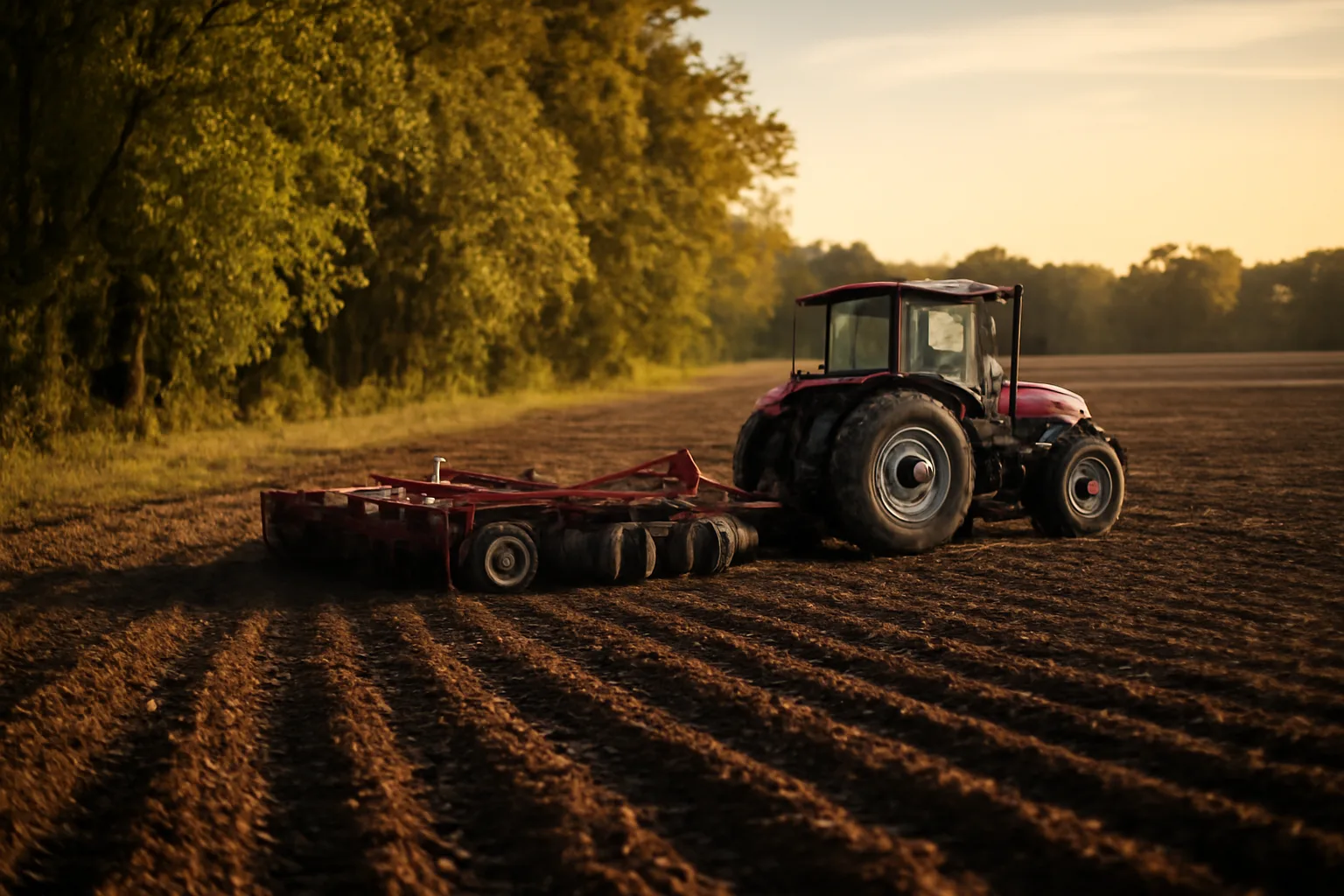
A food plot disc is a set of angled steel blades, called disc gangs, mounted on a frame and pulled behind a tractor or a heavy ATV/UTV. As it moves across the ground, the concave blades slice into soil, lift it, and flip it over. That action cuts through existing vegetation, breaks up clods, and levels the surface enough to plant into. Discs come in two rough categories for food plot use. Compact tractor discs (often called "box discs" or offset discs) run 4 to 6 feet wide and need a 20 to 45 horsepower tractor. ATV discs are smaller, usually 3 to 5 feet wide, lighter gauge steel, and built to be pulled by a 400cc+ four-wheeler or side by side. Neither is a plow. A disc doesn't invert soil the way a moldboard plow does. It cuts, mixes, and levels. The basic job of a disc in a food plot rotation is seedbed prep and seed incorporation. You disc once to break ground and kill existing growth, let it sit if weeds resprout so you can hit them again, then disc a second time right before or right after you broadcast seed to work it into the top inch of soil. Want the bigger picture on plot styles before you get into tillage decisions? See food plot whitetail for how plot type drives every other choice, including equipment.
when should you disc a food plot, and how many passes
Most food plot programs disc twice: once 2 to 4 weeks ahead of planting to expose and kill weed seed as it germinates, then again right at planting to work up a fine seedbed and cover the new seed. A single-pass disc-and-plant approach works on ground that's been in row crops or a maintained plot for years and has low weed pressure, but on rough or fallow ground you're fighting weeds all season if you skip the first pass. Depth matters more than pass count. Most food plot discs only need to go 2 to 4 inches deep. Going deeper doesn't help germination and it brings up more weed seed from the seed bank, which just means more weeds competing with your clover or brassicas later. USDA Natural Resources Conservation Service guidance on soil health management notes that minimizing soil disturbance and keeping the soil covered are core principles for maintaining productive seedbeds, and that excess tillage disrupts the soil aggregation that helps seedlings establish [1]. Timing the last disc pass to weather is the part people get wrong. If you disc and the ground sits bare for two weeks before rain, you've just built a weed nursery. Disc close to your planting window (within a few days) and try to time seed drop right ahead of rain in the forecast.
when to plant food plots for deer, by region
| 3-4 | MN, WI, northern ME | Late July-Aug | Mid-May-early June | |
|---|---|---|---|---|
| 5-6 | IA, PA, KY, southern NY | Mid-Aug-mid Sept | Late April-May | |
| 7-8 | TN, NC, OK, VA | Sept-early Oct | Mid-April-early May | |
| 9-10 | Deep South, TX Gulf Coast | Oct-Nov | March-April | These are general windows, not guarantees, and your local extension office has better numbers for your county than any national chart. Check your state land-grant university's food plot or wildlife extension page before you lock in a date. |
There's no single national planting date, because "when to plant food plots for deer" really means "when does my region get reliable fall rain and cooling soil temps, or spring warmth and frost-free days." Extension planting calendars break the country into rough zones based on first and last frost dates. For fall plots (clover, brassicas, cereal grains), most of the whitetail range plants somewhere between mid-August and early October, aiming to get seed in the ground 6 to 8 weeks before the first hard frost so plants establish before growth slows. The USDA plant hardiness zone map is the standard reference for frost timing by location. For spring/summer plots (soybeans, cowpeas, warm-season annuals), planting typically runs from mid-April in the Deep South through early June in the northern tier, once soil temps are reliably above 50-55°F and frost risk has passed. Here's a rough framework by USDA hardiness zone: | Zone | Region example | Fall plot window | Spring plot window |
when to plant oats for deer
Oats go in as a fall plot, typically 6 to 8 weeks before your area's average first frost date, so plants get 4 to 6 inches of growth before cold slows them down. In most of the Midwest and mid-South, that lands somewhere between late August and mid-September. In the Deep South it can push into October. Oats germinate fast, often in 7 to 10 days with decent soil moisture, and they tolerate a light frost better than a lot of people expect. They don't survive hard freezes the way winter wheat or cereal rye does, so in the northern half of the whitetail range oats are usually a fall-only annual, not a plant that carries deer through a full winter. Seeding rate for oats broadcast into a disced seedbed generally runs 2 to 3 bushels per acre (roughly 64-96 lbs/acre), covered a half inch to an inch deep. Drilled rates run a bit lower. Kentucky's small grain variety testing program, run through the University of Kentucky, evaluates oat seeding rates for forage and grain stands and generally recommends drilled forage oat rates in the 90-110 lbs/acre range depending on planting date and use.
when to plant turnips for deer
Turnips are a fall brassica, planted roughly 60 to 90 days before your first expected hard frost so bulbs have time to size up before deer start hitting them hard, which is usually after a couple of frosts sweeten the greens and bulbs. That planting window generally falls in July through early September depending on latitude. Turnip seed is tiny, and depth is the single most common mistake growers make. Turnips should go no deeper than 1/4 to 1/2 inch. A disc pass that's too aggressive right after broadcasting can bury turnip seed too deep to emerge. The better technique is a light drag or cultipacker pass after broadcasting rather than a full disc pass, or a very shallow, single light disc pass at most. Deer often ignore turnip bulbs and even the tops until after a hard frost converts starches to sugars, so don't judge a turnip plot's success in September. Give it until November or December in most zones.
what is a food plot, and what's it actually for
A food plot is a planted area of forage, grain, or browse on hunting land, established specifically to provide supplemental nutrition and, often, a hunting location near cover. It's not a wildlife feeder and it's not the same as scattering corn. A plot is a planted crop, usually annual or perennial forage species chosen for palatability and nutrition value to deer, turkey, and other wildlife. Plots generally fall into two functional categories: food source plots (larger, meant to feed animals and hold them on the property, often clover, alfalfa, brassicas, or grain) and hunting plots or kill plots (smaller, positioned for a shot, often planted with something highly attractive like oats or clover near a stand). Most managed properties run a mix of both. State wildlife agencies generally regulate food plots differently than bait piles or feeders. In most states, a planted food plot that isn't harvested and is left standing is legal to hunt over, while piling loose grain or minerals counts as baiting and is restricted or banned in many states during hunting season. Rules vary a lot state to state, so check your state wildlife agency's baiting and feeding regulations before you plant or hunt near a plot, especially if any grain or supplement will be scattered rather than growing in place. For a broader rundown of plot categories and how they fit your land plan, see deer food plots and food plot whitetail.
do deer eat sorghum
Yes, deer eat grain sorghum (milo), both the standing grain heads and the leaves, and it's a legitimate fall/winter food plot and screening crop in the southern half of the whitetail range. It's more heat and drought tolerant than corn, which is why it's common in Texas, Oklahoma, and the southern Plains food plot mixes. Sorghum isn't usually a deer's first choice when better food is available nearby. It gets hit harder in late fall and winter once acorns and softer browse run out, and it holds up well as standing grain through winter compared to something like oats. Some growers plant sorghum mainly for cover and screening between plots rather than as the primary food source, since it grows tall and thick. Oklahoma State University Extension's forage sorghum guidance describes grain sorghum as more drought tolerant than corn and suitable for wildlife and livestock forage programs on marginal soils, typically seeded at 6 to 10 lbs per acre in a prepared seedbed depending on row spacing [2].
do deer eat clover, and do deer like clover
Yes. Clover is one of the most consistently preferred food plot forages across the whitetail range, and it's a mainstay recommendation from nearly every state wildlife agency and extension program that publishes food plot guidance. Deer graze clover through spring, summer, and fall, and it stays high in crude protein (often 20-25% or higher in well-managed stands) through most of the growing season. White clover (including ladino types) and red clover are the two most common food plot clovers. White clover tends to handle grazing pressure better because it grows low and spreads by stolons, so it recovers from heavy browsing. Red clover grows more upright, yields more tonnage per cutting, but doesn't take repeated close grazing as well. Clover is a perennial in most zones (typically lasting 3-5 years with good management) so it's usually the anchor of a food source plot rather than a rotate-every-year annual. It does need mowing a few times a season to keep it from getting shaded out by weeds, and it responds well to a mid-summer nitrogen-free fertilizer application based on soil test results, since clover fixes its own nitrogen. If you're picking seed for a clover-based plot, deer food plot seed breaks down blend options by region.
what are deer's favorite foods, really
There's no single ranked "favorite food" list that holds true everywhere, because deer preference shifts by season, region, and what's locally available. That said, a few patterns show up consistently in browse studies and extension forage trials. Acorns are usually at or near the top when they're dropping, because of the fat and carbohydrate content, and deer will often walk past a planted plot to hit a good white oak drop. Outside of acorn season, food plot species that consistently rank high in preference trials and crude protein content include clover, soybeans (as forage and as pods/beans), cowpeas, and brassicas like turnips and radishes once cold weather sweetens them. Corn and grain sorghum matter more in late fall and winter as energy sources when protein needs drop and deer are trying to build fat reserves. Research summarized by the Noble Research Institute on warm-season food plot forages found that soybeans and cowpeas rank among the most preferred and highest-protein legume options for deer, commonly testing above 20% crude protein in leaf tissue during the growing season [3]. Bottom line: there's no one silver-bullet species. A property with a mix of clover for spring/summer, brassicas or cereal grains for fall/winter, and standing soybeans or corn for late-season energy covers more of the calendar than betting on any single plant.
do deer like honey
There's no real food plot or wildlife management application here, and no credible data showing deer seek out honey in the wild or that it's used as a supplemental feed. Deer are herbivores that browse forbs, browse, mast, and grasses. Honey isn't part of any natural or managed deer diet that shows up in extension or wildlife agency literature. If you've seen this question paired with deer attractant products, note that some commercial deer lures and mineral mixes use sugar, molasses, or sweet scents to draw deer, which is a different thing than honey itself being a preferred food. Those products also fall under the same state baiting and feeding restrictions as grain piles in many states, so check your state wildlife agency's regulations before using any scent or sweet attractant near a stand during season.
food plot disc vs. no-till drill vs. cultipacker: which do you actually need
| ATV/tractor disc | First-time ground-breaking, heavy weeds, sod conversion | $600-$3,000+ used to new, ATV-size | |
|---|---|---|---|
| No-till drill | Established plots, annual rotation, erosion-prone ground | $3,000-$15,000+ | |
| Cultipacker/drag | Firming seedbed, small seed coverage | $200-$1,500 | Prices vary widely by width, condition (used vs. new), and brand, and these are rough market ranges, not fixed pricing from any single source. |
A disc, a no-till drill, and a cultipacker do different jobs, and a lot of new plotters buy the wrong one first. A disc is for breaking ground: killing existing sod or weeds and creating a loose seedbed. You need one if you're converting a field edge, old pasture, or logging clear-cut into a plot for the first time, or if weed pressure is heavy enough that you need to till it under. A no-till drill places seed at a set depth directly into standing residue or lightly disturbed ground, without a full tillage pass. It's the better tool once a plot is established and you're rotating crops on the same ground year to year, since it preserves soil structure and cuts erosion. No-till drills cost more to buy but save fuel, time, and soil health over years of use. A cultipacker (or a drag/harrow) doesn't till at all. It firms and levels soil after discing, and it's the right tool for pressing tiny seed like clover or turnips into the surface without burying it. Most successful plot plantings actually use a disc and a cultipacker together: disc to prep, broadcast seed, cultipack to firm it in. | Tool | Best for | Rough cost range |
how deep should you disc for different seed types
| Clover, chicory | 1/4 inch or less (surface broadcast + light cultipack) | |
|---|---|---|
| Turnips, radishes, brassicas | 1/4 to 1/2 inch | |
| Oats, wheat, rye (cereal grains) | 1 to 1.5 inches | |
| Soybeans, cowpeas | 1 to 1.5 inches | |
| Corn | 1.5 to 2 inches | A disc alone tends to bury seed unevenly, some too deep, some left on the surface. That's why the standard sequence is: disc to break ground, broadcast seed, then run a light disc pass or a drag/cultipacker to cover it, rather than broadcasting first and discing hard afterward. For fine seed like clover or brassicas, skip the second disc pass entirely and just cultipack or drag, since even a light disc pass can bury that seed past its emergence depth. Soil test results from your county extension lab will tell you pH and nutrient needs, but no soil test tells you planting depth, that's a seed-specific mechanical question, not an agronomy one. |
Depth is where most disced plots succeed or fail, and it's specific to seed size. As a rule of thumb: the smaller the seed, the shallower it goes. | Seed type | Ideal planting depth |
building a planting plan around your disc and your soil test
A disc gets your seedbed ready. What you plant into it, and how much lime or fertilizer that ground needs, comes from your soil test, not from a generic chart. Your soil test lab is the authority on pH corrections and nutrient rates for your specific field; a national average doesn't know your soil. Once you know your soil test numbers and your planting zone, the decisions that matter are: which species fit your season and soil, how much seed per acre, and what equipment sequence gets seed to the right depth. That's the part a $99 one-time Custom Food Plot Plan is built to answer, it takes your location, soil test numbers, and equipment on hand and turns them into a straight seed list and planting calendar, rather than you cross-referencing five extension PDFs on a Saturday morning. Whatever plan you land on, the plan is general guidance based on your inputs, not a site visit or a guarantee of deer activity, soil chemistry still has the final word, so follow your soil test lab's specific lime and fertilizer recommendations over any generic rate you find online.
Frequently asked questions
Do deer eat sorghum?
Yes. Deer eat both the grain and leaves of grain sorghum (milo), especially in fall and winter once acorns and softer browse thin out. It's common in southern food plot mixes because it tolerates heat and drought better than corn, and it also works as a tall screening crop between plots.
Do deer eat clover, and do deer like clover?
Deer consistently prefer clover, and it's a staple recommendation across nearly every state wildlife agency's food plot guidance. White and red clover stay high in crude protein (often 20-25%+) through the growing season and regrow quickly after grazing, which is why clover anchors most perennial food source plots.
When should you plant food plots for deer?
Timing depends on your USDA hardiness zone. Fall plots (clover, brassicas, cereal grains) generally go in 6-8 weeks before first frost, roughly mid-August to early October across most of the whitetail range. Spring/summer plots (soybeans, cowpeas) go in after frost risk passes, typically mid-April to early June.
When is the best time to plant oats for deer?
Plant oats 6 to 8 weeks before your area's average first frost date, usually late August to mid-September in the Midwest and mid-South, later in the Deep South. Oats germinate in about 7-10 days and tolerate light frost, but they're generally a fall-only annual in colder zones, not a plant that survives hard freezes all winter.
When should you plant turnips for deer?
Plant turnips 60 to 90 days before your first expected hard frost, generally July through early September depending on latitude. Seed them shallow, 1/4 to 1/2 inch, and expect deer to largely ignore them until after a few frosts sweeten the bulbs and greens, often not until November or December.
What is a food plot exactly?
A food plot is a planted area of forage, grain, or browse established on hunting land to provide supplemental deer nutrition and often a hunting location near cover. It's a planted crop, not a bait pile or feeder, and most states regulate standing planted plots differently than scattered grain under baiting laws.
What are deer's favorite foods?
There's no single universal favorite; preference shifts by season and region. Acorns rank highest when dropping due to fat content. Outside mast season, clover, soybeans, cowpeas, and brassicas (after frost) consistently rank high in preference trials and crude protein across extension forage research.
Do deer like honey?
There's no credible evidence deer seek out honey, and it has no real role in food plot or wildlife feeding programs. Deer are herbivores browsing forbs, mast, and grasses. Some commercial attractants use sweet scents like molasses, which is a different product category and still falls under state baiting rules in many states.
What's the difference between a food plot disc and a plow?
A disc cuts, mixes, and levels the top few inches of soil using angled rotating blades, without fully inverting it. A moldboard plow flips soil over completely, burying surface residue deep. For food plots, a disc is standard; full plowing is rarely necessary and can bring up more weed seed than it's worth.
How many times should you disc a food plot before planting?
Most programs disc twice: once 2-4 weeks before planting to expose and kill germinating weeds, then again at planting to create a fine seedbed and work in seed. On low-weed-pressure ground already in rotation, a single disc-and-plant pass at planting time can work fine.
Can you use an ATV to disc a food plot instead of a tractor?
Yes, for smaller plots. ATV discs run 3 to 5 feet wide and need at least a 400cc four-wheeler or side by side to pull them through sod or heavy weeds. Tractor discs (4-6+ feet, 20-45+ horsepower) handle bigger acreage and tougher ground faster and with less strain on the machine.
Should I disc before or after broadcasting seed?
Disc first to break ground, broadcast seed second, then run a light disc pass or cultipacker to cover it, rather than broadcasting onto unbroken ground and discing hard afterward. For small seed like clover or turnips, skip the second disc pass and use a drag or cultipacker instead so seed doesn't get buried too deep.
Sources
- USDA Natural Resources Conservation Service, Soil Health Key Points: Minimizing soil disturbance and keeping soil covered are core soil health principles that support seedbed and germination quality
- Oklahoma State University Extension, Forage Sorghum (PSS-2587): Grain sorghum is more drought tolerant than corn and is seeded at rates suited to marginal soils for forage and wildlife use
- Noble Research Institute, Food Plots for White-Tailed Deer: Clover, soybeans, and cowpeas rank among the highest-preference, highest-protein warm season food plot plantings
- USDA Natural Resources Conservation Service, Nutrient Management and Soil Fertility guidance: Soil test results, not generic charts, should guide site-specific lime and fertilizer recommendations for planted stands
- University of Georgia Extension: Regional planting dates for cool-season forages like oats and turnips for deer food plots