Last updated 2026-07-26
TL;DR
Most fall food plots go in the ground 6 to 10 weeks before your area's average first frost date, roughly late July through September depending on latitude. Brassicas like turnips need the full 8 to 10 weeks; cereal grains and clover can go in closer to frost. Get a soil test first, that beats guessing every time.
What is a food plot?
A food plot is a planted area on hunting land, usually a fraction of an acre up to a few acres, seeded with forage that deer and other wildlife eat. It's not a garden and it's not a lawn. The goal is either to feed deer through a nutritional stress period (spring/summer plots) or to pull deer into shooting range and hold them on your property during hunting season (fall plots). Most food plots fall into two camps: annuals you replant every year (clover, brassicas, cereal grains, soybeans) and perennials that can last 3 to 5 years with maintenance (many clover and chicory blends). Fall plots skew toward annuals because you're often working around a short window before frost, and brassicas and cereal grains are cheap, fast, and reliably attractive once cold weather hits. State wildlife agencies generally don't regulate food plots themselves, but plenty of states have baiting and feeding restrictions that matter if you're also running feeders or mineral sites nearby. Michigan, for example, restricts baiting deer in the Lower Peninsula under its wildlife baiting and feeding rules, and the rules shift year to year with disease concerns like CWD; the current prohibited baiting area and exceptions are laid out in Michigan's Wildlife Conservation Order under Part 2, Section 2.2 [1]. Check your state agency's current regulations before you assume a food plot and a bait pile are treated the same, they usually aren't, but some states blur the line more than others. If you want a plan built around your specific ground instead of general advice, that's the whole idea behind our $99 Custom Food Plot Plan, it takes your zone, soil test, and acreage and gives you a species and timing plan instead of a generic calendar.
When to plant food plots for deer in the fall?
| Northern (MN, WI, MI, ME, northern NY) | Late Sept to early Oct | Late July to mid-August | |
|---|---|---|---|
| Mid-latitude (IA, IL, IN, OH, PA, southern NY) | Mid to late Oct | Mid August to early September | |
| Transition zone (KY, TN, VA, NC, MO) | Late Oct to mid-Nov | Late August to mid-September | |
| Deep South (GA, AL, MS, LA, FL panhandle) | Mid-Nov to early Dec | Mid September to mid-October | Soil temperature matters as much as the calendar date. Cool-season forages like brassicas and cereal grains establish best once soil temperatures drop into the mid-50s to mid-60s Fahrenheit, because seeding into hot, dry August soil often means poor germination even if you're technically inside the frost-based window. Check soil temperature with a simple soil thermometer at planting depth rather than relying on air temperature alone. Planting too early into summer heat wastes seed. Planting too late means your plot never reaches attractive maturity before deer season winds down. Most guys err on the early side out of anxiety, that's usually the bigger mistake. Better to wait for a real rain forecast than to dump seed into bone-dry dirt on the calendar date. |
The rule most extension agronomists use: count backward from your area's average first frost date. Brassicas need 80 to 90 days to reach full maturity but are frost-tolerant, so you plant them 8 to 10 weeks before frost. Cereal grains like oats and winter rye need less lead time, often just 4 to 6 weeks, and can be planted right up near frost since they're built to grow in cool soil. Here's a rough national breakdown, but your local extension office will have a more exact date for your county: | Zone (general) | Average first frost | Fall plot planting window |
When to plant turnips for deer?
Turnips need 8 to 10 weeks before your first hard frost, because they need time to bulb up and the plant becomes noticeably sweeter and more attractive to deer after a couple of frosts convert starches to sugars. Plant too late and you get leafy tops with no bulb development, plant too early and the bulbs may be past peak or rot before season. In the mid-latitude zone (Iowa, Illinois, Ohio, Pennsylvania) that generally means seeding turnips between mid-July and mid-August. In the deep South, late August into September works. University forage agronomy guidance across the Midwest generally places brassica forage seeding, including turnips, from mid-July through August for fall and early winter grazing or wildlife use, giving the bulb enough of a growing window before hard freeze. Seeding rate for turnips alone runs about 4 to 6 pounds per acre broadcast, drilled a bit less. Deer often ignore turnip tops early in the season and hit them hard after several frosts, so don't panic if your turnip plot looks untouched in October. That's normal, the sugar conversion is the whole point. A lot of hunters blend turnips with oats or winter peas for a plot that's attractive early (oats) and stays attractive after frost (turnips). That combination gives you a longer attraction window than either species planted alone.
When to plant oats for deer?
Oats go in 4 to 8 weeks before first frost, later than brassicas, since they germinate fast and don't need the same lead time to become attractive. Oats are often the first thing deer hit in a fall plot because the tender young growth is immediately palatable, no frost conversion needed. In most of the whitetail's range, that means an oat planting window from mid-August through mid-September. Oats tolerate light frost fine but will eventually winterkill in hard freezes, which is actually useful, they give you strong early-to-mid season attraction and then fade, rather than competing with your brassicas for attention all winter. Seeding rate for oats alone is typically 2 to 3 bushels per acre (roughly 64 to 96 pounds, since a bushel of oats weighs about 32 pounds), drilled at 1 to 1.5 inches deep. Broadcast rates run higher since surface seed has lower germination success. Oats paired with winter peas or clover is a classic fall blend, the oats provide quick cover and early food while the clover establishes underneath for a plot that carries into next spring.
Do deer eat sorghum?
Yes, deer eat sorghum, particularly the grain heads once they mature, and it's a reasonable fall/winter standing forage in warmer zones, but it's not a top-tier fall food plot choice for most hunters. Sorghum is more commonly planted as a summer forage or a screening/cover crop than as a primary fall attraction species. Whitetail deer will browse sorghum leaves and eat the grain, and it holds up well as standing forage into winter in the South, which is part of why it shows up in some wildlife food plot mixes there. But compared to brassicas, cereal grains, or soybeans, sorghum generally ranks lower in deer preference studies and forage quality analyses, and it's more valuable to hunters as cover or a wind break planted alongside a food plot than as the primary draw. If you're choosing between sorghum and something like oats or turnips for your main fall plot, go with the oats or turnips. Save sorghum for screening cover along plot edges or field borders where you want visual separation between the plot and your access trail.
Do deer like clover, and do deer eat clover?
Yes, deer eat clover readily and it's consistently one of the most preferred forages in food plot studies and extension trials. Clover is a perennial, though, which changes how it fits into a fall planting plan. White clover and red clover are both highly palatable, high in protein (often 25 to 30% crude protein in vegetative stages), and deer will hit an established clover plot hard in spring and summer. The catch for fall planting: clover establishes slowly and doesn't hit peak production until its second growing season. If you're planting clover in fall, you're usually planting it as a long-term investment for next spring and beyond, not as this season's primary hunting attractant. That said, a fall-seeded clover plot (August through early September in most zones, giving it time to establish before hard freeze) can still get some fall browsing, and it sets you up with an established, low-maintenance plot for years two through four or five. Many agronomists recommend fall planting of clover in regions with hot, dry summers specifically because cooler temperatures and better soil moisture in early fall reduce competition from weeds compared to spring seeding. If your main goal this season is hunting attraction over new-growth clover, plant a brassica or cereal grain blend instead and treat clover as a separate, longer-horizon plot. Combining both is common: cereal grain and brassica plots for this season's hunt, clover plots that mature into next year's early-season and summer draw.
What are deer's favorite foods, and do deer like honey?
Deer preference varies by region, season, and what's naturally available, but extension research and browse studies consistently rank a handful of species at the top: soybeans, clover, cowpeas, and chicory during the growing season, and brassicas plus acorns and cereal grains in fall and winter. Acorns, particularly white oak acorns, are frequently the single most preferred natural food when they're dropping, often outcompeting planted food plots entirely during a heavy mast year. Deer are also opportunistic browsers of hundreds of native plant species, forbs, woody browse, and agricultural crops like corn and soybeans where available. There's no single universal favorite, it depends on what's regionally abundant and what nutritional stage the deer are in (does nursing fawns need protein, bucks in late fall need carbs and fat). As for honey: no, deer do not eat honey in any meaningful dietary sense, and it's not a real food plot or attractant strategy backed by any wildlife agency or extension source. This question shows up online likely confused with deer's known attraction to sweet, sugary substances in general, similar to the sugar-conversion effect in frosted brassicas, or from confusion with bear attractant products, since honey and sweet baits are a legitimate bear attractant in areas where baiting bears is legal. For deer, stick with actual forage species. Some hunters do use molasses-based mineral or protein supplements, which deer will use, but that's a different product category entirely and subject to your state's baiting and feeding rules.
What's the best fall food plot planting calendar by zone?
Rather than one national date, think in three planting windows tied to your zone's frost timing. This is general guidance, your county extension office and a soil test are the real authority on your specific ground. Northern zone (most of MN, WI, MI, ME, northern New England, first frost late September to early October): plant brassicas by early to mid-August, cereal grains by late August to early September, clover by mid-August at the latest to allow establishment. Mid-latitude zone (IA, IL, IN, OH, PA, southern NY and New England, first frost mid to late October): brassicas mid-August, cereal grains through mid-September, clover through early September. Transition zone (KY, TN, VA, NC, MO, AR, first frost late October to mid-November): brassicas late August to early September, cereal grains through late September, clover through mid-September. Deep South (GA, AL, MS, LA, southern TX, FL panhandle, first frost mid-November to early December): brassicas mid-September, cereal grains through October, clover through late September. The USDA's Plant Hardiness Zone Map is built for perennial survival, not planting dates, but it's still a useful shorthand reference for how far north or south you sit relative to other hunters discussing plot timing online [2]. For actual average first frost dates specific to your county, contact your local Cooperative Extension office or state climatologist's office, which typically publishes station-level frost date tables more precise than a hardiness zone alone. If you want this narrowed to your actual property instead of a zone-wide range, that's exactly the gap our Custom Food Plot Plan fills for $99, one time, based on your zip code, acreage, and soil test.
Do I need a soil test before planting a fall food plot?
Yes, and it matters more than species selection for most struggling plots. A soil test tells you pH and major nutrient levels (phosphorus, potassium, sometimes micronutrients), and most food plot failures trace back to low pH, not the wrong seed choice. Many extension services, including Penn State's Agricultural Analytical Services Lab, recommend soil pH between 6.0 and 7.0 for most food plot species, with brassicas and clover both particularly sensitive to acidic soil below 6.0 . If your test comes back at pH 5.2, adding more fertilizer won't fix that, you need lime, and lime takes months to fully react in the soil, which is exactly why fall soil testing (ideally done in spring or early summer, ahead of your fall planting) gives you time to correct pH before seeding. A basic soil test through your county extension office typically costs somewhere in the range of $10 to $20 depending on the state and lab, cheap insurance against wasting $150 in seed on ground that can't support it. Your soil test lab's specific lime and fertilizer recommendations are the real authority here, follow their numbers over any generic rule of thumb, since recommendations shift based on your exact P and K levels, more than pH. If you've already got a soil test in hand and just need help translating it into a fall planting plan, that's a common starting point for our Custom Food Plot Plan.
What equipment do I actually need to plant a fall food plot?
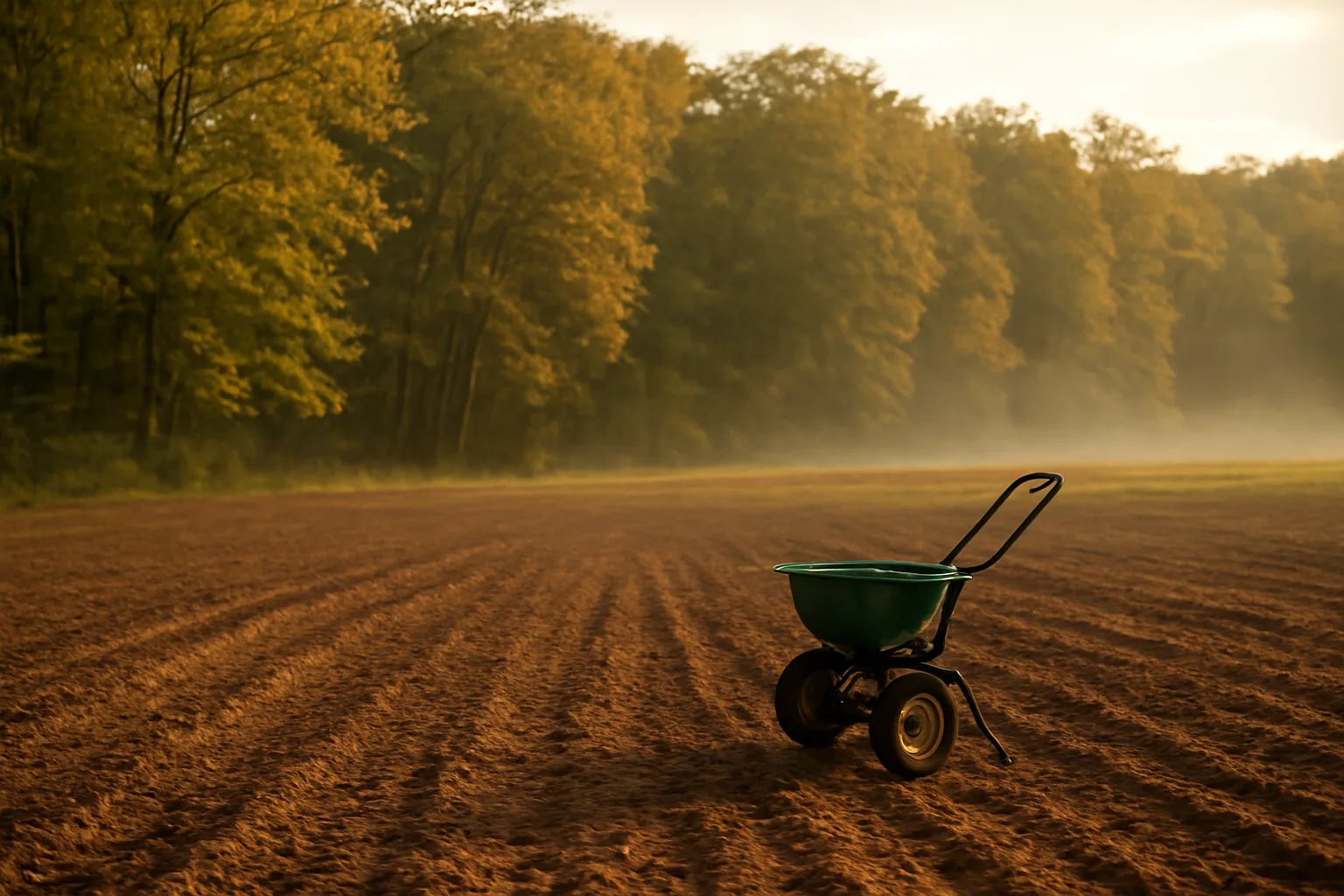
For a small plot (under an acre), you can get by with a hand seeder or broadcast spreader, a rake or drag harrow for seed-to-soil contact, and a way to knock down existing vegetation, whether that's an ATV disc, a herbicide application, or plain mowing and tilling. For larger plots, a disc harrow or no-till drill mounted to a tractor or ATV speeds things up considerably and improves germination rates, since broadcast seed sitting on top of dry soil often fails regardless of timing. Brassica and clover seed especially need to be pressed into the soil, not buried deep, most brassica seed should go no deeper than a quarter inch. Don't overspend on equipment before you've got a plot working. A $40 broadcast spreader, a soil test, and a good frost calendar will outperform a $3,000 no-till drill on ground with the wrong pH or wrong species for the site. Fix soil chemistry and timing first, upgrade equipment once you know a spot is worth the investment.
Frequently asked questions
Do deer eat sorghum?
Yes, deer browse sorghum leaves and eat the grain heads, and it holds up as standing winter forage in southern climates. It's not a top fall food plot pick compared to brassicas or cereal grains, though. Most hunters get more value using sorghum as screening cover along plot edges than as the primary attraction species.
Do deer eat clover?
Yes, clover is one of the most preferred forages in extension food plot studies, often 25 to 30% crude protein in its vegetative stage. It's a perennial that takes a full growing season to peak, so fall-planted clover mainly sets up strong spring and summer attraction rather than immediate fall hunting draw.
When to plant deer food plots?
Count backward from your area's average first frost date. Brassicas need 8 to 10 weeks before frost, cereal grains need 4 to 8 weeks, and clover needs planting by early to mid-September in most zones to establish before winter. Exact dates shift by 200 to 400 miles of latitude, so check your county extension's frost date.
Do deer like clover?
Yes, clover ranks near the top of preferred deer forages in university browse studies, alongside soybeans and chicory. It's especially valuable in spring and summer when deer need protein for antler growth and lactation. As a fall planting, it's more of a long-term investment for next year than this season's hunting plot.
When to plant oats for deer?
Plant oats 4 to 8 weeks before your area's first fall frost. Oats germinate fast and become attractive within weeks, so they don't need the long lead time brassicas do. In most whitetail range, that's a mid-August to mid-September planting window, later in southern zones.
When to plant food plots for deer?
There's no single national date. Work backward from your local average first frost: brassicas need 8 to 10 weeks lead time, cereal grains need 4 to 8 weeks, and clover should go in by early September in most zones. Northern hunters plant in late July and August, southern hunters plant into October.
When to plant turnips for deer?
Turnips need 8 to 10 weeks before your area's first hard frost so the bulb can fully develop and sweeten after a few frosts convert starches to sugar. In the Midwest that's typically mid-July through mid-August. Deep South hunters can wait until late August or September.
What is a food plot?
A food plot is a small planted area on hunting or wildlife land, seeded with forage like clover, brassicas, or cereal grains to feed deer and draw them into range during hunting season. Plots range from a quarter acre to several acres and are typically annual or perennial plantings depending on the species and goal.
What are deer's favorite foods?
There's no single universal favorite; it shifts by season and region. Extension browse studies consistently rank soybeans, clover, cowpeas, and chicory high during the growing season, with acorns (especially white oak) and brassicas topping preference in fall and winter, often outcompeting planted plots during a heavy acorn drop.
Do deer like honey?
No, honey isn't a real deer attractant or dietary item in any meaningful sense, and no wildlife agency or extension source recommends it. Deer are drawn to sugar-rich foods like frosted brassicas and ripe mast, which may be where the honey confusion comes from, but honey itself isn't part of their natural diet.
How big should a fall food plot be?
There's no required size; plots range from a quarter acre hidden pocket plot to several open acres. Smaller, hidden plots (under half an acre) tend to work well for bowhunting setups close to bedding cover, while larger plots suit rifle season and pull deer from farther off. Match plot size to your access and hunting style.
Can I plant a fall food plot without a soil test?
You can, but you're guessing on pH and fertilizer needs, and low pH is the single most common reason food plots fail regardless of species chosen. A basic county extension soil test usually costs $10 to $20 and takes the guesswork out of lime and fertilizer decisions before you spend money on seed.
Sources
- USDA NRCS, Plant Fact Sheet reference for cool-season forage brassicas: Cool-season brassica forages establish best in cooler soil temperatures typical of late summer seeding
- USDA NRCS Plant Fact Sheet, Turnip (Brassica rapa): Turnip is grown as a cool-season forage crop typically seeded in late summer for fall and winter use
- USDA NRCS Plant Guide, White Clover (Trifolium repens): White clover is a perennial forage legume commonly established in late summer to early fall
- NOAA National Weather Service, Frost/Freeze climate data: NOAA regional climate offices publish station-level average first frost and freeze dates
- Penn State Agricultural Analytical Services Lab, Soil Testing: Recommended soil pH range of 6.0 to 7.0 for most food plot forage species