Last updated 2026-07-24
TL;DR
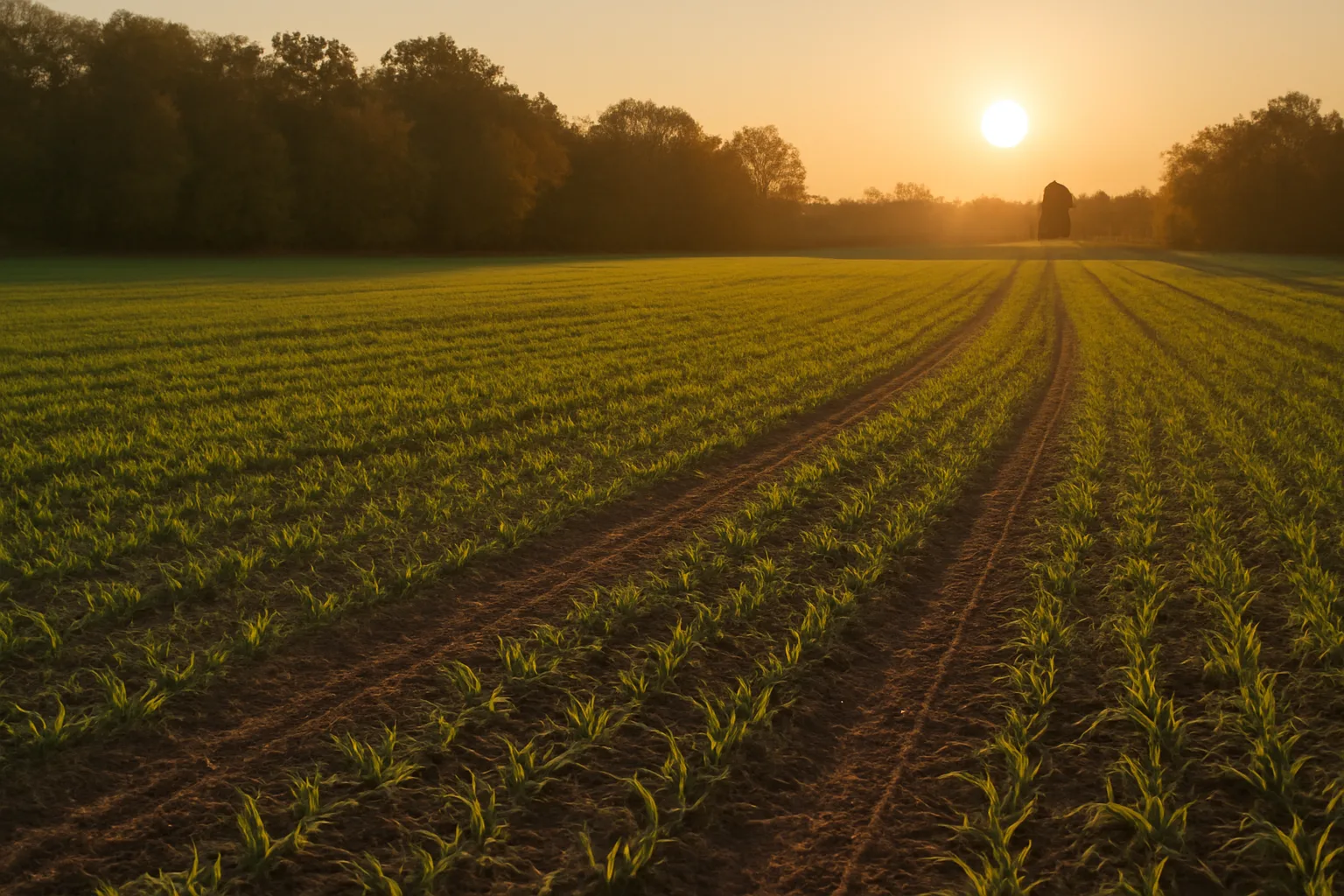
Fall food plots are planted seed mixes (usually brassicas, cereal grains, and clover) put in the ground 6 to 10 weeks before your area's first killing frost, timed so plants establish before deer season and cold weather hit. Most of the U.S. falls between late July (far north) and mid-October (Deep South) for planting.
What is a food plot, exactly?
A food plot is a planted area, usually somewhere from a quarter acre to several acres, put in specifically to grow forage that deer and other wildlife will eat. That's it. No mystery to it. People plant them on owned or leased ground to hold deer through hunting season, help does and fawns through late summer stress, or just grow more deer on a property year-round. Food plots aren't the same as agricultural fields, even though a lot of the same equipment and seed shows up in both. A soybean field planted for grain is farming. A soybean field planted at a low rate specifically so deer browse it down all summer is a food plot, even though it's the same seed bag. The University of Tennessee Extension describes food plots as a way to "supplement the natural food supply" for deer, not replace it [1]. Natural habitat, browse, mast crops like acorns, still do the heavy lifting on most properties. A good plot is a supplement, not a substitute for actual habitat work. Fall food plots specifically mean plots timed to be attractive and available during hunting season and into winter. That's different from spring/summer plots, which are more about nutrition for antler growth and lactating does. Different goals, different species, different planting windows. Check your state wildlife agency's baiting and feeding regulations before you plant anything near a stand. Standing food plots are legal to hunt over in nearly every state, but some states draw a legal line between a "planted crop left standing" and piled or broadcast feed, and the definitions get specific. Michigan, for example, treats food plots as legal but has separate rules for supplemental feeding [2]. Don't assume; check your own state agency's page.
When to plant food plots for deer (by region)
| Upper Midwest / Northern tier (MN, WI, MI, ME) | Late July to mid-August | Late August to mid-September | Late July to early September | |
|---|---|---|---|---|
| Mid-South / Transition zone (KY, TN, VA, MO) | Mid-August to mid-September | Mid-September to mid-October | Late August to mid-October | |
| Deep South (GA, AL, MS, LA, FL) | Late September to mid-October | Early October to early November | Late September to November | The Noble Research Institute, which works mostly in the southern Great Plains and mid-South, recommends planting cool-season annual forages there from mid-September through October depending on rainfall timing [3]. Penn State Extension recommends planting brassica-type plots in the Northeast by early-to-mid August so plants reach full size before frost. If you only remember one rule: count backward from your first frost date, not forward from a calendar page. A frost date calculator from your state extension office is more useful than any generic planting chart, including this one. |
Timing matters more than species selection. Plant fall brassicas too early in the South and they bolt or get eaten to nothing by August heat and bugs before season even opens. Plant too late up north and a hard frost kills your clover seedlings before they root in. The general rule extension agronomists use: back-count from your area's average first frost date. Brassicas and cereal grains want 60 to 90 days of growing time before a killing frost. Clover wants less absolute time to establish but does best planted in late summer to early fall in the North, or early fall in transition zones. Here's a rough breakdown by region. These are generalized windows, always confirm against your local extension office's frost date charts, since a hundred miles can shift things two or three weeks. | Region | Brassicas/turnips | Cereal grains (oats, wheat, rye) | Clover |
When to plant oats for deer
Oats go in the ground 6 to 8 weeks before your first fall frost, which for most of the whitetail range lands somewhere between late August and early October. Oats are fast, cheap, and deer hit them hard as soon as they emerge, especially in early fall before other food sources go dormant. Oats winterkill in most of the country once temperatures drop into the low 20s and teens for sustained periods, which is actually fine for a lot of hunters, since the plot's job is to be green and attractive during archery and gun season, not to survive to spring. If you want a plot that holds into late winter, mix oats with winter wheat or cereal rye, which are more cold-hardy and will often green back up in early spring. Oats do best on well-drained soil with a pH close to neutral, in the 6.0 to 7.0 range, and respond well to nitrogen. Kansas State University Extension notes that oats are commonly used in wildlife food plot mixes because of quick establishment and high early tonnage, but cautions they're less winter-hardy than wheat or rye in the northern Plains [4].
When to plant turnips for deer
Turnips (and other brassicas like radishes and rape) go in 80 to 90 days before your first hard frost, which is earlier than most people think. In the Midwest that's typically late July through mid-August. In the mid-South it's late August into September. The reason turnips need that long lead time is because deer usually ignore the leaves and roots until after a couple of frosts convert starches to sugars, making them sweeter. If you plant too late, you get small plants and no real forage value by the time deer start actually eating them in November and December. Mississippi State University Extension recommends brassica food plots be planted from mid-August to mid-September in that state, giving plants time to bulb out before frost sweetens them [5]. Turnips need decent fertility and a pH above 6.0 to really produce tonnage; on acidic ground without lime, you'll get spindly plants regardless of planting date. That's a soil test conversation, not a planting date conversation, and your soil test lab's recommendation on lime and fertilizer rate should be the final word on your specific field, since soil varies a lot even across one farm.
Do deer eat sorghum?
Yes, deer eat sorghum, both the grain heads and the young leaves, though it's usually a secondary food plot component rather than a stand-alone attractant. Grain sorghum (milo) is more commonly planted as a standing grain crop for winter cover and late-season food, especially in the South and Midwest, than as a primary fall attractant plot. Deer will browse young sorghum shoots in summer, and they'll hit the grain heads in fall and winter once the plant matures and the heads dry down. It's more of a slow-burn food source, useful for holding deer through the toughest part of winter when other plots are gone, rather than something that pulls deer in during the first week of October. Some food plot mixes include forage sorghum or sorghum-sudangrass as a nurse crop or cover component, planted alongside clover or brassicas to give young seedlings some wind and browse protection. If your main goal is a magnet plot for opening week of bow season, sorghum isn't the pick. If your goal is standing winter cover and late-season calories, it's worth a strip.
Do deer eat clover, and do deer like clover?
Yes, deer eat clover readily, and it's one of the most consistently preferred food plot forages across nearly every study and extension bulletin on the subject. Clover is high in protein, typically 20 to 30 percent crude protein in vegetative growth, and deer will use it from spring green-up through fall, right up until snow covers it. The reason clover shows up in almost every serious food plot program is that it's a perennial. Plant it once, manage it (mowing, occasional herbicide for grass competition, a maintenance lime/fertilizer application), and you can get 3 to 5 years out of a stand before it needs replanting. That's a real cost advantage over annual brassica or grain plots that need replanting every single year. For fall specifically, clover that's already established from a spring or late-summer planting will keep producing into fall, especially after a late-summer mowing knocks back weed competition and pushes fresh regrowth. New clover plantings in fall (August through September in most of the whitetail range) will establish through fall and be ready to produce heavily the following spring, but won't be a big fall food source in year one. If you want fall tonnage in year one, pair clover with an annual grain or brassica in the same plot.
What are deer's favorite foods?
There's no single universal answer, deer preference shifts by season, region, and what's available, but research consistently ranks a handful of foods at the top: acorns, soybeans, clover, and, where available, agricultural crops like corn and alfalfa. Acorns are usually the single most preferred fall food where oaks are present, because of the fat and carbohydrate content deer need heading into winter. A Mississippi State study on deer food habits found mast crops, especially acorns, made up a large share of fall diet volume when available, with deer shifting to other forages when mast crops failed . That's the well-known "mast year" problem: in a heavy acorn year, your food plot might get ignored in October and November because deer don't need it, they're vacuuming up free calories under white oaks. Among planted food plot species, soybeans (in the vegetative/growing stage) and clover consistently test as most preferred in deer preference trials. Brassicas and cereal grains rank a notch below those but improve in preference after frost sweetens them. Sorghum, corn, and cereal rye are generally lower preference but higher tolerance for poor soil and drought, which is why they're common in mixes rather than as stand-alone attractants. Bottom line: there is no one silver-bullet species. What works changes acorn year to acorn year, region to region, and even field to field depending on soil quality.
Do deer like honey?
There's no real evidence deer seek out honey in the wild or that it's part of any natural deer diet, and it's not something wildlife biologists or extension programs recommend for food plots or attractants. Deer are herbivores adapted to browse, forbs, mast, and grasses; they don't forage for honey the way bears do. Some commercial deer attractant products use sweet scents or syrups (including honey-based or molasses-based liquids) as an olfactory lure rather than a nutritional food source, the idea being the smell pulls deer in, not that deer are craving sugar. There's limited independent research testing whether these products actually change deer behavior versus just being marketing. If you're deciding between a mineral/attractant product and a planted food source, the planted food plot has a much stronger evidence base behind it. Honey and sugar-based attractants are a novelty at best, not a food plot strategy.
How do you actually plan and plant a fall plot?
Start with a soil test, not a seed bag. Every serious extension publication on food plots says the same thing: soil pH is the single biggest factor determining whether your fertilizer dollars do anything at all. The University of Georgia Extension notes that most food plot forages perform best in a soil pH range of 6.0 to 7.0, and that below pH 5.5, phosphorus and other nutrients become chemically locked up and unavailable to plants no matter how much fertilizer you add . A $10 to $20 soil test through your county extension office or a private ag lab tells you exactly how much lime and fertilizer your specific field needs, and that number should come from your lab report, not a general estimate. Once you know your soil test numbers, the sequence is roughly: lime (if needed, ideally 2 to 3 months before planting since lime takes time to change pH), disk or no-till drill the seed at the right depth, and fertilize at planting or shortly after per your soil test recommendation. Small-seeded stuff like clover and brassica goes in at a shallow depth, a quarter inch or less; cereal grains go deeper, an inch to an inch and a half. Equipment scales with your budget. A hand-crank spreader and a hard rake will plant a small plot. A cultipacker or drag behind an ATV improves seed-to-soil contact on bigger plots. A no-till drill is the gold standard for larger acreage and lets you skip a full disking pass, which matters if erosion or time is a concern. If you want a starting point tailored to your zone, species mix, and acreage without guessing at all this, PlotSeason's Custom Food Plot Plan is a $99 one-time report that walks through species picks and a planting calendar for your specific region. It's general planning guidance built from your inputs, not site-specific agronomy, so your soil test lab is still the final word on lime and fertilizer rates for your dirt.
What should go in a fall food plot mix?
| Under 1 acre | Oats + turnip blend | 60-90 lbs/acre oats, 3-5 lbs/acre turnip | |
|---|---|---|---|
| 1-3 acres | Oats/wheat + clover overseed | 90-120 lbs/acre grain, 8-10 lbs/acre clover | |
| 3+ acres, multi-plot | Split fields: grain/brassica in one, perennial clover in another | Varies by field | Rates vary by product and region, always check the seed tag, since commercial blends already account for the mix ratio and a straight per-species rate will oversow. For deeper species-by-species detail, see food plot whitetail for a broader species breakdown, or deer food plot seed if you're comparing specific commercial blends before you buy. |
Most successful fall plots aren't single-species, they're blends that stagger maturity and cover for weak spots in any one plant's performance. A common and reliable combination is a cereal grain (oats or winter wheat) for fast early cover and tonnage, a brassica (turnips or radish) for late-season sweetness after frost, and clover as a perennial base that carries the plot into next year. A simple starter blend by acreage: | Plot size | Suggested mix | Approx. seeding rate |
What mistakes wreck fall food plots most often?
Planting too late is the single most common mistake, hands down. Hunters get busy in September, put brassica seed down in late September in a zone that needed it in August, and end up with three-inch plants that never bulb out. Back-count from frost date, every single year, don't go off memory of last year's calendar. Skipping the soil test is the second big one. Extension agronomists at multiple land-grant universities point to soil pH as the top limiting factor in plot performance, more than seed cost, seed brand, or fertilizer amount . A $15 test that tells you to add two tons of lime per acre is worth more than a $40 bag of premium seed thrown on soil at pH 5.0. Other common failures: planting into sod without killing competition first (grass will out-compete clover and brassica seedlings every time), seeding too deep (small seeds like clover need to basically sit on the surface, barely covered), and ignoring deer pressure, meaning planting one plot on a small property and hunting it so hard deer stop using it in daylight.
How big should a fall food plot be?
There's no single right size, it depends on property size, hunting pressure, and whether the plot is a destination field or a small kill plot. As a rough guide, many state agencies and extension programs suggest food plots make up somewhere around 1 to 5 percent of total huntable acreage on a property, though this is a general guideline, not a regulation, and varies a lot by region and habitat quality. Small, hidden kill plots (a quarter acre to half acre) tucked near bedding are built to catch deer moving between food and cover in daylight, ideal for bow hunting. Larger destination fields (2 acres and up) hold more deer overall and work better as a nutrition source, but daylight use by mature bucks tends to drop as visibility and pressure go up. Many hunters run both: one or two small secluded plots for hunting, and a larger field elsewhere on the property (or off the beaten path) for overall herd nutrition. If you're planning your first plot and unsure of scale, deer food plots and deer for food cover sizing and placement strategy in more depth.
Frequently asked questions
Do deer eat sorghum?
Yes. Deer browse young sorghum leaves in summer and eat mature grain heads in fall and winter. It's more commonly used as a standing winter food and cover crop than as a primary fall attractant, and it's often included in mixes alongside clover or brassicas rather than planted alone.
Do deer eat clover?
Yes, clover is one of the most consistently preferred deer forages, with crude protein often in the 20 to 30 percent range during active growth. Deer use it spring through fall and it's a staple perennial in most serious food plot programs because one planting can last 3 to 5 years with maintenance.
When should I plant food plots for deer?
Count backward from your area's average first fall frost date. Brassicas need 80 to 90 days before frost, cereal grains need 60 to 90 days, and clover does best planted late summer into early fall. Exact windows range from late July in the northern U.S. to mid-October in the Deep South.
Do deer like clover more than other food plot plants?
In most preference studies and extension trials, clover ranks at or near the top, alongside soybeans in the vegetative stage. Preference shifts seasonally though; deer often favor acorns over any planted food source in a heavy mast year, so clover's ranking isn't absolute.
When do you plant oats for deer food plots?
Plant oats 6 to 8 weeks before your first fall frost, generally late August through early October depending on region. Oats establish fast and deer hit them early, but oats usually winterkill once sustained temperatures drop into the low 20s, so pair with wheat or rye if you want the plot to survive into late winter.
When is the best time to plant food plots for deer season?
For fall/hunting-season plots, aim to have brassicas and grains in the ground 60 to 90 days before your local first frost date so they're grown out and either sweetened by frost (brassicas) or established (grains) by opening day of archery season in most states.
When should turnips be planted for deer?
Turnips need roughly 80 to 90 days before your first hard frost, since deer generally won't hit the bulbs and leaves hard until after a frost converts starches to sugar. That puts planting in late July to mid-August in the north, and late August to September in the mid-South.
What exactly is a food plot?
A food plot is a planted patch of forage, from a fraction of an acre up to several acres, established specifically to feed deer or other wildlife and supplement the natural food already on a property. It's not a replacement for habitat, mast, and native browse, just an addition to it.
What is a deer's favorite food?
There's no single universal favorite. Acorns typically top the list where oak mast is available, and among planted forages, soybeans and clover usually rank highest in preference trials. Preference shifts by season, region, and mast crop availability year to year.
Do deer like honey?
There's no good evidence deer naturally seek out honey; it isn't part of their normal browse-based diet. Some commercial attractant products use honey or sugar-based scents to lure deer by smell, but that's a marketing angle, not a nutritional strategy, and it's not something wildlife extension programs recommend.
Can I plant a fall food plot without a soil test?
You can, but you're guessing on lime and fertilizer, and extension research consistently shows soil pH is the biggest limiting factor in plot success. A $10 to $20 test through your county extension office tells you exactly what your field needs instead of hoping a generic fertilizer rate works.
Is it legal to hunt over a food plot?
In most states, yes, a planted and standing crop is legal to hunt over, but rules on baiting, piled feed, and supplemental feeding vary a lot by state and sometimes by county. Always check your state wildlife agency's current regulations before hunting near any plot or feed source.
Sources
- University of Tennessee Extension, Wildlife Food Plots: Food plots supplement the natural food supply for deer rather than replace it
- Michigan DNR, Baiting and Feeding Regulations: States regulate supplemental feeding separately from standing planted food plots
- Noble Research Institute, Cool-Season Food Plots: Recommended fall planting window for cool-season annual forages in the southern Great Plains/mid-South
- Kansas State University Extension, Wildlife Food Plots: Oats establish quickly and produce high early tonnage but are less winter-hardy than wheat or rye
- University of Georgia Extension, Soil Testing for Wildlife Food Plots: Optimal food plot forage pH range and nutrient lockup below pH 5.5