Last updated 2026-07-24
TL;DR
A deer plot mix is a blend of forages (usually a legume like clover with a cereal grain or brassica) planted together so something is palatable and available across more of the season. Good mixes match your soil, planting window, and hunting goals rather than copying a bag label blind.
what is a food plot, exactly
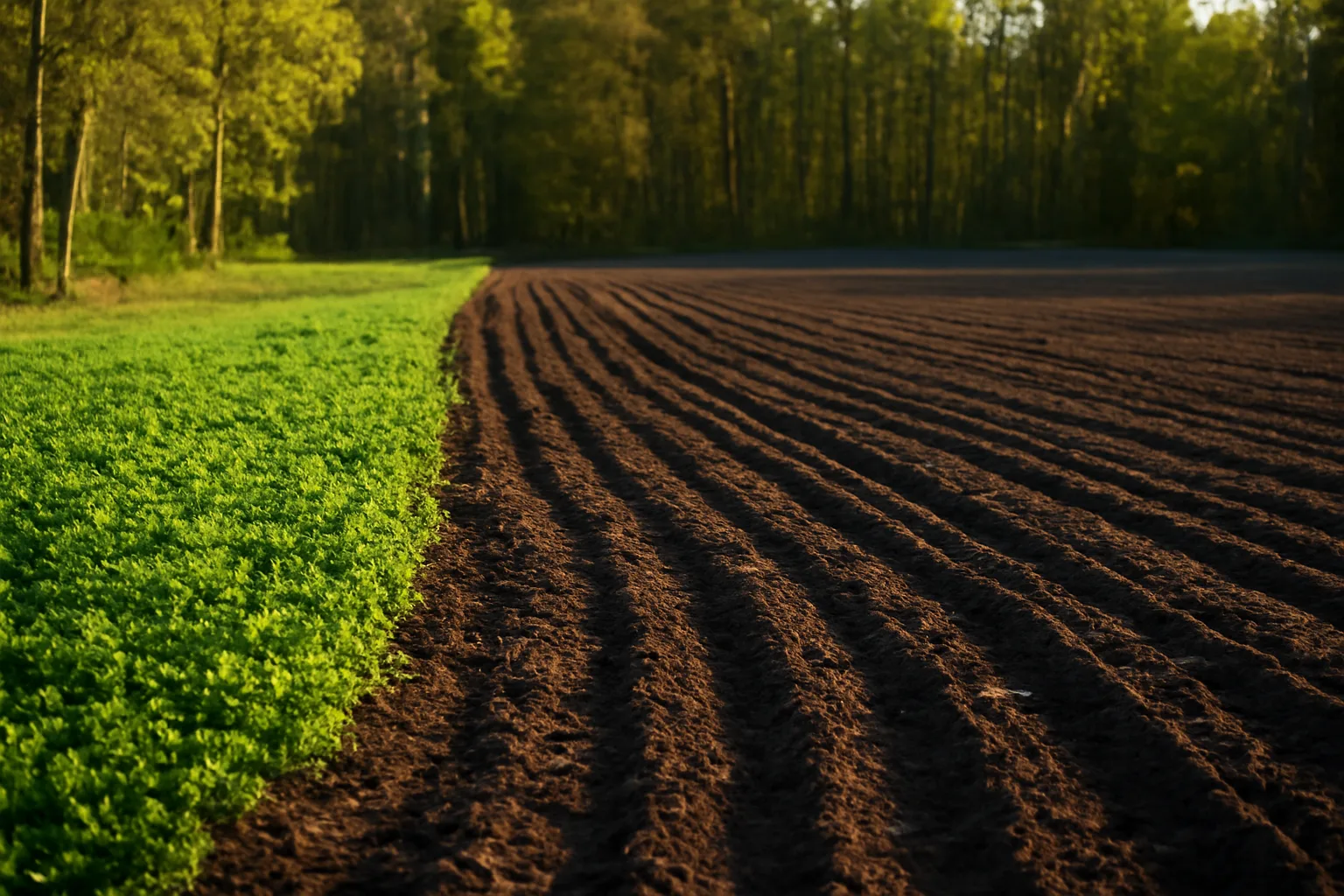
A food plot is a planted area of forage on hunting land meant to feed and hold deer, and often to give a hunter a clear shooting lane during season. It's not the same as a mineral site or a bait pile. Most states regulate baiting and feeding separately from agricultural plantings, and the legal line matters. A planted, growing crop is almost universally legal to hunt over; a pile of corn or a mineral lick is not, in a lot of states. The USDA and land-grant extension services generally treat food plots as a wildlife habitat practice, distinct from row-crop agriculture, though the agronomy underneath (soil pH, fertility, seed-to-soil contact) is identical [1]. A plot can be as small as a quarter acre tucked in a clearcut or as large as several acres of a field edge. Size and shape matter less than most people think. Soil fertility and species choice matter more. Check your state wildlife agency's regulations before you plant if you're unsure whether a mix counts as a plot or crosses into baiting territory, especially with mineral-heavy soil amendments or supplemental feed added on top of the planting. Rules vary a lot state to state and some states have added feeding restrictions in specific counties tied to chronic wasting disease management [2].
what do deer actually prefer to eat
Deer preference research consistently ranks clover and other legumes at or near the top of preferred forages, with acorns, agricultural crops (soybeans, corn), and browse species filling out the list depending on season and region [3]. There's no single universal favorite. What a deer eats changes by month, by region, and by what's available. A widely cited food-habit discussion from the Noble Research Institute describes whitetails as highly selective grazers that often choose the most digestible, highest-protein plant available rather than eating everything in reach. In spring and summer that tends to mean clover, alfalfa, and soybeans. In fall, acorns and standing grain crops often out-compete a plot. In late winter, brassica tops and tubers (turnips, radish) that have been hit by frost become far more attractive because cold converts starches to sugars. So when someone asks what a deer's favorite food is, the honest answer is: it depends on the month. A clover plot might get hammered in May and mostly ignored in October when acorns are dropping. That's normal, not a plot failure.
do deer like clover
Yes. Clover (white clover, red clover, and various blends) is one of the most consistently preferred and most planted food plot forages in North America [3]. It's a perennial legume, meaning a good stand can produce for three to five years with proper mowing and fertility, which makes it one of the better costs-per-year options once established. White clover (Trifolium repens) tolerates mowing and some shade and works well in smaller, more permanent plots. Red clover (Trifolium pratense) grows taller, tolerates poorer drainage a bit better, and is often mixed with white clover for a longer productive window. Clover needs a soil pH close to 6.0 to 6.5 to perform well and fix nitrogen efficiently; below that, lime is usually the first fix your soil test will call for [4]. Clover is also one of the higher crude-protein forages available to deer, often tested in the 20 to 30 percent range depending on growth stage and fertility, which is a real factor during antler growth and lactation in late spring. The tradeoff: clover is slow to establish, doesn't like drought or heavy shade, and gets out-competed by weeds fast if you skip a burndown herbicide before planting.
do deer eat sorghum
Deer will eat grain sorghum (milo), but it's not a top preference forage and it's used more often as a screening or bedding cover crop than a primary food source. Sorghum produces a tall, dense stand that deer use for cover, and the grain heads do get browsed, especially late in the season once softer forages are gone [5]. In practice, sorghum shows up in deer plots mostly in warm-season blends aimed at cover and structure rather than pure nutrition, similar to how some hunters use forage sorghum or Egyptian wheat as a screen along a field edge. If your goal is pure attraction and nutrition, soybeans, cowpeas, or clover will out-perform sorghum most seasons. If your goal is a visual screen plus a late-season grain source, sorghum earns its place. One caution: grain sorghum can accumulate prussic acid (cyanogenic compounds) under certain stress conditions like frost or drought, which is a documented livestock feeding hazard tracked by several state extension services . It's not commonly reported as a deer health issue, but it's worth knowing if you're grazing or feeding it heavily to any animal.
do deer like honey
Deer aren't drawn to honey in any meaningful nutritional or field sense, and there's no wildlife research supporting honey as a food plot or attractant additive. Some commercial deer attractant products use sugar-based or molasses-based scents marketed loosely around the idea of sweetness, but that's a product marketing claim, not a documented deer feeding behavior backed by extension or state wildlife research. What is documented: deer are drawn to high-sugar, high-carbohydrate foods, especially in fall when they're bulking up fat reserves, and to frost-sweetened brassica tops in early winter. If you're chasing a sweet attractant effect, a properly planted brassica or sugar beet plot does far more heavy lifting than any bottled additive, and it's food deer can actually eat as forage rather than lick off the ground. Save your money on honey-based lures. Put it into soil amendments instead.
when to plant food plots for deer
| Upper Midwest / North (zones 3-4) | mid-May to mid-June | late July to mid-August | |
|---|---|---|---|
| Mid-South / Transition (zones 5-6) | late April to late May | mid-August to early September | |
| Deep South (zones 7-8) | March to April | September to early October | These are starting points, not guarantees. Always check your county's average first and last frost dates through your local extension office rather than relying on a zone number alone . |
Timing is set by your USDA Plant Hardiness Zone, your local frost dates, and whether you're planting a spring/summer plot or a fall plot . There is no single national planting date; a zone 4 hunter in Minnesota and a zone 8 hunter in Georgia are working with a six-to-eight week difference in both directions. As a general framework: spring plots (clover, alfalfa, soybeans, chicory) go in after your last frost date, typically April through June depending on zone. Fall plots (brassicas, cereal grains, winter peas) go in 60 to 90 days before your average first frost, so the seed has time to establish before cold shuts growth down, typically late July through early September across most whitetail range . Here's a rough planting window by region, based on typical USDA hardiness zones and average frost dates : | Region (approx. USDA zone) | Spring plot window | Fall plot window |
when to plant clover for deer
Clover can go in during spring or late summer/early fall, and both windows work, with fall often producing a cleaner stand because weed pressure is lower. Spring plantings should go in as soon as soil is workable after the last frost, generally April into May in most whitetail range [4]. Fall clover plantings, sometimes called a frost-seeding or late-summer seeding depending on method, typically go in six to eight weeks before your first fall frost so the plant can establish a root system before winter dormancy. University of Tennessee Extension guidance on clover establishment recommends a firm, weed-free seedbed and notes that clover seed should be planted no deeper than a quarter inch, since it's a small seed that fails badly if buried too deep [4]. Whichever season you choose, don't skip the soil test. Clover is sensitive to low pH and will underperform badly below 6.0 no matter how good the seed genetics are [4].
when to plant oats for deer
Oats are a fall-planted cereal grain in most of whitetail country, going in six to eight weeks before your first expected frost so plants reach 6 to 8 inches of growth before cold slows them down. That generally lands in the window of mid-August through mid-September for most of the Midwest and Southeast, and slightly earlier (late July to mid-August) in the northern tier . Oats are fast-germinating, cheap, and highly attractive to deer in the fall, which is why they show up in almost every bagged fall blend. They're also frost-tolerant to a point but will eventually winterkill in hard cold, unlike winter wheat or cereal rye, which survive through to spring in most zones. If you want fall attraction that also carries into late winter, blend oats with wheat or rye rather than planting oats alone. A spring oat planting is possible too, mostly as a nurse crop or quick cover while a perennial like clover establishes underneath, but it's less common as a standalone strategy since oats mature and die back by mid-summer.
when to plant turnips for deer
Turnips, like other brassicas, go in during late summer, generally 90 to 100 days before your first hard frost, because the plant needs that much time to bulb out and reach peak tonnage. In most of the Midwest and mid-South that puts planting in late July through mid-August; in the Deep South it can push into early September . Turnips are a two-stage food source. Deer often ignore the leafy tops early, then hit both tops and bulbs hard after the first hard frosts convert starches to sugars, usually late fall into winter. That's why a lot of hunters see turnip plots sit almost untouched in October and then get hammered in December. It's not a failed plot; it's the plant doing what it's supposed to do on a delay. Brassicas including turnips need a similarly forgiving pH range to clover (around 5.5 to 6.8 tends to work) but they're heavier nitrogen feeders, so a soil test result calling for 40 to 60 pounds of actual nitrogen per acre isn't unusual for a brassica-heavy mix .
what should go into a good deer plot mix
A solid deer plot mix usually pairs a legume (for protein and soil nitrogen) with either a cereal grain (for fast cover and fall attraction) or a brassica (for late-season tonnage). Pure single-species plots work fine too, but blends spread your risk across weather, timing, and deer preference shifts through the season. A few combinations that consistently perform well across whitetail range, based on standard extension forage guidance [4] : - Clover + chicory: perennial, drought-tolerant blend, good for a 3 to 5 year plot with annual mowing.
- Oats + winter wheat + crimson clover: fast fall cover plus a perennial legume carryover into spring.
- Turnips + radish + winter peas: heavy tonnage brassica blend with a nitrogen-fixing legume mixed in to reduce fertilizer need.
- Soybeans (forage type) alone or with sunn hemp: high-protein summer plot, best on larger acreage since deer browsing pressure can wipe out small soybean plots before they mature. The mix you pick should follow your soil test, your planting window, and your hunting goal (early season, rut, or late season) more than any bag's marketing copy. If you want help matching a mix to your specific soil test and zone rather than guessing off a label, that's the exact gap a Custom Food Plot Plan is built to close: a one-time $99 plan based on your test results and location instead of a generic bag ratio.
how do i pick species based on my soil test
Your soil test result is the actual authority here, not a blog post or a bag label. Send a sample to your state or county extension lab (most land-grant universities run one for $10 to $20 per sample) and follow their lime and fertilizer recommendations exactly . Generally: clover and alfalfa want pH 6.0 to 6.8 and moderate phosphorus and potassium; brassicas tolerate a slightly wider pH range but want more nitrogen; cereal grains like oats, wheat, and rye are the most forgiving of low fertility and marginal pH, which is why they're a common starter plot on new ground while lime works into the soil over a season or two. Lime takes time to change soil chemistry, often 3 to 6 months or more to fully react depending on soil type and how well it's incorporated, so a fall soil test result calling for 2 tons of lime per acre won't fix your pH before a fall planting that same year . That's a real planning constraint, not a nitpick: plant something forgiving this season and correct pH for next year's stand. For more detail on turning a soil test into an actual planting plan, see food plot whitetail and deer food plot seed selection guidance.
how big should a plot be and how much seed do i need
Seeding rates vary a lot by species, so the bag label (or your extension guide) beats any rule of thumb. As reference points: clover is typically seeded at 6 to 8 pounds per acre broadcast, oats at 2 to 3 bushels (roughly 96 to 128 pounds) per acre, and turnips at 4 to 6 pounds per acre . Overseeding brassicas is a common mistake; the seed is tiny and a little goes a long way. Plot size is more about goals than magic acreage numbers. A quarter-acre to half-acre clover plot tucked in timber works fine as a hunting plot with modest deer pressure. Larger destination or feeding-focused plots (1 to 5 acres) hold up better under heavy browsing, since deer can eat a small plot into the dirt before it ever matures, especially with brassicas and soybeans. If you're comparing seed options across species, deer food plot seed and food plot seed break down species-by-species seeding rates and blend ratios in more depth.
what equipment do i actually need
At minimum: a way to test soil pH, a way to kill existing vegetation or till a seedbed, a way to broadcast or drill seed, and a way to firm the seedbed afterward (a cultipacker, ATV tire drag, or even foot traffic on a small plot). None of that requires a farm-size tractor. For small plots (under an acre), an ATV or UTV with a tow-behind disc, a broadcast spreader, and a drag section covers most of what you need. For larger plots, a compact tractor with a disc, a no-till drill if you're planting into standing residue, and a sprayer for burndown herbicide speeds things up a lot and improves germination consistency. A no-till drill is genuinely worth renting or borrowing if you can, especially for small-seeded species like clover and brassicas, since seed-to-soil contact at the right depth matters more than almost any other single factor in stand establishment [4]. Broadcasting works fine too; it just needs a cultipacker or drag pass afterward to press seed into contact with soil rather than sitting exposed on top where birds and drying wind take their toll.
Frequently asked questions
Do deer eat sorghum?
Yes, deer will browse grain sorghum heads and use tall sorghum stands for cover, but it's a secondary forage rather than a top attraction species. Extension research and field use both point to sorghum working better as a screening or late-season cover crop than as a primary nutrition plot compared to clover or soybeans [6].
Do deer like clover?
Yes, clover is one of the most consistently preferred forages for whitetail deer, especially white and red clover blends. It's a high-protein perennial legume that, with correct soil pH (6.0 to 6.8) and mowing, can produce for three to five years from one planting [5].
When should I plant food plots for deer?
It depends on your USDA hardiness zone and plot type. Spring plots (clover, soybeans) go in after your last frost, generally April through June. Fall plots (brassicas, cereal grains) go in 60 to 100 days before your first fall frost, typically late July through September depending on region [8][9].
When should I plant clover for deer?
Clover can be planted in spring (April to May, after last frost) or late summer/fall (six to eight weeks before first frost), with fall plantings often having less weed competition. Seed shallow, no deeper than a quarter inch, into a firm, weed-free seedbed [5].
When should I plant oats for deer?
Plant oats six to eight weeks before your area's average first fall frost, generally mid-August through mid-September in most of the Midwest and Southeast, earlier in northern zones. Oats germinate fast and are highly attractive in fall but will winterkill in hard cold [9].
When should I plant turnips for deer?
Plant turnips 90 to 100 days before your first hard frost, generally late July through mid-August in most whitetail range. Deer often ignore the tops until after a hard frost sweetens the starches into sugar, so don't judge the plot before December [9].
What is a food plot?
A food plot is a planted area of forage crops on hunting or wildlife land meant to feed and attract deer, distinct from bait piles or mineral sites which many states regulate separately. It uses standard agronomy (soil testing, liming, seeding) applied to a wildlife rather than commercial-crop goal [1].
What are deer's favorite foods?
There's no single favorite; it shifts by season. Clover, soybeans, and other legumes rank high in spring and summer, while acorns and standing grain often outcompete plots in fall, and frost-sweetened brassicas take over in late winter [3][4].
Do deer like honey?
There's no wildlife research showing deer are specifically drawn to honey. Some commercial attractants use sweet scents in marketing, but documented deer behavior points to sugar-rich natural foods like frost-sweetened brassicas and fall mast crops, not honey itself, as real drivers of feeding activity [4].
What's the difference between a fall plot and a spring plot?
Spring plots (clover, soybeans, chicory) are planted after last frost and feed deer through summer growth and antler development. Fall plots (brassicas, oats, wheat, rye) are planted 60 to 100 days before first frost and target hunting-season and late-winter attraction and nutrition [8][9].
How much does a soil test cost and is it really necessary?
Most land-grant university extension labs charge $10 to $20 per sample, and yes, it's worth doing before planting anything. Your soil test result, not a bag label, should set your lime and fertilizer rates; skipping it is the single most common reason plots underperform [11].
Can I plant a food plot mix without any equipment?
On a small plot (under a quarter acre) you can hand-broadcast seed after knocking down weeds with a mower or herbicide, then drag a section of chain-link or a mat behind an ATV to press seed into soil. Bigger plots benefit a lot from a disc, drill, or cultipacker for consistent germination [5].
Sources
- Noble Research Institute, Food Plots for White-tailed Deer: Deer are selective grazers that favor high-protein, high-digestibility forage, and preference shifts seasonally
- Oklahoma State University Extension PSS-2160, Grain Sorghum Production Guide: Grain sorghum use as cover and grain forage and prussic acid risk under stress conditions
- Kansas State University Research and Extension MF3122, Nitrate and Prussic Acid Testing: Sorghum species can accumulate prussic acid under frost or drought stress
- University of Georgia Extension Bulletin 1347, Establishing and Managing Wildlife Food Plots: Seeding rates and fertility requirements for brassicas, clover, and cereal grain plot mixes
- University of Missouri Extension G9110, Soil Testing for Lawns, Gardens and Wildlife Plantings: Soil test costs and the multi-month lag time for lime to fully adjust soil pH