Last updated 2026-07-25
TL;DR
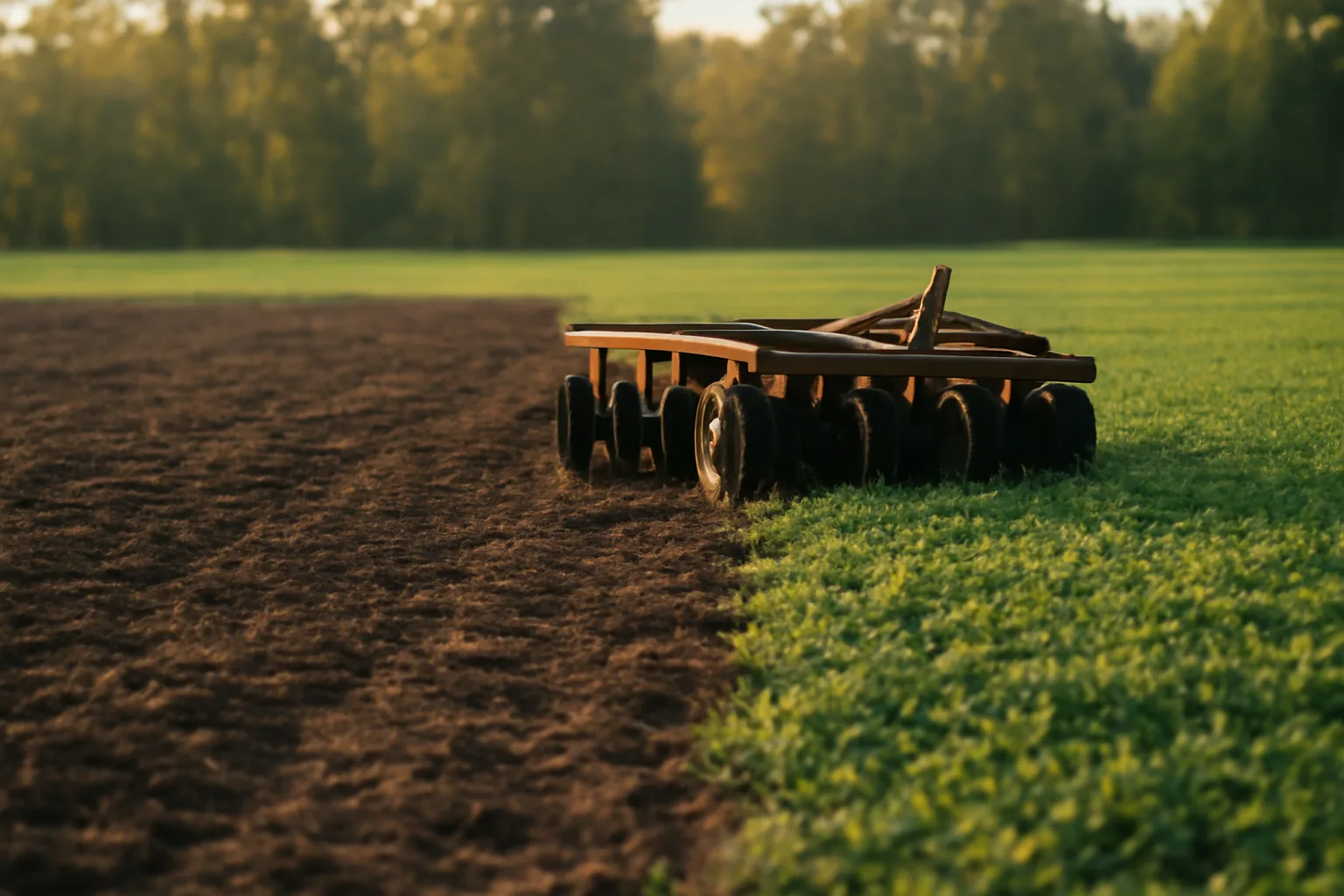
A deer food plot planter is any implement, from a hand spreader to a no-till drill, used to get seed into the ground at the right depth and rate. For most small plots (under 3 acres), a disc harrow plus a broadcast spreader beats an expensive drill. For larger acreage or heavy clay, a compact no-till drill earns its cost. Match the tool to your seed size and soil, not the other way around.
what is a food plot planter, exactly
A food plot planter is any piece of equipment that puts seed into soil at a workable depth and spacing. That's a broad definition on purpose, because the category runs from a $30 handheld crank spreader all the way to a $15,000 no-till drill built for row crops. For most hunters managing under 5 acres of plots, "planter" really means a combination of tools: something to break or scratch the soil, something to distribute seed, and something to firm the seed into contact with dirt. The term gets used loosely in the industry. Some ATV implement makers call their tow-behind disc-and-cultipacker combo units "planters" even though they don't meter seed at all, you still broadcast it by hand or with a spreader first. True planters, in the row-crop sense, open a furrow, drop seed at a set spacing, and close the furrow behind it. Drills do something similar but in narrow bands rather than individual furrows, which is why food plotters use the terms planter and drill almost interchangeably. What actually matters for a hunter is this: does the tool get your specific seed to its specific depth, reliably, given your soil and your tractor or ATV's horsepower. A brassica seed needs to sit at 1/4 inch or shallower. A soybean wants 1 to 1.5 inches. No single setting on one machine does both well without adjustment, so know your seed before you buy or borrow equipment.
what equipment do you actually need for a small food plot
For plots under 2 to 3 acres, most experienced plotters run a three-step system: disc or till to break ground, broadcast seed by hand or spreader, then cultipack or drag to firm it in. That's it. A no-till drill is nice but not necessary at this scale. Minimum viable setup for an ATV or UTV: a tow-behind disc harrow (used units run $300 to $800), a broadcast spreader (a good tow-behind unit is $150 to $400, a handheld one is $20 to $50), and a section of chain-link fence or a homemade drag for cultipacking (many guys build one for under $50 from scrap chain-link and cinder blocks). If you're working from a tractor with a 3-point hitch, add a box blade or disc for seedbed prep and consider a cultipacker attachment ($400 to $1,500 used) instead of a drag, since it gives more consistent seed-to-soil contact on larger ground. Where a no-till drill earns its keep: plots over 3 to 5 acres, ground you can't or don't want to till (steep, rocky, or erosion-prone sites), and cereal grain or clover seed that benefits from precise depth control. Compact no-till drills sized for food plots (Genesis, Firminator, Whitetail Institute's Imperial drill, and similar) run $3,000 to $8,000 new. That's a real investment, and it only makes sense if you're planting multiple plots a year or splitting the cost with a hunting group.
when to plant food plots for deer
Planting windows depend entirely on your USDA plant hardiness zone and whether you're planting a spring/summer annual or a fall food source. There's no single national date, and anyone who gives you one without asking your zip code is guessing. General rule from state extension programs: spring plots (soybeans, cowpeas, corn) go in after your last frost date, typically April through June depending on latitude. Fall plots (brassicas, cereal grains, clover) go in 60 to 90 days before your average first fall frost, so timing runs from late July in the upper Midwest and Northeast down to September or even October in the Deep South. The Mississippi State University Deer Lab, one of the most cited whitetail research programs in the country, frames it simply: match the planting date to the growing season the plant needs to mature, then work backward from your first hard freeze for fall plots. Check your local NOAA climate normals or your state extension office's frost date tables for your county specifically, since "first frost" can vary by two to three weeks even within a single state.
when to plant clover for deer
Clover establishes well in either early spring (as soon as soil can be worked, often March to May depending on zone) or late summer to early fall (August to September), and both windows work because clover is a perennial that just needs a full growing season before hard winter to get established. Frost seeding, broadcasting clover seed onto frozen or freeze-thaw ground in late winter, is also a common low-cost method extension agronomists describe for red and white clover establishment. Clover needs good seed-to-soil contact and shallow planting, no deeper than 1/4 inch, since it's a small seed that can't push through much soil. A cultipacker or light drag after broadcasting works better than heavy tillage.
do deer like clover
Yes, clover is one of the most consistently preferred forages in whitetail diet studies and food plot trials, and it's a foundation planting for a reason: it's high in protein (often 25 to 30 percent crude protein in vegetative growth stages, per extension forage testing), it regrows after grazing, and it holds up for years once established [1]. White clover (Ladino types especially) and red clover are the two most common food plot varieties. Deer will hit clover hard in spring and early summer when protein demand is highest for antler growth and lactation. It's less of a draw in late fall once it goes semi-dormant in colder zones, which is why most plotters pair clover with a fall annual like brassicas or cereal grain rather than relying on clover alone for hunting season.
do deer eat sorghum
Yes, deer eat grain sorghum, both the standing plant and dropped seed heads, and it's used both as a food plot component and as a cover/screening crop in taller plantings. Sorghum is more drought-tolerant than corn, which makes it a reasonable substitute in the southern Plains and parts of the Southeast where corn struggles without irrigation. That said, sorghum isn't a top-tier deer preference food the way soybeans or clover are. It's often planted as a mix component with cowpeas or soybeans (a "deer forage sorghum" or grain sorghum blend), partly for the food value and partly because the tall stalks provide screening cover, which extension wildlife programs note is useful for creating sanctuary or travel-corridor plots [2]. If your goal is pure attraction during hunting season, sorghum is a supporting player, not the headline crop.
when to plant turnips for deer
Turnips go in as a fall brassica planting, typically 90 to 100 days before your first expected hard frost, since they need that runway to bulb out and reach peak palatability. In most of the whitetail range that means a planting window from mid-July in the northern tier down through early September in the mid-South. Turnips are shallow-seeded, no more than 1/2 inch deep, and prefer a firm, fine seedbed. A common mistake is planting too early: turnips planted in June in a zone with a September frost can bolt, get woody, and lose palatability before hunting season even starts. Extension guidance on brassica forage crops recommends timing planting so the crop hits peak sugar conversion (which brassicas do after a few frosts) right around archery and early gun seasons. That frost-sweetening effect is well documented and is a big reason brassica plots get hit hard in late fall when other forage has died back.
when to plant oats for deer
Oats are a fall-planted cereal grain in most of the whitetail range, going in 45 to 60 days before your first fall frost date, similar timing to other cool-season cereals like winter wheat and rye. That puts most planting windows from late August through September depending on zone, with some southern areas able to plant into October. Oats germinate fast (often within a week in good moisture and warm soil) and green up quickly, making them a popular choice for plotters who want visible growth and deer activity within a few weeks of planting. They're also commonly used as a nurse crop mixed with clover, since the oats grow fast and give deer something to eat while the slower clover establishes underneath. One caveat worth knowing: oats winterkill in a lot of the northern half of the country once temperatures drop into the teens and below for extended periods, unlike winter wheat or cereal rye, which survive hard freezes and regrow in spring. If you want a plot that lasts into late winter in a cold zone, pair oats with wheat or rye rather than planting oats alone.
what are deer's favorite foods
There's no single universal answer because preference shifts by season, region, and what's locally available, but research on whitetail diet consistently ranks a handful of categories at the top: soft mast (acorns especially), soybeans and other legumes, clover, and agricultural crops like corn when available. Acorns are frequently cited as the single most preferred natural fall food, and in years with a heavy acorn crop, deer will often bypass food plots entirely in favor of mast, a well-documented pattern in whitetail research that frustrates plenty of hunters who can't figure out why their plot suddenly went quiet in October. Among planted forages, soybeans rank extremely high during the growing season (deer will hammer young soybean plants hard enough to kill a small plot if it isn't planted at enough acreage or paired with a decoy plot), and clover and alfalfa are consistent high performers where established. The honest answer for most food plot managers: plant a mix of a spring/summer legume (soybeans or clover) and a fall annual (brassica or cereal grain), because deer preference changes across the season and a single-species plot only covers part of the calendar.
do deer like honey
There's no research or field evidence supporting honey as a meaningful deer attractant, and it's not something wildlife agencies, extension programs, or credible food plot research references as deer forage. Deer don't seek out honey in the wild, they're browsers and grazers built around plant forage, not sugar syrups. What likely drives this question is confusion with commercial deer attractant products that use sugar, molasses, or scent additives, some of which are marketed with "honey" in the name or as a flavor note. Those products fall into the mineral/attractant category, not food plot planting, and their legality varies a lot by state. Many states restrict or ban baiting and supplemental feeding for disease control reasons (chronic wasting disease spread is the主 driver), so check your state wildlife agency's regulations before using any attractant, mineral lick, or supplemental feed, since rules differ from food plot planting rules in most states [3].
how do you choose the right planter for your soil type
Soil texture drives equipment choice more than acreage does. Heavy clay needs more aggressive tillage or a no-till drill with strong down-pressure to punch through; sandy loam can often be worked with light disc and cultipacker passes; rocky or thin-soil ground usually does better with no-till methods that disturb less soil and reduce erosion risk. Your soil test (through your state land-grant extension soil lab, most run $10 to $20 per sample) tells you texture, pH, and nutrient levels, and that data should guide both your seed choice and your tillage approach, more than your fertilizer rate. A soil test from a university lab is the authority on your lime and fertilizer numbers, not a blog post or a bag label, since recommendations are calibrated to your specific soil chemistry. If you're unsure how to translate a soil test and your acreage into an actual seed mix, planting window, and equipment approach, that's exactly the kind of site-specific planning question a Custom Food Plot Plan is built to answer for $99 as a one-time purchase. It won't replace your soil lab's lime and fertilizer recommendation, but it can help you turn test results and property details into a workable planting plan.
pull-behind disc vs no-till drill: which is worth the money
| Feature | Pull-behind disc + spreader | Compact no-till drill | |
|---|---|---|---|
| Typical cost (used/new) | $300 - $1,200 total | $3,000 - $8,000 | |
| Best plot size | Under 3 acres | 3+ acres, multiple plots | |
| Works on rocky/steep ground | Poor to fair | Good | |
| Seed depth precision | Low (relies on drag/cultipacker) | High | |
| Learning curve | Low | Moderate | |
| Tillage required first | Yes | No | |
| Good for small seeds (clover, brassica) | Yes, with care | Yes | |
| Good for large seeds (soybeans, corn) | Yes | Yes, more consistent | For a single food plot under 2 acres, the disc-and-spreader combo is the better financial call almost every time. You'll spend under $1,000 total and get results that are plenty good for hunting purposes. The no-till drill starts making sense once you're managing several plots, working ground you don't want to till (erosion-prone slopes, thin rocky soil), or you've got a group of hunters splitting the cost across a lease. Don't buy a drill because it looks better in a video. Buy it because your acreage and soil actually need it. |
step-by-step: how to plant a food plot with basic equipment
First, pull a soil sample and send it to your state extension lab or a private ag lab, then apply lime and fertilizer per that report (lime months ahead of planting if you can, since it takes time to adjust pH). Second, kill existing vegetation, either with a labeled herbicide (glyphosate is standard for a burndown, applied per label rate) or by tilling repeatedly over a few weeks to exhaust weed seed germination. Third, work the seedbed to a fine, firm texture, not fluffy. A common mistake is disking too deep and leaving loose, cloddy soil that swallows small seed and dries it out. Fourth, broadcast or drill seed at the label rate for your species and depth. Small seeds (clover, brassica) go on the surface or barely covered; larger seeds (soybeans, corn, cereal grains) need actual soil coverage, usually 1 to 1.5 inches. Fifth, cultipack or drag to firm seed-to-soil contact. This step gets skipped more than any other and it's often the difference between a thick stand and a patchy one. For species selection specifics, see our guides on food plot whitetail strategy, deer food plot seed options by region, and deer food plots planning basics.
common mistakes that ruin a food plot planting
Planting too deep is the number one killer of small-seeded plots. Clover and brassica seed planted more than 1/2 inch deep often never emerges. Skipping the soil test is the second most common mistake, and it's an expensive one. Extension research consistently shows that soil pH below 6.0 locks up a big share of applied fertilizer's availability to plants, meaning you can spend real money on fertilizer and get a fraction of its value if your pH is off [4]. Lime is cheap. Wasted fertilizer isn't. Planting a single-species plot and expecting it to perform in every season is the third. Deer preference shifts through the year, so a plot that's dynamite in October might sit untouched in July, and vice versa. Finally, ignoring your state's baiting and feeding regulations before adding minerals, supplemental feed, or attractant products alongside a plot can put you in violation of rules built around chronic wasting disease management, and those rules vary widely by state, so check your state wildlife agency's current regulations before combining a food plot with any supplemental feeding [3].
Frequently asked questions
What is a food plot in simple terms
A food plot is a planted area, usually a fraction of an acre up to several acres, seeded with forage crops to attract and feed deer on land a hunter owns or leases. It's distinct from baiting or supplemental feeding, which involve placing feed rather than growing it, and states regulate the two activities differently.
Do deer eat sorghum
Yes. Deer eat grain sorghum both as standing forage and dropped grain, though it's usually planted as part of a mix with soybeans or cowpeas rather than alone, since it's more valued for its drought tolerance and screening cover than as a top preference food.
Do deer like clover, and is it worth planting
Yes, clover is one of the highest-preference forages in whitetail research, often tested at 25 to 30 percent crude protein in vegetative stages. It's a strong foundation planting for spring and summer, though it goes semi-dormant in cold weather, so pair it with a fall annual for hunting season coverage.
When should you plant food plots for deer
It depends on your USDA hardiness zone and whether it's a spring or fall plot. Spring annuals go in after your last frost date; fall plots (brassicas, cereal grains) go in 60 to 100 days before your first fall frost, so timing ranges from late July in the North to September or October in the South.
When should you plant turnips for deer food plots
Plant turnips 90 to 100 days before your expected first hard frost so they have time to bulb and sweeten from frost exposure. Planting too early in a short-season zone causes bolting and woody, less palatable roots by hunting season.
When is the best time to plant oats for deer
Oats go in 45 to 60 days before your first fall frost, typically late August through September in most of the whitetail range. They germinate fast but generally winterkill in cold northern zones, so pair with wheat or rye if you want the plot to survive into late winter.
What are deer's favorite foods overall
Acorns rank as one of the top preferred natural foods, and in heavy mast years deer often ignore food plots for them. Among planted forages, soybeans, clover, and alfalfa consistently rank highest. Preference shifts by season, so no single species covers the whole year.
Do deer like honey or sugar-based attractants
There's no research supporting honey as a deer attractant, and it isn't referenced in wildlife agency or extension forage guidance. Deer are browsers built around plant forage, not sugar. Commercial sugar or molasses-based attractants exist but fall under baiting rules in many states, not food plot planting rules.
Do you need an expensive no-till drill for a small food plot
No. For plots under 2 to 3 acres on workable ground, a pull-behind disc, a broadcast spreader, and a cultipacker or drag ($300 to $1,200 total) get the job done. A no-till drill ($3,000 to $8,000) earns its cost mainly on larger acreage or ground you don't want to till.
What's the minimum equipment to plant a food plot with an ATV
A tow-behind disc harrow, a tow-behind or handheld broadcast spreader, and a homemade or purchased drag/cultipacker cover the basics. Many hunters build a drag from scrap chain-link fence and cinder blocks for under $50, which is enough to firm seed-to-soil contact on a small plot.
How deep should you plant food plot seed
It depends entirely on seed size. Clover and brassica seed need 1/4 inch or less, barely covered. Cereal grains like oats and wheat want about 1 inch. Soybeans and corn need 1 to 1.5 inches. Planting small seed too deep is one of the most common reasons a plot fails to establish.
Should you till before every food plot planting
Not necessarily. Tillage helps break sod and incorporate lime and fertilizer but increases erosion risk on slopes and disturbs soil structure. No-till drilling into a chemically terminated cover crop is a common alternative, especially on rocky or steep ground where repeated tillage isn't practical.
Sources
- University of Georgia Extension, Forage Testing and Nutritive Value: Clover in vegetative growth stages commonly tests in the 25 to 30 percent crude protein range.
- University of Tennessee Extension, Wildlife Food Plots: Tall grain crops like sorghum are used in plots partly for screening and travel-corridor cover in addition to food value.
- Association of Fish and Wildlife Agencies, Chronic Wasting Disease and Baiting/Feeding Regulations: States vary widely in baiting and supplemental feeding regulations, largely tied to chronic wasting disease management.
- USDA Natural Resources Conservation Service, Soil pH and Nutrient Availability: Soil pH below optimal range reduces the availability of applied fertilizer nutrients to plants.
- University of Georgia Extension: Soil testing and liming recommendations for establishing productive wildlife food plots