Last updated 2026-07-25
TL;DR
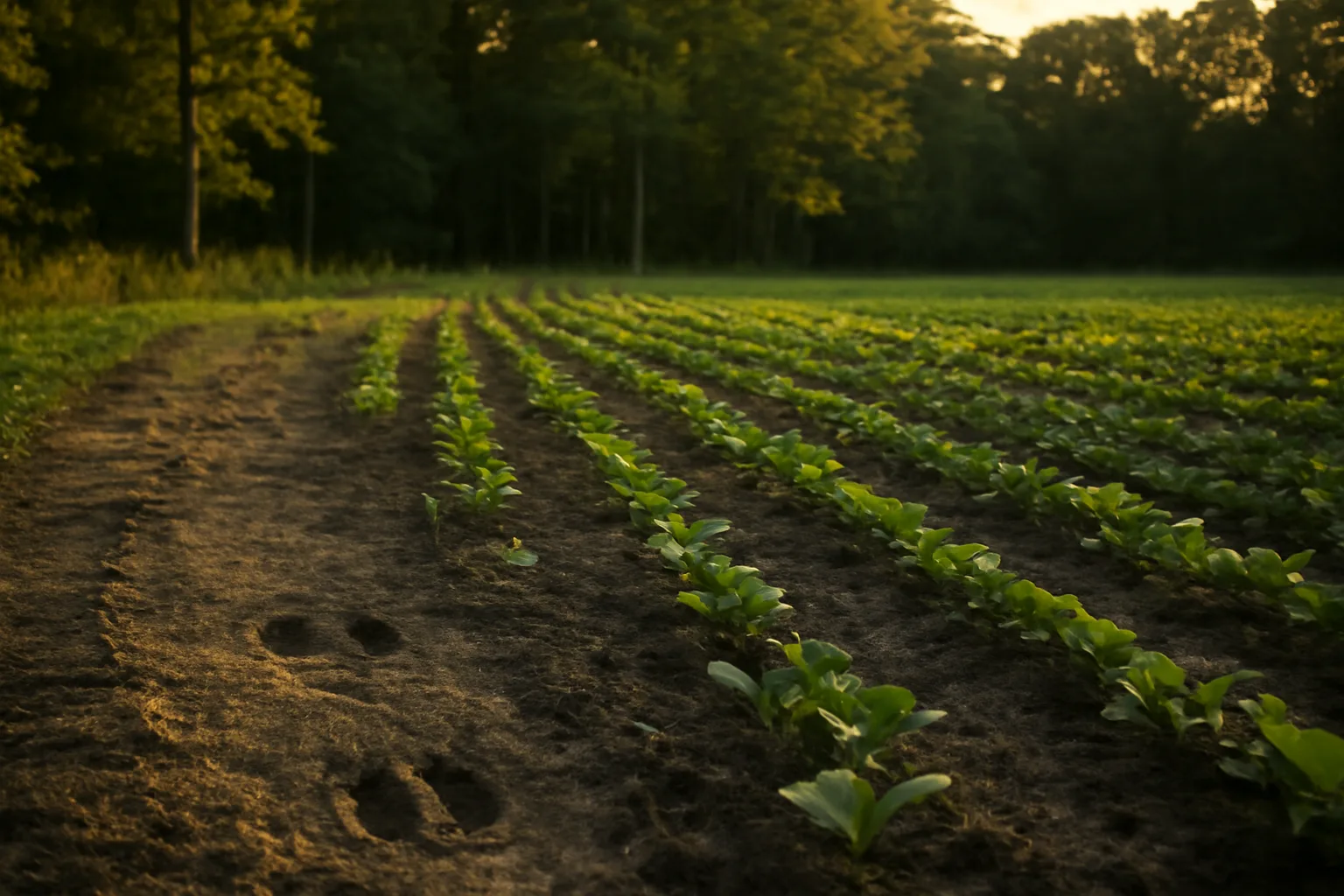
A deer feed plot is a planted patch of forage (clover, brassicas, cereal grains, or annual blends) meant to feed deer and hold them on your ground. Most plots go in during two windows: spring (April-May) for clover and warm-season annuals, and late summer (August-September) for brassicas and cereal grains, timed to a soil test.
What is a food plot, exactly?
A food plot is a cleared, planted area on hunting land, usually between a quarter acre and a few acres, seeded with forage that deer will eat. That's it. No mystery to the definition, though people overcomplicate the execution constantly. Plots do two things at once, and it's worth separating them because they change your seed choice. A nutrition plot is meant to feed deer through a stress period (late summer drought, or the post-rut crash in January and February) and help does raise fawns and bucks grow antlers. A hunting plot, sometimes called a kill plot, is small, tucked near bedding, and planted with something deer find in early fall specifically so you can put an arrow in one from a stand 40 yards away. The agronomy behind a food plot is identical to any forage crop: you need a soil test, the right pH, adequate phosphorus and potassium, and a planting date that matches your first and last frost dates. The USDA NRCS runs cost-share and technical assistance programs for wildlife habitat plantings under its Environmental Quality Incentives Program, and the practice standards behind those programs assume the same soil-test-first approach any row-crop farmer would use [1]. Skip any one of those steps and the plot underperforms no matter how good the seed bag looks. If you want a walk through the different plot categories (kill plots vs. nutrition plots vs. transition strips), the food plot whitetail guide breaks that down in more depth than we can here.
When to plant food plots for deer (by season)
| 3-4 (northern MN, WI, upper MI) | May 15 - June 10 | Aug 1 - Aug 20 | |
|---|---|---|---|
| 5-6 (IA, IL, IN, OH, PA) | Apr 15 - May 20 | Aug 10 - Sep 10 | |
| 7 (VA, NC, TN, AR) | Apr 1 - May 10 | Aug 25 - Sep 25 | |
| 8-9 (Deep South, TX) | Mar 1 - Apr 15 | Sep 15 - Oct 15 | These windows are general guidance built around typical frost dates for each zone. Your county extension office and a current soil test should set the final call, since a river bottom and a ridge top ten miles apart can differ by two full weeks. |
Timing splits into two camps: spring plantings and late-summer/fall plantings, and the split matters more than species choice for most failures we see. Spring plots (April through late May in most of the Midwest and Northeast, March in the Deep South) are for perennial clover, chicory, and warm-season annuals like soybeans, cowpeas, and sorghum. Soil temperature needs to hit at least 50-55°F for clover germination and warmer still for beans, so don't rush it just because the calendar says spring. A late frost can wipe out a too-early planting. Late-summer plots (roughly 6 to 10 weeks before your area's average first frost) are for brassicas (turnips, radishes, rape) and cereal grains (oats, winter wheat, winter rye). This window is the one deer hunters screw up most, because it feels backwards to plant in August when hunting season isn't until October or November. But brassicas need that lag time to bulb up and sweeten after a frost, and cereal grains need a few weeks of growth before cold weather slows them down. Here's a rough framework by USDA plant hardiness zone, understanding that local extension recommendations should always override a general chart like this: | Zone | Spring planting window | Late-summer/fall window |
When to plant clover for deer
Plant clover in early spring once soil hits about 50°F, or in late summer 6 to 8 weeks before your first fall frost, using a frost-seeding or no-till drill approach depending on your ground. Clover is a perennial, so timing is less rigid than annuals, but a poor establishment window means a thin stand for the next three years. Most extension guides recommend a spring frost-seeding method for red and white clover: broadcast the seed onto frozen or frost-heaved ground in late winter (Feb-March in the upper Midwest) and let freeze-thaw cycles work the seed into the soil. The alternative is a clean late-summer planting into a prepared seedbed, which often gives a more even stand because there's less weed competition than spring brings. Whichever window you pick, clover needs a soil pH in the 6.0 to 6.5 range to nodulate properly and fix nitrogen. It also responds hard to phosphorus and potassium if your soil test shows a deficiency. Lime takes months to fully react in the soil. If your test says you need it, get it down the season before you plant, not the week of.
Do deer like clover? Is it really their favorite?
Yes, deer eat clover readily and it's one of the most planted food plot forages in North America, but calling it a single favorite oversimplifies how deer actually forage. White clover and red clover both rank high in preference trials and offer roughly 20-25% crude protein in vegetative growth, which is why they're a staple of nutrition-focused perennial plots [2]. Clover's real advantage isn't that deer prefer it above all else in every situation. It's that clover regrows fast after grazing, tolerates repeated browsing pressure all spring and summer, and comes back year after year with basic maintenance (mowing, spraying broadleaf weeds, topdressing fertilizer). A soybean field might get hammered to nothing by July in a high-deer-density area. A good clover stand can take that same pressure and keep producing. Deer will often switch off clover seasonally when something more attractive shows up, like acorns dropping in October or standing corn. That's normal deer behavior, not a sign your clover failed.
What are deer's favorite foods, really?
Deer are opportunistic browsers, and their actual favorite changes by season, region, and what's available. There's no single food that beats everything else year-round. In fall, acorns are often the single most preferred food where they're available in quantity. White oak acorns in particular carry lower tannin levels than red oak acorns, which makes them more palatable and easier to digest, a pattern described in food habits guidance from state and university wildlife programs [3]. In a plot context, deer show strong seasonal preferences: soybeans and cowpeas in summer, standing corn and soybeans into fall, brassicas and cereal grains after a hard frost sweetens them, and clover nearly year-round when it's actively growing. Preference also shifts based on what's scarce. A deer herd in a corn-and-bean agricultural landscape treats a food plot totally differently than a herd in solid timber with no row-crop neighbors. The honest answer for "favorite food" is whatever is highest in sugar or starch and easiest to digest at that specific moment. That's exactly why brassicas get hit hard after the first frost converts starches to sugars, and why acorns disappear fast the week they start dropping.
When to plant oats for deer
Plant oats 6 to 10 weeks before your area's first fall frost, which puts most of the country in an August to mid-September window, since oats are a cool-season annual that grows fast, tolerates light frost, and dies back completely in hard winter cold in most zones. That die-back is a feature, not a bug, for many hunters because it means no herbicide burndown headache the next spring. Oats germinate quickly, typically 5-10 days in warm soil, and put on serious tonnage in 6 to 8 weeks. That makes them one of the most forgiving cereal grains for a late-planted plot. They also make a strong nurse crop or blend partner with brassicas and winter peas, since the oats come up fast and give some early cover while the slower brassicas establish underneath. One planning note: oats are not as cold-hardy as winter wheat or winter rye. In zone 4 and colder, oats will often die completely by December, so if you want green forage into late winter, blend in wheat or rye alongside the oats rather than planting oats alone.
When to plant turnips for deer
Plant turnips 60 to 90 days before your area's first expected frost, which lands most plantings in late July through early September depending on zone, because turnips need that runway to bulb out and the leaves and roots both need a frost or two to convert starch to sugar and get genuinely palatable to deer. A common mistake is planting turnips too late, chasing the idea that a mid-October planting will be perfect right at gun season. Instead you get small, spindly plants with no bulb development and thin leaf tonnage, because turnips genuinely need 80-90 days from seed to full maturity for the brassica varieties bred for deer plots (Purple Top, Barkant, and similar). Deer often ignore turnip bulbs and tops early in the season, then hit them hard once temperatures drop into the 20s and 30s a few times. That's a real, observed pattern in deer plot management, tied to the same starch-to-sugar conversion that makes brassicas a strong late-season draw when most other green forage has died or gone dormant. If you're planning a brassica-heavy plot, the deer food plot seed rundown covers blend ratios and seeding rates in more detail.
Do deer eat sorghum?
Yes, deer eat both the leaves and the grain heads of sorghum, and grain sorghum (milo) is planted as a food plot summer annual in parts of the whitetail range, particularly the South and Midwest, where it tolerates heat and drought better than corn. It's a warm-season crop, planted after soil warms past roughly 60°F, generally May through June depending on latitude. Sorghum isn't usually a first-choice deer plot species on its own. It's more common as a component in a summer blend with cowpeas, soybeans, and sunflowers, or planted as a standalone screening/bedding cover crop that also happens to produce a grain head deer and turkey will use into fall. Where it shines is drought tolerance. Sorghum handles dry summers that would stunt soybeans, which matters a lot in parts of Texas, Oklahoma, and Kansas. One caution worth knowing: certain sorghum and sudangrass varieties can produce prussic acid (cyanogenic compounds) in young, drought-stressed, or frost-damaged growth, a documented risk in livestock forage management. University of Nebraska-Lincoln Extension guidance on prussic acid poisoning notes that risk rises "when plants are young, drought-stressed, or damaged by frost," and recommends delaying grazing until stressed regrowth has passed [4]. It's a livestock feeding concern more than a documented deer-plot hazard, but it's a real reason to avoid grazing sorghum heavily right after a frost or during a drought stress period, whatever species is eating it.
Do deer like honey? Where does that question even come from?
No, deer do not eat honey in any meaningful dietary sense, and it has no role in food plot planning. Deer are herbivores built to digest plant fiber through a four-chambered rumen system; honey is a concentrated sugar product from bees, not a forage deer seek out or a food source that shows up in any wildlife feeding research. The question likely comes from confusion with "honey hole" (hunter slang for a great stand location) or with sugar-based attractant products marketed for deer, some of which do use molasses or sugar-based scent additives. Molasses shows up in some mineral lick and supplement products, and there's a difference between a manufactured attractant and an actual forage crop. For an actual food plot plan, skip the honey and sugar-based products and put your money into soil amendments instead. A soil test and the lime or fertilizer it calls for will do far more for deer nutrition and plot productivity than any attractant on a shelf.
How does soil testing change what and when you plant?
A soil test tells you your current pH and nutrient levels (phosphorus, potassium, and often organic matter), and every legitimate planting recommendation, including all the windows in this article, assumes you're planting into soil that's been limed and fertilized to spec, more than seeded into whatever dirt is there. Most university soil labs target a pH of 6.0 to 7.0 for clover, brassicas, and cereal grains, which covers the vast majority of common food plot species. Lime is slow. It can take 3 to 6 months to fully react and raise pH, depending on soil type and how finely the lime is ground, so a fall soil test result calling for 2 tons of lime per acre should get applied that fall for a spring planting, not two weeks before you drill seed. If you're planting in spring off a spring soil test, you're often playing catch-up on pH for that season and should treat it as a multi-year project. Your soil test lab is the actual authority on lime and fertilizer rates for your specific field. A general planting guide like this one can tell you what species need on average, but only a test result tied to your dirt tells you your actual numbers. That's true whether you're running the numbers yourself or using a service to help translate a test into a seeding plan. A $99 Custom Food Plot Plan (available at /plot-plan-builder) can take your soil test and location and turn it into species and timing recommendations, but it still can't replace the lab's specific lime and fertilizer call for your field. Treat any plan, ours included, as a planning tool built on top of your lab's numbers, not a substitute for them.
What equipment do you actually need for a feed plot?
At minimum you need a way to kill existing vegetation (herbicide and a sprayer, or tillage), a way to get seed-to-soil contact (a drill, a cultipacker, or a disc and drag), and a way to fertilize per your soil test. Beyond that, everything else is a convenience upgrade, not a requirement. A quarter-acre to half-acre plot is entirely doable with an ATV or UTV, a tow-behind sprayer, a small disc or tiller, and a hand or tow-behind spreader. A no-till drill is the single biggest upgrade for consistency, because it puts seed at the right depth in one pass and handles crop residue that would otherwise choke a cultipacker-only setup, but a drill isn't mandatory for small brassica or clover plots broadcast onto a clean, firm seedbed. The equipment question matters less than most gear articles suggest. A soil test, the right lime and fertilizer, and a planting date that matches your zone will outperform expensive equipment on bad timing every time.
Do you need to worry about baiting and feeding laws for a food plot?
A planted, standing food plot is legal to hunt over in every state, but that's a different question from baiting (piling loose grain, minerals, or feed on the ground), which many states restrict or ban outright, especially where chronic wasting disease is a concern. The two are regulated very differently and it's worth knowing your state's specific line. Michigan is a clear example. Under its Wildlife Conservation Order, the Michigan Natural Resources Commission prohibits baiting and feeding of deer statewide in the Lower Peninsula and in Core CWD Areas of the Upper Peninsula, a rule tied directly to reducing nose-to-nose contact at bait piles where chronic wasting disease can spread [5]. Other states, like Texas, allow baiting broadly outside of specific management units. Wisconsin similarly bans baiting and feeding of deer in any county with a confirmed case of chronic wasting disease, under rules administered by the Wisconsin DNR, with the ban applying to the county of detection and, in practice, expanding as new counties turn up positive tests . Before you plant, spread mineral, or set up any supplemental feed source, check your state wildlife agency's current baiting and feeding regulations directly, since these rules change year to year as CWD zones expand or shrink, and a standing food plot that's perfectly legal in one county can sit right next to a county where a mineral lick would violate baiting law.
How big should a feed plot be, and does size change the planting date?
Size doesn't change your planting window, but it does change what species make sense; smaller plots (under a half acre) do better with high-tonnage, browse-tolerant forages like clover and brassicas, while larger plots (one acre-plus) can support row crops like corn and soybeans that need more acreage to survive early browsing pressure before they mature. A common rule of thumb from wildlife biologists is that food plots should make up somewhere around 1-5% of a property's total acreage to meaningfully supplement natural browse without over-investing in a monoculture, though this varies widely by region, deer density, and how much natural forage the surrounding timber already provides. There's no hard regulatory number here. It's a management guideline, and plenty of good programs run outside that range depending on goals. An acre-plus soybean field can get hit so hard by deer in June and July in a high-density area that it never reaches maturity. In that situation, a bigger plot or an exclusion cage to track browse pressure tells you a lot about whether your acreage is actually big enough for what you planted. If you're weighing size against species options across your whole property, the deer food plots overview and the food plot seed comparison guide both help frame that math before you buy seed.
Frequently asked questions
What is a food plot in simple terms?
A food plot is a planted patch of forage, usually clover, brassicas, cereal grains, or a blend, put in specifically to feed deer and other wildlife and to give hunters a predictable place to hunt near it. It's a habitat practice, not a farming operation, though the underlying agronomy (soil test, pH, fertility, planting date) is the same.
When is the best time to plant food plots for deer?
Spring (April-May in most zones) for clover and warm-season annuals like soybeans; late summer (6-10 weeks before first frost, often August into September) for brassicas and cereal grains like oats and wheat. Exact dates shift by USDA hardiness zone and should be checked against your county extension office's local frost data.
Do deer eat clover, and is it a good plot choice?
Yes, clover is one of the most preferred and most planted food plot forages, offering roughly 20-25% crude protein and regrowing fast after grazing. It's a perennial, so it needs less annual replanting than brassicas or grains, but it does need a soil pH of 6.0-6.5 and regular mowing or spraying to stay productive.
When should I plant oats for a deer plot?
Plant oats 6 to 10 weeks before your area's average first fall frost, generally August to mid-September in most whitetail range. Oats germinate fast and die back completely after hard freezes in colder zones, so blend in winter wheat or rye if you want forage surviving into late winter.
When is the right time to plant turnips for deer?
Plant turnips 60 to 90 days before your first expected fall frost, usually late July through early September. Turnips need that full window to bulb out; planted too late they stay small and thin, and deer typically don't hit them hard until after a few frosts sweeten the leaves and bulbs.
Do deer eat sorghum?
Yes, deer eat sorghum leaves and grain heads, and grain sorghum (milo) is planted as a warm-season summer plot option, especially in hot, dry regions like Texas and Oklahoma where it outperforms corn under drought stress. It's more often used in a blend than as a standalone plot.
Do deer like clover more than other food plot options?
Deer readily eat clover and it ranks high in preference studies, but it's not a universal favorite above everything; deer shift to acorns, standing corn, or fresh brassicas seasonally when those are available. Clover's real strength is regrowth speed and year-round availability, not outranking every other forage at every moment.
What are deer's favorite foods overall?
There's no single favorite; preference shifts by season and availability. White oak acorns are often the top fall preference where present, soybeans and cowpeas lead in summer, and frost-sweetened brassicas and cereal grains take over in late season. It comes down to sugar and starch content at that moment, not one universal food.
Do deer like honey or sugar-based attractants?
No, deer don't eat honey and it has no place in food plot planning; deer are herbivores that browse plant forage, not a species drawn to honey as food. The question likely stems from confusion with sugar-based scent attractants or the slang term "honey hole" for a good hunting spot.
How do I know when to plant my specific food plot?
Start with your USDA plant hardiness zone and average first/last frost dates from your county extension office, then work backward: perennials and warm-season annuals go in spring after soil warms past 50°F, while brassicas and cereal grains go in 6-10 weeks before first fall frost. A soil test should guide fertility timing alongside the planting date.
Can I plant a food plot without a soil test?
You can, but you're guessing on lime and fertilizer needs, which is the single biggest driver of plot success or failure. A soil test typically costs $10-20 through a university extension lab and tells you exact pH and nutrient levels, letting you apply only what your field actually needs instead of over- or under-fertilizing blind.
Is it legal to plant a food plot and hunt over it?
Yes, a standing, planted food plot is legal to hunt over in every U.S. state; that's different from baiting, which means placing loose grain, minerals, or feed piles, and many states restrict or ban baiting, especially in CWD-affected areas. Always check your state wildlife agency's current regulations before adding any supplemental feed beyond a planted plot.
Sources
- USDA Natural Resources Conservation Service, Environmental Quality Incentives Program: Food plots are treated as a wildlife habitat conservation practice supported through federal cost-share programs guided by standard agronomic principles including soil testing and regional planting dates
- University of Tennessee Extension, Wildlife Food Plots (PB1769): White and red clover offer roughly 20-25% crude protein in vegetative growth stages and are among the most preferred food plot forages
- University of Nebraska-Lincoln Extension, Prussic Acid Poisoning (NebGuide G2005): Sorghum and sudangrass species can produce prussic acid (cyanogenic compounds) in young, drought-stressed, or frost-damaged growth
- Michigan Department of Natural Resources, Wildlife Conservation Order (Baiting and Feeding of Deer and Elk): Michigan prohibits baiting and feeding deer statewide in the Lower Peninsula and in Core CWD Areas of the Upper Peninsula due to disease transmission risk
- Wisconsin Department of Natural Resources, Baiting and Feeding Regulations: Wisconsin restricts baiting and feeding of deer in counties with confirmed chronic wasting disease detections