Last updated 2026-07-25
TL;DR
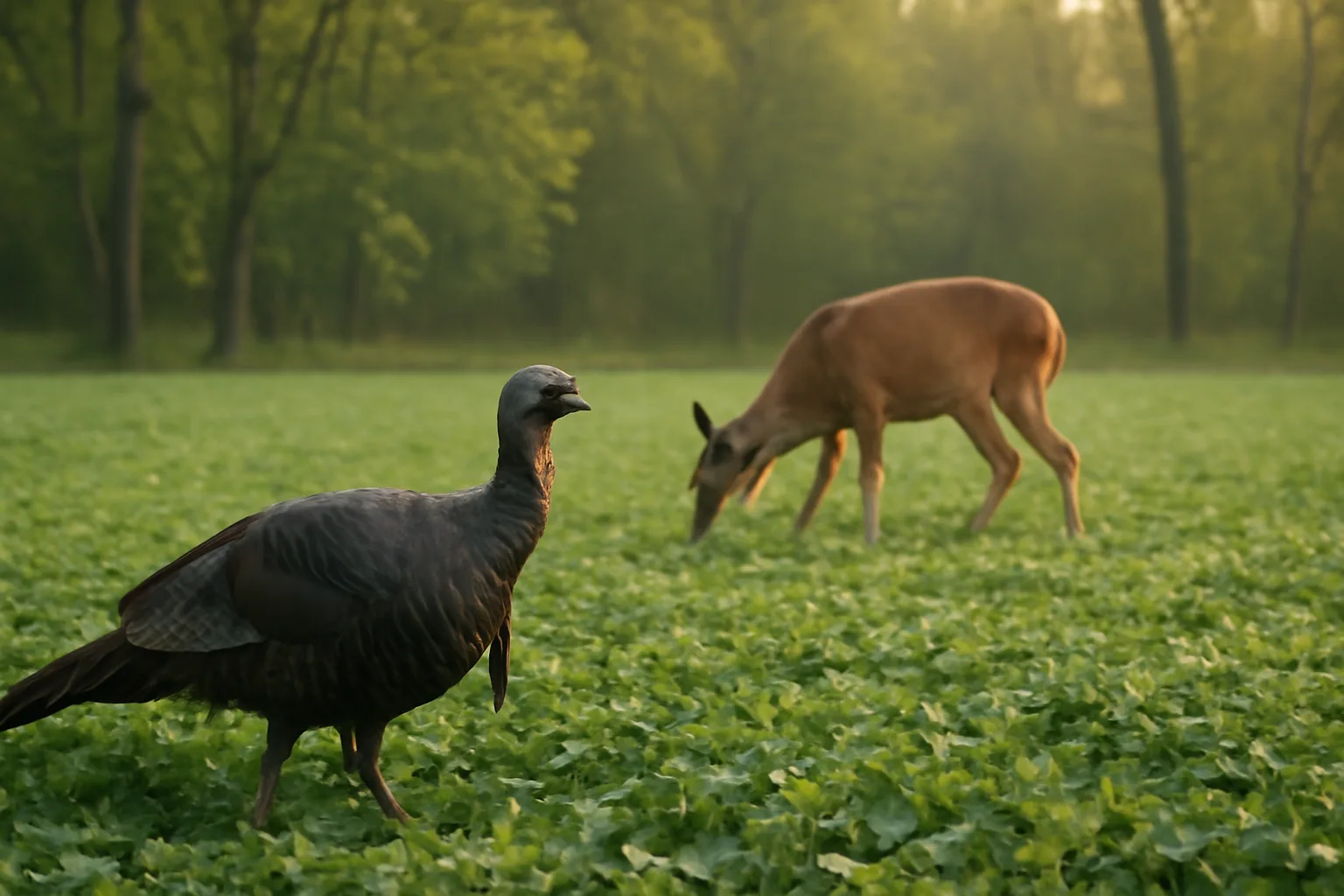
The best deer and turkey food plot seed usually means clover, chicory, oats, and brassicas planted in blends. Turkeys favor open, bug-rich clover and forb stands more than deer-specific brassicas. Plant cool-season blends in late summer to early fall and warm-season plots (clover, chicory) in spring once soil hits 50-55°F.
what is a food plot, exactly
A food plot is a planted patch of forage, usually a half acre to a few acres, put in specifically to feed and hold wildlife on a property. It is more than a mowed field. Most plots run some mix of legumes (clover, alfalfa), brassicas (turnips, radishes, rape), cereal grains (oats, wheat, rye), or grain crops like corn and soybeans, chosen for the season and the animal you're targeting. For deer hunters, a plot is usually built around either a summer-long protein source (clover, soybeans) or a fall attractant (brassicas, cereal grains) timed to peak right as hunting season opens. For turkey, the calculus is different. Turkeys eat far less plant forage directly than deer do. What they really want is bugs, and clover and forb-heavy plots grow more insects than a brassica monoculture does. The National Wild Turkey Federation notes that poults depend on insects for protein during their first weeks of life, shifting toward more plant material as they mature [1]. So a true dual-purpose deer and turkey plot leans on clover, chicory, and native forbs rather than pure brassica or pure grain. That is the seed mix conversation most guys skip, and it is the one that actually matters if you want both species using the same field. If you want a rundown of general plot construction (soil prep, plot size, layout), the food plot whitetail piece covers that ground well and pairs with this one.
do deer eat sorghum
Yes, deer will eat sorghum, especially the seed heads once they mature and dry down in late fall, but it is not a top-tier deer food plot seed on its own. Grain sorghum (milo) is more of a food source and cover crop than a magnet crop. Deer browse the young leaves some in summer, then hit the seed heads harder once frost knocks down other food sources. Sorghum's bigger value in a deer and turkey plot is structure and drought tolerance. It handles heat and dry spells better than corn, needs less nitrogen, and the standing stalks give turkeys and deer both cover and a slow-release food source through winter. Iowa State University Extension and Outreach covers grain sorghum as a wildlife planting option for dry, poor-soil ground where corn struggles, in its wildlife habitat forage guidance [2]. Turkeys will work sorghum fields too, scratching through dropped seed on the ground after the heads shatter. But if sorghum is your only planting, you're leaving a lot on the table. Pair it with a clover or brassica strip nearby rather than planting a whole property in sorghum and expecting it to carry both species.
do deer eat clover, and do deer like clover
Deer eat clover readily, and it is one of the most reliable food plot seed choices for both deer and turkey. Clover regrows fast after grazing, handles repeated browsing pressure better than almost anything else you can plant, and stays palatable through spring, summer, and fall in a perennial stand. Whitetail deer preference studies and extension forage-quality data consistently rank clover among the higher crude-protein forages available in a plot setting, often in the 20-30% crude protein range for well-managed stands, according to Penn State Extension forage guidance for wildlife plantings. That protein level matters most in late spring and summer, when does are lactating and bucks are growing antlers. For turkeys, clover plots do double duty. The clover itself gets some use, but the real draw is the insect population a thick clover stand supports. Grasshoppers, crickets, and other bugs live in clover far more than in a bare brassica field, and that's what poults need to survive their first six to eight weeks. Ladino and red clover blends are the common picks. Ladino is more shade tolerant and persists longer; red clover establishes faster and tolerates poorer drainage. One honest caveat: clover struggles in acidic soil. If your soil test comes back below pH 6.0, clover will sulk no matter how good the seed is. Get lime down according to what your soil test lab recommends before you bother planting clover seed. Your lab knows your dirt better than any generic article does.
when to plant food plots for deer (regional windows)
| Deep South (zone 8-9) | March-April | September-October | |
|---|---|---|---|
| Mid-South / Transition (zone 7) | April | August-September | |
| Midwest / Upper South (zone 6) | April-May | Late July-August | |
| Northern / Upper Midwest (zone 4-5) | May | Late July-early August | Fall brassica and cereal grain plots need roughly 45-90 days before a killing frost to reach full growth, so back-planning from your average first frost date is the safest method. NOAA's climate normals data gives you that first-frost average if you don't already know it off the top of your head [5]. For a more granulated look at exact planting calendars by zone, the site's own seasonal calendars coverage under the plot-types hub breaks this down further, and it's worth cross-checking against your specific county extension office too, since they track local frost data more precisely than any national chart can. |
Timing splits into two seasons: spring plantings for summer forage (clover, chicory, soybeans) and late-summer to fall plantings for cool-season attractants (brassicas, cereal grains, wheat). The right window depends heavily on your latitude and first-frost date. As a rough national framework, extension services frame food plot timing around soil temperature and frost dates rather than a fixed calendar date, since a grower in Alabama and one in Minnesota are working with completely different growing seasons [3] [4]. Here's a general regional breakdown: | Region | Spring/summer plot window | Fall plot window |
when to plant oats for deer
Plant oats for deer in late summer to early fall, generally 60 to 90 days before your first expected frost, so the plants have time to establish before cold slows growth. Oats are a cool-season annual grain, and deer hit them hard in the fall, especially right after a light frost sweetens the leaves by converting starches to sugars. In most of the whitetail's range that means a planting window somewhere between late July in the far north and mid-to-late September in the Deep South. Oats germinate fast, often within 5-10 days in warm soil, which makes them a good nurse crop mixed with slower-establishing clover, since the oats give quick cover and early browse while the clover gets rooted in underneath. Oats won't survive hard winters in the northern tier the way winter wheat or rye will. If you're in a zone with real winter cold, expect oats to die back after repeated hard freezes, usually somewhere in the mid-20s°F and below for sustained periods. That is fine if your goal is a fall attraction plot rather than a plot meant to carry into spring. If you want green growth into late winter and early spring, plant winter rye or wheat instead, or blend the two.
when to plant turnips for deer
Plant turnips for deer in late summer, timed so they mature 80 to 90 days before your first hard frost, since the sweet spot for deer use is after a couple of frosts convert the bulb starches to sugar. Turnips are a classic late-season brassica plot, and deer often ignore the leaves and bulbs early on, then hammer the plot hard once temperatures drop. That delayed-use pattern trips up a lot of first-time planters. You'll plant turnips in August, see deer walk right past a lush green plot in October, and think the seed failed. It didn't. Give it a real frost or two. Penn State Extension and Iowa State University Extension both note brassica palatability improves markedly after frost exposure due to that starch-to-sugar conversion [2]. Planting dates by region run roughly: Deep South, late August to mid-September; transition zone, mid-August to early September; upper Midwest and North, late July to mid-August. Turnips need loose, well-drained soil and a soil pH close to neutral (6.0-6.5) to perform well; a soil test through your county extension office or a private ag lab will tell you exactly where your ground stands and what lime rate to apply. Turkeys get much less direct value from a pure turnip plot than deer do. If turnips are your fall plan, consider a border strip of clover or a grain like wheat nearby so turkeys have something to work while deer focus on the brassicas.
what are deer's favorite foods, and does that change by season
Deer preference shifts by season and by what's actually available, but across food plot options, clover, soybeans, and chicory consistently rank as high-preference, high-use forages, while brassicas and cereal grains take over as fall and winter draws. In spring and summer, does are nursing fawns and bucks are growing antlers, so protein-dense forage matters most. Clover and soybean leaves both run high in crude protein, often 20-30%, and deer will hit a good soybean field hard from the moment it sprouts through pod stage, according to agronomic forage data compiled by Penn State Extension. In fall, energy needs shift toward carbohydrates for fat storage ahead of winter and the rut. That's when brassicas, corn, and standing grain sorghum become the preferred draw, especially after frost sweetens the bulbs and leaves. Acorns complicate all of this. In a good mast year, deer will often abandon a food plot entirely in favor of a dropping white oak or red oak, because acorns deliver more fat and calories per bite than almost anything a plot can offer. That's not a seed problem, it's just biology. Nobody plants a food plot that beats a heavy acorn crop in October; the goal is to give deer something reliable in years when mast fails or once the acorns run out.
do deer like honey (and does it belong in a food plot conversation)
Deer do not eat honey in any meaningful wildlife management sense, and it has no real role in food plot seed selection. This question gets asked online mostly because of confusion with "honeysuckle" or scent-based deer attractant products marketed with names that reference honey or sweetness, not because deer forage on honey itself in the wild. Deer are herbivores built around a four-chambered rumen adapted for browsing plant material, not the kind of digestive system built for processing concentrated sugars like honey. If you've seen commercial deer attractant sprays or blocks marketed with sweet, sugary, or "honey" branding, those are scent and mineral lick products, not food plot seed, and they operate on a totally different premise (drawing deer in with smell over a short range, not sustaining them nutritionally). If your real interest is sweetness as an attractant mechanism, that's exactly why frost-sweetened brassicas and turnips work so well as described above: it's a natural sugar shift in the plant itself, not an additive.
do turkeys use the same plots as deer, and what should a dual-purpose blend look like
Turkeys will absolutely use deer food plots, but what they get out of them is different from what deer get, and a smart dual-purpose blend accounts for that gap. Clover, chicory, and cereal grain plots pull real turkey use; pure brassica and pure corn/soybean plots pull much less. The core idea: turkeys are opportunistic omnivores. Adults eat a fair amount of plant material, seeds, and grain, but poults in their first weeks need bugs almost exclusively for protein, per the National Wild Turkey Federation's brood-rearing habitat guidance [1]. A dense clover or clover/chicory plot supports far more insect life than a bare-dirt brassica field, which is why turkey hunters and habitat managers alike lean on clover plots for spring gobbler activity and brood-rearing cover in early summer. A workable dual-purpose seed mix for a lot of properties looks like this: - A perennial clover/chicory base (2-4 lbs/acre clover, roughly 1-2 lbs/acre chicory) for spring through fall use by both species and bug production for poults.
- A cereal grain strip (oats or winter wheat, 60-100 lbs/acre depending on species and drill vs. broadcast) for fall deer draw and turkey grain feeding.
- A brassica strip (turnips, radish, or a blend, 4-6 lbs/acre) kept separate if you want a dedicated late-season deer plot, since turkeys use this the least. Keep clover and brassica plantings in different fields or at least different halves of a larger field if you can, since brassica establishment (bare, tilled ground, wider row spacing tolerance) and clover establishment (fine seed, shallow planting depth, needs firm seedbed) want different prep. Trying to broadcast both into one pass usually shorts one crop. If you'd rather not guess at ratios and timing for your specific soil test and region, that's the exact gap a $99 one-time Custom Food Plot Plan is built to close (/plot-plan-builder). It's general planning guidance built from your inputs, not a substitute for what your soil test lab tells you about lime and fertilizer rates for your actual dirt.
how do state baiting and feeding rules affect food plot seed choices
Standard, properly planted and maintained food plots are legal to hunt over in the overwhelming majority of states, but baiting and supplemental feeding rules vary a lot, and some states draw a hard line between a planted crop and a pile of shelled corn or mineral block. Always check your state wildlife agency's current regulations before you plant or hunt over anything you're unsure about. Some states, including Michigan and Wisconsin, restrict or ban baiting and supplemental feeding of deer in specific counties or zones tied to chronic wasting disease management, with the affected areas changing as disease surveillance data updates. Michigan's baiting and feeding restrictions are set out in its wildlife conservation order provisions, which the Michigan Department of Natural Resources summarizes for hunters each season [6]. Because these boundaries shift year to year and sometimes mid-season, the only reliable source is your state wildlife agency's current hunting digest or regulations summary for the season you're hunting, not a general article like this one. The general national pattern: a food plot that is planted, growing, and left standing is treated as normal agriculture almost everywhere and is legal to hunt over. A pile of corn, a mineral block, or a plot that's been mowed and left as loose grain on the ground can cross into "bait" territory in states with strict definitions. Don't assume your neighboring state's rules apply to you. Pull up your own state wildlife agency's current hunting regulations guide before the season, since these rules get updated yearly and sometimes mid-season in CWD zones.
what soil and site prep actually matters for deer and turkey seed mixes
A soil test is the one step almost nobody skips in theory and almost everybody shortcuts in practice. Clover and chicory in particular are unforgiving of low pH and low phosphorus, and no amount of good seed genetics fixes a 5.2 pH soil that needed two tons of lime per acre. Most land-grant extension offices (Penn State, Iowa State among them) recommend a soil test through your county extension office or a private ag lab before every planting season, more than once when you start the plot [2]. Lime takes months to fully react in the soil, so fall soil testing ahead of a spring clover planting, or spring testing ahead of a fall brassica planting, gives the lime time to work before the crop needs it. Your soil test lab's recommendations are the actual authority on lime and fertilizer rates for your ground. Generic articles (this one included) can tell you the general ranges land-grant universities publish, but only your specific test result knows your specific field's pH, phosphorus, and potassium levels. Don't skip that step to save $15-20 on a soil test kit; it's the cheapest insurance in the whole plot budget. For turkey-focused ground specifically, mowing strips instead of the whole field, and leaving some bare or lightly disked edges, gives poults room to move through cover while still hunting bugs, which matters more for turkey use than for deer.
how much seed and what mix ratios actually work
Seeding rates matter more than most first-time plotters expect; too heavy a rate wastes seed and money, too light a rate lets weeds win the competition before your plot establishes. Rough broadcast seeding rate ranges commonly cited by extension publications: ladino clover 2-4 lbs/acre, red clover 8-10 lbs/acre, chicory 2-4 lbs/acre (often blended with clover rather than planted alone), oats 2-3 bushels (roughly 64-96 lbs) per acre, winter wheat 90-120 lbs/acre, and brassica blends 4-6 lbs/acre depending on the specific mix of turnip, radish, and rape ratios in the bag. These ranges shift depending on whether you're drilling (lower rate works since seed-to-soil contact is better) or broadcasting (higher rate compensates for less reliable germination). Always check the actual seed tag or extension publication rate for the specific variety you bought, since commercial blends vary. For a broader look at how these seed choices compare side by side across species and goals, deer food plot seed and food plot seed both go deeper into product-level comparisons than this piece does. If you're planting for deer specifically and want the fuller playbook on plot placement and size, deer food plots and deer for food round out the reference set worth bookmarking alongside this one.
Frequently asked questions
Do deer eat sorghum?
Yes. Deer browse young sorghum leaves in summer and eat the mature seed heads heavily in late fall, especially after frost. It's a drought-tolerant option for poor soil but works best paired with clover or brassicas rather than planted alone, since it's not a top-tier standalone attractant.
Do deer eat clover?
Deer eat clover readily and it's one of the highest-use food plot forages available, often testing near 20-30% crude protein in well-managed stands per Penn State Extension forage data. Clover also supports insect populations that benefit turkey poults, making it a strong dual-purpose choice.
When should I plant deer food plots?
Spring plantings (clover, chicory, soybeans) typically go in March through May depending on latitude, once soil hits 50-55°F. Fall plantings (brassicas, oats, wheat) go in 45-90 days before your first frost, roughly late July in the north through late September or October in the Deep South.
Do deer like clover?
Yes, strongly. Clover regrows fast after grazing, tolerates repeated browsing better than most forages, and stays palatable spring through fall. It struggles below pH 6.0, so a soil test and lime application matter more for clover success than for almost any other plot seed.
When should I plant oats for deer?
Plant oats 60-90 days before your first expected frost, generally late July in northern states through mid-to-late September in the Deep South. Oats germinate fast (5-10 days) and work well as a nurse crop mixed with slower-establishing clover.
When should I plant turnips for deer?
Plant turnips so they mature 80-90 days before your first hard frost. Deer often ignore turnips until after a frost or two sweetens the bulbs and leaves through a starch-to-sugar conversion, so don't judge the plot's success before that happens.
What is a food plot?
A food plot is a planted patch of forage, usually a half acre to several acres, established specifically to feed and attract wildlife. Common plantings include clover, brassicas, cereal grains, and soybeans, chosen based on the target season and species.
What do deer like to eat most?
Preference shifts by season. In spring and summer, high-protein clover and soybeans rank highest. In fall, brassicas, cereal grains, and acorns take over as deer shift toward carbohydrate and fat storage ahead of winter. A heavy acorn year will often pull deer off plots entirely.
Do deer like honey?
No, not in any real wildlife-management sense. Deer are browsers with digestive systems built for plant material, not concentrated sugars. This question usually stems from confusion with honeysuckle or sweet-scented commercial attractant products, which are separate from food plot seed entirely.
Will turkeys use the same plot as deer?
Yes, but they use it differently. Turkeys get more value from clover, chicory, and grain strips than from pure brassica plots, since clover supports the insect populations poults need for protein in their first weeks. A mixed planting serves both species better than a single crop.
Is it legal to hunt over a food plot?
In most states, a planted and growing food plot counts as normal agriculture and is legal to hunt over. Baiting rules (piles of corn, mineral blocks) are stricter and vary by state, with some states banning feeding entirely in CWD management zones. Always check your state wildlife agency's current rules first.
How do I know my soil pH before planting clover or brassicas?
Get a soil test through your county extension office or a private ag lab, ideally a season ahead of planting since lime takes months to fully adjust pH. Your test results, not a generic article, are the real authority on your field's lime and fertilizer needs.
Sources
- National Wild Turkey Federation, Wild Turkey Basics: Brood Rearing and Poult Survival: Wild turkey poults rely heavily on insects for protein in their first weeks of life
- Iowa State University Extension and Outreach, Wildlife Habitat Publications: Grain sorghum is a viable food plot option for dry, poor-soil conditions where corn struggles
- University of Tennessee Extension, Establishing Wildlife Food Plots (PB1769): Food plot timing is based on soil temperature and frost dates rather than fixed calendar dates
- NOAA National Centers for Environmental Information, U.S. Climate Normals: Average first-frost dates by location used to back-plan fall food plot seeding windows
- Michigan Department of Natural Resources, Deer Baiting and Feeding Regulations: Michigan restricts baiting in parts of the Lower Peninsula due to chronic wasting disease concerns
- Wisconsin Department of Natural Resources, Baiting and Feeding Regulations: Wisconsin bans feeding and baiting in counties affected by chronic wasting disease