Last updated 2026-07-25
TL;DR
Crushing food plot seed only helps with hard-coated seeds like some clover varieties and certain brassica blends, and even then, scarifying (nicking the coat) beats crushing. For sorghum, oats, and turnips, crushing does nothing but waste seed. What matters more: seed-to-soil contact, planting depth, and timing for your zone.
does crushing food plot seed actually improve germination?
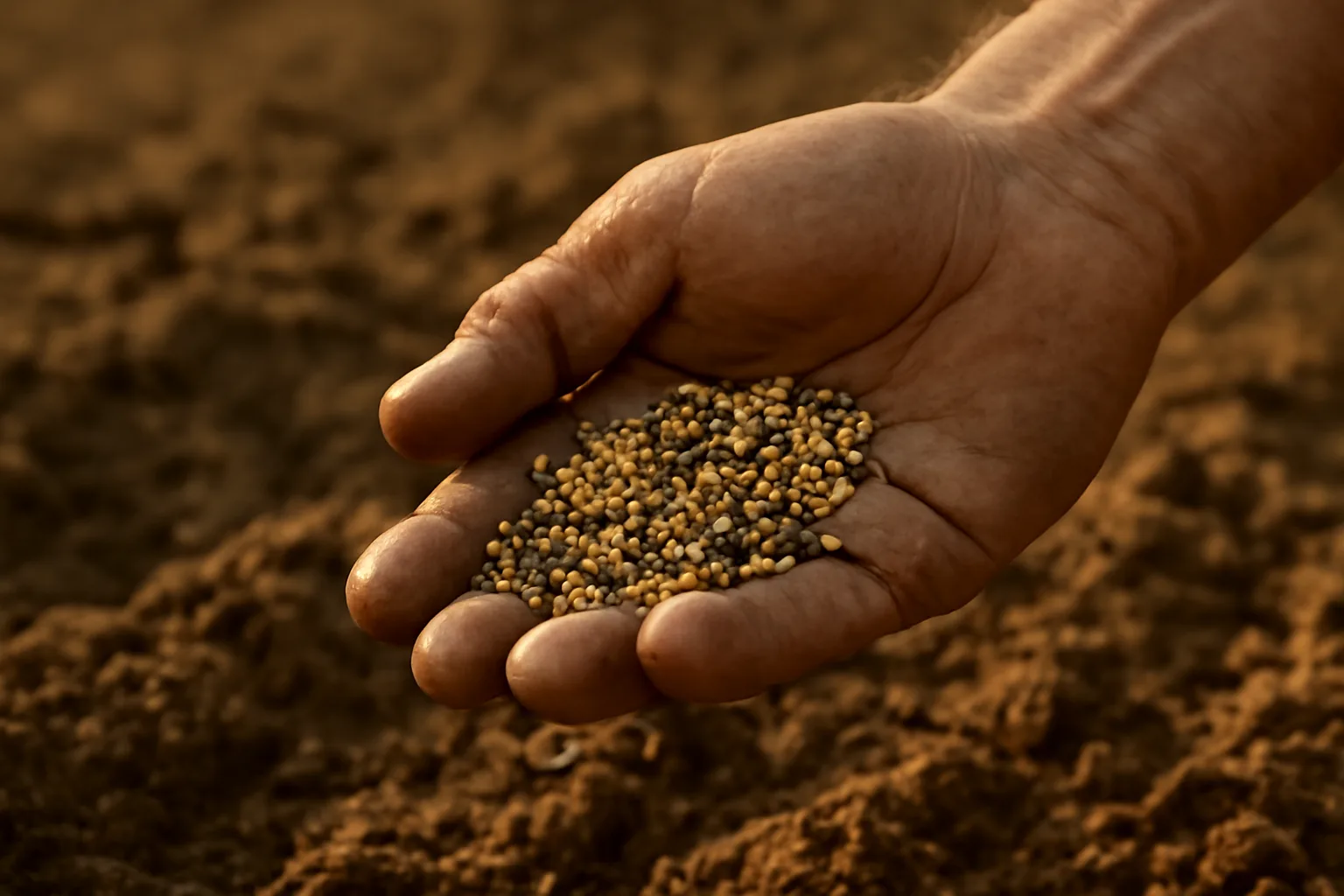
Mostly no. Crushing is a shortcut some hunters use, hoping to break seed dormancy or speed up water uptake, but for the vast majority of food plot species it does more harm than good. You're just as likely to crack the embryo and kill the seed as you are to help it sprout. The idea has some real roots. Certain legume seeds, especially clovers and vetches, have a hard, waxy seed coat that resists water penetration. Agronomists call this "hard seed" and it's a documented trait in clover breeding and seed testing, not a myth [1]. Breaking or nicking that coat, a process called scarification, can speed germination in a lab setting. But crushing with a hammer, a truck tire, or a cement mixer isn't scarification. It's blunt trauma, and it damages the cotyledon and radicle just as often as it opens the coat. For grass-type seeds like oats, sorghum, wheat, and rye, there's no hard coat to break. These seeds germinate through moisture absorption and temperature cues, not physical breakdown. Crushing them just gives you broken seed that either rots in the ground or gets picked off by birds before it ever puts down a root. Brassicas (turnips, radishes, rapeseed) have a thin seed coat by design. They're bred to germinate fast, often in 4 to 7 days under good soil moisture [2]. There's nothing to crush through. If anything, crushing a brassica seed just destroys it. So the honest answer: skip the crushing. If you're worried about hard-coated legume seed, buy inoculated, scarified seed from a reputable supplier, or just plant a bit heavier to account for natural hard-seed dormancy that will break down over a season or two anyway.
which food plot seeds have hard coats that resist germination?
Legumes are the main culprits. White clover, red clover, alfalfa, and vetch all carry a percentage of "hard seed" in any given lot, meaning seed with a coat impermeable to water at the time of planting. Seed testing labs report this as a distinct percentage on the germination tag, separate from the germination rate itself [1]. A typical clover seed tag might show something like 90% germination and an additional 5% hard seed. That hard seed isn't dead. It just won't sprout that season. Over the following year, as the coat weathers from freeze-thaw cycles, soil microbes, and moisture swings, a portion of it will break dormancy and germinate later. This is actually a feature for perennial clover plots: it gives you a staggered stand that isn't wiped out by one bad frost or one dry week right after planting. Commercial seed processors already scarify a lot of clover seed mechanically before it's bagged, using sandpaper-lined drums or acid treatments in a controlled setting, not a truck tire in your driveway [3]. That's why most bagged clover you buy from a farm store or land-grant seed program already germinates well without any home treatment. Grass seeds, brassicas, and most annual food plot blends (like oats, winter peas, sorghum, and soybeans) don't have meaningful hard-seed issues. Save the effort.
do deer eat sorghum?
Yes, deer eat sorghum, particularly the grain heads once they mature, and they'll browse the young leaves earlier in the season too. Grain sorghum (milo) is planted less often than corn in food plots but works as a decent substitute in areas where corn struggles with drought, since sorghum tolerates dry conditions better [4]. Deer use sorghum more as a fall and winter standing grain crop than a summer attractant. The seed heads mature in late summer and hold through fall, giving deer (and turkey, and various birds) a carbohydrate source heading into winter. It's not a top-tier attractant compared to a good brassica blend or soybeans in early fall, but as a drought-tolerant grain option for marginal soil, it has a place. One caution: sorghum can develop toxic levels of prussic acid (cyanogenic glycosides) in young, stressed, or frost-damaged growth, a known risk in sorghum and sudangrass forage documented by university extension programs [5]. This mostly matters for cattle grazing management, but it's worth knowing if you're grazing livestock on the same ground or wondering why extension bulletins harp on it.
do deer eat clover, and do deer like clover?
Yes, and it's one of the most consistently preferred food plot forages available. Clover, particularly white clover varieties like Durana and Ladino, ranks at or near the top of deer preference studies and field observation across most of the whitetail's range [6]. It's high in protein (often 20 to 30% crude protein in vegetative growth) and stays palatable through most of the growing season if it's mowed or grazed to keep it from getting stemmy. What makes clover valuable isn't just that deer eat it. It's a perennial, so a well-established stand can produce for 3 to 5 years with proper mowing and fertility upkeep, which beats replanting an annual plot every year. Clover also fixes its own nitrogen through rhizobium bacteria in root nodules, cutting your fertilizer bill compared to a straight grass or brassica plot [7]. The tradeoff: clover needs decent soil, a pH generally above 6.0, and it struggles in heavy shade or poorly drained ground. If your soil test comes back at 5.2, you're going to need lime before clover does anything worthwhile, and that lime takes months to fully react in the soil [8]. For species selection and how clover stacks up against brassicas, cereal grains, and legume blends, see food plot whitetail and deer food plot seed.
what are deer's favorite food plot foods?
There's no single universal answer, because preference shifts by season, region, and what's available naturally. But across studies and repeated field observation, a few categories come up again and again: acorns (when available, deer will often bypass planted plots for a good acorn drop), soybeans and clover during the growing season, and brassicas and cereal grains after the first hard frost sweetens them up. Brassicas like turnips and radishes go through a process where frost converts starches to sugars, making the greens and bulbs noticeably more palatable in late fall, a well-documented physiological response in brassica crops generally [2]. This is why a turnip plot that deer ignore in October gets hammered in December. Soybeans, where deer density and plot size allow them to survive to maturity, are consistently ranked as one of the highest-preference forages, both as a vegetative browse in summer and as a bean/pod source in fall. The catch is that soybeans need acreage; a half-acre bean plot in a high-density deer area often gets grazed to the dirt before it ever sets pods. Honestly, there's no perfect ranking that applies everywhere. Local ag crops, mast availability, and deer density change the equation every year on the same piece of ground.
do deer like honey?
This one comes up a lot, and the answer is: not really, and it's not a food plot input anyway. Deer are herbivores with a rumen suited to browsing plants, forbs, mast, and agricultural crops. Honey, made by bees from flower nectar, isn't part of a whitetail's natural diet, and there's no wildlife research base suggesting deer seek it out. Where this question probably comes from is confusion with mineral or attractant products marketed with names like "deer honey" or sweet-smelling molasses-based attractants, which are a different thing entirely: often molasses, salt, and mineral mixes sold for bait piles or mineral sites. Those products fall under bait and attractant rules, which vary heavily by state. Baiting deer is illegal in a long list of states and legal with restrictions in others, so check your state wildlife agency's regulations before using any attractant, mineral lick, or bait product . For an actual food plot, skip the honey question entirely and focus on real forage: clover, brassicas, cereal grains, and legumes that deer already evolved to eat.
what is a food plot?
A food plot is a planted area, usually somewhere between a quarter acre and several acres, seeded with forage crops specifically to provide deer (and often turkey, or other wildlife) a concentrated, reliable food source on land you own or lease. It's distinct from natural browse or agricultural fields planted for commercial harvest, though food plots often borrow crop species (soybeans, corn, clover) straight from row-crop agriculture. Food plots serve a few purposes depending on the plot type: some are "destination" plots meant to hold deer during hunting season, some are "nutrition" plots meant to support herd health and antler growth through spring and summer, and some are transition plots planted along travel corridors. USDA NRCS conservation practice standards cover food plot type plantings as part of wildlife habitat management guidance, treating it as a small-scale version of forage crop management . The basics are the same as any planted crop: soil testing, correct pH and fertility, right species for your zone and soil type, correct seeding depth and rate, and timing tied to your local frost dates. Skipping any one of those steps is the most common reason a plot fails, far more often than seed quality or crushing debates. For a broader look at plot types and how to pick one for your ground, see deer food plots and food plot seed.
when to plant food plots for deer, by zone
| Deep South (zone 8-9) | March | September to October | |
|---|---|---|---|
| Mid-South / Transition (zone 7) | Early to mid-April | Mid-September to early October | |
| Midwest / Mid-Atlantic (zone 6) | Late April to May | Late August to mid-September | |
| Upper Midwest / Northeast (zone 4-5) | May | Mid-August to early September | These are general windows, not guarantees; local frost dates vary by elevation and microclimate, and NOAA publishes freeze and frost date data by weather station that you can check against your own county . Always check your own last and first frost dates rather than relying on a generic national chart. Fall brassica and clover plots need enough time before the ground freezes to establish a root system and several inches of top growth, typically 60 to 90 days depending on species. Plant too late and you get a thin, weak stand that won't survive winter or won't be worth much as forage. |
Timing depends entirely on your crop type and your first and last frost dates, not a fixed calendar date. Cool-season crops (clover, brassicas, oats, wheat, rye) go in either early spring or late summer/early fall, timed so they hit peak growth during cooler weather. Warm-season crops (soybeans, corn, sorghum, cowpeas) go in after your last spring frost, when soil has warmed. A rough national breakdown: | Region | Spring planting window | Fall planting window |
when to plant oats for deer
Oats go in during the fall planting window in most whitetail range, generally 45 to 60 days before your average first fall frost, so the plant has time to establish before cold weather slows growth. In the Midwest and mid-Atlantic that's typically late August through mid-September; in the Deep South it stretches into October . Oats are a fall annual cereal grain, valued in food plots because deer hit the tender green shoots hard right after germination and again after frost sweetens the leaves. They also grow fast, often showing green within 5 to 10 days of planting given decent soil moisture, which makes them a good nurse crop mixed with slower-establishing clover. Spring oat planting is possible in northern climates too, mostly as a quick cover crop or early-season plot, but oats planted in spring tend to mature and go to seed by mid-summer, losing palatability faster than a fall-planted stand that stays vegetative into winter. One practical note: oats alone winterkill in much of the northern half of whitetail range once temperatures drop into the teens or lower for extended periods, so don't count on a pure oat plot to hold forage all winter that far north. Pairing oats with winter-hardy wheat, rye, or clover in the mix extends usable forage later into the season.
when to plant turnips for deer
Turnips are planted in the late summer to early fall window, generally 80 to 100 days before your first hard frost, since they need that runway to develop both leaf mass and a bulb before frost sweetens them. In zone 6 (much of the Midwest and mid-Atlantic), that puts planting around late July to mid-August. Further south, it pushes into September. Turnips are brassicas, and like other brassicas they benefit from that first hard frost, which converts starches into sugars and makes both the greens and the bulb noticeably more attractive to deer, a change university extension horticulture guidance on brassica crops confirms happens with cold exposure [2]. This is why a turnip plot often looks untouched in early fall and gets hammered in December and January. Seeding rate matters more than people think. Broadcast turnip seed too heavy and you get all leaf, no bulb, because the plants crowd each other. Most university extension recommendations land turnip seeding rates around 4 to 6 pounds per acre when planted alone, less when blended with other brassicas or cereal grains . Soil pH matters here too. Brassicas tolerate a slightly wider pH range than clover, but they still perform best in the 6.0 to 6.8 range, and a soil test is the only way to know where your ground actually sits before you spend money on seed and fertilizer.
how do I know what to plant and when for my specific property?
Species, soil, and timing decisions all depend on your particular ground, and generic charts only get you so far. A soil test from your local extension lab or a private ag lab is the real starting point; it tells you your exact pH, phosphorus, potassium, and organic matter, and your lab's recommendation is the actual authority on how much lime and fertilizer to apply, not a blanket internet number. Once you have that test back, matching species to your soil type, drainage, sunlight, and deer pressure gets specific fast. Heavy clay ground drains differently than sandy loam. A plot bordered by thick cover holds deer differently than one out in the open. Shade from a treeline cuts clover yield more than most people expect. This is the gap a $99 one-time Custom Food Plot Plan is built to close: you get a species and seeding plan matched to your zone, soil test results, and property layout, without hiring a full-time agronomist. It's general planning guidance built around your inputs, not a site visit or a guarantee of deer activity or harvest results, and your soil lab's lime and fertilizer numbers still take priority over any general plan. Whatever route you take, plan on retesting soil every 2 to 3 years, since lime application and crop uptake shift pH and nutrient levels over time [8].
what mistakes waste the most food plot seed?
Planting too deep is probably the single biggest seed-waster. Clover and brassica seed is tiny and only needs to go a quarter inch deep or less, often just pressed into the soil surface with a cultipacker. Bury it an inch down with a drill set for soybeans and it never emerges. Check your seed tag or a land-grant planting guide for the specific depth for each species before you set equipment . Poor seed-to-soil contact is next. Broadcasting seed onto unworked, weedy, or crusted ground and walking away wastes a huge percentage of what you spread. A light disking or dragging pass, followed by cultipacking or rolling, dramatically improves germination compared to broadcast-and-pray. Planting on the wrong soil pH is a slow-motion waste. Clover on a 5.0 pH plot might come up but never thrive, and you'll blame the seed when the real problem sat in the soil test you never pulled. And finally, skipping fertility. Even nitrogen-fixing legumes need adequate phosphorus and potassium to get established, and brassicas and cereal grains are heavy nitrogen feeders. A soil test plus your lab's fertilizer recommendation beats any generic bag rate every time [8].
Frequently asked questions
Does crushing clover seed before planting help it germinate?
Not really. Crushing risks damaging the embryo more than it helps break the seed coat. If hard seed dormancy concerns you, buy seed that's already been mechanically scarified by the processor, which most bagged commercial clover seed already is. Home crushing with tools or vehicles is too imprecise to help reliably.
Do deer eat sorghum?
Yes. Deer browse young sorghum leaves and eat mature grain heads, especially in fall and winter. It's more valuable as a drought-tolerant standing grain crop than as a top-tier summer attractant, and it's a solid option on marginal or dry soils where corn struggles.
Do deer like clover?
Yes, clover is one of the most consistently preferred food plot forages, especially white clover varieties. It's high in protein, stays palatable through the growing season with mowing, and as a perennial can produce for 3 to 5 years without replanting, unlike annual plots.
When should I plant food plots for deer?
Timing depends on crop type and your local frost dates. Cool-season crops like clover, oats, and brassicas go in during spring or, more commonly, 45 to 100 days before your first fall frost. Warm-season crops like soybeans and corn go in after your last spring frost. Check NOAA or your county extension frost date data for exact windows.
When should I plant oats for deer food plots?
Plant oats 45 to 60 days before your average first fall frost, typically late August through mid-September in the Midwest and mid-Atlantic, later in the Deep South. Oats green up fast, often within 5 to 10 days, making them a good nurse crop for slower clover establishment.
When should I plant turnips for deer?
Plant turnips 80 to 100 days before your first hard frost, generally late July to mid-August in zone 6 climates, later further south. That runway lets the plant build leaf mass and a bulb before frost sweetens the plant and makes it more attractive to deer.
What is a food plot?
A food plot is a planted area seeded with forage crops like clover, brassicas, or cereal grains to provide deer and other wildlife a concentrated food source on hunted land. It borrows species and agronomy practices from row-crop farming, scaled down to a quarter acre to a few acres.
What are deer's favorite foods in a food plot?
It varies by season and region, but acorns (when available), soybeans, and clover rank high in growing season, while frost-sweetened brassicas and cereal grains take over in late fall and winter. Local mast crops and agricultural fields nearby change the picture every year.
Do deer like honey?
No, honey isn't part of a whitetail's natural diet and isn't a food plot input. Confusion sometimes comes from molasses-based mineral or attractant products marketed with names like it. Those fall under bait and attractant regulations that vary by state, so check your state wildlife agency's rules before using any.
Should I crush or scarify hard-coated legume seed myself?
Generally no. Commercial scarification uses controlled abrasion or acid treatment in a processing facility, not a hammer or truck tire. Most bagged clover and legume seed sold for food plots is already scarified. Home crushing risks destroying more seed than it helps.
Do I need a soil test before planting a food plot?
Yes, strongly recommended. A soil test tells you exact pH, phosphorus, and potassium levels, and your lab's lime and fertilizer recommendation is the real authority for your ground, not a generic online rate. Skipping it is one of the most common reasons plots underperform.
How deep should I plant food plot seed?
It depends on species. Small seed like clover and brassicas needs about a quarter inch or less, often just pressed in with a cultipacker. Larger seed like soybeans or oats needs roughly 1 to 1.5 inches. Check the seed tag or a land-grant planting guide for exact depth.
Sources
- Association of Official Seed Analysts / USDA seed testing standards on hard seed in legumes: Hard seed is a recognized, tested percentage in legume seed lots separate from standard germination rate
- Utah State University Extension, Growing Brassica Cover Crops: Frost converts starches to sugars in brassica greens and bulbs, increasing palatability
- University of Georgia Extension, Grain Sorghum Production Guide (Bulletin 1180): Sorghum is more drought tolerant than corn and used as a substitute grain crop on marginal soils
- University of Nebraska-Lincoln Extension, Prussic Acid Poisoning (G1745): Young, stressed, or frost-damaged sorghum can develop toxic prussic acid levels
- USDA NRCS Plant Guide, White Clover (Trifolium repens): Clover fixes atmospheric nitrogen through rhizobium bacteria in root nodules
- University of Missouri Extension, Soil Acidity and Liming (G9101): Soil pH below roughly 6.0 significantly limits clover establishment and lime takes months to fully react in soil
- 16 U.S. Code Section 3372, Wildlife Violator Compact and Lacey Act enforcement provisions: Deer baiting and attractant rules vary substantially by state and enforcement ties to federal wildlife law
- NOAA National Centers for Environmental Information, US Climate Normals freeze/frost data: First and last frost dates vary by specific location and should guide planting windows rather than a national calendar