Last updated 2026-07-26
TL;DR
The best fall food plots in Michigan mix brassicas (turnips, radish) planted by late July/early August, cereal grains like oats planted late August to mid-September, and perennial clover established in spring but grazed hard each fall. Timing depends on Michigan's zone (north vs south), first frost dates, and soil test results.
What is a food plot, exactly?
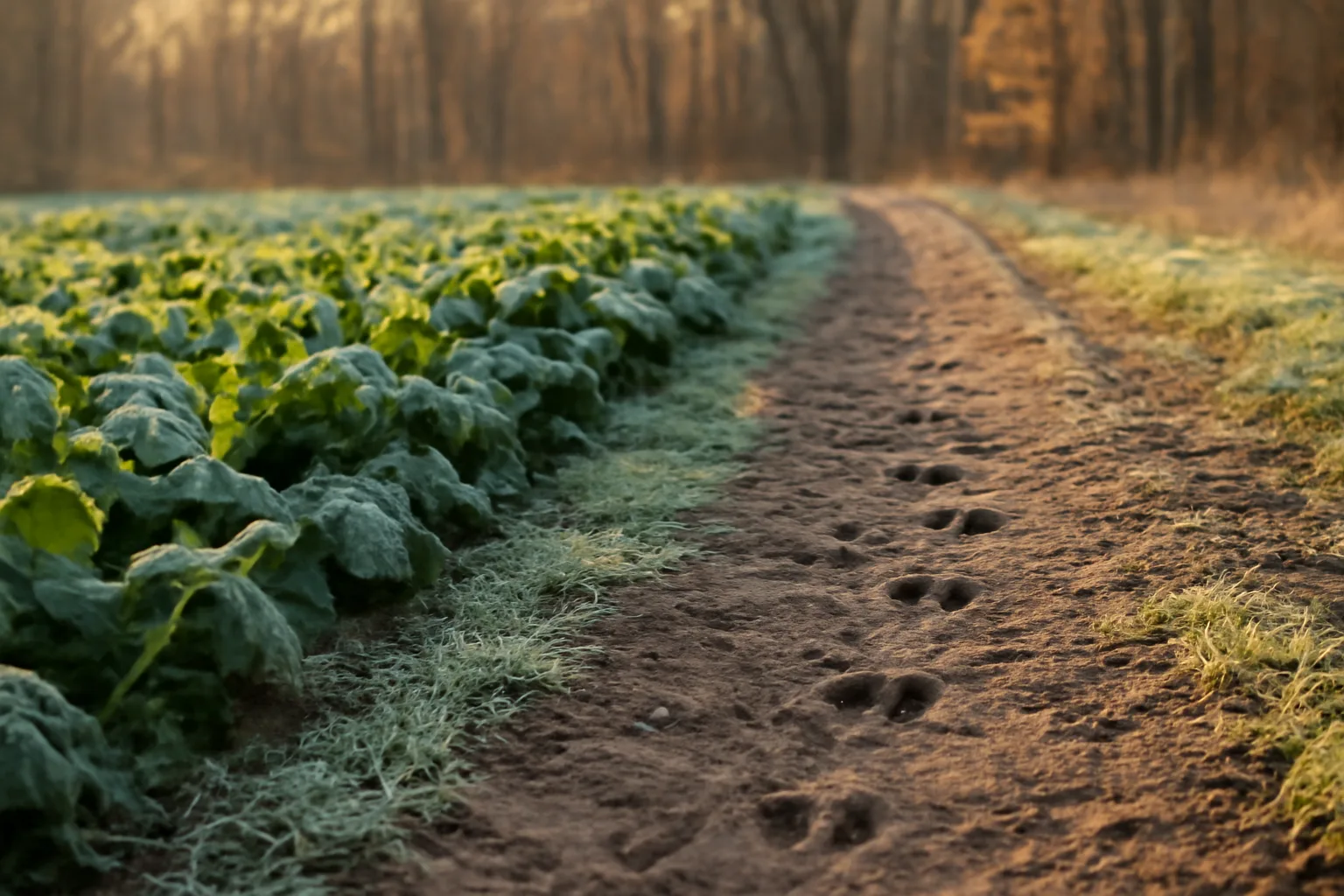
A food plot is a planted patch of forage on hunting land meant to feed and hold deer, not a garden and not a lawn. Most Michigan plots run from a quarter acre tucked into a clearcut to several acres in an open field, planted with annuals, perennials, or a mix of both. The point isn't just calories. A well-placed plot pulls deer onto land where you can hunt them, concentrates browse pressure so native habitat gets a break, and in fall specifically, gives deer a high-energy food source right when they need it for the rut and the push into winter. Michigan State University Extension describes food plots as a habitat management tool that works best paired with existing cover and natural browse, not as a replacement for it [1]. There's no single best food plot. What works on sandy soil in Roscommon County looks nothing like what works on heavy clay in Hillsdale County. That's the whole reason soil tests and zone-specific timing matter more than which bag of seed you buy. If you're building your first plot plan from scratch, it helps to start with the broader category before picking species. See food plot whitetail for the foundational rundown.
When to plant food plots for deer in Michigan?
| Brassicas (turnips, radish) | July 15 - Aug 5 | Aug 1 - Aug 20 | |
|---|---|---|---|
| Oats/cereal rye | Aug 15 - Sept 5 | Sept 1 - Sept 20 | |
| Clover (fall dormant seeding) | Late Aug - early Sept | Mid Sept - early Oct | |
| Winter wheat | Late Aug - mid Sept | Mid Sept - early Oct | These windows aren't exact science. A wet August or an early cold snap shifts things. Check your local MSU Extension county office or a regional forecast for actual frost trends before you commit seed to dirt. |
Timing splits into two seasons: spring plantings (clover, chicory, alfalfa) and late-summer plantings for fall annuals (brassicas, cereal grains). For fall food plots specifically, you're working backward from Michigan's first frost. Michigan spans two very different growing zones. Northern Michigan (roughly north of a line through Clare and Alpena) sees first frost as early as mid to late September, sometimes earlier in the Upper Peninsula. Southern Michigan often doesn't see a hard frost until mid to late October. The USDA plant hardiness zone map puts most of northern Michigan and the U.P. in zones 4b-5a, while southern Michigan runs zones 5b-6b. That frost date matters because brassicas need 80-90 days to mature and actually taste better after a frost converts starches to sugars. Cereal grains need less time, usually 60-70 days to reach good grazing height, and they tolerate a wider planting window. Here's a rough fall planting calendar by region: | Species | Northern MI (Zone 4b-5a) | Southern MI (Zone 5b-6b) |
What are deer's favorite fall foods in Michigan?
Deer preference shifts by season and by what's naturally available. In early fall, deer are still hitting soft mast, acorns, and standing corn or soybeans if it's around. As natural food drops off in October and November, planted brassicas, clover, and cereal grains become a lot more attractive because deer are loading up ahead of winter and the rut is burning calories fast. Acorns are probably the single most preferred natural fall food in Michigan's hardwood country, and in a heavy mast year deer will walk past a decent food plot to hit a white oak flat. That's not a knock on food plots, it's just biology. Extension research on deer forage consistently ranks acorns, especially white oak group acorns, as highly preferred over red oak acorns because of lower tannin content [2]. Among planted options, brassicas (turnips, radishes, and forage rape) often become the top draw in late fall once a couple of hard frosts sweeten the leaves and bulbs. Clover holds strong through early fall until frost knocks growth back. Cereal grains like oats are a favorite through the first frost or two, after which oats generally die off in most of Michigan and deer shift to whatever's still green. There's no universal answer to "favorite food" because it depends on what's scarce. A plot that gets ignored in September can get hammered in December once acorns run out.
Do deer like clover, and does it work in Michigan?
Yes, clover is one of the most reliable food plot species in Michigan, and it's the backbone perennial for a reason. White clover (Dutch, Ladino) and red clover both establish well across Michigan's soil types when pH and fertility are managed, and they provide season-long forage from spring through fall, with a second wind after the first fall rains. Clover is planted in spring or late summer/early fall, not deep fall. If you're seeding clover for a fall plot benefit, you actually want it in the ground by early September in southern Michigan or late August up north, so it has time to establish a root system before frost. A true fall-planted clover plot for a hunting season starting in October is really last year's planting doing the work. One real limitation: clover needs decent soil pH (ideally 6.0-6.5) and struggles on Michigan's more acidic sandy soils common up north without lime applied per a soil test [3]. MSU Extension recommends testing soil before planting any perennial forage, since correcting pH after the fact is slow and lime takes months to fully react in the soil. Clover also can't handle severe drought or repeated overgrazing without some rest. If you've got heavy deer density on a small property, clover alone may get grazed to the dirt and need a rotation or larger plot size to survive. For seed selection tailored to clover-heavy plans, see deer food plot seed.
Do deer eat sorghum, and is it worth planting?
Deer do eat sorghum, particularly grain sorghum heads and young sorghum-sudangrass shoots, but it's not a top-tier whitetail food plot choice in Michigan and most serious plotters skip it. Sorghum is more of a Southern and Midwestern row-crop staple grown for grain and cover, and deer will browse it, but it isn't as attractive or nutrient-dense for deer as brassicas, soybeans, or clover. Where sorghum earns a place in a Michigan plot is as a screening or cover crop, not a primary food source. Tall sorghum varieties planted along field edges can block sightlines and create a travel corridor, similar to how some hunters use standing corn. If your goal is pure fall nutrition and attraction, spend your seed budget on brassicas or cereal grains instead. There's also a practical issue: sorghum needs a longer, warmer growing season than a lot of Michigan summers reliably deliver, especially up north. It's planted in late spring, not fall, so it's not part of a fall-planting conversation at all unless you're leaving a spring-planted stand standing into hunting season for cover.
When to plant oats for deer in Michigan?
Oats go in the ground in late August through mid-September in most of Michigan, aiming for 45-60 days of growth before a hard frost. In the north, that means planting by early September at the latest; in southern Michigan, you can push into mid-to-late September and still get a solid stand. Oats are a fall annual, cheap, fast-growing, and highly attractive to deer while actively growing. They germinate in as little as 5-7 days with adequate moisture and can be ready for grazing in three to four weeks. Michigan State University Extension row crop guidance notes oats are a common fall cover crop choice in Michigan because of their quick establishment and frost tolerance down to around 20°F before they're killed off [4]. That frost tolerance matters. Oats will keep growing through light frosts, and deer often prefer them most right after a frost sweetens the leaves, similar to brassicas. Once temperatures drop into the teens for a sustained stretch, oats typically die and stop being a green food source, so don't expect an oat plot to carry deer through a Michigan January. A common combo is oats mixed with cereal rye or winter wheat. The oats provide fast early attraction, and the rye or wheat survives colder temps and keeps some green forage available into late fall and even early spring.
When to plant turnips for deer in Michigan?
Turnips need to go in the ground by early August in northern Michigan and no later than mid-to-late August in southern Michigan, because they need 80-90 days to fully bulb out and reach peak palatability after frost. This is one of the most common timing mistakes new plotters make. Turnips planted in September in Michigan will grow leafy tops but rarely have time to develop the bulb, and they won't get the sweetening frost effect before winter shuts things down. The leaves are still edible and deer will eat them, but you lose the high-energy bulb that makes brassica plots so good for late-season and post-rut nutrition. A rough rule extension agronomists use: count backward from your average first hard frost date and plant turnips at least 90 days before that date, with some buffer for a dry spell or slow germination. If your area sees first frost around September 25 (fairly typical for parts of northern Michigan), turnips should be in the ground by late June to early July for full maturity, which is earlier than a lot of people expect. Deer often ignore turnip plots completely in September and early October, then hammer them hard in November and December once a few frosts have hit and other food sources thin out. That delayed attraction is normal, not a sign the plot failed. For more on blending turnips with other brassicas and grains, deer food plots covers common mix ratios.
Do deer like honey, and does it matter for food plots?
Deer don't seek out honey in the wild, and there's no meaningful role for honey in food plot planning. This question shows up online mostly because of scent and attractant products that use honey or sugar-based additives, not because honey has any real place in forage planting. Some commercial deer attractant sprays and mineral licks include sugar, molasses, or honey-scented components to boost initial attraction to a mineral site or trail camera location. That's a different category entirely from food plots, which are about season-long nutrition, not a one-time lure. If you're deciding between a mineral site and an actual planted plot, know that mineral sites are regulated similarly to bait in some states, and Michigan has specific rules on baiting and feeding deer that vary by region and disease zone. Michigan's Department of Natural Resources maintains baiting and feeding regulations that differ by county due to chronic wasting disease and bovine TB management zones, and those rules change periodically, so check the current DNR baiting and feeding page before using any bait or mineral product [5]. A planted food plot is generally treated differently from baiting in most states' regulations, but always confirm with your state agency since definitions and legality shift.
What's a realistic fall food plot mix for Michigan hunters?
Most experienced Michigan plotters run two to three plot types rather than betting everything on one species, because attraction shifts across the season and a frost event changes what deer want almost overnight. A common approach: a perennial clover plot established in spring for summer-through-fall grazing, a brassica blend (turnips, radish, forage rape) planted by early August for late-season high-energy food, and a cereal grain patch (oats plus winter rye or wheat) planted in early September for quick fall attraction and some winter carryover. Soil testing before any of this matters more than the seed bag choice. MSU Extension's soil testing program recommends testing at least every three years and adjusting lime and fertilizer based on results rather than guessing, since Michigan's soils range from sandy and acidic in the north to heavier and more neutral in parts of the south . Your soil test lab, not a seed label, is the real authority on how much lime or fertilizer your specific plot needs. If you want a plan built around your actual property, zone, and soil test results rather than a generic calendar, that's exactly what a $99 one-time Custom Food Plot Plan is built for at /plot-plan-builder. It's guidance based on your inputs, not a guarantee of deer activity or harvest success, and your soil lab's specific lime and fertilizer recommendations should always take priority over general planting advice.
How much does a Michigan fall food plot cost to plant?
Rough per-acre costs run anywhere from $50 to $200+ depending on species, whether you're renting or owning equipment, and how much lime or fertilizer your soil test calls for. Brassica and cereal grain seed tends to run cheaper per acre than clover or alfalfa seed, but clover is a one-time perennial investment that pays off over three to five years versus reseeding annuals every year. Lime is often the biggest hidden cost. If your soil test comes back needing 2 tons of lime per acre to correct pH, that alone can cost more than the seed. MSU Extension's soil test recommendations are based on actual buffer pH results, not a flat guess, which is why skipping the test and just "throwing lime down" wastes money either through under-application that doesn't fix pH or over-application that's simply wasted product . Equipment costs vary widely too. A no-till drill rental or a small ATV disc setup can run $50-150 for a weekend, versus owning a tractor and implements that cost thousands but pay off over many seasons on larger acreage. For equipment-specific guidance, food plot seed and domain food plot seed cover seed selection matched to different planting methods.
Frequently asked questions
Do deer eat sorghum?
Yes, deer will eat grain sorghum heads and young sorghum-sudangrass growth, but it's not a top food plot choice for Michigan whitetails. It's more useful as a screening or cover crop planted in late spring. For fall nutrition, brassicas, clover, and cereal grains attract deer better and fit Michigan's growing season more reliably.
Do deer eat clover?
Yes, clover is one of deer's most consistently preferred forages and a staple of Michigan food plots. White and red clover provide season-long grazing from spring through fall. It needs decent soil pH (6.0-6.5) and periodic rest from heavy grazing pressure to stay productive year over year.
When should I plant food plots for deer in Michigan?
It depends on species and region. Brassicas go in by late July to mid-August, cereal grains like oats by early to mid-September, and clover in spring or by early September for fall establishment. Northern Michigan zones need earlier planting than southern Michigan due to earlier frost dates.
Do deer like clover more than other food plot plants?
Clover ranks among deer's most preferred forages, but preference shifts seasonally. In late fall, deer often favor frost-sweetened brassicas over clover. Clover's strength is season-long availability and lower reseeding cost since it's a perennial, not that it always beats every other option in raw preference.
When should I plant oats for deer in Michigan?
Plant oats late August through mid-September, aiming for 45-60 days of growth before a hard frost. Oats germinate fast, in about 5-7 days, and tolerate light frost down to roughly 20°F before dying off, per Michigan State University Extension cover crop guidance.
When is the best time to plant food plots for deer overall?
There's no single best date since it depends on species and your zone. Perennials like clover go in spring or early fall. Fall annuals like brassicas need 80-90 days before frost (plant by late July/early August), while oats and cereal grains need only 45-60 days (plant late August to mid-September).
When should turnips be planted for deer food plots?
Turnips need 80-90 days to mature, so plant by early August in northern Michigan or mid-to-late August in southern Michigan. Planting later produces leafy tops but skips the bulb development and frost-sweetening that makes turnip plots so attractive to deer in November and December.
What exactly is a food plot?
A food plot is a planted area on hunting land, typically a quarter acre to several acres, seeded with forage species to feed and attract deer. It's used to supplement natural browse, concentrate deer activity for hunting, and provide high-energy nutrition during fall rut and pre-winter periods, per Michigan State University Extension habitat guidance.
What are deer's favorite foods in fall?
It varies by availability. Acorns, especially from white oaks, rank as one of the most preferred natural fall foods due to low tannin content. Among planted options, frost-sweetened brassicas, clover, and cereal grains like oats are consistently high on the list, though preference shifts as natural food sources deplete.
Do deer like honey?
Deer don't naturally seek out honey, and it has no real role in food plot planning. Some commercial mineral and attractant products include honey or sugar for scent appeal at mineral sites, but that's a separate strategy from planting forage, and mineral/bait use is regulated differently by state.
How many acres should a Michigan fall food plot be?
There's no universal size, but many hunting-focused plots run a quarter acre to two acres for small hidden plots near stands, and larger destination fields run three to five acres or more. Smaller plots get overgrazed faster with high deer density, so size should match herd pressure on your specific property.
Can I plant a fall food plot without a soil test?
You can, but you're guessing on lime and fertilizer needs, which often wastes money either way. MSU Extension recommends testing soil every three years since Michigan's soils vary widely in pH and fertility from sandy, acidic ground up north to heavier soils in southern counties.
Sources
- Michigan State University Extension, Food Plots for Wildlife: Food plots work as a habitat management tool paired with existing cover, not a replacement for natural browse
- Michigan State University Extension, Managing Oaks for Acorn Production: White oak group acorns have lower tannin content and are more preferred by deer than red oak acorns
- Michigan State University Extension, Soil pH and Liming: Clover establishment and productivity depend on soil pH correction via lime based on soil test results
- Michigan State University Extension, Cover Crops for Michigan: Oats are a common fast-establishing fall cover crop in Michigan with frost tolerance to around 20°F
- Michigan State University Extension, Soil Testing for Field Crops: MSU Extension recommends soil testing at least every three years to guide lime and fertilizer application