Last updated 2026-07-24
TL;DR
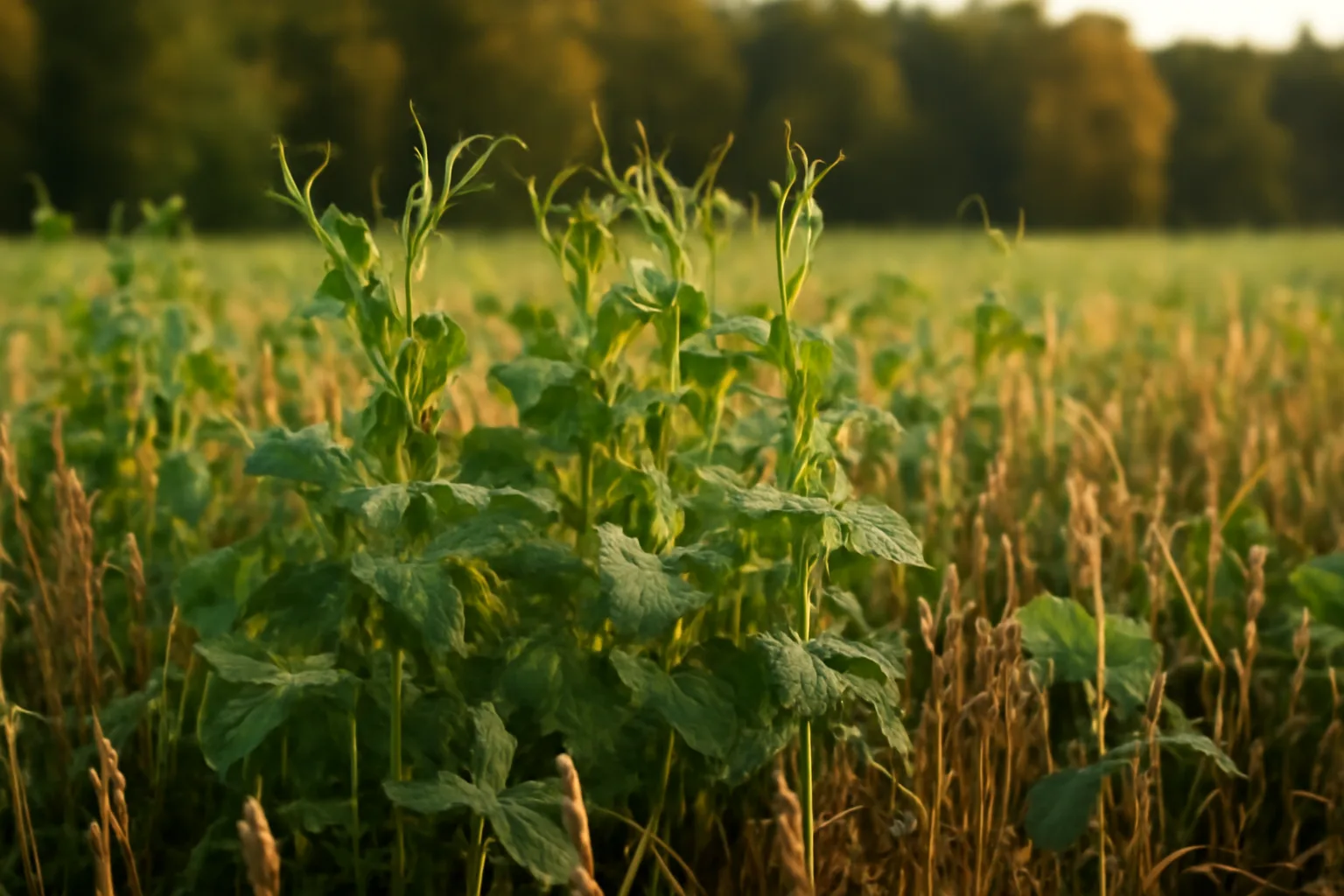
Austrian winter peas are a cold-hardy legume that hunters plant in late summer to early fall for high-protein deer forage that can survive light frosts and keep growing into winter. They work best in a blend with cereal grains like oats or wheat, need soil pH near 6.0-6.8, and typically go in the ground 6 to 8 weeks before your area's first hard frost.
What are Austrian winter peas and why do deer plots use them
Austrian winter peas (Pisum sativum subsp. arvense, sometimes called field peas or winter peas) are a cool-season annual legume bred for cold tolerance, originally used as a cover crop and cattle forage. Deer hunters adopted them because the plant does two things well: it fixes nitrogen in the soil and it produces leaves that carry 20 to 30 percent crude protein, similar to alfalfa and clover, according to forage analyses referenced by university extension programs [1]. The vine sprawls rather than stands upright, which is why almost nobody plants peas alone. Left on their own, peas flop over into a mat that deer can strip clean in a few weeks, and the plant has no structure to keep growing once that happens. Mixed with a cereal grain, the peas climb the grain stalks, the whole plot stands more upright, and you get a longer feeding window. Peas are not a warm-season crop. They germinate best in cooler soil, they tolerate frost down into the low 20s Fahrenheit once established, and they stall out or die in summer heat. That puts them squarely in the fall planting category, right alongside brassicas and cereal grains, not with soybeans or cowpeas. If you're new to plot planning generally, it helps to understand the basic categories food plots fall into before picking a species. See our overview on food plot whitetail strategy for that bigger picture.
What is a food plot, exactly
A food plot is a planted area, usually somewhere between a quarter acre and several acres, established specifically to grow forage that attracts and feeds deer or other wildlife. It's distinct from a natural food source like an oak flat or a farmer's soybean field because you control the species, the timing, and the soil fertility. Most hunters split their plots into two functional types: annual plots (replanted every year, often brassicas, cereal grains, or peas) and perennial plots (clover or alfalfa that persists for 3 to 5 years with mowing and maintenance). Annual plots tend to produce more tonnage per acre in a shorter window; perennials give you season-long grazing pressure relief once established. State wildlife agencies regulate food plots differently than bait piles or feeders. Planting and growing a crop in place is legal hunting-over-it in nearly every state, but piling loose grain, seed, or feed is a separate category often banned or restricted, especially where chronic wasting disease is a concern. Check your state wildlife agency's regulations before you plant near a stand, because the line between a plot and a bait pile is a legal one, not a common-sense one, and it varies. Michigan, for example, bans supplemental feeding and baiting in the Lower Peninsula in ways that don't apply to standing food plots [2]. For a broader rundown on how plots differ from feeders and mineral sites, see deer food plots.
When to plant food plots for deer
| Upper Midwest / Northeast | mid-Aug to mid-Sept | late April to May | |
|---|---|---|---|
| Mid-South / Transition zone | early Sept to early Oct | March to April | |
| Deep South | late Sept to Nov | Feb to March | These are general windows, not guarantees. Your local NRCS field office or state extension office publishes frost date tables specific to your county, and that's the number you should actually plan around, not a national average [4]. |
Timing splits into two seasons: spring/summer plantings for warm-season annuals and perennials, and late-summer/fall plantings for cool-season annuals like peas, brassicas, oats, and wheat. Austrian winter peas fall firmly into the second category. The rule of thumb from most land-grant extension guides is to plant cool-season fall plots 6 to 8 weeks before your area's average first killing frost, so the plants get enough growing degree days to establish a root system and some top growth before cold really sets in [3]. In the Upper Midwest and Northeast, that often means planting in mid-August to early September. In the mid-South and Southeast, you can push into late September or October. Spring plots (clover, chicory, warm-season legumes) go in after your last frost date, generally April through May depending on latitude, once soil temps are consistently above 50°F. Here's a rough framework by region: | Region | Fall plot window (peas, brassicas, cereal grains) | Spring plot window (clover, chicory) |
When to plant oats for deer (and how peas fit with them)
Oats go in the ground at the same time as Austrian winter peas, which is exactly why the two are planted together so often. Both want that 6-to-8-week-before-frost window, both germinate in cool soil, and oats give the peas something to climb. A common blend ratio is 50 to 70 pounds of oats per acre with 30 to 40 pounds of peas per acre, drilled or broadcast together at a total planting depth around half an inch to one inch. Winter-hardy oat varieties (as opposed to spring oat varieties) will survive further into cold weather and regrow some in early spring, extending the plot's usefulness past first frost. Wheat and cereal rye are the other common cereal partners. Rye is the toughest of the three in cold climates and will green up again in spring; wheat sits in the middle; oats are the least cold-hardy but often the most palatable to deer early in the season. If you're planting in zone 4 or colder, lean toward rye or wheat as the pea's partner. In zone 6 and warmer, oats work fine on their own timeline. For seed sourcing and blend options built around these combinations, see deer food plot seed.
When to plant turnips for deer, and do peas mix with brassicas
Turnips get planted in the same late-summer window as peas, generally 60 to 90 days before your first expected frost, since turnips need time to bulb up before the ground gets cold [5]. That overlaps closely enough with the pea planting window that some hunters build a three-way blend: peas, a cereal grain, and a brassica like turnips or radish. It works, but it takes some planning. Brassica seed is tiny (turnip seed runs somewhere around 150,000 seeds per pound) and needs to be planted shallow, almost on the surface, while peas want to go down half an inch to an inch. If you're broadcasting rather than drilling, a workable approach is to broadcast the brassica seed first, then drill or lightly disc in the peas and cereal grain over the top, which buries the peas at proper depth while leaving brassica seed close to the surface. Deer tend to hit brassica leaves first in early fall, then switch to the bulbs after a few hard frosts convert starches to sugars. Peas and oats, meanwhile, get hit hard in the early weeks and may be grazed down before the brassicas even mature, so don't be surprised if your pea/oat mix looks thin by November while the turnips are just hitting their stride.
Soil, pH, and fertility peas actually need
Austrian winter peas, like most legumes, want soil pH between 6.0 and 6.8 for best nodulation and nitrogen fixation. Below pH 5.5, the rhizobium bacteria that peas depend on to fix nitrogen struggle, and you'll see pale, stunted plants regardless of how much fertilizer you throw at them. A soil test is the only honest way to know where your dirt actually sits. Extension offices and most seed suppliers offer $10 to $20 soil tests that report pH, phosphorus, potassium, and organic matter. Lime takes months to fully react in soil, so if your test comes back below pH 6.0, ideally you're applying lime the fall or spring before you plant peas, not the week of planting. Peas don't need much nitrogen fertilizer since they make their own once nodulated, assuming you've inoculated the seed with the right rhizobium strain (Rhizobium leguminosarum) or bought pre-inoculated seed. Phosphorus and potassium are a different story. Peas respond well to phosphorus at planting, and a soil test will tell you whether you need it or already have plenty. Your soil test lab is the authority on exact lime and fertilizer rates for your specific field. A general guide like this one can tell you the target range; it can't tell you what your dirt actually needs this year. If you want a plan built around your specific test results and region, that's exactly the gap a $99 one-time Custom Food Plot Plan is meant to fill: you send in your soil test and location, and get a species and rate recommendation instead of a national average.
Planting method: drilling, broadcasting, and seeding rates
Peas can be broadcast or drilled, but drilling gets more consistent results because seed placement at the right depth matters more for peas than for tiny brassica seed. Target seeding depth is 1 to 1.5 inches in a drill; if broadcasting, cover the seed with a light disc pass or drag afterward, because peas left on the surface germinate poorly and are easy pickings for birds and rodents. Seeding rate alone (peas planted solo, no companion) runs 40 to 60 pounds per acre in extension trial guidance. In a blend with oats or another cereal grain, drop the pea rate to 30 to 40 pounds per acre and add 50 to 70 pounds per acre of the grain. A firm, moist seedbed matters more than fancy equipment. A disc, a cultipacker, or even a well-timed rain after broadcast seeding can make the difference between a thick stand and a spotty one. If your only equipment is an ATV and a broadcast spreader, that's workable, you just need to compensate with a cultipacker pass or drag chains to press seed-to-soil contact. For a rundown of equipment options across budget levels, our food plot seed guide covers drills, broadcast spreaders, and no-till options in more depth.
Do deer eat sorghum
Yes, deer will eat grain sorghum (milo) heads and young sorghum shoots, but it's not a top-tier food plot choice for whitetail specifically. Sorghum is more commonly planted as a screening cover crop or a game bird food source (it's a staple in dove field mixes) than as a primary deer forage. Deer will browse young sorghum leaves in summer and will eat the grain heads once they mature and dry down, and turkey, quail, and dove use sorghum heavily too. But compared to soybeans, cowpeas, or a well-managed brassica plot, sorghum offers lower protein content and deer don't preferentially select it the way they do legumes or brassica tops. Most food plot programs use sorghum, if at all, as a wildlife cover or screening component along plot edges rather than as the plot itself.
Do deer eat clover, and do deer like clover
Deer eat clover readily and it's one of the most consistently preferred food plot forages available, which is why it shows up in nearly every serious plot rotation. White clover varieties (Ladino, especially) and red clover both test in the 25 to 30 percent crude protein range during active growth, competitive with alfalfa [6]. Clover's biggest advantage over Austrian winter peas is longevity. A well-maintained clover stand persists 3 to 5 years with proper mowing and occasional herbicide for grass control, while peas are a one-season annual you replant every fall. The tradeoff is that clover is a perennial commitment: it needs mowing several times a season and doesn't tolerate heavy shade or poor drainage well. Many experienced plotters run clover as their spring/summer perennial base and rotate peas, brassicas, and cereal grains through separate annual plots for fall. That gives deer protein-rich forage nearly year-round without asking one plot to do everything. For species comparisons across clover, alfalfa, chicory, and annuals, see our deer for food breakdown.
What are deer's favorite foods, and where do peas rank
Deer preference studies and extension forage rankings consistently put acorns, soybeans, clover, and other legumes at the top of the list, largely because deer key in on protein and fat content, especially during antler growth and lactation in spring and summer, and again as they build fat reserves before winter [7]. Acorns from white oak family trees are particularly preferred over red oak acorns because of lower tannin content. Among planted food plot species, soybeans and cowpeas (warm season) and clover and Austrian winter peas (cool season) consistently rank near the top of deer preference in extension forage trials, largely because all four are legumes with high protein and palatability. Brassicas rank lower for palatability until after a hard frost converts starches to sugars, at which point deer preference for turnip and radish tops and bulbs increases sharply. Austrian winter peas specifically are often cited by extension wildlife programs as one of the most preferred fall forages available, sometimes grazed down faster than the cereal grain planted alongside them [1]. That's a double-edged sword: high preference means fast grazing pressure, and a pure pea plot can get stripped to bare vines within a few weeks on properties with a dense deer population.
Do deer like honey (and why this question keeps coming up)
There's no real evidence that deer specifically seek out honey, and it's not a practical or legal food plot or attractant strategy in most states. Deer are occasionally reported investigating exposed honeycomb or bee-damaged trees, likely drawn to the sugar content the same way many mammals are opportunistically drawn to any sweet, high-calorie substance, but this isn't documented as a meaningful part of natural whitetail diet in the wildlife literature, and it's not something extension forage guides address at all. More relevant to hunters asking this question: liquid or scent-based attractants, including anything sugar or scent-based marketed as a deer lure, fall under baiting and feeding restrictions in many states. Those rules are usually written around grain, salt, and mineral products, but some states define bait broadly enough to include any substance placed to attract game. Check your state wildlife agency's specific baiting statute before using any attractant product, honey included, near a stand.
How Austrian winter peas compare to other cool-season plot options
| Austrian winter peas | 20-30% [1] | Good to low 20s°F once established | Legume component in a blend | |||||
|---|---|---|---|---|---|---|---|---|
| Cereal rye | 12-15% | Excellent, regrows in spring | Structure/climbing support, latest planting window | |||||
| Oats | 12-16% | Fair, winterkills in hard cold | Early-season palatability, structure | Winter wheat | 12-15% | Good | Structure, extends into late fall | |
| Brassicas (turnip/radish) | 15-25% in tops, higher sugar in bulbs after frost | Very good | Late fall/winter tonnage, bulb feeding | |||||
| White clover | 25-30% [6] | Perennial, persists winter dormant | Season-long perennial base | No single species does everything. That's the actual argument for blends: peas bring protein and palatability, a cereal grain brings structure and extends the cold tolerance, and a brassica adds late-season tonnage after frost sweetens the bulbs. A three- or four-way blend covers more of the calendar than any one species planted alone. |
Here's how peas stack up against the other cool-season staples on protein, cold tolerance, and typical role in a blend. | Species | Crude protein (approx.) | Cold tolerance | Typical role |
Frequently asked questions
Do deer eat sorghum?
Yes, deer browse young sorghum leaves and eat mature grain heads, but it's a lower priority than legumes or brassicas for dedicated deer plots. Sorghum is more often used for dove and quail food plots or as screening cover along plot edges than as a primary whitetail forage.
Do deer eat clover?
Deer eat clover readily and prefer it strongly; white and red clover run 25 to 30 percent crude protein during active growth, similar to alfalfa. Clover is a perennial that persists 3 to 5 years with mowing, making it a common season-long base plot alongside fall annuals like peas.
When should I plant food plots for deer?
Cool-season fall plots (peas, brassicas, cereal grains) go in 6 to 8 weeks before your area's first killing frost, often mid-August to October depending on latitude. Warm-season and perennial plots (clover, soybeans) go in after your last spring frost, generally April to May in northern regions and earlier in the South.
Do deer like clover?
Yes, clover is one of the most consistently preferred forages in extension food plot trials, ranking near soybeans and other legumes in deer preference. Its high protein content (25-30%) and season-long availability make it a staple perennial plot choice across nearly every region.
When should I plant oats for deer?
Plant oats 6 to 8 weeks before your area's first fall frost, the same window used for Austrian winter peas and other cool-season annuals. Oats are less cold-hardy than rye or wheat and will winterkill in harder freezes, so in colder zones consider wheat or rye instead.
When should I plant turnips for deer?
Plant turnips 60 to 90 days before your expected first frost so bulbs have time to size up before cold weather. Deer often ignore turnip tops early and switch to eating both tops and frost-sweetened bulbs after a few hard freezes convert starches to sugars.
What is a food plot?
A food plot is a planted, managed area, typically a quarter acre to several acres, established specifically to grow forage for deer or other wildlife. It differs from a bait pile or feeder because it's a standing crop, which most states treat as legal hunting even where baiting is restricted.
What are deer's favorite foods?
Acorns (especially white oak family), soybeans, clover, and other high-protein legumes consistently rank as top preferred deer foods in extension studies. Austrian winter peas are frequently cited among the most preferred fall food plot forages, sometimes grazed down faster than the cereal grain planted alongside them.
Do deer like honey?
There's no solid evidence deer seek out honey as a meaningful food source; occasional interest in honeycomb likely reflects general attraction to sugar, not a documented dietary pattern. It's not a practical food plot strategy, and sweet or scent-based attractants may fall under state baiting restrictions.
Can Austrian winter peas be planted alone, without a cereal grain?
You can plant peas alone at 40 to 60 pounds per acre, but the vines sprawl into a mat on the ground with no structure, which speeds up grazing pressure and can shorten the plot's usable life. Nearly every experienced plotter pairs peas with oats, wheat, or rye for support and a longer feeding window.
What pH do Austrian winter peas need?
Peas nodulate and fix nitrogen best in soil with pH between 6.0 and 6.8. Below pH 5.5, the rhizobium bacteria peas depend on struggle to function, leading to pale, nitrogen-starved plants regardless of added fertilizer. A soil test is the only reliable way to know your actual number.
How cold-hardy are Austrian winter peas compared to cereal rye?
Established Austrian winter peas tolerate light frosts and temperatures into the low 20s°F, but cereal rye is more cold-hardy overall and will regrow in spring after a hard winter. In zone 4 and colder, pairing peas with rye rather than oats gives more reliable winter survival.
Should I inoculate Austrian winter pea seed before planting?
Yes, unless you buy pre-inoculated seed. Peas need the rhizobium bacteria Rhizobium leguminosarum on the seed coat to fix nitrogen effectively; uninoculated seed in soil without existing pea-compatible rhizobium populations will grow but won't fix nitrogen well, costing you the crop's main soil benefit.
Sources
- Alabama Cooperative Extension System, Wildlife Food Plot Forages: Austrian winter peas and other legumes carry roughly 20-30% crude protein
- Michigan Department of Natural Resources, Baiting and Feeding Regulations: Michigan restricts baiting and supplemental feeding of deer in parts of the state
- Mississippi State University Extension, Establishing Wildlife Food Plots: Cool-season fall food plots should be planted roughly 6-8 weeks before first frost
- USDA Natural Resources Conservation Service, Plant Materials Program: Local NRCS offices provide region-specific planting guidance including frost date data
- University of Tennessee Extension, Establishing and Managing Wildlife Food Plots: Brassica species like turnips should be planted 60-90 days before first frost to bulb properly
- USDA NRCS Plant Fact Sheet, White Clover: White clover crude protein content of roughly 25-30% during active growth
- Mississippi State University Extension, Deer Nutrition and Food Habits: Deer preference favors high protein and fat sources like acorns, soybeans, and legumes seasonally