Last updated 2026-07-26
TL;DR
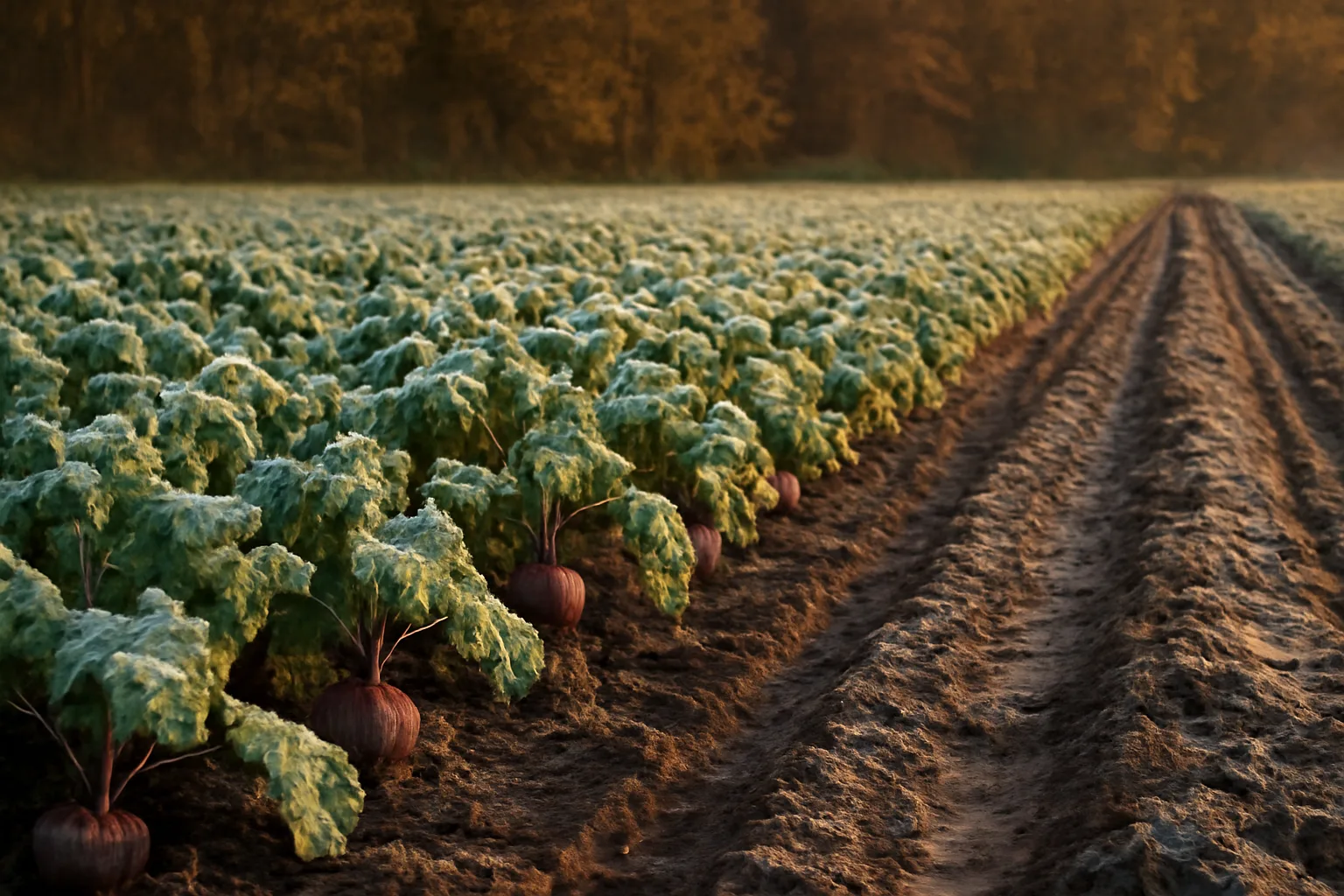
Beets and greens food plot seed is usually a forage/sugar beet and brassica greens (turnip, kale, or rape) blend, planted 60-90 days before your first hard frost, typically late July through August in the North and August through early September in the South. Deer eat the leafy tops first, then dig up the beet roots after frost sweetens them.
what is a food plot, exactly?
A food plot is a planted patch of forage, usually somewhere between a quarter acre and several acres, put in specifically to feed deer or other wildlife and to give hunters a predictable place to see animals. It is not a garden and it is not natural browse; it is a managed planting, usually of annual or perennial forage crops, on ground you own or lease. Most hunters split plots into two jobs. A food plot provides nutrition (protein for antler and body growth in spring and summer, energy and carbohydrates for fall and winter), and it provides a hunting location with good sightlines and wind options. Beets and greens mixes lean hard into the second half of the calendar. They are cold-season annuals, meaning they grow through summer and peak in value right when November and December hunts happen. Most land-grant extension programs treat food plots as a wildlife habitat management practice, similar in principle to planting a cover crop, just with a different end user. If you're new to the whole concept, our food plot whitetail guide covers the basics of plot sizing, placement, and access before you even get to seed selection.
what's actually in a beets and greens food plot seed blend?
Most bagged "beets and greens" or "beets and greens deer plot" mixes combine a forage or sugar beet variety with one or more brassica greens, usually turnip, kale, or forage rape. Some blends throw in a small amount of radish for early-season soil breakup and quick tonnage. The beet component is bred for a big root and a leafy canopy, not for human table use. Forage beets can produce 4 to 8 tons of dry matter per acre under good conditions, according to trial data compiled by university forage programs, though real-world food plot yields on marginal soil run well below research-plot numbers. The greens component germinates fast, usually 5 to 10 days, and gives deer something to eat within a few weeks of planting. The beet roots take the whole season to bulk up and aren't really attractive until after a hard frost converts starches to sugars. Think of the greens as the appetizer and the beet root as the main course deer come back for in December and January, after most other food sources are gone or under snow. That extended availability is the main reason hunters plant beets and greens instead of a straight brassica mix. The roots hold food value into late winter far better than leaf-only crops.
when to plant beets and greens food plots (and food plots generally)?
| Upper Midwest / Northeast | Late July to mid-August | Late Sept to early Oct | |
|---|---|---|---|
| Mid-South / Mid-Atlantic | Mid-August to early Sept | Mid to late Oct | |
| Deep South | Late August to mid-Sept | Early to mid Nov | These are starting points, not guarantees. Many land-grant extension bulletins on brassica forages for deer recommend seeding roughly 60 to 90 days ahead of the first killing frost so the crop can reach a useful stage of maturity before growth slows for the season. That guidance shows up consistently enough across programs in Kentucky, Virginia, and the upper Midwest that it's a safe rule of thumb regardless of which specific bulletin you pull it from. If you plant later than that window, you'll still get some green growth, but the beet roots may not bulk up before winter locks things down. For a full season overview, more than this one crop, see our deer food plots planting calendar breakdown by zone. |
The single most important rule for beets and greens, and for brassicas generally, is to count backward from your area's average first hard frost date. Extension programs across the whitetail range consistently recommend planting brassica-type forages 60 to 90 days before that date, which gives the beet roots time to size up and the greens time to establish before growth slows. Here's a rough planting window by region, based on typical first-frost dates and extension planting guidance: | Region | Typical planting window | Typical first frost |
when to plant turnips for deer?
Turnips follow the same 60 to 90 day rule as beets and other brassica greens. Plant them from late July through August in northern states, and from mid-August into early September through the mid-South, aiming to land 60 to 90 days ahead of your first hard frost. Turnip greens are usually the first thing deer eat in a mixed brassica plot. The bulb, or root, doesn't become attractive until frost sweetens it, which is the same mechanism that makes beet roots palatable. If you plant turnips too early in warm soil, you risk poor germination and disease pressure. Too late, and the bulb never sizes up. Seeding rate for turnips alone typically runs 4 to 6 pounds per acre broadcast, a range consistent with land-grant extension forage seeding tables for brassica plots. In a mix with beets and other greens, turnip is usually a smaller percentage of the blend by weight since the seed is small and germinates easily.
when to plant oats for deer?
Oats are a cool-season cereal grain, not a brassica, and they follow a slightly different clock. Most extension guidance recommends planting oats for fall deer forage 6 to 8 weeks before the first frost, which usually lands in late August through mid-September across much of the whitetail range, a bit later than the beets and greens window in the same latitude. Oats are often mixed with brassicas or clover because they germinate in 5 to 7 days, giving deer something green to browse while slower crops establish. They also winterkill in most of the North, so many hunters treat them as a one-season attractant rather than a standalone plot. Spring oat plantings are also common as a nurse crop for clover, planted as soon as soil can be worked in early spring. That's a different use case than fall forage, so match your planting date to your actual goal.
do deer eat sorghum?
Yes, deer eat sorghum, particularly the grain heads once they mature, and whitetails also browse young sorghum leaves. Grain sorghum (milo) is more commonly planted as a standalone summer annual or as part of a warm-season blend than mixed into a beets and greens plot, since sorghum is planted in late spring once soil temperatures hit around 60°F, not in the late-summer window that suits brassicas. Sorghum's real value in deer country is as a standing grain source into late fall and winter, plus the cover it provides while growing 5 to 8 feet tall. Some hunters use sorghum strips as a screen around a beets and greens plot rather than blending the two, since their planting dates don't line up well. If sorghum is browsed heavily as seedlings by deer, it may never reach grain maturity, which is a real risk on high-density deer ground. Consider fencing small test plots the first year to see how much pressure your property gets.
do deer eat clover, and do deer like clover?
Yes, deer eat clover readily, and it's consistently ranked among the most preferred food plot forages by extension researchers and wildlife biologists. White clover and red clover are both heavily used, with crude protein content commonly measured between 25 and 30 percent in vegetative growth stages, according to forage testing summarized by university extension programs. Clover's advantage over beets and greens is that it's a perennial, typically productive for 3 to 5 years with good management, and it feeds deer from spring green-up through fall, more than in the late season like beet roots do. Its disadvantage is that it can't compete with a hungry deer herd in the seedling stage, and it needs mowing and periodic weed control to stay productive. Many hunters run clover as their spring/summer plot and beets and greens as their fall/winter plot on the same property, which spreads food availability across more of the year than either crop alone. If you want a deeper comparison of clover against other perennials and annuals, check deer food plot seed for a broader species rundown.
how do beets and greens compare to other food plot options?
| Beets and greens blend | 60-90 days pre-frost | Late fall through winter (roots after frost) | No, annual | 4-8 lb/acre (varies by blend) | |
|---|---|---|---|---|---|
| Turnips alone | 60-90 days pre-frost | Fall greens, then bulb after frost | No, annual | 4-6 lb/acre | |
| Oats | 6-8 weeks pre-frost | Immediate, into early winter | No, annual (winterkills in North) | 2-3 bushels/acre (~64-96 lb) | |
| White/red clover | Spring or late summer | Spring through fall | Yes, 3-5 years | 6-8 lb/acre | |
| Grain sorghum | Late spring, 60°F+ soil | Late summer through winter (grain) | No, annual | 6-8 lb/acre drilled | Seeding rates above are general ranges pulled from extension forage guidance and common commercial blend labels. Always follow the rate printed on your specific bag, since blend ratios vary by brand. |
Here's how beets and greens stack up against the other major fall/winter plot options on the traits that matter most for planning: | Forage type | Planting window | Peak deer use | Perennial? | Typical seeding rate |
how much soil prep does a beets and greens plot need?
Brassicas, including beets, want a fine, firm seedbed and don't tolerate heavy thatch or rocky, compacted ground well. Most university guides recommend disking or tilling to a 2 to 3 inch depth, then cultipacking or rolling the seedbed before broadcasting, since beet and brassica seed is small and needs good soil contact, not deep burial. Soil pH matters more here than with a lot of other forages. Brassicas generally grow best between pH 6.0 and 7.5. Cornell University's soil pH management guidance for field crops notes that lime recommendations rise sharply as pH falls below the optimal range, since acidic soils reduce phosphorus availability and other nutrients that brassicas need to use fertilizer efficiently [1]. Your soil test lab is the authority on exactly how much lime and fertilizer your specific field needs. General online rate charts are a starting point, not a substitute for your test results. Brassicas are nitrogen-hungry crops and typically respond strongly to a split application: some nitrogen at planting and a second shot roughly a month later once the stand is established [2]. Phosphorus and potassium needs depend entirely on what your soil test shows. Don't guess on those two. If you want a plan built around your actual soil test numbers instead of a generic rate chart, PlotSeason's $99 Custom Food Plot Plan takes your test results and property details and builds a species and fertility plan around them, rather than a one-size-fits-all bag rate.
what equipment do you actually need to plant beets and greens?
You don't need a drill for beets and greens; broadcasting works fine because the seed is small and the goal is a dense stand, not row spacing. A basic setup is a disk or tiller to break ground, a broadcast spreader (even a handheld one works on small plots), and a cultipacker, drag, or ATV tire drag to firm the seedbed after spreading. Planting depth matters less than most row crops. Brassica and beet seed should sit at roughly a quarter inch deep, essentially just pressed into firm soil, not buried. Planting too deep is a commonly cited failure mode for small-seeded brassica plantings. For larger acreage, a no-till drill set at a shallow depth speeds things up and improves seed-to-soil contact versus broadcasting, but it's not a requirement for a plot under 2 to 3 acres. See food plot seed for a broader look at equipment tradeoffs by plot size.
what are deer's favorite foods, and do deer like honey?
There's no single universal "favorite food" ranking, because preference shifts by season, region, and what else is available. Extension research consistently puts a few categories at the top: acorns (especially white oak acorns) in fall, soybeans and clover during the growing season, and standing corn or brassica roots in late winter when little else is left. Acorns can dominate fall whitetail diets in years of heavy mast production. White oak acorns in particular are lower in tannins and more palatable to deer than red oak acorns, a pattern documented in wildlife forestry research on acorn tannin content and deer selection [3]. As for honey: deer don't seek out honey in the wild, and it's not a natural or practical food plot or bait product for whitetails. There's no meaningful research or wildlife agency guidance recommending it, and in most states, using any sweet bait or feed to attract deer for hunting purposes runs into baiting and feeding regulations, which vary significantly by state and sometimes by county or disease-management zone. Check your state wildlife agency's current baiting and feeding rules before using any attractant, mineral, or supplemental feed near a hunting location. Some states restrict or ban baiting in parts of the state tied to chronic wasting disease management. Michigan's baiting restrictions, for example, are codified under Michigan's Wildlife Conservation Order, which the Michigan Department of Natural Resources amends periodically for CWD management zones [4].
when should you plant food plots for deer, by season?
Food plot timing splits into two main windows: spring plantings for warm-season perennials and annuals (clover, chicory, soybeans, corn), and late-summer plantings for cool-season annuals like beets, turnips, and other brassicas. There isn't one "right" month; it depends entirely on the crop and your region's frost dates. Spring plots generally go in once soil temperatures reach the mid-50s and the risk of a hard frost has passed, which in most of the whitetail range is April through May. Fall/winter plots, including beets and greens, go in 60 to 90 days before your first expected hard frost, which is usually late July through early September depending on latitude. A lot of hunters run both: a spring/summer perennial plot for nutrition during antler growth and fawn-rearing, and a fall brassica or beets-and-greens plot timed to peak right as hunting season and the following winter arrive. For a full month-by-month breakdown by zone, our deer for food article walks through both windows in more detail.
Frequently asked questions
Do deer eat sorghum?
Yes. Deer browse young sorghum leaves and eat the mature grain heads. Sorghum is planted in late spring once soil hits about 60°F, so it's usually a separate summer plot rather than part of a beets and greens blend, which goes in during late summer.
Do deer eat clover?
Yes, and clover is one of the most consistently preferred food plot forages tracked by wildlife extension programs. White and red clover both test at 25-30% crude protein in vegetative growth, making them strong spring and summer options alongside a fall beets and greens plot.
When should I plant food plots for deer?
It depends on the crop. Spring perennials and warm-season annuals go in April through May once frost risk passes. Fall annuals like beets, greens, and turnips go in 60 to 90 days before your area's first hard frost, usually late July through early September.
Do deer like clover?
Yes, deer show strong preference for clover across most extension forage studies, and it's often ranked at or near the top of preferred food plot species. It's most valuable spring through fall; it doesn't hold up as a standalone winter food source the way beets or turnips do.
When should I plant oats for deer?
Plant fall oats 6 to 8 weeks before your first hard frost, typically late August through mid-September in most of the whitetail range. Oats germinate fast (5-7 days) and usually winterkill in the North, so treat them as a one-season attractant, not a perennial plot.
When should I plant food plots in general?
There are two main windows: spring (April-May) for warm-season perennials and annuals, and late summer (late July-early September) for cool-season annuals like brassicas, turnips, and beets, timed 60-90 days before your first hard frost.
When should I plant turnips for deer?
Plant turnips 60 to 90 days before your first hard frost, generally late July through August in the North and mid-August through early September in the mid-South. This gives the greens time to establish and the bulb time to size up before frost sweetens it.
What is a food plot?
A food plot is a planted patch of forage, often a quarter acre to several acres, put in on hunting or managed land specifically to feed deer or other wildlife and create a predictable hunting location. It's a managed agricultural planting, not natural habitat.
What are deer's favorite foods?
Preference shifts by season and region, but acorns (especially white oak) top fall diets, soybeans and clover dominate spring through summer, and standing corn or brassica roots matter most in late winter. White oak acorns are lower in tannins and more palatable to deer than red oak acorns.
Do deer like honey?
No, honey isn't a natural whitetail food and there's no wildlife research supporting it as an attractant. It's also not a practical food plot input. Using sweet bait or feed near a hunting site can also run into state baiting and feeding regulations, so check your state wildlife agency's rules first.
What's actually in a bagged beets and greens food plot seed mix?
Most blends combine a forage or sugar beet variety with brassica greens like turnip, kale, or forage rape, sometimes with a bit of radish added for fast early cover. The greens feed deer within weeks; the beet roots take a full season and peak after frost.
Do beet roots need frost to become attractive to deer?
Yes, generally. Frost converts starches in the beet root to sugars, which is the same process that makes turnip bulbs more palatable. Before a hard frost, deer usually focus on the leafy tops and largely ignore the roots underground.
How big should a beets and greens food plot be?
There's no fixed rule; extension guidance focuses more on soil prep and timing than acreage. Many hunters run beets and greens plots between a half acre and 2 acres, sized to their equipment and how much late-season food they want available per deer using the property.
Can I mix beets and greens seed with clover in the same plot?
Not in the same planting, because their timing and life cycles differ (clover is a spring-planted perennial, beets and greens are late-summer annuals). Many hunters instead run them as separate plots on the same property to cover both spring and fall nutrition windows.
Sources
- Cornell University Nutrient Management Spear Program, "Cornell Guide for Integrated Field Crop Management" (soil pH and liming): Lime recommendations rise as soil pH falls below the optimal range, since acidic soils tie up phosphorus and other nutrients
- Michigan Department of Natural Resources, Wildlife Conservation Order, Section 5.1 (baiting and feeding): Michigan restricts or bans baiting and feeding of deer in parts of the state tied to chronic wasting disease management
- USDA Natural Resources Conservation Service, Conservation Practice Standard: Wildlife Habitat Planting (Code 420), October 2020: Food plots are treated as a wildlife habitat management practice similar in principle to planting a cover crop
- Purdue University Extension, "Forage Brassicas for Deer Food Plots" (FNR-435-W): Brassica forages for deer are typically seeded 60 to 90 days before the first killing frost to reach a useful stage of maturity
- Rogers, M.J. and Miller, K.V., "Tannin Concentrations and Acorn Preference by White-tailed Deer," Journal of the Southeastern Association of Fish and Wildlife Agencies: White oak acorns are lower in tannins and more palatable to deer than red oak acorns, and acorns can dominate fall diets in heavy mast years
- Oklahoma State University Extension, "Forage Systems for Stocker Cattle" (PSS-2871), nitrogen management guidance for brassica-type forages: Brassica forages respond strongly to split nitrogen applications, with a portion applied at planting and a second application about a month later