Last updated 2026-07-26
TL;DR
For most Northeast ground, a mix of perennial clover for spring/summer and a brassica-cereal grain blend (like oats, winter rye, and turnips or radish) for fall gives the best combined coverage. Plant clover in April-May, brassicas and cereal grains in late July through early September, depending on your zone and first frost date.
What is a food plot, exactly?
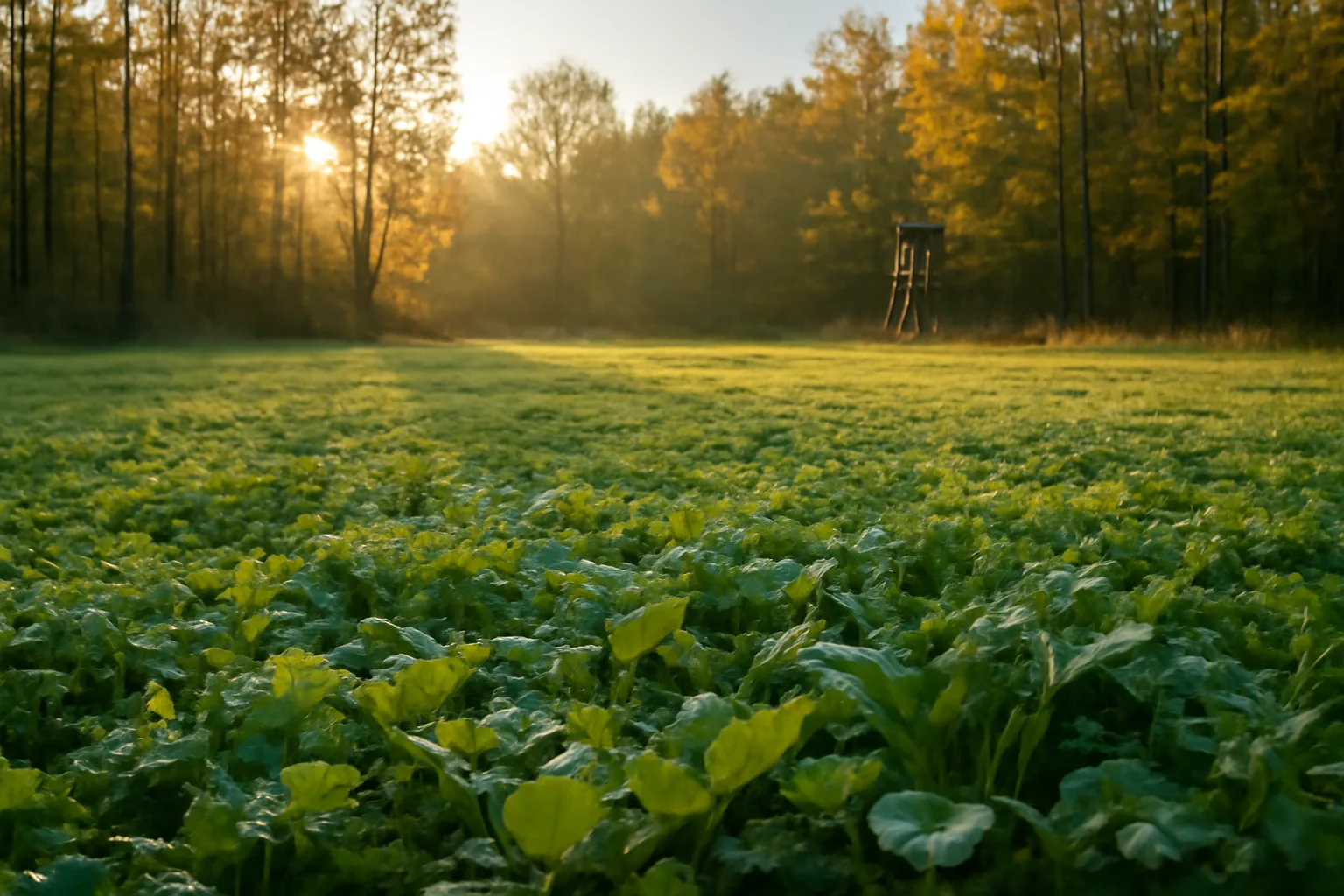
A food plot is a planted patch of forage on your land, sized anywhere from a quarter acre to several acres, meant to feed deer and other wildlife and give hunters a place to observe or intercept animals. It is farming, just on a small scale and with a different customer. Most Northeast plots run somewhere between a half acre and two acres, tucked into a field corner, a logging cut, or a strip cleared out of timber. The goal isn't to feed every deer in the county. It's to give the deer on your specific ground a reliable food source that also gives you a spot to hunt. The USDA Natural Resources Conservation Service runs the Environmental Quality Incentives Program (EQIP), which funds wildlife habitat practices on private land, and cost-share is sometimes available through state NRCS offices for wildlife food plots on qualifying ground under practice standards like Wildlife Habitat Planting. That's a real option worth a phone call if you're planting more than a token patch [1]. If you want a broader primer on plot types before narrowing down species, the food plot whitetail overview is a good next stop.
What do deer actually prefer to eat in the Northeast?
Deer are opportunistic browsers, and their preferences shift by season, but in the Northeast the standout categories are soft mast (apples, acorns), clover, and standing corn or soybeans when available. Acorns, especially from white oak group trees, are often preferred over almost anything planted because of lower tannin content and higher palatability. White oak acorns typically run under 2% tannic acid by weight, while red oak group acorns often run several times higher, which is a big part of why deer clean up white oak drops first when both are on the ground at once [2]. In spring and summer, deer lean hard on high-protein forbs and legumes. Clover consistently tests as one of the most attractive and most digestible plot forages, which is part of why it shows up in nearly every regional seed mix sold in the Northeast. In fall, energy needs shift toward carbohydrates to build fat reserves for winter and the rut. That's when brassicas (turnips, radish) and cereal grains (oats, wheat, rye) become the priority, because deer will hit the leafy tops first and then switch to digging up the roots after a hard frost sweetens the starches. There's no single "favorite." But if you had to rank general plot forage preference across most Northeast studies and extension observations, it runs roughly: acorns and soft mast > clover and other legumes > brassicas > cereal grains > sorghum and other grain crops, with a lot of local variation depending on what's already available naturally.
Do deer eat clover, and is it worth planting?
Yes, deer eat clover readily, and it's one of the most reliable perennial plot choices for the Northeast. White clover (Trifolium repens) and red clover (Trifolium pratense) both hold up well in the region's soils and climate, and university forage trial data consistently shows clover among the top-rated options for deer preference and crude protein content, often in the 25-30% crude protein range when actively growing. Clover's biggest advantage is that it comes back year after year if you maintain it. A well-managed clover stand can produce for three to five years before you need to reseed, which makes it cheaper per season than an annual replant even though the upfront seed cost per pound is often higher. The tradeoff: clover needs decent soil pH (aim for 6.0 to 6.5 per most extension guidance) and it struggles in deep shade or poorly drained ground. Cornell's nutrient management guidance notes that legumes fix nitrogen most efficiently within that range and that yields drop off sharply in acidic soils below about pH 5.5 [3]. It also goes semi-dormant in the coldest months, so it's a spring-through-fall plot, not a late-season one, unless you're in a milder pocket of the region. If you're deciding between clover and other perennial options, the deer food plots guide breaks down more species-by-species tradeoffs.
Do deer eat sorghum, and where does it fit in a Northeast plot plan?
Deer will eat sorghum, particularly the grain heads once they mature and dry down, but it's a secondary choice in most Northeast plot plans rather than a headline species. Sorghum is more commonly grown as a screening or standing-corn-alternative crop, valued as much for cover and structure as for direct forage. Grain sorghum needs a longer, warmer growing season than a lot of the Northeast offers outside of the southern half of the region (roughly USDA zones 6b and warmer). In northern New England and higher elevations, a cool, wet spring can push planting late enough that sorghum doesn't mature before frost, which defeats the purpose. If you're set on a summer annual, most Northeast plotters get more consistent results from soybeans or a forage sorghum-sudangrass hybrid, since sudangrass tolerates a shorter maturity window better than full grain sorghum. Deer will browse the leaves of sorghum-sudangrass through summer even before any grain forms, which is a real advantage over standard field corn if your goal is season-long tonnage rather than a fall grain source.
When should you plant food plots for deer in the Northeast?
| Southern New England, lower Hudson Valley, mid-Atlantic (Zones 6b-7a) | Late April - mid May | Late July - mid August | |
|---|---|---|---|
| Central NY, western PA, southern VT/NH (Zones 5b-6a) | Mid May - early June | Mid July - early August | |
| Northern Maine, Adirondacks, high elevation Appalachians (Zones 4-5a) | Late May - mid June | Early-mid July | These windows line up with USDA Plant Hardiness Zone data and typical frost-date ranges published by NOAA climate normals [4] [5]. Always check your specific county's average frost dates rather than relying on the zone alone, since two spots in the same zone can differ by two or three weeks. |
Timing splits into two windows: spring planting for perennials and warm-season annuals, and late summer planting for fall annuals like brassicas and cereal grains. Spring plots (clover, chicory, soybeans) generally go in after your last frost date, which ranges from early May in southern New England and the mid-Atlantic to early-to-mid June in northern Maine, the Adirondacks, and higher elevations of the Appalachians [4]. Fall plots go in earlier than most new planters expect. You want brassicas and cereal grains in the ground 60 to 90 days before your area's average first fall frost so they have time to establish before deer start hammering them and before growth slows with shorter days. Here's a rough planting window table by general Northeast sub-region. These are starting points, not guarantees, since a specific valley or ridge can run a full growing zone warmer or colder than the county average. | Region example | Spring plot window | Fall plot window |
When should you plant oats for deer?
Plant oats for fall food plots roughly 45 to 60 days before your first expected frost, which in most of the Northeast lands somewhere between late July and early September depending on latitude and elevation. Oats germinate fast, often in 5 to 10 days under good soil moisture, and deer will hit young oat shoots almost as soon as they emerge. Oats are a cool-season annual grass, and in the Northeast they typically get killed back by hard freezes in the 20s (Fahrenheit), so they function as a fall-into-early-winter plot rather than a year-round stand. That makes them a strong complementary planting alongside brassicas or a cereal rye blend, since oats provide immediate green forage while turnips and rye are still bulking up. If you're in the warmer end of the region (coastal mid-Atlantic, southern New England), you can push oat planting into early September and still get a solid fall stand. Farther north, aim for a late July to mid-August window so the plants have enough growing degree days before frost shuts things down.
When should you plant turnips for deer?
Turnips need roughly 80 to 90 days from planting to full maturity, including bulb development, so the Northeast planting window generally runs late July through mid-August, with earlier planting favored the farther north or higher in elevation you are. Deer typically ignore turnip bulbs until after a couple of hard frosts convert starches to sugars, which is why late-season plots built around turnips shine in November and December rather than October. A common mistake is planting turnips too late, chasing a slightly cooler soil temperature, and ending up with small bulbs and thin tonnage going into winter. General land-grant agronomy guidance across the Northeast and Mid-Atlantic recommends getting brassicas in the ground by mid-August in most of the region to hit full maturity before killing frosts arrive. Turnips also do well mixed with radish and a cereal grain like winter rye or wheat. The grain holds soil, gives early green browse, and stretches your plot's usefulness from October through the end of the season.
Do deer like honey, or is that a food plot myth?
No, deer don't eat honey in any meaningful sense as part of their natural diet, and it has no real place in food plot planning. This question comes up because of "honey hole" terminology and some old-school (and unverified) claims about sweet attractant sprays, but there's no wildlife agency or extension research supporting honey as a deer food source or attractant. Deer are herbivores built to digest cellulose and plant sugars through a four-chambered rumen system, not to seek out concentrated sugars like honey. If you want a sweet-scent attractant, commercial products using apple or acorn-based scents have more grounding in actual deer feeding behavior, though even those work as a supplement to a real food source, not a replacement for one. Worth noting: baiting and the use of scent attractants or supplemental feed is regulated differently state by state in the Northeast. New York's Environmental Conservation Law and its implementing regulations restrict feeding of deer and other wildlife in most of the state, with specific provisions tied to Chronic Wasting Disease containment areas . Pennsylvania has its own feeding ban tied to CWD Disease Management Areas . Check your state wildlife agency's current regulations before assuming any attractant or supplemental feed is legal on your ground.
How do soil test results shape which species you should plant?
Your soil test result is the single most useful piece of data you have before choosing a species mix, because pH and nutrient levels determine which forages will actually establish and produce, more than which ones sound good on a seed bag. Clover and most legumes want a pH in the 6.0 to 6.8 range and struggle badly below 5.5 unless you lime first [3]. Brassicas are somewhat more forgiving of lower pH but still perform best above 6.0. A basic soil test through your state's land-grant university lab (Cornell, Penn State, University of Maine, and others all run these programs) typically costs somewhere between $15 and $25 per sample and takes one to two weeks for results. That's cheap insurance against dumping seed and fertilizer into ground that can't use it. Your lab report will usually recommend lime in tons per acre and fertilizer in pounds of N-P-K per acre based on the crop you tell them you're planting. Follow those numbers over anything generic you read online, including this article. Your soil lab knows your dirt. Nobody else does. If you've got a soil test in hand and want help translating it into an actual seed and fertilizer plan for your specific ground, that's exactly the kind of thing a Custom Food Plot Plan is built to do. It's a $99 one-time plan, not a subscription, and it's meant to sit alongside your soil lab's recommendations, not replace them.
What's the single best food plot mix for most Northeast hunters?
If you can only run one plot, a two-part system beats a single species almost every time: perennial clover for spring through early fall, paired with a brassica-cereal grain blend planted in late summer for a fall and winter food source. This combination covers the growing season gap that a single annual or single perennial leaves open. Why this combination works better than chasing a single "best" seed: clover feeds deer (and turkeys, and rabbits) all spring and summer when protein demands are highest for lactating does and antler growth in bucks. Then, as clover growth slows with shorter fall days, your brassica and cereal grain plot ramps up right as deer shift toward carbohydrate loading for winter and the rut kicks off hunting pressure. A realistic two-plot rotation for a hunter with, say, three acres of plottable ground: put one acre in a perennial clover blend, and split the other two acres between a brassica mix (turnips, radish, a little rape) and a cereal grain (oats or winter rye) planted in early August. That gives you green forage basically year-round except for the deepest winter months, plus two distinct hunting setups instead of one. For seed selection specifics by species, the deer food plot seed and food plot seed guides go deeper on blends and seeding rates than this article has room for.
What equipment do you actually need to plant a Northeast food plot?
At minimum you need a way to kill or knock down existing vegetation, a way to work the seedbed, a way to spread seed, and a way to pack it in. That can be as simple as a hand sprayer, a hand tiller or disc harrow behind an ATV, a hand-crank spreader, and a lawn roller, or as involved as a tractor with a disc, cultipacker, and drill. For small plots (under an acre), a lot of Northeast hunters get by with an ATV or UTV, a pull-behind disc or harrow, and a broadcast spreader. That setup runs somewhere in the $1,500 to $4,000 range used, depending on what you already own. A soil test again matters here indirectly: if your lime recommendation calls for two or three tons per acre, you need some way to spread it evenly, which usually means a lime spreader attachment or hiring it done, since hand-spreading that much lime is a slow, miserable day. Don't skip the cultipacker step (or at least dragging a chain-link section or piece of carpet) after seeding brassicas and clover. Seed-to-soil contact matters more than almost any other single factor in plot establishment, and a lot of thin, patchy plots trace back to seed that just sat on top of dry ground and never germinated.
Frequently asked questions
Do deer eat sorghum in the Northeast?
Yes, deer eat sorghum, especially the grain heads once mature, and they'll browse sorghum-sudangrass leaves through summer. It's a secondary plot choice in most of the Northeast though, since grain sorghum needs a longer warm season than northern parts of the region reliably offer.
Do deer eat clover?
Yes. Clover is one of the most preferred and most studied food plot forages for whitetail deer, often testing at 25-30% crude protein when actively growing, according to university forage trial data. White and red clover both perform well across most Northeast soils with a pH of 6.0 or higher.
When should I plant food plots for deer in the Northeast?
Spring plots (clover, soybeans) go in after your last frost, generally late April to mid-June depending on latitude and elevation. Fall plots (brassicas, cereal grains) go in 60 to 90 days before your first fall frost, usually mid-July through early September across the region.
When should I plant turnips for deer?
Plant turnips late July through mid-August in most of the Northeast, since they need 80 to 90 days to reach full bulb maturity. Deer generally won't hit the bulbs hard until after a couple of frosts sweeten the sugars, making turnips a late-season, not early-fall, food source.
When should I plant oats for deer?
Plant oats 45 to 60 days before your area's first fall frost, typically late July through early September in the Northeast. Oats germinate fast, often within 5 to 10 days, and deer will browse young shoots almost immediately, but hard freezes in the 20s Fahrenheit will kill the stand.
What is a food plot?
A food plot is a planted area, usually a fraction of an acre up to a few acres, seeded with forage crops to feed deer and other wildlife and to give hunters a predictable spot to hunt. It's small-scale farming aimed at a wildlife audience rather than a commercial harvest.
What are deer's favorite foods?
In the Northeast, acorns and soft mast (like apples) typically top the list when available, followed by clover and other legumes, then brassicas, then cereal grains and sorghum. Preference shifts seasonally: legumes and forbs in spring and summer, carbohydrate-heavy foods like acorns and brassica bulbs in fall and winter.
Do deer like honey?
No. Deer are herbivores adapted to digest plant cellulose and sugars, not concentrated sugars like honey, and there's no wildlife agency or extension research supporting honey as deer food or an effective attractant. The idea seems to come from "honey hole" slang, not actual deer feeding behavior.
What's the best single food plot species for the Northeast?
There isn't one best species for every situation, but clover is the strongest single perennial choice for spring through fall, and a brassica-cereal grain blend is the strongest fall option. Pairing the two covers more of the year than any single species alone.
How much does a soil test cost before planting a food plot?
Most land-grant university soil labs in the Northeast (Cornell, Penn State, University of Maine, and similar) charge roughly $15 to $25 per sample, with results back in one to two weeks. It's the cheapest step in the whole process and the one most likely to save you money on wasted lime and fertilizer.
Can I legally use bait or supplemental feed near my food plot?
It depends on your state. New York restricts deer feeding in most of the state outside specific exceptions, and Pennsylvania bans feeding in Chronic Wasting Disease Established Areas. Check your state wildlife agency's current regulations before assuming any feeding or baiting practice is legal on your land.
How big should a Northeast food plot be?
Most successful Northeast plots run a half acre to two acres, though productive plots exist well outside that range depending on land size and goals. Bigger isn't always better; a well-placed half-acre plot tucked near bedding cover often outperforms a large open field plot for hunting purposes.
Do I need a tractor to plant a food plot?
No. Many Northeast hunters plant successful small plots using just an ATV or UTV with a pull-behind disc or harrow, a broadcast spreader, and something to pack seed in like a cultipacker or dragged chain-link section. A full tractor setup helps on larger acreage but isn't required under an acre or two.
Sources
- USDA Forest Service, Fire Effects Information System - Quercus alba (white oak): White oak acorns have lower tannin content than red oak group acorns, making them more palatable and readily eaten by wildlife
- USDA Natural Resources Conservation Service, Plant Guide: White Clover (Trifolium repens): Clover forages are highly palatable to wildlife and commonly test high in crude protein during active growth
- NOAA National Centers for Environmental Information, U.S. Climate Normals: Average first and last frost dates vary widely across the Northeast by latitude and elevation
- USDA Natural Resources Conservation Service, Plant Guide: Forage Turnip / Brassica species: Brassicas need roughly 80-90 days to reach full maturity and should be planted in mid-to-late summer to mature before killing frost
- New York Consolidated Laws, Environmental Conservation Law Section 11-0507: New York regulates the feeding of deer and other wildlife, with provisions tied to disease management
- Pennsylvania Game Commission, Chronic Wasting Disease Response Plan: Pennsylvania bans feeding deer within Disease Management Areas tied to Chronic Wasting Disease