Last updated 2026-07-26
TL;DR
There's no single best corn seed for every plot. Pick a full-season or shorter-day grain corn suited to your growing zone, match hybrid traits to your deer pressure and browse risk, and get soil test-based fertility right first. Corn feeds deer best from late summer standing crop through winter if it survives establishment.
what is a food plot, and where does corn fit in?
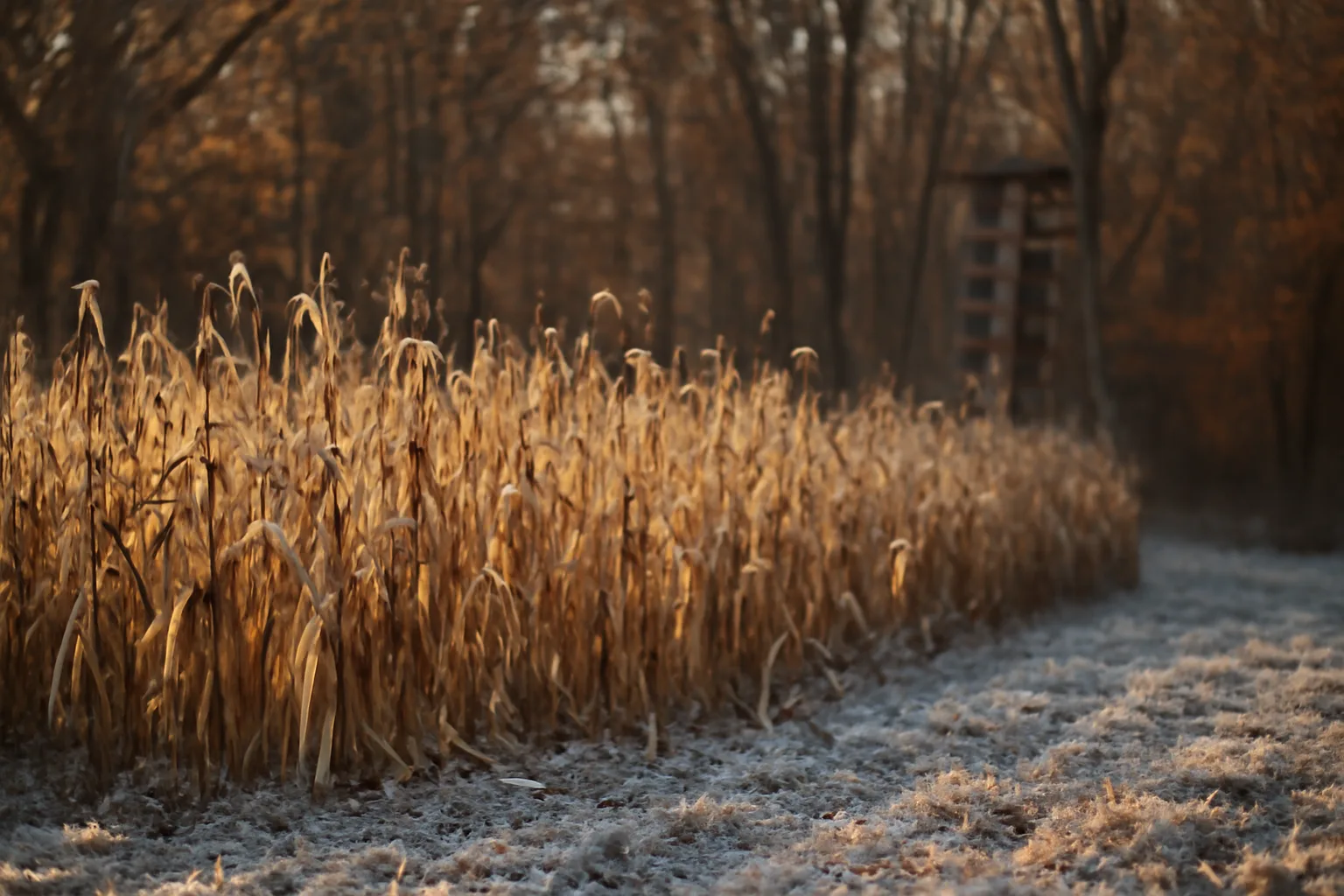
A food plot is a planted area on hunting land, usually a fraction of an acre to several acres, grown specifically to feed and attract deer or other wildlife rather than to sell as a cash crop. Food plots range from small hidden "kill plots" tucked into timber to large destination fields planted along field edges or old ag ground. Corn's job in a food plot system is mostly about winter carbohydrates and cover. A mature corn plot left standing gives deer a dense energy source when acorns and browse thin out, and the stalks themselves give deer (and turkeys, and you on a stand) visual cover. Corn is not a great early-season attractant. It's a late-season and stress-period food. Most serious plotters treat corn as one piece of a rotation, not the whole plan. Corn pairs well with a fall brassica or clover plot nearby, so you've got early-season greens and late-season carbs covered. If you're mapping out a whole-property plan, the food plot whitetail approach of layering plot types by season is worth reading before you commit acres to corn alone.
what's the best corn seed for food plots?
The best corn seed for a food plot is whichever full-season grain corn hybrid is bred and rated for your specific growing zone, has decent standability so it holds up into winter, and fits a fertility program your soil test actually supports. There is no single hybrid that wins everywhere. That said, a few practical rules hold across most of the whitetail range. First, buy a grain corn hybrid, not sweet corn. Sweet corn is bred for human eating quality and tends to have thinner stalks and lower total yield per acre; it's fine in a tiny garden-style plot but a poor use of acres if your goal is late-season tonnage. Second, match the hybrid's relative maturity (measured in "days" like 95-day or 110-day corn) to your frost-free window. Land-grant extension corn hybrid trial data (University of Wisconsin, Iowa State, Purdue, and others) publishes relative maturity ratings and local yield performance every year, and that data is a far better guide than a food-plot seed bag's marketing copy [1] [2]. Third, decide if you actually need a "food plot specific" corn blend versus standard ag seed corn from a local co-op. Food-plot branded corn often costs two to four times more per bag than comparable ag hybrids, and in most cases the genetics aren't dramatically different from what your local elevator sells. If you're planting under 3 to 5 acres, the premium might be worth it for convenience and smaller bag sizes. If you're planting bigger acreage, a call to your local seed dealer or ag extension agent for a regionally proven hybrid will save real money. Brown midrib (BMR) corn hybrids are worth knowing about too. BMR corn has a genetic mutation that lowers lignin content, making the plant more digestible and often more palatable to browsing animals, which is why some food-plot brands push it hard. Purdue and other agronomy programs note BMR hybrids typically yield less grain and have weaker stalks than standard hybrids, so you're trading some tonnage and standability for palatability [3]. That trade can make sense in a plot where deer numbers are low and you want them to eat more of what's there, but it's a real tradeoff, not a free upgrade.
do deer eat sorghum, and is it a corn alternative?
Yes, deer eat sorghum readily, including grain sorghum (milo) and forage sorghum types, and it's a legitimate substitute or companion to corn in food plots. Sorghum tends to be more drought tolerant than corn and can handle lighter, sandier soils better, which makes it a good option in regions where corn struggles without irrigation. Sorghum also generally costs less per acre in seed than corn and needs less nitrogen to hit reasonable yields, according to state extension agronomy guides that cover sorghum as a grain crop [4]. The downside is that sorghum heads are more attractive to birds, so in areas with heavy blackbird or dove pressure you can lose a chunk of your crop before deer season even opens. Some plotters plant a corn-sorghum mix specifically to hedge against drought, since if the corn struggles the sorghum often still produces something. It's not a bad strategy on marginal ground, but on your best dirt with decent rainfall, straight corn will usually out-yield a mixed stand in total tonnage per acre.
do deer like clover, and should it replace corn in my plan?
Deer strongly prefer clover, especially in spring and summer when it's actively growing, and most whitetail food plot research and extension guidance rates it among the top forage plot choices for season-long attraction. But clover and corn aren't really competing for the same job. Clover is a perennial forage that gets hit hard spring through fall; corn is an annual grain crop that peaks as a food source in late fall and winter. A lot of experienced plotters run both: clover in one or more fields for spring and summer nutrition, and corn (or beans, or brassicas) for the late-season push. If you're trying to figure out which species to prioritize on a limited number of acres, the deer food plot seed breakdown covers how clover, brassicas, and grain crops each fit a season, and it's a useful gut check before you buy corn seed you may not need.
do deer like honey, and does it matter for food plots?
Deer don't seek out honey in any meaningful, documented way, and it has no real place in food plot planning. This question mostly comes up because people confuse "honey" with sweetness in general, or they've heard about "honey hole" terminology used loosely in hunting culture, which refers to a productive hunting spot, not an actual food source. If you're looking for something genuinely sweet that deer do respond to, sugar beets and certain brassica varieties develop real sugar content after a frost, which is part of why turnips and radishes get more palatable and more heavily browsed once temperatures drop. That's a real, documented phenomenon tied to how plants convert starches to sugars as a cold-stress response. Honey isn't part of that picture in any practical sense, and pouring or spraying honey products in a plot is also going to run into most states' baiting rules (more on that below).
what do deer actually prefer to eat, and where does corn rank?
Deer are selective browsers, and their preferences shift hard by season, region, and what's available. Broadly, whitetails favor high-protein forbs and legumes in spring and summer (clover, soybeans, native forbs), acorns and other mast in early fall when it's available, and high-carbohydrate foods like corn, standing soybeans, and brassica roots in late fall and winter when they need energy reserves for cold weather and the rut's aftermath. State wildlife agency deer nutrition guidance and university deer research (Mississippi State University's Deer Lab, Penn State's deer research program, and others) consistently point to acorns as a preferred natural food where available, with agricultural foods like corn and soybeans becoming more important where mast is scarce or in years of poor mast production. Corn's real value is calories per acre in the toughest part of the year, not being a deer's single favorite food. If mast fails in a given year, or in regions with little hard mast, standing corn becomes a much bigger draw simply because the alternatives thin out.
when to plant food plots for deer, in general
Food plot timing splits into two windows: spring plantings (roughly April through June depending on zone) for warm-season annuals like corn, soybeans, and sorghum, and late-summer plantings (roughly late July through September) for cool-season annuals like brassicas, clover, and cereal grains. Corn falls squarely in the spring window. Your actual planting date depends on your last frost date and soil temperature, not the calendar. Corn needs soil temperatures consistently at or above 50°F to germinate well, and most agronomy guidance recommends waiting until soil hits that mark and the risk of a hard frost has passed [5]. In the Upper Midwest and northern tier states that's often early to mid-May; in the Mid-South and Southeast it can be a month earlier. Your state land-grant extension office publishes localized planting date windows by county, and that's a better source than a national seed catalog's generic map.
when should you plant corn for a food plot specifically?
Plant corn as soon as soil temperature is reliably above 50°F and your local frost risk has passed, which for most of the whitetail range falls between mid-April (Deep South) and late May/early June (northern border states and Canada). Corn needs a long growing season, typically 90 to 120+ days depending on hybrid maturity, so late planting in northern zones risks the crop not maturing before a killing frost. Soil temperature matters more than the calendar date. Corn planted into cold, wet soil germinates unevenly and is more vulnerable to seedling disease and insect damage, per land-grant agronomy planting guides [5]. If you've got a soil thermometer, use it; if not, a rough rule many extension guides use is waiting until your region's average risk of frost has passed and topsoil is workable and not waterlogged. Row spacing and seeding rate matter too. Most ag-style planters run 30-inch rows at 28,000 to 34,000 seeds per acre for grain corn, though food-plot-specific guidance sometimes recommends tighter spacing or block planting (multiple rows planted close together, sometimes called a "deer block") to reduce edge browsing pressure on young plants. If deer numbers are high relative to plot size, a small corn plot can get browsed to nothing before it ever reaches knee height, so plot size and shape matter as much as planting date.
when to plant oats for deer
Plant oats for deer in late summer to early fall, generally 6 to 10 weeks before your area's first hard frost, so most of the country is looking at a window from mid-August through mid-September. Oats are a cool-season annual grain that deer readily browse as green forage, and they're often mixed with brassicas, cereal rye, or clover in fall blend plots. Oats germinate fast and can be grazed within a few weeks of planting, which makes them a popular choice for a quick-hitting early-season plot. They're not winter-hardy in most northern climates, though; a hard freeze will usually kill oats back, while cereal rye or winter wheat will keep growing. If you want a plot that lasts through the whole late season in a cold climate, oats alone won't do it, but they're a solid short-term green forage component in a fall blend.
when to plant turnips for deer, and how do they compare to corn?
Plant turnips for deer in late summer, roughly 80 to 100 days before your first expected frost, since turnip bulbs need that runway to size up before deer start hitting them hard post-frost. For most of the whitetail range that lands somewhere between late July and mid-August, though the Deep South can push into September. Turnips (and other brassicas like radishes and rape) work on a completely different timeline and job than corn. Corn is a spring-planted, high-carb late-season standing crop; turnips are a late-summer-planted forage and root crop that actually gets sweeter and more palatable after a frost, because the plant converts starches to sugars as a cold-tolerance response. Extension horticulture guidance on brassica crops confirms this frost-driven sweetening effect, which is why deer often ignore turnip plots in September and hammer them in December [6]. A lot of food plot plans run both: brassicas for a late fall through early winter push, corn for the deepest, coldest part of winter when deer need pure calories and the brassica tops have been grazed down. If you're weighing brassicas against corn for a specific piece of ground, the deer food plots overview walks through how to sequence multiple plot types across one season.
how much does corn seed for food plots actually cost?
| standard ag grain corn (local dealer) | $80-$150 | best value for larger plots, choose regionally proven hybrid | |
|---|---|---|---|
| food-plot branded corn blend | $150-$300+ | convenience, small bag sizes, marketing premium | |
| BMR (brown midrib) corn | $130-$250 | more digestible, lower yield and weaker stalks | |
| grain sorghum (as alternative) | $30-$60 | cheaper, more drought tolerant, more bird loss risk | Seed cost is only part of the budget. Fertilizer, lime if your soil test calls for it, and herbicide for weed control in a corn plot often add up to as much or more than the seed itself, especially on ground that hasn't been limed in a few years. |
Grain corn seed generally runs somewhere between $150 and $350 per bag depending on hybrid and trait package, with a standard 80,000-kernel bag typically covering 2 to 3 acres at normal seeding rates. Food-plot branded corn blends, sold in smaller bags aimed at the 1-to-5-acre plotter, often price out noticeably higher per acre than buying straight from a local ag seed dealer, sometimes by a factor of two or more, mainly because of smaller-batch packaging and marketing costs rather than meaningfully different genetics. Here's a rough cost comparison to plan a budget around, based on typical per-acre seed costs from land-grant extension crop budget guides and current ag retail pricing patterns [7]: | corn type | typical seed cost/acre | notes |
what soil and fertility does corn need to actually produce for deer?
Corn is a heavy nitrogen feeder and one of the least forgiving food plot crops when soil fertility is off, so a current soil test is close to mandatory if you want a plot that actually stands up and produces grain rather than stunted stalks. Most land-grant extension corn guides recommend a soil pH between 6.0 and 6.8 for good nutrient availability, and nitrogen rates commonly in the range of 1 to 1.3 pounds of nitrogen per bushel of expected yield, split between a planting-time application and a sidedress application later in the season [8]. Your soil test lab is the authority here, not a blog post or seed bag label, because lime and fertilizer recommendations depend on your specific soil's existing nutrient levels, cation exchange capacity, and organic matter. A soil test typically costs $10 to $20 through most state land-grant extension soil labs and takes one to two weeks to turn around results. If you're building a planting plan around your soil test results and don't want to guess at rates, a service like PlotSeason's $99 one-time Custom Food Plot Plan will turn your test numbers and property details into general seeding and fertility guidance. That's general planning help, though, not a substitute for your lab's specific lime and fertilizer recommendations, which are based on your actual soil chemistry.
do baiting and feeding rules affect planting standing corn for deer?
Standing food plots, including corn left to mature in the field, are legal to hunt over in every state, but the rules change fast once you start adding loose grain, mineral, or supplemental feed on top of a growing plot, and several states draw a legal line between a planted crop and a bait pile. Baiting and feeding regulations vary significantly by state, and some states ban baiting outright for deer hunting while others allow it with restrictions on distance from a stand or timing before season. Because these rules change year to year and vary so much by state, the only reliable source is your state wildlife agency's current hunting regulations, checked before the season you're planning for. A properly planted and grown food plot, including corn, is treated differently from bait almost everywhere, but supplementing that plot with additional loose corn or feed can cross into bait territory depending on your state's specific definition.
how do you choose between corn and other grain crops for late-season deer food?
Corn's main competition for the late-season carbohydrate job is soybeans (left standing rather than harvested) and, in some regions, grain sorghum. Each has real tradeoffs worth weighing against your soil, budget, and deer pressure before you commit acres. Corn generally produces the most total calories per acre of the three when grown well, and its standing stalks hold up better through wind and heavy snow than soybeans, which can get flattened. Standing soybeans are often hit harder and earlier in fall since deer favor the pods before frost, then the plot loses food value faster than corn does. Sorghum costs less and handles drought and poor soil better than corn, but loses more yield to birds and generally produces fewer total calories per acre. If you're planting less than an acre and deer density is high relative to plot size, all three crops face the same real risk: young plants get browsed down before they can establish, especially corn and soybeans in the seedling stage. Fencing a small plot temporarily, or choosing a larger perimeter plot rather than a tiny interior kill plot, matters more to corn's success than which specific hybrid you buy. For a broader look at matching seed choice to plot size and deer pressure, the domain food plot seed guide covers that tradeoff in more depth, and the general food plot seed overview is a good starting point if you're still deciding on species before hybrid.
Frequently asked questions
Do deer eat sorghum?
Yes. Deer readily eat grain sorghum (milo) and forage sorghum, and it's a common corn alternative on drought-prone or sandy ground because it needs less water and nitrogen. The main downside is bird damage to the seed heads, which can cut into yield before deer season even opens.
Do deer eat clover?
Yes, and clover is one of the most consistently preferred food plot forages available, especially in spring and summer growth periods. It's a perennial, not an annual like corn, so it fills a different role: season-long grazing pressure rather than a late-season energy crop.
Do deer like clover more than corn?
They're not really comparable head-to-head since deer use them at different times of year. Clover gets hammered spring through fall as an active growing forage; corn becomes more attractive in late fall and winter as a dense carbohydrate source when other food thins out.
When should I plant food plots for deer?
Spring annuals like corn, soybeans, and sorghum go in April through June depending on your zone and frost dates. Fall annuals like brassicas, oats, and clover go in late July through September. Your state land-grant extension office publishes county-level planting windows that beat generic national charts.
When should I plant oats for deer?
Plant oats 6 to 10 weeks before your area's first hard frost, generally mid-August through mid-September across most of the whitetail range. Oats grow fast and get grazed within weeks but usually die back at the first hard freeze, so they work best as one part of a fall blend rather than a standalone winter plot.
When should I plant turnips for deer?
Plant turnips 80 to 100 days before your first expected frost, typically late July through mid-August in most regions. Turnip bulbs need that time to size up, and the plant actually gets sweeter and more palatable to deer after a frost hits, so plots often see the heaviest use in December, not September.
What is a food plot?
A food plot is a planted area, from a small hidden clearing to several open acres, grown specifically to provide food for deer or other wildlife rather than as a commercial crop. Plots range from perennial clover fields to annual grain plots like corn, and most hunting properties use a mix of types to cover different seasons.
What is a deer's favorite food?
There's no single favorite; deer preference shifts by season and availability. Acorns and other hard mast are often top choices in fall when available, legumes like clover and soybeans dominate spring and summer diets, and high-carb foods like corn and brassica roots become more important in late fall and winter.
Do deer like honey?
No, honey isn't a documented deer attractant and has no real role in food plot planning. It's often confused with hunting slang like 'honey hole,' which describes a productive stand location, not a food source. Frost-sweetened brassicas are the real-world equivalent of a 'sweet' food deer respond to.
What's the best corn seed for a small food plot under 2 acres?
For small plots, prioritize a full-season grain hybrid matched to your local frost dates over any food-plot branded blend, and consider tighter block planting to reduce edge browsing pressure. On plots under an acre with high deer density, even a good hybrid can get browsed out before it matures, so plot size and fencing often matter more than the seed bag.
Should I use brown midrib (BMR) corn in my food plot?
BMR corn is more digestible and often more palatable to deer because of its lower lignin content, but it typically yields less grain and has weaker stalks than standard hybrids, according to agronomy trial data. It can make sense where you want deer eating more of a smaller stand, but it's a real tradeoff, not a pure upgrade.
Is food-plot branded corn seed worth the extra cost over regular ag seed corn?
Usually not for larger plots. Food-plot branded corn often costs two to four times more per acre than a regionally proven ag hybrid from a local seed dealer, without meaningfully different genetics. The convenience of small bag sizes may be worth it under 2 to 3 acres, but bigger plots save real money buying standard ag seed.
How many acres of corn should I plant for deer?
There's no fixed rule, but many plotters treat corn as a smaller share of total plot acreage compared to clover or brassicas, since it costs more per acre in seed and fertility and its main value window is short (late fall through winter). A soil-test-based plan for your specific property will give a more useful number than a general acreage rule.
Sources
- University of Wisconsin-Madison Extension, Wisconsin Corn Hybrid Performance Trials: Land-grant extension programs publish regional corn hybrid maturity and yield trial data
- Iowa State University Extension and Outreach, Corn Hybrid Trials: Iowa State publishes corn hybrid trial performance data by region
- Purdue University Extension, Corn & Soybean Field Guide / BMR forage guidance: Brown midrib (BMR) corn hybrids trade lower lignin and higher digestibility for reduced yield and weaker stalks
- Kansas State University Extension, Grain Sorghum Production Handbook: Grain sorghum generally needs less nitrogen and is more drought tolerant than corn
- Purdue University Extension, Corn Planting Guide (Chat 'n Chew Cafe / Corny News Network): Corn germinates best when soil temperature is consistently at or above 50°F and frost risk has passed
- University of Minnesota Extension, Growing Brassica Crops: Brassica crops like turnips become sweeter after frost as plants convert starches to sugars
- USDA Economic Research Service, Feed Grains Data / Corn Sector at a Glance: USDA tracks corn production costs and pricing patterns used to compare seed cost estimates
- Iowa State University Extension, Corn Nitrogen Rate Calculator / Nitrogen Fertilization for Corn: Corn nitrogen recommendations commonly run in the range of 1 to 1.3 pounds of nitrogen per expected bushel of yield