Last updated 2026-07-26
TL;DR
Standard field corn (grain hybrids used for cattle feed) works fine in food plots if you have at least 3 to 5 acres, decent equipment, and can afford the fertilizer bill. For smaller plots, deer-specific brands mostly repackage the same commodity hybrids at a markup. Corn shines as a winter standing crop that holds deer through deep snow and hard cold, not as a fall attraction planting.
what is a food plot and where does corn fit in
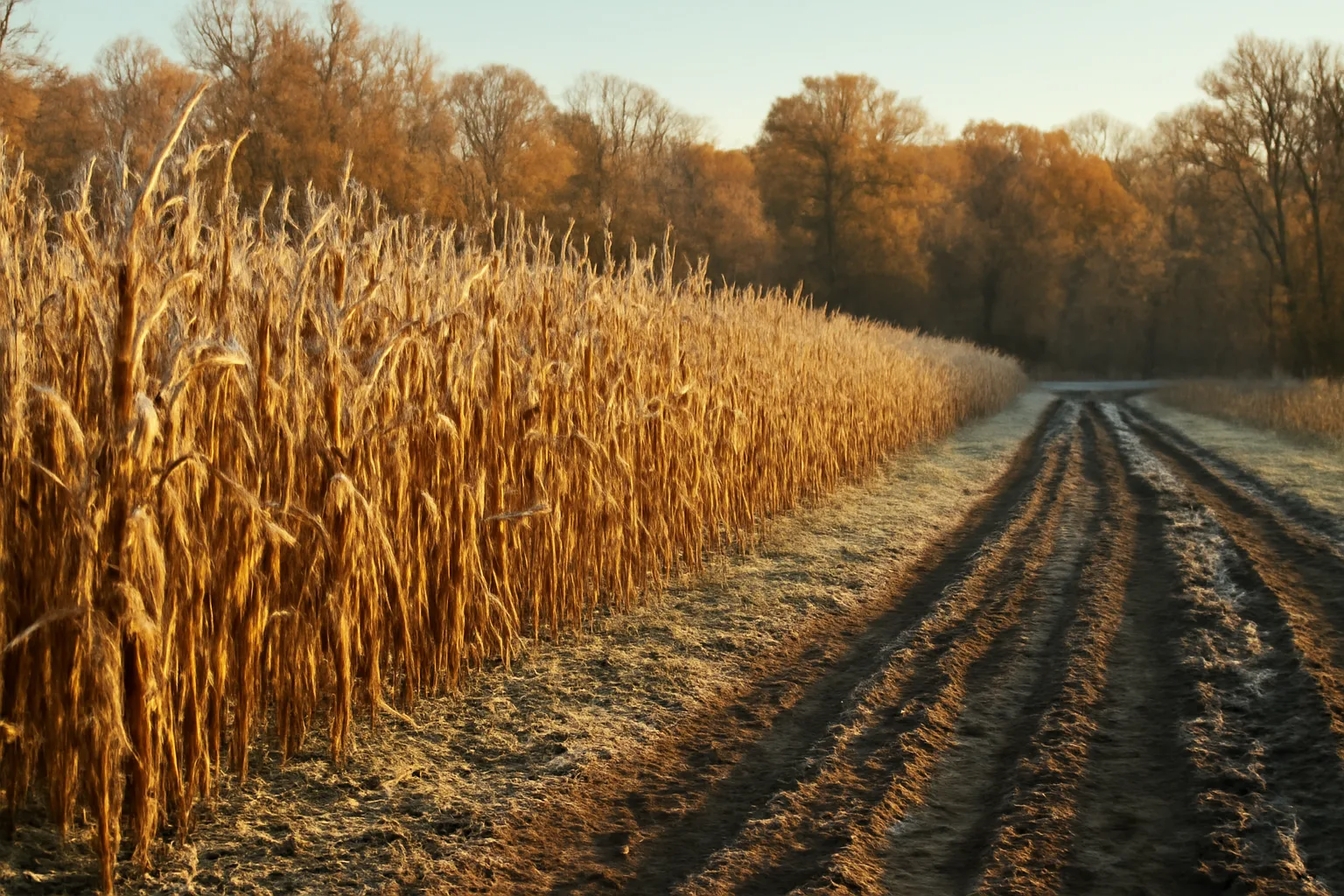
A food plot is a planted patch of ground, usually on hunting land, seeded with something deer (or other wildlife) will eat. Plots range from a quarter-acre kill plot tucked in the timber to a 20-acre field planted for winter cover and food. State wildlife agencies and Cooperative Extension programs generally treat food plots as a wildlife habitat practice meant to supplement natural browse rather than replace it. Corn fits a specific niche in that world. It is not a great fall attraction crop the way clover, brassicas, or beans can be, because deer don't dig into standing corn kernels with much enthusiasm until food gets scarce. What corn does really well is stand up through winter. The stalk holds the ear off the ground, snow doesn't bury it, and by January and February, when browse is picked over and beans are gone, a corn plot becomes one of the few high-energy food sources left standing. That's the entire case for planting it: winter carbohydrate reserve, not an October magnet. If your goal is early season hunting over something deer will hit hard in September, look at food plot whitetail options like clover or brassica blends instead. Corn is a late-season and structural play.
what kind of corn is actually best for food plots
Most of the corn planted in food plots, deer-specific brand or not, is a standard yellow dent grain hybrid, the same type row-crop farmers plant for grain or silage. There is no botanically distinct "deer corn" hybrid. Companies that sell food plot corn are almost always selling a commodity hybrid, sometimes an older or shorter-season variety, packaged in smaller bags at a premium price. That's not automatically a rip-off. Smaller bag sizes matter if you're only planting one or two acres, and some blends add a modest amount of soybean seed to the bag to boost protein and diversify the stand. But if you have a local co-op or seed dealer and a planter, buying a regionally-adapted grain hybrid selected for your relative maturity zone will save real money over a bagged "trophy corn" product, often by half or more per acre in seed cost. What you actually want to select for is maturity date (days to maturity matched to your first frost), standability (a hybrid with strong stalk strength so it stays upright into February), and, if you can get it, some drought tolerance if your soil holds water poorly. Ear height and husk coverage matter too. Deer and other wildlife pick through husk cover more easily on varieties with looser husks, and hybrids bred for good standability tend to hold ears through winter wind and ice better than weaker-stalked varieties.
do deer eat sorghum, and how does it compare to corn
Yes, deer eat grain sorghum (milo), and it's a legitimate substitute for corn in food plots, especially in the southern half of the whitetail's range and in areas prone to drought. Grain sorghum generally needs less water than corn and tends to be more drought-tolerant, which matters a lot in Texas, Oklahoma, and the southern Great Plains where corn can fail outright in a dry summer. Sorghum also stands reasonably well through winter, similar to corn, and deer will feed on the grain heads once they've dried down, along with turkeys, quail, and doves. The tradeoff is total yield and energy density. Corn generally out-produces sorghum in total pounds of grain per acre under good conditions, and deer tend to prefer corn where both are available in decent supply. Working rule of thumb: if you're in a reliably wet region with good soil, plant corn. If you're managing thin, sandy, or drought-prone ground, especially south of about Interstate 70, grain sorghum is worth strong consideration as either a replacement or a mix partner with corn.
when should you plant corn for a deer food plot
Plant corn after soil temperatures at planting depth (about 2 inches) hit a consistent 50 degrees Fahrenheit, the minimum germination threshold most Extension corn guides use. In practice that lands somewhere between early April in the Deep South and late May to early June in the northern tier of whitetail country (Minnesota, Wisconsin, upper Michigan, southern Canada border states). Corn takes anywhere from 90 to 120-plus days to reach maturity depending on the hybrid's relative maturity rating, so back-calculate from your area's typical first killing frost date. Planting too late risks the corn never fully drying down before winter, which hurts both yield and how well it stands through snow load. If you want a general answer to when to plant food plots for deer more broadly, the honest response is: it depends entirely on what you're planting and what season you're hunting. Spring plantings (corn, soybeans, warm-season forages) go in after last frost, generally April through early June depending on latitude. Fall plantings (clover, brassicas, cereal grains) go in 60 to 90 days before your first hard frost, typically late July through September. Corn is exclusively a spring-planted, warm-season crop. There is no fall-planted corn option for deer plots.
how much fertilizer and lime does corn actually need
Corn is one of the hungriest crops you can put in a food plot, full stop. Nitrogen recommendation frameworks used by land-grant agronomy programs, including Iowa State's Corn Nitrogen Rate Calculator, generally point to total nitrogen needs that put a modest 120-bushel food plot corn crop somewhere around 120 to 150 pounds of actual nitrogen per acre across the season depending on soil type, prior crop, and yield goal. That is far more than clover, brassicas, or beans require, and it's the single biggest reason corn costs more to grow than almost any other food plot option. Phosphorus and potassium needs vary by soil, but corn also responds strongly to both, and it wants a soil pH in the 6.0 to 6.8 range for best nutrient availability, per Purdue University's Corn and Soybean Field Guide. If your pH sits below 6.0, nitrogen and phosphorus won't be used efficiently no matter how much you spread. Your soil test result is the actual authority here, not this article or any blanket recommendation online. Send a sample to your state's land-grant soil testing lab or a private ag lab, follow their specific lime and fertilizer recommendation in pounds per acre, and treat any generic number here as a ballpark, not a prescription. Corn planted on a 5.2 pH field with no lime applied will disappoint you regardless of hybrid choice or fertilizer rate. Because of that fertility demand, corn plots make the most financial sense on larger, better ground, generally 3 acres or more, where the input cost per acre gets spread over enough yield to justify it. On small, poor-soil plots, you're often better off putting your fertilizer dollars into a legume like clover or beans that fixes its own nitrogen.
do deer like clover, and how does it compare to corn
Yes, deer strongly prefer clover, and it's one of the most consistently used food plot crops in the country for good reason. Clover offers roughly 20 to 30-plus percent crude protein during active growth, is highly digestible, and regrows after grazing, unlike corn which is a one-shot annual crop deer can't touch again once eaten down. The practical difference is timing and role. Clover is a perennial or biennial forage that gets hit hard from spring green-up through fall, stretching your grazing pressure across most of the year for three to five seasons before you need to reseed. Corn is an annual, planted once a year, and deer largely ignore it as green forage; they wait for the grain to mature and dry down in fall and winter. Most serious food plot programs run both: clover or a clover-alfalfa blend as the perennial protein base, and corn (where acreage and budget allow) as the winter carbohydrate reserve. Neither replaces the other. If you can only plant one thing this year and you're working with under 2 acres, clover is almost always the better return on investment. See deer food plot seed for variety comparisons.
when to plant oats for deer, and where they fit next to corn
Plant oats for deer in late summer to early fall, roughly 60 to 90 days before your area's first killing frost, the same general window as other cereal grains and brassicas. In much of the whitetail range that lands between mid-August and mid-September; in the Deep South it can push into October. Oats are a cool-season annual grain, the opposite growing season from corn. They germinate fast, often in 5 to 7 days under good moisture, and provide quick, tender, highly attractive fall forage that deer hit almost immediately after emergence. Oats generally winterkill in the northern half of the country once temperatures drop into the teens or lower, though some varieties (like Everest or other winter-hardy oat cultivars) tolerate more cold. Oats and corn almost never occupy the same plot at the same time since they're on opposite calendars, but they complement each other across a property. Corn holds a field through winter; oats (often blended with brassicas or cereal rye) draws deer in during archery season in September and October.
when to plant turnips for deer, and how they stack up to corn
Plant turnips for deer in late July through early September, giving them 80 to 90 days to mature before a hard frost, since turnips actually get sweeter and more palatable after a freeze converts starches to sugars. This makes them a classic late-season brassica pairing with corn. Turnips offer high tonnage per acre and both leaf and bulb forage, but deer often ignore the leaves and bulbs early in fall and don't hammer them until after several hard frosts, sometimes not until December or January. That late-season timing overlaps nicely with when a standing corn plot is also at its most useful, which is why a lot of food plot layouts put corn and brassicas (turnips, radishes, or a blend) in adjacent strips or fields: one holds grain, the other holds high-sugar greens, both peaking in the same brutal midwinter window when deer need calories most. Soil test guidance again applies directly here. Brassicas like turnips want a pH close to neutral (6.0 to 6.5) and respond well to boron in some deficient soils, something only your specific soil test will tell you.
what are deer's favorite foods, and where does corn rank
There's no single scientifically-ranked "favorite food" list for deer, because preference shifts hard by season, region, and what's locally available. State wildlife agency and Extension forage studies consistently point to a similar shortlist though: acorns and other hard mast, agricultural crops like soybeans and corn, clover and other legumes, and browse from woody plants and forbs. Acorns, when available in good mast years, generally outrank planted food plots entirely. Deer will bypass a lush soybean field to hammer a white oak dropping acorns. Soybeans and corn, both high-energy row crops, rank near the top of cultivated options, with beans generally preferred as green forage in summer and corn preferred as dry grain in winter. Clover ranks extremely high for spring through fall grazing given its protein content and regrowth. Brassicas rank lower in immediate preference (deer often need a season to "learn" a new brassica planting) but climb sharply after frost. Corn's rank is conditional: low preference as a green plant, high preference as dry grain once nothing else is standing, which circles back to why it's a winter-specific tool rather than an all-season attractant.
do deer eat honey, and should you use honey-based attractants near a plot
No, deer don't eat honey in any meaningful dietary sense, though they're drawn to sweet scents and some mineral and attractant products use honey, molasses, or sugar-based ingredients to increase palatability of a mineral lick or supplemental feed. There's no research showing honey itself is a food deer seek out in the wild. The more relevant issue is that in a lot of states, using honey, syrup, grain, or any attractant to draw deer for hunting purposes crosses directly into baiting, which is regulated and often illegal. Baiting and supplemental feeding rules vary enormously by state. Some states ban it outright statewide, some allow it with restrictions on distance from a stand or quantity, and some allow it only outside hunting season or only for non-hunting purposes like wildlife viewing. Check your state wildlife agency's current regulations before using any attractant, mineral, or supplemental feed near a hunting area. A legally-planted food plot is treated completely differently from bait in essentially every state, but the line between "food plot" and "bait pile" gets legally blurry with loose grain, mineral blocks, or feeders.
how do you actually plant a corn food plot, step by step
Start with a soil test, taken 3 to 6 months ahead if possible so lime has time to adjust pH before planting. Corn punishes low pH and low fertility harder than almost any other food plot crop, so this step matters more here than anywhere else. Prep ground by killing existing vegetation (tillage or a burndown herbicide), then plant at a seeding rate around 24,000 to 32,000 seeds per acre for most food plot situations, adjusted down for drier or poorer soils and up for irrigated or high-fertility ground, per standard land-grant agronomy guidance for grain corn. Plant at a depth of about 1.5 to 2 inches. Row spacing of 30 to 36 inches works with most row-crop planters; some food plotters plant corn in blocks rather than long rows specifically to help it stand better against wind and to concentrate deer use in a smaller footprint. Apply starter fertilizer at planting based on your soil test, then a nitrogen sidedress application around the 6 to 8 leaf stage, which is standard practice in commercial corn production and improves both yield and stalk strength going into winter. Weed control (pre-emergent herbicide, cultivation, or a labeled post-emergent product matched to conventional or herbicide-tolerant seed) matters a lot in the first 4 to 6 weeks; corn seedlings lose badly to weed competition early on. A 3 to 5 acre minimum plot size is a reasonable rule of thumb for corn specifically, both because deer and other wildlife can eat down a small corn plot before it ever reaches maturity, and because the fertility cost per acre only pencils out with enough total yield behind it. If you're planning your first plot layout and aren't sure corn fits your acreage or budget, a deer food plots overview walks through sizing decisions in more depth, and PlotSeason's $99 Custom Food Plot Plan (/plot-plan-builder) will lay out a specific seed mix, rate, and calendar for your acreage and zone if you want it built out rather than pieced together.
should you even plant corn, or is something else a better fit
| Corn | Spring, after soil hits 50°F | Winter standing grain | High (100+ lb N/acre) | 3+ acres | |
|---|---|---|---|---|---|
| Grain sorghum | Spring, similar to corn | Winter grain, drought-prone areas | Moderate | 2+ acres | |
| Clover | Spring or late summer | Spring-fall protein forage | Low (fixes own N) | Any size | |
| Oats | Late summer/early fall | Fast fall attraction | Moderate | Any size | |
| Turnips/brassicas | Late summer | Late-season high-sugar forage | Low-moderate | Any size | For most hunters working a handful of small plots on leased or owned ground, a mix beats a monoculture: clover for season-long protein, a brassica or oat blend for early bow season pull, and corn only if there's a larger field to dedicate to it. If you're starting from scratch, browse food plot seed and domain food plot seed options to see how corn-inclusive blends compare to standalone bags, and check deer for food for a broader look at how food plots fit into deer management goals. |
Corn is worth planting if you have at least 3 to 5 acres to dedicate to it, equipment capable of proper seed placement and weed control, and a winter-holding goal (keeping deer on your property through the toughest months, or giving turkeys and other wildlife a food source into late winter). It is not a great choice if your total plot acreage is under 2 acres, your budget for fertilizer is tight, or your main goal is an early-season attraction plot for bow season. Here's a quick side-by-side of where corn sits against the other crops covered in this article. | Crop | Planting window | Primary role | Relative fertility cost | Best plot size |
Frequently asked questions
Do deer eat sorghum?
Yes. Deer eat grain sorghum (milo) heads once they dry down in fall, similar to how they eat corn kernels. Sorghum is more drought-tolerant than corn, making it a solid substitute or companion crop in the southern and drier parts of whitetail range, though corn generally out-yields it and deer often prefer corn where both are available.
Do deer eat clover?
Yes, and heavily. Clover is one of the most preferred food plot forages because of its high crude protein (commonly 20 to 30 percent during active growth) and because it regrows after grazing, unlike an annual crop like corn that gets eaten once and doesn't come back that season.
When to plant deer food plots?
It depends on the crop. Spring-planted crops (corn, soybeans, sorghum) go in after last frost, generally April through early June depending on latitude. Fall-planted crops (clover, brassicas, oats, cereal rye) go in 60 to 90 days before your area's first killing frost, typically late July through September.
Do deer like clover?
Yes, clover ranks among the most consistently preferred food plot forages available, largely because of its high protein content and its ability to regrow after grazing pressure, giving deer a season-long food source rather than a one-time crop like corn or oats.
When to plant oats for deer?
Plant oats 60 to 90 days before your first expected killing frost, usually mid-August through mid-September across most of the whitetail range, later in the Deep South. Oats germinate quickly, often within 5 to 7 days, and provide fast, attractive fall forage before typically winterkilling in colder regions.
When to plant food plots for deer, spring or fall?
Both, depending on your crop and goal. Plant warm-season crops like corn and beans in spring for summer growth and winter grain. Plant cool-season crops like clover, brassicas, and cereal grains in late summer for fall attraction and winter forage. Most well-rounded properties plant in both windows.
When to plant turnips for deer?
Plant turnips 80 to 90 days before your first hard frost, generally late July through early September depending on region. Turnips actually improve in palatability after a freeze converts starches to sugar, so they're built to peak in the same late-season window that a standing corn plot also serves.
What is a food plot?
A food plot is a planted area, typically on hunting land, seeded with forage or grain crops meant to supplement natural browse for deer or other wildlife. Plots range from a quarter-acre bow-season kill plot to multi-acre fields planted with corn, beans, clover, or brassicas depending on the season and goal.
What are deer's favorite foods?
There's no official ranked list, but acorns and other hard mast typically top preference when available, followed by high-energy crops like soybeans and corn, then clover and other legumes, then general browse and forbs. Preference shifts heavily by season and what's locally available, so a favorite in October may be ignored in July.
Do deer like honey?
Not really. There's no evidence deer seek out honey as a natural food source. Some attractant and mineral products use honey or sugar-based scents to boost palatability, but using such attractants for hunting purposes may qualify as baiting under state law, so check your state wildlife agency's regulations first.
Is deer corn different from regular field corn?
Usually not botanically. Most bagged "deer corn" or food plot corn is a standard yellow dent grain hybrid, the same type planted for livestock feed, just packaged in smaller bags at a premium. A local seed dealer selling a regionally-adapted grain hybrid is often a cheaper, equally effective option for larger plots.
How many acres of corn do you need for a deer food plot to work?
Most experienced food plotters recommend at least 3 to 5 acres for a corn plot. Smaller plots often get eaten down by deer and other wildlife before the corn matures, and the heavy fertilizer investment corn requires doesn't pencil out well on very small acreage.
Does corn need more fertilizer than other food plot crops?
Yes, significantly more. Land-grant nitrogen recommendation tools commonly put corn's seasonal nitrogen need for even a modest crop at roughly 120 to 150 pounds per acre, well above what clover, brassicas, or other food plot staples need.
Sources
- Iowa State University Extension and Outreach, Corn Nitrogen Rate Calculator (overview and methodology): Nitrogen recommendation tools used by land-grant agronomy programs put corn's seasonal N need for a modest crop around 120 to 150 lb/acre depending on soil, prior crop, and yield goal
- Texas A&M AgriLife Extension, "Grain Sorghum Production in Texas" (ESC-004): Grain sorghum is more drought-tolerant than corn and suited to dry, southern regions
- Purdue University, Corn and Soybean Field Guide / Corn Growth Stages: Corn germination requires soil temperature at planting depth of about 50 degrees Fahrenheit
- University of Georgia Extension, Clover for Wildlife Food Plots (Bulletin 1466): Clover offers high crude protein, commonly 20 to 30 percent, during active growth
- Pennsylvania Game Commission, White-tailed Deer Food Habits: Deer diet preferences shift by season among mast, agricultural crops, legumes, and browse
- Michigan Department of Natural Resources, 2023 Baiting and Feeding Order (summary): States regulate baiting and supplemental feeding separately from food plot planting, with rules varying by state