Last updated 2026-07-26
TL;DR
Plant brassica radishes 6 to 10 weeks before your area's first killing frost, which usually lands between late July (northern zones) and early September (mid-South). Radishes need that runway to bulb up before cold weather sends deer hunting for them. Pair with oats or clover for a mix that feeds deer earlier in the fall and holds ground longer.
When should you plant radishes for a deer food plot?
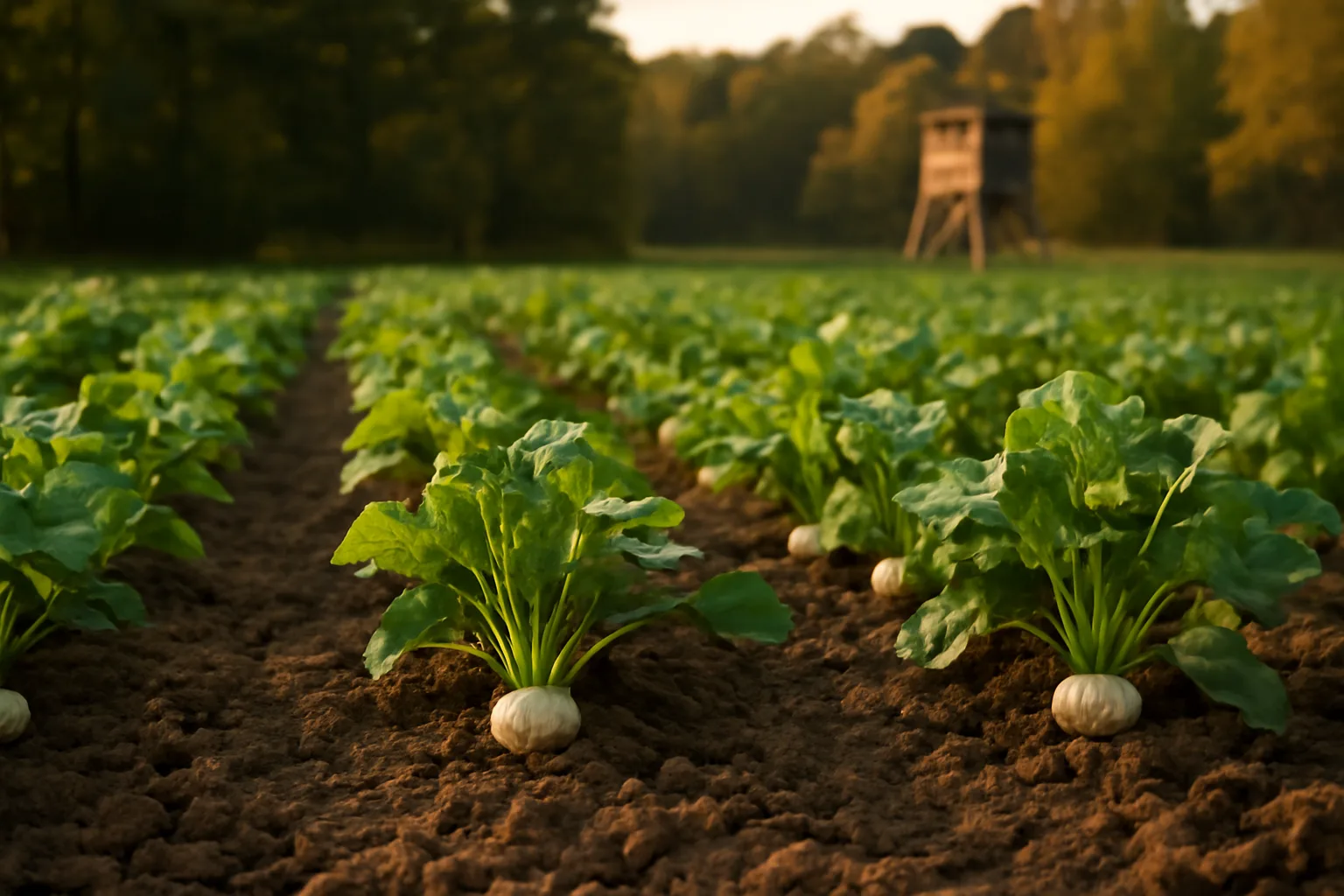
The short answer: count backward 6 to 10 weeks from your area's average first hard frost date. Radishes are a fall and winter food source, and they need that window to grow a real taproot and top growth before cold weather shuts them down. Plant too early in hot, dry August conditions and you risk poor germination or bolting. Plant too late and you get spindly plants deer won't bother with. For most of the whitetail range, that means a planting window somewhere between mid-July and early September, depending on latitude. Northern states (think Minnesota, Wisconsin, Michigan, upstate New York) should target late July through mid-August. The Midwest and mid-South (Missouri, Kentucky, southern Illinois, Virginia) generally do better planting mid-August to early September. The Deep South can push into late September since frost arrives so much later. Radishes (usually the Daikon or forage-radish type, often sold as "tillage radish" or blended into brassica mixes) grow fast, but they're not instant. Purdue University Extension's forage guidance on brassica crops notes that most brassica forages, including radish and turnip, need 80 to 90 days to reach full maturity, which is why growers are told to work backward from the first expected frost when picking a planting date [1]. Miss that window and you're planting a cover crop, not a food plot.
What's the exact planting window by zone?
| Northern (MN, WI, northern MI, ME) | Late Sept to early Oct | Late July to mid-Aug | |
|---|---|---|---|
| Upper Midwest/Northeast (IA, southern MI, PA, NY) | Early to mid-Oct | Early to late Aug | |
| Mid-South/Central (MO, KY, VA, southern IL) | Mid to late Oct | Mid-Aug to early Sept | |
| Deep South (AL, GA, MS, LA) | Nov or later | Late Aug to late Sept | These are rough bands, not gospel. Check your state's frost-date data or a local extension office before you buy seed. NOAA's National Centers for Environmental Information publishes 1991-2020 U.S. Climate Normals with station-level freeze and frost date data if you want actual numbers instead of a guess [2]. If you're between zones, err on the earlier side. A radish plot that matures three weeks early still feeds deer. One that never bulbs out because you planted too late feeds nobody. |
Nobody has a single national date because frost timing swings by weeks even within one state. Use your local first-frost average as the anchor, then work backward. | Zone (rough) | Typical first frost | Radish planting window |
When should you plant food plots for deer in general?
Timing depends entirely on whether you're planting a warm-season plot (spring/summer) or a cool-season plot (late summer/fall), and radishes fall firmly in the cool-season, fall-plot category. Spring plots (clover, chicory, soybeans, cowpeas) go in after your last frost, generally April through June depending on latitude. Fall plots (brassicas, cereal grains, some clover overseeding) go in 6 to 10 weeks before first frost, generally July through September. Soil temperature and moisture matter as much as the calendar. Brassicas and radishes germinate best in soil around 55 to 75 degrees F with decent moisture. Planting into bone-dry August dirt with no rain in the forecast is a common way to waste a bag of seed. Many hunters watch the weather and plant right ahead of a forecasted rain rather than sticking to a fixed date. If you're building a full-season rotation, radishes and brassicas are usually the anchor of the fall plot, planted once, mid-to-late summer, timed to peak in November and December when deer need the calories most.
When should you plant turnips for deer, and are they different from radishes?
Turnips follow almost the identical calendar as radishes: 6 to 10 weeks before first frost, generally late July through early September depending on zone. Agronomically they're close cousins (both are brassicas), but they behave a little differently in a plot. Turnips tend to produce more leafy top growth early, which deer often hit first, while the bulb sweetens after a few frosts as starches convert to sugar. Radishes push a longer taproot deeper into the soil, which helps break up compacted ground (that's why straight forage radish is popular as a soil-building cover crop, more than deer feed) but the radish bulb itself is often smaller and less consistently eaten than turnip bulb. University of Tennessee Extension's food plot guidance on brassicas notes that a hard frost improves palatability of turnips and other brassica forages by converting starches to sugars, which is a key reason deer use of these plots increases through late fall and into winter [3]. Many seed mixes blend turnip, radish, and sometimes rape or kale specifically because they mature at slightly different rates and give deer a longer feeding window. If you're planting a single species, turnip is generally the safer bet for raw tonnage of deer-preferred forage; radish shines more as a soil conditioner that deer will also eat, especially the tops early and the bulbs after frost.
When should you plant oats for deer?
Oats go in the same general fall window as radishes and turnips, roughly 6 to 8 weeks before first frost, but oats germinate faster and tolerate a slightly later planting date than brassicas because they don't need to bulb up. In much of the whitetail range that's mid-August through mid-September. Oats are a smart pairing with radish in a mix. Oats provide quick, leafy, highly palatable green-up within 2 to 3 weeks of planting, giving deer something to eat while the radishes are still building their root systems underground. By the time the oats get grazed down or winter-killed, the radish bulbs are maturing and taking over as the food source. This is a common strategy in fall blends and it's one reason a lot of commercial "deer blend" bags combine oats, radish, and turnip or clover in one bag. Oats will winterkill in most of the northern and central whitetail range once temperatures drop into the low 20s and below for sustained periods, so don't expect them to carry a plot past December in cold climates.
What is a food plot, exactly?
A food plot is a planted area, usually somewhere between a quarter-acre and several acres, established specifically to grow forage that attracts and feeds deer or other wildlife on hunting land. It's not a garden and it's not pasture in the farming sense; it's a wildlife management tool planted with species chosen for palatability, nutrition, and seasonal timing rather than for human consumption or livestock. Food plots generally fall into two broad categories: annual plots (replanted every year, like brassicas, cereal grains, and soybeans) and perennial plots (planted once and managed for multiple years, like clover and chicory stands). Most serious plot programs run both, using perennials for spring and summer nutrition and annuals for a fall and winter food source timed to hunting season and late-season deer needs. State wildlife agencies generally treat food plots as a land management practice, not as baiting, as long as the crop is planted and grown in the ground rather than piled or spread loose. Michigan's Wildlife Conservation Order, administered under the state's Natural Resources and Environmental Protection Act, defines baiting as placing, exposing, depositing, distributing, or scattering feed to attract deer, which is a distinct legal category from a standing planted crop [4]. That said, rules on baiting, feeding, and even food plot practices near property lines vary a lot by state, so check your state wildlife agency's regulations before assuming a practice is legal, especially if you're near a public boundary or in a chronic wasting disease management zone. If you want a plan built around your specific soil test and acreage rather than general rules of thumb, that's exactly what a Custom Food Plot Plan from PlotSeason is for; it takes your soil results and location and turns them into a species and timing plan instead of a guess.
Do deer eat clover, and do they actually like it?
Yes. Clover is one of the most consistently preferred whitetail forages available, and it's often the top choice for spring and summer food plots because it's high in protein (commonly 20 to 30 percent crude protein in vegetative growth) and it regrows after grazing rather than getting wiped out like an annual. Deer favor clover heavily in spring and early summer when does need protein for lactation and bucks need it for antler growth. Clover's popularity comes partly from taste and digestibility and partly from availability; a well-maintained perennial clover stand offers tender regrowth almost continuously from spring through fall, which is more than most annuals can claim. White clover (Dutch white, ladino types) and red clover are the two most common food-plot species. Both tolerate mowing and light grazing pressure well, which matters because deer will hammer a good clover plot hard enough to need rest periods. If you're deciding between clover and a fall brassica/radish plot, they're not really competitors; most plot programs run both, clover for the growing season and radish or turnip mixes for late fall and winter.
Do deer eat sorghum?
Yes, deer will eat sorghum, particularly the grain heads and, to a lesser extent, the leaves, but it's not typically planted as a primary deer food plot species the way corn, soybeans, or brassicas are. Sorghum (including grain sorghum and forage sorghum types) is more commonly used as a screening or cover crop in food plot programs, planted in tall, dense strips to block wind and sight lines around a plot or stand rather than as the main food source. Where sorghum does get eaten seriously is after frost and through winter, when the grain heads mature and other food sources thin out, similar to how deer use standing corn. Turkeys and other wildlife often hit sorghum heads hard too, so competition for that food source isn't limited to deer. If your goal is straight deer nutrition and attraction, sorghum is a lower priority than clover, brassicas, or cereal grains. If your goal includes screening cover along with some late-season food value, it's a reasonable choice, often planted alongside or bordering a radish or clover plot rather than replacing it.
What are deer's favorite foods overall?
Deer preference shifts by season, region, and what's locally available, so there's no single universal "favorite," but research and long-term plot experience point to a consistent short list: acorns (especially white oak group acorns, which are lower in tannins and more palatable than red oak group acorns), soybeans, clover, and standing corn rank among the most consistently preferred foods across most of the whitetail range. Within food-plot species specifically, clover and soybeans tend to top deer preference during the growing season, while brassicas (radish, turnip, kale) and cereal grains (oats, wheat, rye) take over as preferred foods in late fall and winter, especially after a hard frost sweetens them up. Corn, both standing and as high-energy carbohydrate, becomes especially important in the coldest part of winter when deer need calories to maintain body temperature. Acorns often trump planted plots entirely in years with a strong mast crop, which is one reason plot hunters sometimes get frustrated in a big acorn year; the deer simply have a better, more concentrated food source in the woods. This is normal and not a sign of a bad plot.
Do deer like honey, or is that a myth?
There's no real biological basis for deer specifically seeking out honey, and it's not a practical or legal food-plot or attractant strategy in most states. Deer are herbivores adapted to browse, forbs, mast, and grain; they don't have a natural feeding pattern built around honey the way, say, bears do. Some commercial deer attractant sprays and mineral products include sugar or molasses-based ingredients marketed with sweet scents, and deer will investigate strong, sweet, or unusual smells out of curiosity, but that's different from honey being a preferred food. There's no peer-reviewed wildlife research establishing honey as a meaningful whitetail food source or attractant. More importantly, spreading any loose food substance, including honey, sugar, or syrup-based products, on the ground can legally qualify as baiting in states that regulate baiting and feeding, which is a separate and often stricter rule than food plot regulations. Michigan's Wildlife Conservation Order defines bait broadly enough to include minerals and scent products placed to attract deer, more than grain piles [4]. Check your state wildlife agency's current baiting and feeding rules before using any additive product, since definitions of "bait" vary by state.
How do you actually plant a radish food plot step by step?
Start with a soil test, not a seed bag. Radishes and other brassicas do best in soil with a pH between about 6.0 and 6.8; below that, lime is doing more for your plot than any seed choice will. Your soil test lab's specific lime and fertilizer recommendations are the real authority here, not a general rule of thumb, since soils vary block to block even on the same farm. Once soil prep is handled (till or disc a clean seedbed, or spray and no-till into dying cover), broadcast radish seed at roughly 4 to 6 pounds per acre if planting alone, lighter (1 to 3 pounds per acre) if blended with turnip, clover, or oats, since radish seed is large and cheap seeding rates go a long way. Seed depth should be shallow, about a quarter to half inch, or simply broadcast and lightly drag/cultipack; radish seed left fully exposed on the surface germinates poorly. Fertilize according to your soil test, but brassicas are nitrogen-hungry and generally respond well to 40 to 60 pounds of actual nitrogen per acre if your soil test doesn't already call for something different. Water isn't something you control, so time planting around a rain forecast when you can. Expect visible growth within 2 weeks and full bulb development by 8 to 10 weeks, which is exactly why the planting-date math matters so much. If you want species and seeding rates matched to your actual soil test numbers and zone instead of averaged advice, that's the gap a Custom Food Plot Plan is built to close for $99, one time, no subscription.
What should you plant radishes with, and does it change the timing?
Radish rarely goes in alone in a serious plot program; it's almost always part of a blend, and the blend partner can shift your planting math slightly. Common pairings: - Radish + oats: plant on the earlier side of your window (closer to 8 to 10 weeks before frost) since oats want to establish fast and radish needs the runway too.
- Radish + turnip: nearly identical timing needs, so plant together with no adjustment.
- Radish + clover: trickier, since clover is a perennial that ideally gets a full season to establish; many hunters frost-seed clover into a radish plot the following spring rather than planting both together in the fall.
- Radish + cereal rye or winter wheat: rye and wheat tolerate later planting (into October in many zones) better than radish does, so if you're blending, plant on radish's schedule, not the grain's. A good rule: plant on the schedule of whichever species in your mix has the tightest window. For radish blends, that's almost always the radish itself.
Frequently asked questions
When is the best time to plant radishes for deer?
Roughly 6 to 10 weeks before your area's average first hard frost. For most of the whitetail range that lands between mid-July (far north) and early September (mid-South). Check local frost-date averages before locking in a date, since it varies widely by latitude and elevation.
Can you plant radishes too early?
Yes. Planting into hot, dry mid-summer soil often causes poor germination or premature bolting, where the plant flowers and goes to seed instead of building a bulb. If you're more than 10 to 12 weeks ahead of frost, wait, unless you're specifically using radish as a summer cover crop rather than a fall food plot.
Will deer eat radish tops or just the bulb?
Both. Deer often browse the leafy tops first, especially before a frost, then shift to eating the exposed bulb and root more heavily once cold weather sweetens the starches into sugar. Some radish varieties bulb mostly above ground, making them easier for deer to access than deep-rooted types.
Do deer eat sorghum in food plots?
Yes, deer eat sorghum grain heads and some leaf material, especially after frost, but sorghum is more commonly planted for screening cover than as a primary deer food source. Corn, soybeans, clover, and brassicas rank higher for pure deer nutrition and attraction value.
Do deer actually like clover, or is that overstated?
Deer genuinely prefer clover, and it's one of the most reliable food-plot species across the whitetail range. It's high in protein, regrows after grazing, and stays available spring through fall, which is why it's a staple in most perennial food-plot programs.
When should oats be planted for a fall deer plot?
Plant oats roughly 6 to 8 weeks before first frost, generally mid-August through mid-September depending on zone. Oats germinate faster than brassicas and tolerate slightly later planting, which makes them a good early-season food source while a companion radish or turnip crop is still bulbing up.
What's the difference between planting radishes and planting turnips for deer?
They follow nearly the same planting window, but turnips typically produce more early leaf growth deer hit first, while radish pushes a deeper taproot that's better at breaking up compacted soil. Many hunters blend both since they mature at slightly different rates.
What exactly counts as a food plot?
A food plot is a planted area, from a quarter-acre to several acres, established to grow forage specifically for deer or other wildlife on hunting land. It differs from farm crops or gardens because species and timing are chosen for wildlife nutrition and seasonal attraction rather than human harvest.
What are deer's overall favorite foods?
It shifts by season and region, but acorns (especially white oak group), soybeans, clover, and standing corn consistently rank among the most preferred whitetail foods. Brassicas like radish and turnip become top choices in late fall and winter after frost sweetens them.
Do deer like honey?
There's no real evidence deer seek out honey as a food source; it's not part of their natural browsing pattern. Sweet-scented commercial attractants sometimes draw curiosity, but honey itself isn't a meaningful whitetail attractant, and spreading it on the ground may violate state baiting rules.
How late can you plant radishes and still get results?
If you're inside 6 weeks of your average first frost, you're pushing it; the bulb may not fully mature before growth slows. Some hunters still plant late for the leafy top growth alone, but don't expect a full bulb crop on a compressed timeline.
Should radishes be planted alone or in a mix?
Most experienced plot managers blend radish with oats, turnip, or cereal grains rather than planting it alone. The blend gives deer food at different growth stages across the fall and reduces the risk of the whole plot failing if one species struggles with weather or soil conditions.
Sources
- Purdue University Extension, Forage Brassicas for Supplemental Pasture (AY-361): Brassica forages including radish and turnip typically need 80 to 90 days to reach maturity, so planting date should be set by working backward from the expected first frost
- NOAA National Centers for Environmental Information, U.S. Climate Normals: County and station-level first frost date averages used to time fall food plot planting
- University of Tennessee Extension, Brassicas for Deer (SP731-C): Brassica forages including turnips and radishes gain palatability after frost converts starches to sugar, increasing deer use in late fall and winter
- Michigan Department of Natural Resources, Wildlife Conservation Order 2.2 (Baiting and Feeding): State wildlife agency definitions of baiting cover placing, exposing, depositing, distributing, or scattering feed to attract deer, distinct from a standing planted crop, and can include mineral or scent products
- USDA NRCS Plant Guide, Forage Radish (Raphanus sativus): Forage radish grows a deep taproot that breaks up soil compaction and is commonly used as a cover crop as well as a wildlife food source
- University of Missouri Extension, Deer Food Plots: Annual Cool-Season Plantings (G9421): Cool-season annual food plot species including brassicas and cereal grains are generally planted from late summer into early fall so growth peaks during hunting season