Last updated 2026-07-26
TL;DR
Plant brassicas (turnips, radishes) and cereal grains (oats, wheat) 60-90 days before your first frost, and perennial clover in late summer to early fall. Deer favor clover and brassicas heavily once cold weather sweetens the leaves. Exact timing depends on your zone and soil test results, not a calendar date alone.
What is a food plot, exactly?
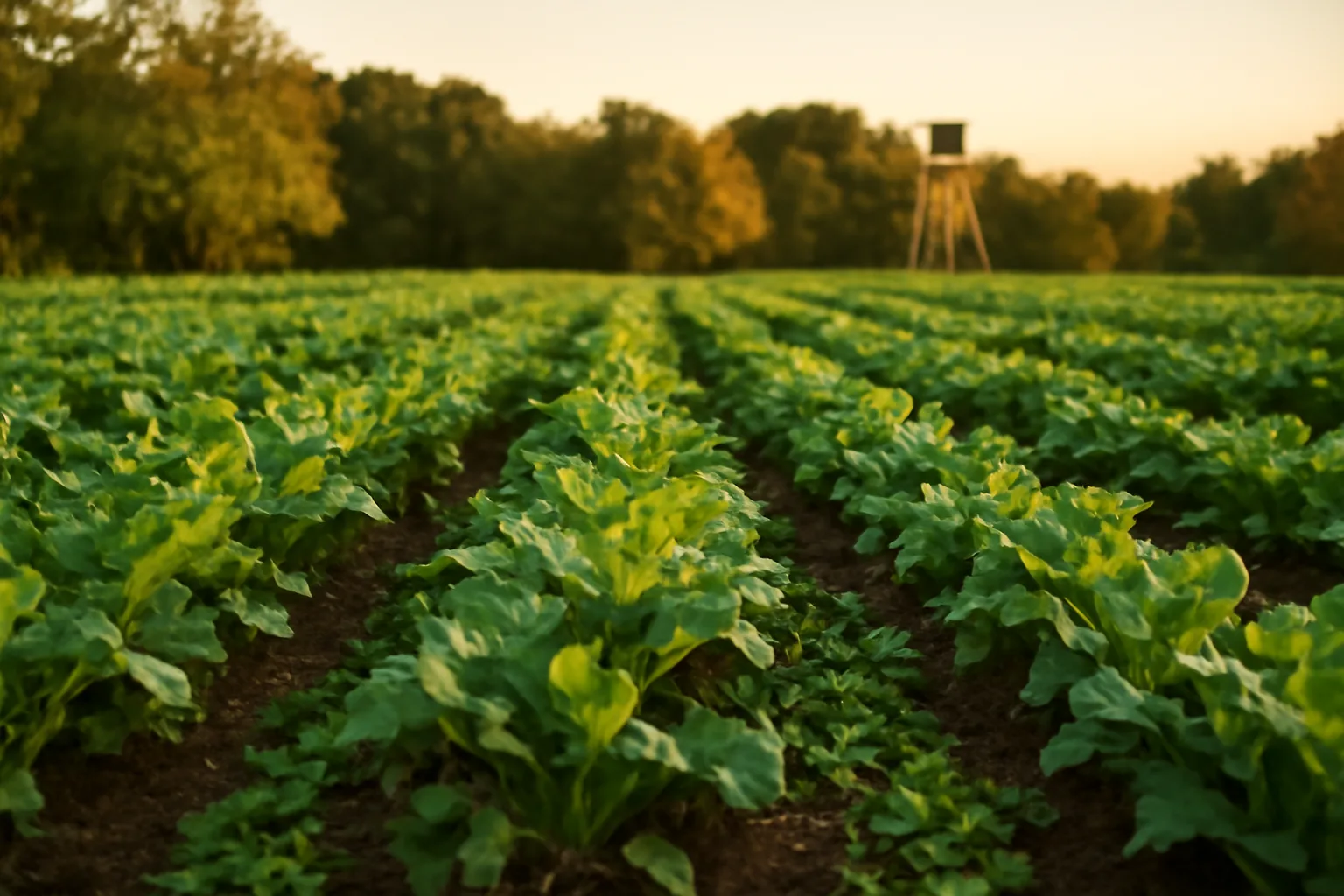
A food plot is a planted patch of forage on hunting land, meant to feed deer and other wildlife while giving hunters a predictable place to observe or intercept animals. It's not a garden and it's not lawn seed thrown on dirt. Most successful plots run somewhere between a quarter acre and a few acres, though plenty of hunters run smaller kill plots tucked into timber and larger destination plots out in open ground. The basic idea is simple: put something deer want to eat where you want them to be, at the time of year you want them there. Fall plots specifically are built around the season when deer need calories to get through winter and bucks are moving during the rut. That's different from a spring/summer plot, which is more about antler growth and fawn-rearing nutrition. A food plot only works if the soil underneath it can support the plant you're asking it to grow. That's why most state wildlife agencies and university extension programs push soil testing before seed selection, not after. The USDA Natural Resources Conservation Service treats food plots as a wildlife habitat practice, and its guidance consistently ties species selection to soil suitability and regional climate [1]. If you want a plan built around your specific dirt rather than a one-size-fits-all bag of seed, that's the whole reason a food plot plan exists, but the concepts below work whether you build the plan yourself or pay someone to do it.
When should you plant food plots for deer?
| Upper Midwest / Northeast | Late July to mid-August | Mid-August to early September | Mid-August to mid-September | |
|---|---|---|---|---|
| Mid-South / Ohio Valley | Mid-August to early September | Early to late September | Early September to early October | |
| Deep South / Gulf Coast | Early to late September | Late September to October | Late September to October | Those ranges aren't gospel. A dry August can push planting back two weeks. Always plant ahead of a forecasted rain if you can, rather than sticking rigidly to a date on paper. |
Fall food plots generally go in the ground 60 to 90 days before your area's average first hard frost, which for most of the whitetail's range lands somewhere between late July and mid-September. The exact window depends on your latitude and elevation more than the calendar month. Farther north (Minnesota, Wisconsin, Michigan, northern New England), that means planting as early as late July for brassicas and mid-August for cereal grains and clover. In the mid-South and lower Midwest, September plantings are typical. In the Deep South and along the Gulf Coast, you can push into early October because frost comes late or not at all some years. Cooperative extension services publish frost date charts specific to each state, and those are more reliable than any generic national planting calendar because they're built from decades of local weather station data [2]. Pennsylvania State University Extension, for instance, recommends planting fall brassica blends 60 to 90 days before the first expected frost in that state so the plants have time to bulb and sweeten before deer season opens. A rough zone breakdown: | Region | Brassicas / turnips | Cereal grains (oats, wheat) | Clover |
What are deer's favorite foods, and does that change in fall?
Deer are opportunistic browsers, and their preferences shift hard with the seasons because their nutritional needs shift too. In late summer and fall, deer key in on foods that pack calories and carbohydrates to build fat reserves before winter, plus soft mast like acorns when it's dropping. Acorns are usually the top natural food source in fall wherever oaks are present; research from the University of Georgia and other whitetail studies has repeatedly shown deer will abandon planted forages temporarily when acorns are falling heavily, especially white oak acorns, which are lower in tannins and more palatable than red oak acorns. That's not a food plot failure, it's just deer doing what deer do. Plots tend to pull deer back hard once the acorn drop tapers off in late fall. Among planted forages, clover, brassicas (turnips, radishes, rape), soybeans, and cereal grains like oats and wheat consistently rank as favorites in state agency and extension forage trials. There's no single scientifically ranked "favorite," because preference varies by region, deer density, and what else is available, but clover shows up as a top choice across nearly every study and agency guide that measures forage utilization [3].
Do deer like clover, and is it worth planting for fall?
Yes, deer like clover, and it's one of the most reliably eaten food plot plantings across the whitetail's range. Perennial clovers like white clover and red clover provide protein-rich forage from spring through fall and often stay green into winter in milder climates, which makes them a strong two-season investment rather than a single-shot fall planting. The catch with clover in a fall-only context: if you're planting clover in August or September, it won't be a mature stand by opening day. It needs a full growing season, sometimes closer to a full year, to hit peak production. Clover planted in early fall is really an investment in the following spring and summer, plus a bonus for late fall and winter grazing once established. Iowa State University Extension notes that clover stands, once established, can persist for three to five years with proper mowing and fertility maintenance, making it one of the better cost-per-year options despite a higher upfront seed cost than annuals [4]. If your goal is strictly "deer food ready to hunt over this November," pair a clover planting with a faster annual like brassicas or oats in a different plot, rather than relying on clover alone for opening weekend.
When should you plant turnips for deer, and do deer actually eat them?
Plant turnips for deer 80 to 90 days before your first fall frost, which usually lands in late July through early September depending on your zone. Deer often ignore turnip leaves and bulbs early in the season, then hit them hard after the first hard frost converts starches into sugars, making the plant noticeably sweeter. This is the single most common frustration hunters report with brassicas: the plot looks untouched in October, then gets hammered down to bare dirt by late December. That's not a fluke, it's how the plant works. University of Tennessee Extension and several other land-grant programs explain that brassica palatability increases substantially after a frost converts stored starches to simple sugars [5]. Turnip bulbs themselves also become a food source, especially once deer have exhausted the tops, and they can hold forage value into January or February in a lot of regions, which makes turnips one of the better late-season plot options if your hunting season runs into winter. If you're only hunting October and early November, turnips might frustrate you. If you're hunting December, they can be some of your best acreage.
When should you plant oats for deer food plots?
Plant oats for deer 6 to 8 weeks before your first fall frost, generally from mid-August through mid-September across most of the whitetail range, a bit earlier up north and later in the Deep South. Oats germinate fast, often within 5 to 10 days in warm, moist soil, and green up quickly, which makes them a good choice if you're planting late or want quick cover on bare dirt. Oats are highly palatable to deer right out of the gate, unlike brassicas which improve after frost. That makes oats a strong pick for early season food plot hunting in September and October. The tradeoff is winter hardiness: oats are less cold-tolerant than wheat, winter rye, or triticale, and a hard freeze can kill them off in northern climates, meaning the plot may play out by December in colder zones. A lot of hunters blend oats with wheat, winter rye, or a brassica for exactly this reason: oats give you fast, palatable growth up front, while the cereal rye or brassica carries the plot later into winter after the oats have died back or been grazed down.
Do deer eat sorghum, and does it belong in a fall plot?
Deer will eat sorghum, particularly the grain heads and young leaves, but it's more commonly planted as a cover and screening crop or as a component of dove/upland game plantings than as a primary deer forage. Grain sorghum (milo) produces a seed head deer and turkeys will feed on once it matures and dries down in fall, and standing sorghum also provides thick visual cover that can hold deer in a field longer during daylight. Compared to soybeans, clover, or brassicas, sorghum isn't a top-tier deer forage on a pounds-of-protein-per-acre basis, and most extension forage guides don't rank it alongside primary deer food plot species. Where sorghum earns its place is in mixed plantings: a screen of sorghum along a plot's edge can make deer more comfortable entering during shooting light, and the grain heads add a fall/winter food source once other plots have been grazed down. If you're picking one species to anchor a plot, sorghum isn't usually it. If you want cover plus a secondary food source, it's a reasonable add-on.
Do deer like honey, and does it matter for food plots?
Deer don't forage on honey in any meaningful way in the wild, and it has nothing to do with food plot planning; this question usually comes up because of confusion with "Honey Hole" branded products or because deer are drawn to sweet, sugary scents in general. Deer do have a documented preference for sugar and can detect sweetness, which is part of why frosted brassicas and sugar beets become so attractive late in the season. Some commercial deer attractants use sugar, molasses, or apple/acorn scent bases rather than honey itself, and mineral/attractant products are regulated differently than food plot seed in most states. If you're looking at a liquid or granular attractant product, check your state wildlife agency's baiting and feeding regulations first, because a lot of states classify scent and mineral products very differently from broadcast bait, and some states restrict or ban baiting for hunting purposes entirely regardless of what the product is [6]. This is a food plot article, and the honest answer is: honey isn't a food plot input. Focus your acreage and budget on real forage species instead.
Which fall food plot species should you actually choose?
| Brassicas (turnips, radish) | 60-90 days | Late July-early Sept | Improves sharply after frost | 5.5-6.8 | |
|---|---|---|---|---|---|
| Oats | 50-60 days | Mid-Aug-mid-Sept | Immediate, high early palatability | 6.0-7.0 | |
| Winter wheat / cereal rye | 60-90 days to graze, overwinters | Late Aug-Oct | Good through winter, regrows in spring | 6.0-7.0 | |
| Clover (white/red) | Full season to establish | Late summer-early fall | Strong, but peaks in following spring/summer | 6.0-7.0 | |
| Soybeans (forage type) | Planted earlier, summer crop | Not a true fall planting | Very high, but plant in spring/early summer | 6.0-6.8 | |
| Grain sorghum | 90-120 days | Planted in late spring/early summer, harvested in fall | Moderate, secondary food + cover | 5.5-7.5 | Most extension programs, including Mississippi State University's deer program and Penn State's forage guides, recommend blending a fast annual (oats or wheat) with a slower brassica or clover so the plot produces food across the whole season rather than in one narrow window [3]. Straight monocultures work, but blends buy you insurance against a bad establishment year for any single species. If you want help narrowing this down to your specific soil test numbers, region, and hunting dates rather than guessing at a blend, that's the exact gap the custom food plot plan is built to fill; it's a one-time $99 planning service, not a subscription, and it's meant to translate your soil test and property specifics into an actual seeding plan rather than replace your soil lab's lime and fertilizer recommendations, which your lab is still the best authority on. |
The right species depends on your soil, your hunting dates, and how much maintenance you want to do, but a few combinations cover most situations well. Here's how the common fall options stack up. | Species | Days to maturity | Best planting window | Deer draw timing | Soil pH preference |
How does your soil test change what you should plant?
Your soil test result should drive species selection more than any planting calendar does, because a species that's a poor fit for your pH or fertility will underperform no matter when you plant it. Clover, for example, struggles badly below pH 6.0, while brassicas tolerate slightly more acidic soil, down to around 5.5, and still perform reasonably. Most state extension soil labs, including Penn State's Agricultural Analytical Services Lab and similar programs at Mississippi State, Auburn, and Purdue, return a lime and fertilizer recommendation alongside pH and nutrient levels, and that recommendation is specific to the crop you tell them you're planting . That's an important detail: the same soil sample can generate a different lime recommendation depending on whether you tell the lab you're planting clover versus corn versus a brassica blend, because target pH ranges differ by species. If your test comes back at pH 5.2 and you want clover, you're not doomed, but you need lime applied months ahead of planting since lime takes time to move through soil and raise pH, often 6 months to a year for full effect depending on how finely it's ground and how much rain falls. In that scenario, a lot of hunters plant a brassica or cereal grain blend that season while lime works into the soil, then switch to clover the following year once pH is corrected. Your soil test lab's specific lime and fertilizer numbers should always take priority over generic advice, including anything in this article, because their recommendation is based on your dirt, not a regional average.
What planting method and equipment do you actually need?
You don't need a tractor to grow a decent fall plot, but you do need to get seed-to-soil contact and manage weed competition, and how you do that depends on your plot size and access. Small plots (under an acre) are often workable with a hand seeder, a UTV-mounted disc or cultipacker, and a backpack sprayer for herbicide. For brassicas and clover, seed depth matters a lot, both are small seeds that fail if buried too deep. Most guidance calls for surface broadcasting followed by light cultipacking or dragging, not deep tillage, with seeding depth under a half inch for brassicas and clover. Oats and wheat can be drilled slightly deeper, around 1 to 1.5 inches, and tolerate more aggressive incorporation. A burndown herbicide application 2 to 3 weeks before planting, timed to your last rain, clears existing weed and grass competition and gives new seed a much better shot at establishing, especially in a field that's been fallow or grown up in grass. Glyphosate is the standard tool here for conventional (non-Roundup Ready) food plot blends, but always read the label rate for your target weeds and re-entry interval before planting. If you're weighing equipment purchases, check out our breakdown on food plot seed selection and our guide to deer food plot seed blends for more on matching seed type to the tools you already own.
Are there rules about baiting or supplemental feeding you should check first?
Food plots are legal to hunt over in every state because they're considered agricultural planting rather than bait, but supplemental feeding and mineral/attractant use are regulated very differently and vary widely by state. Some states, including Michigan and parts of Wisconsin, have baiting bans tied to Chronic Wasting Disease and bovine tuberculosis concerns, restricting feed piles, mineral licks, and scent-based attractants in specific counties or statewide [6]. A planted food plot, standing in the ground and grown rather than piled or poured, is treated differently from bait under nearly every state's regulations, but the line can get blurry with things like mineral blocks, molasses-based attractants, or supplemental corn piles placed near a plot. Before you add any product beyond seed, fertilizer, and lime to your plot setup, check your state wildlife agency's current hunting regulations guide, since these rules change year to year and CWD-related restrictions in particular have expanded in several states over the past decade [6].
What's a realistic fall food plot planting checklist?
Here's the order that actually works, based on how extension programs and most experienced plot managers sequence the work: 1. Pull a soil test 60 to 90 days before your planting window, not the week before, so you have time to lime if needed. 2. Choose species based on your soil test pH and your hunting dates, more than what's on sale at the farm store. 3. Spray a burndown herbicide 2 to 3 weeks ahead of your target planting date. 4. Apply lime and fertilizer per your soil test lab's specific recommendation. 5. Plant ahead of a forecasted rain if possible, using the seeding depth appropriate to your species (broadcast and cultipack for small seeds, drill or lightly disc for grains). 6. Check your state's baiting/feeding regulations before adding any minerals or attractants near the plot. Skipping step one is the most common mistake. Hunters buy seed first and plan around it, when the smarter order is soil test first, species second, calendar date last.
Frequently asked questions
Do deer eat sorghum?
Yes, deer eat sorghum grain heads and young leaves, but it's a secondary forage compared to clover, brassicas, or soybeans. It's more valuable as a cover/screening crop and a fall grain source once it dries down, not as the main species in a fall plot.
Do deer eat clover?
Yes, clover is one of the most consistently eaten food plot forages across the whitetail range, providing high-protein grazing from spring through fall and often into winter in milder climates. Most whitetail forage studies and extension guides rank it among the top preferred plantings.
When to plant deer food plots?
For fall plots, plant 60 to 90 days before your area's first hard frost, roughly late July to mid-September in northern and mid-latitude zones, and into early October in the Deep South. Check your state extension's local frost date data rather than relying on a generic national calendar.
Do deer like clover?
Yes, deer strongly prefer clover, especially white and red clover varieties, because of its high protein content and long grazing season. It's a top choice in nearly every state extension and university forage preference study on whitetail deer.
When to plant oats for deer?
Plant oats 6 to 8 weeks before your first fall frost, typically mid-August through mid-September in most regions. Oats germinate fast and are palatable to deer immediately, but they're less winter-hardy than wheat or cereal rye and may die back by early winter in colder zones.
When to plant food plots for deer?
Fall food plots go in 60 to 90 days ahead of first frost; spring/summer plots (clover, soybeans, alfalfa) go in after your last frost date, typically April through June depending on region. Your local cooperative extension office publishes exact frost date ranges for your county.
When to plant turnips for deer?
Plant turnips 80 to 90 days before your expected first fall frost, usually late July through early September. Deer often ignore turnips until after the first hard frost sweetens the leaves and bulbs by converting starches to sugar.
What is a food plot?
A food plot is a planted area of forage, usually a quarter acre to several acres, established specifically to feed deer or other wildlife and to give hunters a predictable place to hunt. It's managed like a small agricultural planting, with soil testing, fertility, and species selection tailored to the site and season.
What are deer's favorite foods?
In fall, acorns (especially white oak) are often the top natural preference when available, and deer will temporarily leave food plots during a heavy drop. Among planted forages, clover, brassicas, soybeans, and cereal grains consistently rank as top choices in state agency and university forage studies.
Do deer like honey?
Deer don't naturally forage on honey; this question usually stems from confusion with branded scent/attractant products or general knowledge that deer can detect and are drawn to sugary scents. Honey isn't a practical or common food plot input; focus on real forage species instead.
How big should a fall food plot be?
Most hunting food plots run a quarter acre to 5 acres. Small "kill plots" tucked in timber (a quarter to half acre) work well for bow hunting close encounters, while larger destination plots (1 to 5+ acres) hold more deer and better withstand heavy grazing pressure over a season.
Should you plant a blend or a single species in fall?
Blending a fast annual (oats or wheat) with a slower brassica or clover is common advice from extension forage programs, because it spreads out food availability across the season and reduces risk if one species establishes poorly. Straight monocultures work too, but blends provide more of a safety margin.
Why isn't my food plot getting hit until after frost?
This is normal for brassicas like turnips and radishes. Frost converts stored starches in the leaves and bulbs into simple sugars, making the plant noticeably sweeter and more attractive to deer. Expect brassica plots to see heavier use in late fall and winter than in early fall.
Do I need to till the soil before planting a food plot?
Not necessarily. Small-seeded species like clover and brassicas establish well with light surface broadcasting and cultipacking rather than deep tillage. Cereal grains like oats and wheat can be drilled or lightly disced to about 1 to 1.5 inches. Heavy tillage can actually bring up more weed seed than it solves.
Sources
- USDA Natural Resources Conservation Service, Wildlife Habitat Management practice guidance: Food plots are treated as a wildlife habitat management practice tied to regional soil and climate suitability
- NOAA National Centers for Environmental Information, Frost/Freeze data: State and regional first-frost dates vary by latitude and elevation and are tracked via long-term climate normals
- Iowa State University Extension and Outreach, forage legume management: Established clover stands can persist 3 to 5 years with proper mowing and fertility maintenance
- University of Tennessee Extension, food plot forage guidance: Brassica palatability increases after frost converts stored starches into simple sugars
- Michigan Department of Natural Resources, baiting and feeding regulations: Some states restrict baiting and feeding, including mineral and scent attractant products, particularly in CWD-affected areas
- Penn State Agricultural Analytical Services Laboratory, soil testing services: Soil test labs return lime and fertilizer recommendations specific to the crop the grower designates