Last updated 2026-07-25
TL;DR
Chicory is a deep-rooted perennial forb that gives deer high-protein forage (often 20-32% crude protein) from spring through hard frost, survives drought better than clover, and can produce a stand for 3 to 5 years. Plant 1/4 to 1/2 inch deep in a clean, firm seedbed after your last frost, usually with a clover blend.
What is chicory, and why do food plotters plant it?
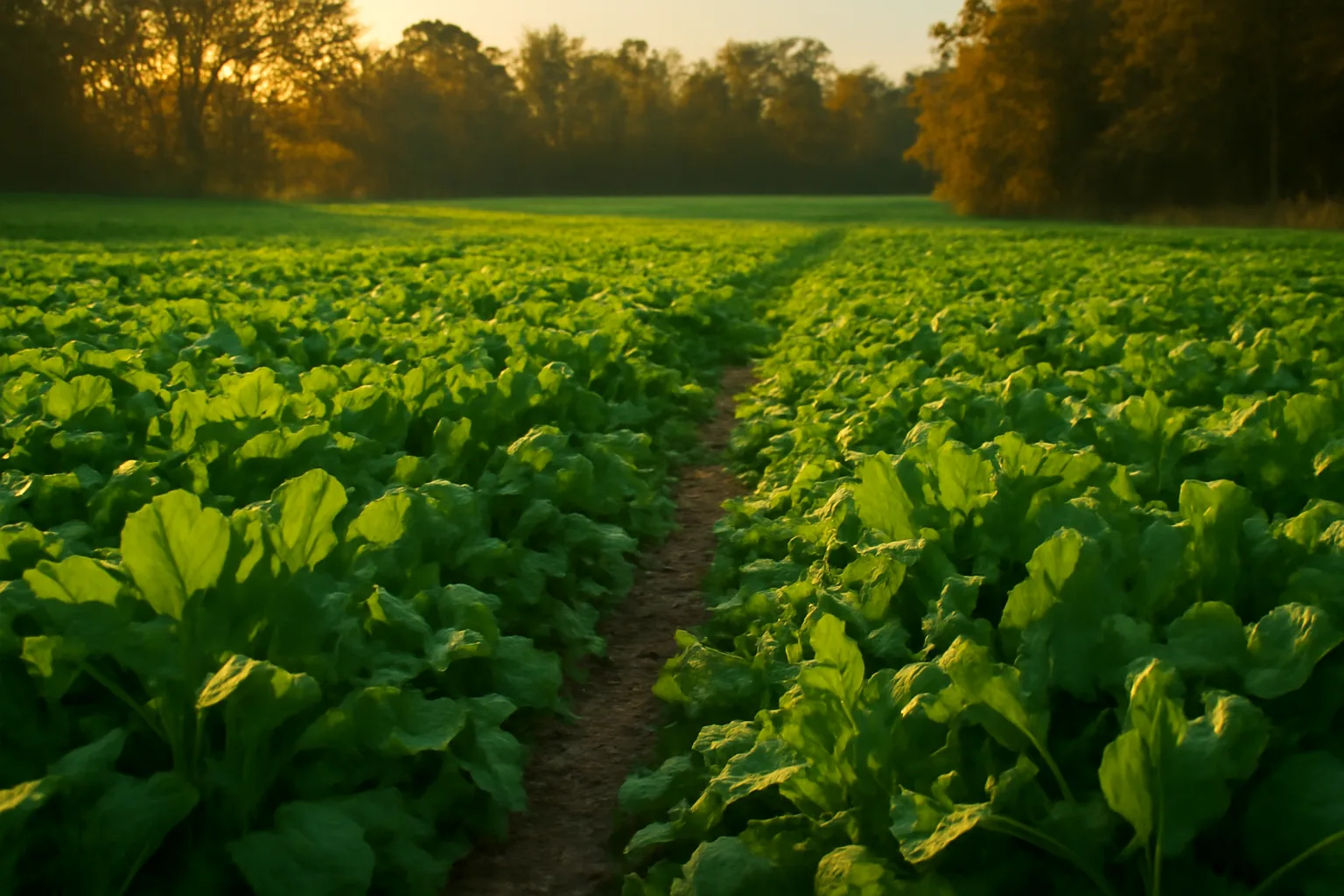
Chicory (Cichorium intybus) is a perennial broadleaf forb, not a grass and not a legume. It grows a deep taproot, often 6 feet or more into the soil profile once established, which is exactly why it handles dry summer stretches that wreck a clover stand. [1] The plant most food plotters use is a forage-type chicory bred for palatability and regrowth, not the wild roadside chicory with the blue flower you see in ditches. Deer plotters like chicory because it's a workhorse. It comes up fast in spring, keeps producing leaf tissue all summer when clover often stalls out from heat, and it holds decent quality right up until a hard frost. University trials on forage chicory report crude protein commonly in the 20 to 32 percent range depending on cutting stage and soil fertility, which is well above what most corn or brassica leaf tissue offers deer during the stress months of July and August. [2] It's also a perennial, meaning a well-managed stand can produce for 3 to 5 years before you need to reseed, similar to red clover but often more drought-tolerant. That makes it a good anchor for a semi-permanent plot rather than something you replant every spring. A food plot, in the simplest terms, is any planted area on a property managed to attract or hold deer and other wildlife by supplying preferred forage. It can be a quarter-acre kill plot tucked in timber or a 5-acre field planted for tonnage. Chicory fits both roles, though it's most often used in perennial clover/chicory blends rather than planted as a monoculture.
When should you plant chicory for deer?
Plant chicory in spring after your last expected frost, once soil temperatures are reliably above 50 degrees F. That's generally April through May in the Midwest and Northeast, and as early as March in the Deep South. [1] Some plotters also plant in late summer (August to early September) in warmer zones, giving the taproot time to establish before winter, but spring seeding is the more reliable window for stand establishment in most of the whitetail range. When to plant food plots for deer really comes down to species and region. Cool-season perennials and biennials like chicory, clover, and brassicas go in during spring or late summer/early fall windows tied to your local frost dates. Warm-season annuals like soybeans, corn, and sorghum need soil temps in the 60s and go in after frost risk has passed, generally May into June depending on latitude. Because chicory is often seeded with clover, timing usually matches your clover planting window. Check your regional planting calendar and don't rely on a single national date. A chicory seeding in zone 4 in April is not the same decision as zone 8 in April.
How do you plant chicory correctly?
Start with a soil test. Chicory grows best in a pH range of 5.5 to 7.5, and forage quality and stand persistence both drop hard on acidic ground that hasn't been limed. [3] Your soil test report from your local lab is the actual authority here on lime and fertilizer rates; a generic plan is guidance, not a replacement for the numbers on your specific field. Seed depth matters more with chicory than with most food plot seeds because it's tiny. Plant 1/4 to 1/2 inch deep into a firm, clean seedbed. Too deep and it won't emerge. Broadcast on a rough seedbed without any coverage and you'll lose a lot of it to birds and wind. A cultipacker before and after broadcasting works well if you don't have a no-till drill capable of handling small seed. Seeding rate for pure chicory is typically 4 to 8 lbs per acre; in a clover blend, chicory usually makes up 2 to 4 lbs per acre of a mix that's otherwise 6 to 10 lbs of clover. [2] Don't plant it too thick. Chicory is competitive and can crowd out clover if you overseed it, which some plotters actually want since deer hit chicory leaf hard in summer heat. Weed control in the seeding year is the biggest establishment risk. Chicory seedlings are slow to compete early on, so a clean, weed-free seedbed (via tillage, herbicide burndown, or both) before planting pays off more than almost anything else you do that year.
Should you plant chicory alone or in a blend with clover?
Most experienced plotters run chicory in a blend with clover rather than as a monoculture, and there's good agronomic reason for that. Clover fixes nitrogen in the soil (legumes host rhizobia bacteria that convert atmospheric nitrogen into plant-available form), which benefits the chicory growing next to it, while chicory's deep taproot pulls up nutrients from lower in the soil profile that shallow-rooted clover can't reach. [1] The two also have different weak points that offset each other. Clover can go dormant or brown out in a hot, dry August. Chicory keeps producing leaf tissue through that stretch because of the taproot's access to deep soil moisture. When fall rains return, clover often outpaces chicory again. A common ratio for a perennial food plot blend is roughly 60 to 70 percent clover seed by weight to 10 to 20 percent chicory, filled out with a small amount of a companion grass or left as a straight legume/forb mix. Commercial "clover/chicory" blends sold for food plots generally follow something close to this ratio, though exact formulas vary by brand. If you're planning multiple plot types across a property (a perennial clover/chicory field plus annual grain plots and a fall brassica plot), a written plot plan helps you sequence what goes where and when so you're not guessing every March. PlotSeason's $99 one-time Custom Food Plot Plan (/plot-plan-builder) is built for exactly that kind of multi-plot planning based on your acreage, region, and soil test.
Do deer actually eat chicory, and how much do they use it?
Yes. Chicory is one of the more consistently used forages in whitetail food plot management, particularly in summer. Deer use tends to be heaviest on new leaf growth, meaning regular mowing (every 4 to 6 weeks during the growing season, cutting off the top third) keeps chicory in a vegetative, palatable state and encourages continued deer use rather than letting it bolt to a tough, bitter flower stalk. [2] Deer favorite foods vary by season and region, but research and extension data consistently point to a short list: soft mast like acorns and apples, high-protein legumes like clover and soybeans, and, where planted, brassicas and chicory during the growing season. There's no single universal "favorite" food for deer; preference shifts with what's available, what's in season, and what the deer have learned to eat on that specific property. Do deer like clover? Generally yes, and it's one of the most planted food plot species in North America because deer show strong, repeated use of it and it's relatively easy to establish. Clover's main limitation is summer heat and drought tolerance, which is exactly the gap chicory fills in a blend. One honest caveat here. Nobody has a clean, controlled study ranking chicory against every other forage option on a percentage-preference basis across regions. Extension and field-observation data show chicory gets heavy use, especially in summer, but "deer prefer chicory over X" claims beyond that are mostly anecdotal from plot managers, not peer-reviewed rankings.
Does chicory work as a summer food source when clover struggles?
Yes, and this is chicory's main selling point over a straight clover plot. Once soil moisture drops in July and August, shallow-rooted clover often goes semi-dormant, producing less leaf tissue and lower quality forage right when lactating does and antler-growing bucks need protein most. Chicory's taproot changes that math. It keeps pulling moisture from deeper soil layers long after the top 6 inches have dried out, so the plant keeps producing new leaf tissue through summer heat that would stunt clover. Extension forage research describes chicory as notably more drought-tolerant than most clover varieties, which is the practical reason it's become a standard addition to perennial plot blends rather than a niche specialty seed. [1] That said, chicory isn't drought-proof. In extreme, extended drought it will still slow down and can go semi-dormant, just later and less severely than clover typically does. Regular mowing through summer also helps by removing the older, more fibrous, bitter-tasting top growth and forcing tender regrowth that deer prefer.
What about oats, turnips, and other fall companions for chicory plots?
Chicory is a perennial anchor, but a lot of plotters interplant it with fall annuals in adjacent plots or in the same field in year one while the perennial stand is establishing. When to plant oats for deer: oats are a cool-season annual grain best planted in late summer to early fall, generally August to September in the North and September to October in the transition zone and South, timed so they get 6 to 8 weeks of growth before hard frost. Oats green up fast, are highly palatable to deer while young and tender, and work well as a nurse crop or companion planted alongside brassicas or a new clover/chicory seeding to reduce erosion and weed pressure in the establishment year. When to plant turnips for deer: turnips are typically planted 60 to 90 days before your first expected fall frost, which usually lands in late July through August depending on latitude. Turnips need that lead time to bulb out and reach peak sugar content, which happens after a few frosts convert starches to sugars, making the bulbs and tops more attractive to deer in late fall and winter. Do deer eat sorghum? Yes, deer will browse grain sorghum (milo) leaf tissue and will hit the grain heads once mature, though sorghum is more commonly planted as a summer screening and grain crop for its tonnage and standing cover value than as a primary attractant like clover or chicory. It's a warm-season annual, planted after soil temps hit the mid-60s, same general window as corn. Do deer like honey? This is a common search but it's not really a food plot question. Deer aren't known to seek out honey in the wild in any documented way relevant to food plot management, and it has no real role in forage planning. If you're thinking of mineral or attractant products marketed with "honey" in the name, check your state's baiting and supplemental feeding regulations first, since many states restrict or ban feeding and baiting for deer, and rules vary significantly by state. [4]
How long does a chicory food plot last, and how do you maintain it?
A well-established chicory stand, especially blended with clover, typically produces for 3 to 5 years before thinning grass and weed pressure make renovation worthwhile. [2] That's a meaningfully longer plot life than annual brassica or grain plots, which is part of why chicory blends are popular for food plotters who don't want to till and replant every single year. Maintenance during those years centers on three things: mowing, fertility, and weed control. Mow every 4 to 6 weeks through the growing season to knock back competing weeds and keep chicory from bolting to seed, which makes the leaves tougher and less palatable. Soil-test annually or every other year and top-dress nitrogen, phosphorus, and potassium according to your lab's recommendation; chicory is a heavier feeder than clover and responds well to nitrogen in particular since it isn't fixing its own like a legume does. Spot-spray grassy weeds with a grass-selective herbicide labeled for use in clover/forb stands, since broadleaf herbicides that would kill weeds will also kill your chicory and clover. By year 4 or 5, expect thinning. At that point most plotters either overseed more clover and chicory into the existing stand (frost-seeding works well for this) or till it under and start fresh, sometimes rotating that field into a warm-season annual like soybeans or corn for a year to break up any disease or weed cycle before coming back to a perennial blend.
What soil and pH conditions does chicory need?
Chicory grows best in well-drained soil with a pH between 5.5 and 7.5, with most guidance targeting closer to 6.0 to 6.5 for best nutrient availability. [3] It tolerates a wider pH range than alfalfa but still suffers in strongly acidic soil below 5.5, where aluminum toxicity and poor nutrient uptake limit root development. That matters even more for chicory than for shallow-rooted species since its whole advantage is that deep taproot. Get a soil test before planting, not after. A basic soil test through your county extension office or a private ag lab typically costs somewhere in the $10 to $20 range and takes 1 to 2 weeks to turn around, and it tells you exactly how much lime and how many pounds per acre of P and K your specific field needs. That's information no blog article can give you accurately since it varies field to field. [3] If your test comes back needing lime, apply it months ahead of planting if you can. Lime takes time to react with soil and move pH, often 6 months to a year for full effect depending on how finely ground it is and how well it's incorporated, so a fall lime application ahead of a spring chicory planting is a smart sequence rather than liming and planting the same week.
Chicory vs. clover vs. brassicas: quick comparison
| Factor | Chicory | White/Red Clover | Brassicas (turnips, radish) | |
|---|---|---|---|---|
| Plant type | Perennial forb | Perennial legume | Annual, usually | |
| Stand life | 3-5 years [2] | 3-5 years (red clover often shorter) | 1 season | |
| Drought tolerance | High (deep taproot) [1] | Moderate | Moderate | |
| Peak deer use | Spring-fall, strong in summer | Spring-fall | Fall-winter after frost | |
| Crude protein | ~20-32% [2] | ~20-30% | Varies by part, often 15-25% | |
| Needs N fertilizer | Yes, doesn't fix its own | No, fixes its own nitrogen | Yes | |
| Best planting window | Spring, after last frost [1] | Spring or late summer | 60-90 days before first frost | This is why so many perennial plot blends combine chicory and clover rather than picking one. They cover each other's weak seasons, and neither one alone gives you both the summer drought tolerance and the nitrogen-fixing soil benefit. |
Is chicory worth planting on a small or leased property?
For most hunters managing owned or leased ground, yes. Chicory earns its place, especially in a clover blend, because it extends quality forage further into summer than clover alone and it doesn't need replanting every year. That second point matters a lot on leased ground where you may not control the field every season or want to minimize equipment and labor costs. The tradeoffs are real, though. Chicory needs a properly prepped seedbed and decent fertility to perform, it's slower to establish in year one than a fast annual like oats or buckwheat, and on very small kill plots (under a half acre) some hunters prefer annual brassica or grain plots timed tightly to the season, since a perennial chicory/clover plot is more of a season-long attraction and nutrition tool than a single hunt setup. If you're mapping out multiple plots across a property, a perennial chicory/clover field is a good anchor plot near bedding or in a larger opening, paired with annual plots (brassicas, cereal grains) closer to stand sites for late-season hunting pressure. Matching species to plot role, rather than planting the same mix everywhere, is most of the actual strategy in food plot planning. If you want that mapped out for your specific acreage and region, that's the exact problem PlotSeason's $99 Custom Food Plot Plan is built to solve at /plot-plan-builder, though everything above will get you a solid chicory stand on its own with no purchase required. For more on matching plot types to goals, see food plot whitetail and deer food plots for broader planning frameworks, or deer food plot seed and food plot seed for species selection beyond chicory.
Frequently asked questions
Do deer eat sorghum?
Yes, deer browse grain sorghum leaf tissue and eat the grain heads once mature, but it's mostly planted as a warm-season screening and tonnage crop rather than a top attractant. It's planted after soil temperatures reach the mid-60s, similar timing to corn.
Do deer eat clover, and do deer like it?
Yes, deer readily eat clover, and it's among the most widely planted food plot species in North America because of consistent, repeated deer use and relatively easy establishment. Its main weakness is reduced growth during hot, dry summer stretches, which is why it's often blended with chicory.
When should you plant food plots for deer?
Timing depends on species and region. Cool-season perennials like clover and chicory go in spring or late summer/early fall; warm-season annuals like corn and soybeans go in after your last frost when soil temps hit the 60s; fall brassica and grain plots go in roughly 60-90 days before your area's first frost.
When should you plant oats for deer?
Plant oats in late summer to early fall, roughly August through September in the North and September through October in the transition zone and South, giving them 6 to 8 weeks to establish before hard frost. Oats green up fast and work well as a nurse crop for new clover or chicory seedings.
When should you plant turnips for deer?
Plant turnips 60 to 90 days before your area's first expected fall frost, generally late July through August depending on latitude. That window lets the bulbs mature and sweeten after a few early frosts convert starches to sugar, which is when deer use typically increases.
What is a food plot?
A food plot is a planted area, from a quarter-acre kill plot to several acres, managed specifically to provide forage that attracts or holds deer and other wildlife on a property. Plots can be annual (replanted yearly) or perennial (lasting several years) depending on the species planted.
What are deer's favorite foods?
There's no single universal favorite; preference shifts by season and region. Commonly documented high-use foods include acorns and other soft mast, clover, soybeans, brassicas in fall and winter, and chicory during the growing season, especially summer when other forages slow down.
Do deer like honey?
There's no meaningful documented evidence that deer seek out honey in the wild, and it has no real role in food plot forage planning. If you're considering a honey-based mineral or attractant product, check your state wildlife agency's baiting and feeding rules first, since these vary widely by state.
How long does a chicory food plot last before you need to replant?
A well-managed chicory stand, especially blended with clover, typically produces usable forage for 3 to 5 years before thinning and weed pressure make renovation or replanting worthwhile. Annual mowing and soil-test-based fertility keep the stand productive longer.
Can you plant chicory alone, or does it need clover?
Chicory can be planted alone, but most food plotters blend it with clover because the two cover each other's weaknesses: clover fixes nitrogen chicory benefits from, and chicory's deep taproot keeps producing through summer drought stretches that slow clover down.
What pH does chicory need to grow well?
Chicory performs best in soil with a pH between 5.5 and 7.5, ideally closer to 6.0 to 6.5 for optimal nutrient availability. A soil test from your local extension office or ag lab, typically $10 to $20, will tell you exactly how much lime your specific field needs.
How deep and how thick should you seed chicory?
Plant chicory seed 1/4 to 1/2 inch deep into a firm, clean seedbed since the seed is very small. As a monoculture, seed at 4 to 8 lbs per acre; in a clover blend, chicory usually makes up 2 to 4 lbs per acre of the total mix.
Sources
- USDA Natural Resources Conservation Service, Plant Guide: Chicory (Cichorium intybus L.): Chicory develops a deep taproot and shows strong drought tolerance compared to shallow-rooted forages
- University of Georgia Extension, Chicory as a Forage Crop, Circular 918: Chicory crude protein range, seeding rates, mowing recommendations, and stand life of 3-5 years
- Oklahoma State University Extension, Establishing Wildlife Food Plots, PSS-2911: Regional planting windows for clover/chicory blends, oats, and brassicas including turnip lead time before first frost
- Clemson Cooperative Extension, Routine Soil Testing: Chicory pH range recommendation and general soil test cost and turnaround guidance
- Michigan Compiled Laws, Section 324.40111c (Baiting and feeding of deer): Baiting and supplemental feeding regulations for deer vary significantly by state and should be checked before use