Last updated 2026-07-25
TL;DR
Chicory is a perennial forb deer hit hard from spring through fall, especially in dry summers when clover slows down. Plant 4-6 lbs/acre (in a mix) at 1/4 inch deep in spring or late summer, keep soil pH near 6.0-6.5, and mow to keep it from bolting. Stands can produce for 3 to 5 years with good management.
What is chicory and why do food plotters plant it?
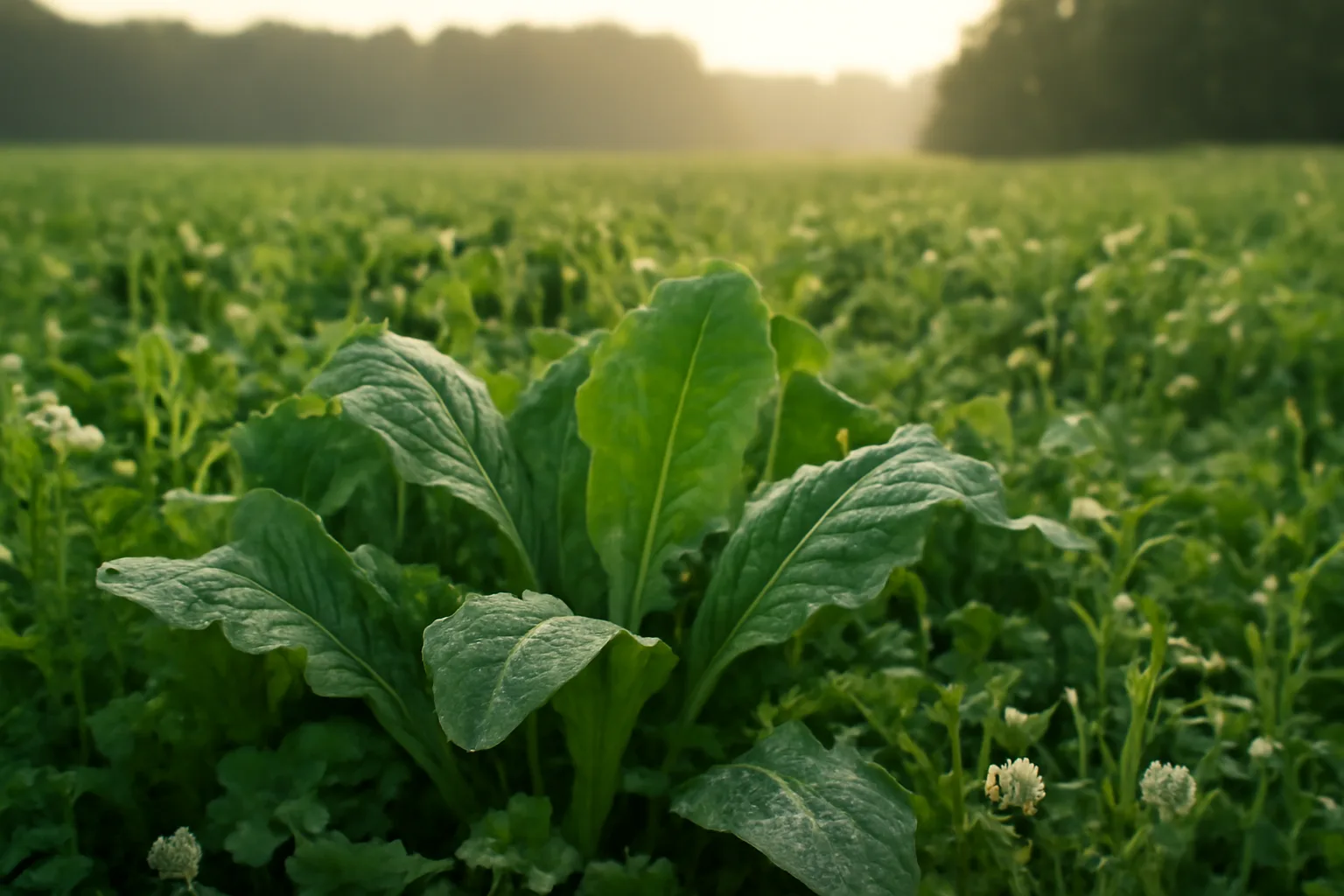
Chicory (Cichorium intybus) is a perennial broadleaf forb, not a grass and not a legume. It grows a deep taproot, sometimes 2 to 3 feet down in loose soil, which is exactly why it shrugs off summer dry spells that turn clover plots brown and crispy [1]. Most food plot chicory sold today is a forage type bred down from the wild, bitter roadside chicory you've probably seen with the pale blue flowers. Forage varieties like Puna II were developed for palatability and tonnage, with lower lignin and less of the bitter compound that turns deer off older, more mature leaves [1]. Hunters plant it because it does something clover and brassicas can't: it holds quality forage through the hottest, driest weeks of July and August, right when clover plots often stall out. It's also perennial, so a well-maintained stand can keep producing for 3 to 5 years, sometimes longer, before you need to till it back in [1]. It's rarely planted alone. Most seed you buy in a bag is chicory blended with white clover, sometimes at 15-20% chicory by weight, because the two species fill different growth windows and root depths.
Do deer actually eat chicory, and how much do they prefer it?
Yes, deer eat chicory readily, and in a lot of plots it gets hit harder than the clover planted next to it, especially from late spring into fall. Extension forage trials have long listed chicory among the highest crude protein perennial forages available for food plots, often testing in the 20-32% crude protein range in young, vegetative growth [2]. That protein number matters for antler growth and lactation in early summer, which is why chicory shows up in a lot of "summer forage" plot mixes rather than fall attractant blends. Deer preference isn't uniform across the growing season, though. Young chicory leaves are tender and low in the bitter sesquiterpene lactones that give mature chicory its harsh taste. As the plant bolts and sends up a flower stalk, the leaves toughen and get more bitter, and deer browsing pressure drops off that plant until you mow it back to fresh regrowth [1]. That's the single biggest management lever with chicory: keep it mowed to 6-8 inches through summer so it stays vegetative and palatable instead of running to seed.
What is a food plot, and where does chicory fit in the plan?
A food plot is a planted patch of forage on hunting land, grown specifically to feed and hold deer (or other wildlife) rather than for human harvest or livestock grazing. Plots range from quarter-acre kill plots tucked in timber to multi-acre agricultural-scale fields, and they're planted with everything from clover and brassicas to cereal grains and soybeans. Chicory fits best as a perennial component of a summer-to-fall plot, usually blended with clover in what's often called a clover/chicory mix. It's not a great standalone fall attractant on its own once frost hits and the leaves get tough and bitter, though deer will still browse it into early fall in a lot of areas. If you're building out a whole property plan rather than one field, it helps to think in terms of a rotation: perennial clover/chicory in your best, most accessible plots for spring-through-fall nutrition, and annual brassicas, cereal grains, or food plot seed blends elsewhere for hunting-season draw. For a broader look at how species selection ties into an overall property plan, see deer food plots and food plot whitetail.
When to plant food plots for deer (and where chicory timing fits)
Timing depends on species and region far more than any single calendar date. Perennial clover and chicory plots generally go in during spring (once soil temps hit the mid-50s Fahrenheit) or in late summer, roughly 6-8 weeks before your first fall frost, so the plants establish before winter dormancy [3]. Annual brassicas and cereal grains follow a different window, usually planted in later summer specifically to be ready for fall hunting season. For chicory specifically, spring planting (April through May in most of the Midwest and Upper South) gives the taproot a full season to establish before its first winter, which tends to produce a hardier stand. Late-summer plantings (mid-August into September, depending on your first frost date) work too, but the plant has less time to build root reserves before cold weather, so winterkill risk goes up a bit in northern zones. Your local extension office and state wildlife agency often publish region-specific planting calendars, and matching seeding dates to your USDA Plant Hardiness Zone and average first frost date is the most reliable way to plan a perennial planting window [4].
When to plant oats for deer, and how does that compare to chicory timing?
Oats are planted in late summer to early fall, typically 60 to 90 days before the first hard frost, so they can put on leafy growth before cold weather slows them down. In most of the Midwest and mid-South that lands somewhere between mid-August and mid-September [5]. This is a completely different planting window than perennial chicory, which is why the two rarely compete for the same spot in a rotation. Oats are an annual, cool-season cereal grain, they die back hard with sustained cold, and they're planted to be consumed that same fall and winter. Chicory is a perennial forb planted to persist across years. A lot of plotters run both on the same property: chicory/clover in a perennial plot for spring through fall nutrition, and an oat-brassica-clover annual mix in a separate plot timed for peak hunting season draw. If you're not sure which combination fits your ground and your local frost dates, that's the kind of decision our $99 Custom Food Plot Plan is built to sort out, species, timing, and rates specific to your zone and soil test.
When to plant turnips for deer
Turnips are planted in late summer, generally 60 to 90 days before your average first frost, similar to the oat window. Most Midwest extension programs recommend late July through August seeding dates depending on latitude, because turnips need that runway to bulb out and build sugar content before frost sweetens the greens and roots . Deer often ignore turnip bulbs and tops early in the season and hammer them hard after a few frosts convert starches to sugars, which is a common source of confusion for first-time plotters who think their turnip plot is a failure in October only to watch it get demolished in December. Turnips don't overlap with chicory in a planting calendar the way you might expect. Turnips are a fall annual brassica, chicory is a spring-or-late-summer perennial forb, and they're almost never seeded in the same pass. Some hunters do plant chicory around the edges of a brassica plot as a perimeter perennial, but the core turnip planting date logic stands on its own.
Do deer like clover, and how does it compare to chicory?
| Lifespan | 3-5 years typical | 3-5 years typical | |
|---|---|---|---|
| Drought tolerance | Moderate, shallow roots | High, deep taproot | |
| Crude protein (vegetative) | ~25-30% | ~20-32% | |
| Shade tolerance | Better than chicory | Poor, needs good sun | |
| Seeding rate alone | 6-8 lbs/acre | 4-6 lbs/acre | |
| Mowing need | Occasional | Regular, to prevent bolting | For most properties, planting them together in a mix gets you the best of both: clover's density and cold tolerance, chicory's summer drought insurance. |
Yes, white and red clover are among the most consistently preferred food plot forages across whitetail range, and that's backed by decades of forage quality data as well as browse-use studies. Clover regularly tests at 25-30%+ crude protein in vegetative growth, similar to chicory, and it's usually cheaper per pound of seed and easier to establish [2]. The real difference between the two shows up in a drought. Clover has a shallower root system than chicory and tends to go dormant, thin out, or brown up when rainfall dries up for a few weeks in July or August. Chicory's deep taproot keeps pulling moisture and staying green through exactly those conditions, which is the main reason the two are blended together rather than planted as competitors. Here's a rough side-by-side for planning purposes: | Trait | White clover | Chicory |
How do you plant chicory seed correctly?
Chicory seed is small, similar in size to clover seed, and it needs to go in shallow, about 1/4 inch deep, into a firm, well-worked seedbed. Planting too deep is the single most common failure mode; if you can't feel the seed by lightly scuffing the soil surface with your boot, it's probably buried too deep to emerge. A typical seeding rate for chicory alone runs 4-6 lbs/acre broadcast, though most food plotters plant it as part of a clover/chicory blend at a lower rate, often 1-2 lbs/acre of chicory mixed with 6-8 lbs/acre of clover, since bagged blends usually pre-mix the ratio for you. Basic steps that hold true across most regions: 1. Test your soil first. Chicory does best in the 6.0-6.5 pH range and won't perform well in acidic soil without lime correction [1]. 2. Work up a clean seedbed, free of heavy weed competition, and firm it with a cultipacker or roller if you have one. 3. Broadcast seed shallow, then lightly drag or cultipack to press it into contact with soil. Don't disc it in deep. 4. Fertilize according to your soil test results, chicory responds well to nitrogen and phosphorus but your soil test lab knows your specific numbers better than any general recommendation can. 5. Mow at 6-8 inches through the growing season to knock back competing weeds and keep the chicory from bolting and going bitter. If you're building your own seed mixes rather than buying a pre-blended bag, deer food plot seed and domain food plot seed cover blend ratios and species pairing in more depth.
What soil and fertility conditions does chicory need?
Chicory wants a soil pH between 6.0 and 6.5 and moderate to high fertility, particularly phosphorus and potassium, to establish a strong root system in year one [1]. Below pH 5.5, expect stunted growth and poor persistence regardless of how good your seed is. This is one of those crops where guessing at lime and fertilizer rates wastes money fast. A basic soil test through your county extension office or a private ag lab typically costs somewhere in the $10-20 range and comes back with an exact lime and fertilizer recommendation for your specific field, not a generic bag rate. Your soil test lab is the authority here, not a seed bag label or a blog post; follow their lime and fertilizer numbers over any blanket recommendation. Chicory tolerates a range of soil textures, from sandy loam to clay, as long as drainage is decent. It does not like standing water or heavy, poorly drained clay that stays saturated after rain; the taproot rots out in those conditions.
Do deer eat sorghum, and does it pair with chicory in a plot rotation?
Yes, deer eat grain sorghum, both the seed heads and, to a lesser extent, the foliage, though it's used more as a fall/winter grain source and cover crop than as a primary attractant forage like clover or chicory. Sorghum is planted in late spring to early summer, similar timing to corn, and it's valued for drought tolerance and standing grain through winter . Sorghum and chicory don't typically share a planting pass since sorghum is a warm-season annual grain crop and chicory is a perennial forb, but they can coexist on the same property in a rotational sense. Some plotters use sorghum or milo as a screening/thermal cover crop bordering a perennial chicory-clover plot, giving deer both food and security cover in the same general area. Sorghum is a heavier feeder than chicory in terms of nitrogen demand, so if you're rotating a field from sorghum into chicory or vice versa, get a fresh soil test before the switch rather than assuming last year's fertility carries over.
What are deer's favorite foods, and where does chicory rank?
There's no single universal "favorite," since deer preference shifts by season, region, and what's locally available, but research and decades of food plot data point to a consistent short list: acorns (especially white oak family acorns, which are lower in tannins and more palatable than red oak acorns), soybeans, clover, and, in late summer through fall, chicory and brassicas once frost sweetens them [2] . Acorns often top the list where they're available in volume, since a good mast year can pull deer off planted plots entirely for weeks. Agricultural crops like soybeans and corn rank high too, when they're accessible and not too mature. Chicory earns its place less because deer choose it over everything else and more because of when it delivers: it's one of the few high-protein forages still green and palatable in the dead of a July drought when almost everything else in the woods and in most plots has gone tough or dormant. That reliability, not raw preference ranking, is the real argument for planting it.
Do deer like honey, and is that relevant to food plots?
There's no research or wildlife agency guidance suggesting deer seek out honey as a natural forage item, and it isn't a legitimate food plot or attractant strategy. Deer are herbivores built to browse forbs, grasses, mast, and woody browse, not sweet liquids like honey. What's actually relevant here is that many states classify placing food, minerals, or scent-based attractants (which some products marketed with "honey" or sweet scents fall under) as baiting, and baiting rules vary widely by state, sometimes by county. Some states ban all baiting for deer hunting outright, others allow it with restrictions on distance from a stand or visibility of the bait pile, and some allow it only outside hunting season . Before you put out any commercial attractant, honey-based or otherwise, check your state wildlife agency's current regulations. A properly planted food plot is legal in every state as normal agricultural activity, but a bait pile or liquid attractant can cross into a different legal category depending on where you hunt.
How long does a chicory food plot last, and when do you need to replant?
A well-maintained chicory or clover/chicory plot typically produces for 3 to 5 years before stand quality declines enough to justify tilling it under and starting over, though good management (regular mowing, timely fertilization based on soil tests, and weed control) can push that toward the higher end [1]. Signs it's time to replant include thinning stands with more bare ground than forage, heavy grass or weed encroachment that outcompetes the chicory, and declining regrowth vigor after mowing. Soil compaction from repeated equipment traffic also shortens stand life, so if you're running heavy equipment across the same plot every year, expect a shorter productive window. Most plotters treat chicory/clover as a rotational perennial: plant it, maintain it for 3-4 years, then rotate that field into an annual crop (brassicas, cereal grain, or a soybean/corn year) for a season before coming back to perennial forage. That rest year helps break weed and disease cycles and gives you a chance to correct soil pH and fertility before reseeding.
Frequently asked questions
Do deer eat sorghum in food plots?
Yes, deer eat grain sorghum, both the standing seed heads and some foliage, though it's mainly used as a fall/winter grain crop and cover option rather than a primary attractant like clover or chicory. It's planted in late spring to early summer, similar to corn, and offers good drought tolerance and standing winter grain.
How deep should you plant chicory seed?
Plant chicory about 1/4 inch deep into a firm, well-worked seedbed. Chicory seed is small, similar in size to clover seed, and it needs light soil contact rather than deep burial. If you broadcast it, drag or cultipack afterward instead of discing it in, since burying it too deep is the most common reason chicory fails to come up.
What is the best seeding rate for chicory food plots?
Chicory planted alone is typically seeded at 4-6 lbs per acre. Most hunters plant it as part of a clover/chicory blend instead, often at 1-2 lbs per acre of chicory mixed with 6-8 lbs per acre of clover. Bagged blend products usually pre-mix this ratio, so follow the bag rate for blends rather than the alone-rate.
What soil pH does chicory need for food plots?
Chicory performs best in soil with a pH between 6.0 and 6.5. Below pH 5.5, expect stunted growth and poor stand persistence even with good seed and fertility. A basic soil test, usually $10-20 through a county extension office or private ag lab, tells you exactly how much lime your field needs to hit that range.
Can you plant chicory alone, or does it need to be mixed with clover?
You can plant chicory alone at 4-6 lbs/acre, but most food plotters blend it with white clover because the two species cover different weaknesses. Clover fills in density and cold tolerance while chicory's deep taproot carries the plot through summer drought. Pure chicory stands also tend to look thinner and weedier without a companion legume filling the gaps.
How long does a chicory food plot last before it needs replanting?
A well-managed chicory or clover/chicory stand typically produces for 3 to 5 years. Regular mowing, timely fertilization based on soil test results, and weed control push stands toward the longer end of that range. Thinning stands, heavy grass encroachment, and weak regrowth after mowing are signs it's time to till and reseed.
When is the best time to plant chicory for deer?
Spring planting, once soil temperatures reach the mid-50s Fahrenheit (roughly April through May across the Midwest and Upper South), gives chicory's taproot a full season to establish before winter. Late-summer planting, 6-8 weeks before your first fall frost, also works, but stands have less time to build root reserves, so winterkill risk rises in northern zones.
Does chicory need to be mowed, and how often?
Yes. Mow chicory to about 6-8 inches through the growing season whenever it starts bolting toward a flower stalk. Mowing keeps the plant in vegetative growth, which is lower in bitter sesquiterpene lactones and more palatable to deer than mature, flowering chicory. Most plots need mowing every few weeks during peak summer growth.
How does chicory compare to clover for food plots?
Clover and chicory both test in the 25-30%+ crude protein range in vegetative growth and are often planted together. Clover has shallower roots and can go dormant or brown up in drought, while chicory's deep taproot (2-3 feet in loose soil) keeps it green through dry summer stretches. Clover is generally cheaper per pound and easier to establish.
Is chicory a good food plot for fall hunting?
Chicory is better as a spring-through-fall nutrition plot than a dedicated fall attractant. Once frost hits, the leaves toughen and get more bitter, and deer draw drops compared to brassicas or cereal grains planted specifically for that window. Many hunters keep chicory/clover in one plot for summer nutrition and plant annuals like oats or turnips elsewhere for peak-season draw.
Do deer prefer chicory over brassicas like turnips?
It depends on the time of year. Chicory is preferred in late spring through summer when it's tender and high in protein. Turnips are largely ignored until after a few hard frosts convert starches to sugars, at which point deer often hit them harder than chicory. The two crops fill different windows rather than directly competing for preference.
What fertilizer does chicory need in a food plot?
Chicory responds well to nitrogen and phosphorus, particularly in establishment year, but exact rates depend on your soil test results rather than a blanket recommendation. A soil test run through your county extension office or a private ag lab will return specific lime and fertilizer numbers for your field's current pH and nutrient levels.
Sources
- USDA NRCS Plant Guide, Chicory (Cichorium intybus): Chicory's deep taproot, pH preference, and multi-year stand persistence
- Oklahoma State University Extension, Forage Quality Interpretations (PSS-2117): Crude protein ranges for legume and forb forages in vegetative growth stages
- USDA NRCS Plant Guide, Sorghum: Sorghum planting timing and use as a grain/cover crop for wildlife
- USDA Forest Service, White Oak (Quercus alba) species overview: White oak acorns lower in tannins and more palatable to deer than red oak acorns
- Congressional Research Service, Baiting and Feeding of Wildlife: State Regulatory Approaches: Baiting and feeding regulations for deer hunting vary widely by state