Last updated 2026-07-25
TL;DR
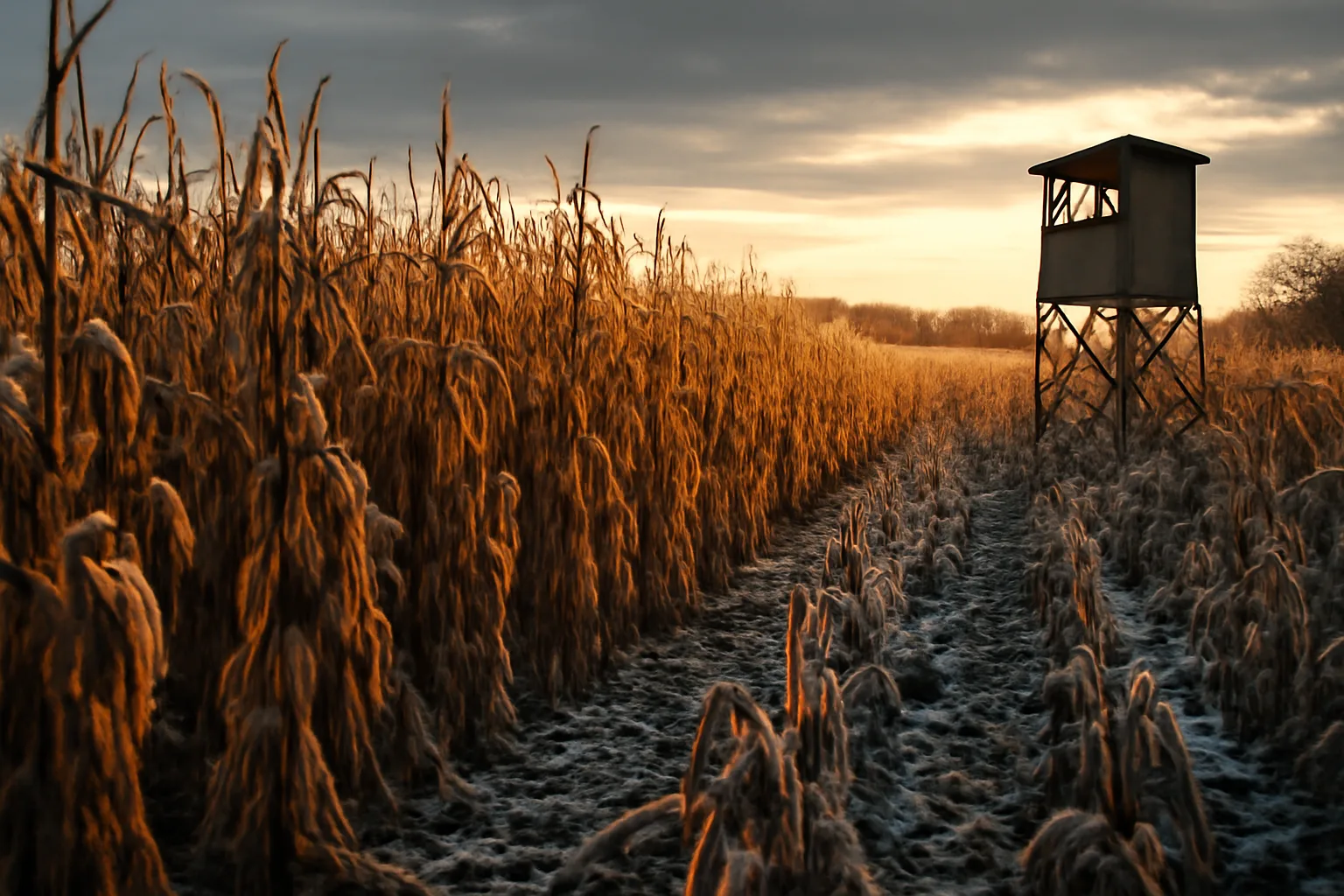
A corn food plot works best on at least a half acre of decent ground, planted after soil temps hit 50°F, with 100+ frost-free days left in the season. Corn is a heavy nitrogen feeder and a late-winter standing food source more than a fall attractant. Most hunters do better pairing a small corn block with clover, brassicas, or beans.
What is a food plot, and where does corn fit in?
A food plot is a planted patch of forage or grain, usually somewhere between a quarter acre and several acres, put in specifically to feed deer and other wildlife and to give hunters a place to watch or hunt from. Cooperative extension programs describe them simply as small-scale plantings of annual or perennial crops managed to supplement natural browse [1]. Corn is one of the oldest food plot crops and one of the most misunderstood. It is not a great October attractant in most of the whitetail range, because deer generally prefer softer, more digestible forages like clover and brassicas until grain gets scarce. Where corn earns its keep is late season: standing corn holds high-energy carbohydrates through brutal cold, and a few rows left up through January can matter a lot more than anything you plant fresh that fall. Corn also asks more of you than almost any other plot crop. It wants decent soil, real fertility, and a planting window that does not forgive much. If your ground is thin, rocky, or under an acre, you are usually better off putting that effort into clover, oats, or a brassica blend and saving corn for a bigger, better field. For context on how corn stacks up against other crop options for whitetail ground, see food plot whitetail.
When to plant food plots for deer, and how does corn's window differ?
Timing for any food plot comes down to your frost dates, your soil temperature, and what you are trying to accomplish (early attraction, late-season standing feed, or both). Corn needs the most planning of any common plot crop because it is a full-season grain crop, not a quick-growing annual. Corn should go in the ground after the danger of a hard frost has passed and once soil temperatures at planting depth reach a consistent 50°F, with 55-60°F preferred for faster, more even germination [2]. In much of the whitetail range that means late April through late May, and in the Deep South it can be as early as March. Corn also needs a long runway: most grain corn hybrids need 90 to 120+ frost-free days to reach maturity depending on the relative maturity rating of the seed. That is the opposite timing problem you have with fall food plots like brassicas or cereal grains, which you plant in late summer specifically so they mature going into hunting season. Corn is a spring-planted, fall-and-winter standing crop. If you want a general answer to "when to plant food plots for deer," the honest answer is: it depends entirely on the species. Spring plantings (corn, soybeans, some clovers) go in after last frost; late-summer plantings (brassicas, oats, wheat, cereal rye) go in 60 to 90 days before your first hard frost so they are mature or still growing when deer need them most [3].
How much soil prep and fertility does a corn plot actually need?
More than almost anything else you'll plant. Corn is a nitrogen hog. University of Wisconsin-Madison guidance for grain corn production notes nitrogen recommendations commonly run from 1.0 to 1.4 pounds of actual nitrogen per bushel of yield goal, adjusted for soil type and prior crop credits [4]. A food plot corn planting shooting for even a modest 100 bushel/acre yield goal is looking at roughly 100 to 140 lbs of actual nitrogen per acre over the season, split between a modest amount at planting and a heavier sidedress application around knee-high (V6 to V8 stage). Before any of that, get a soil test. Your soil test lab is the real authority here, not a blanket rule of thumb, because your pH, existing organic matter, and phosphorus/potassium levels change the math substantially. Corn does best in the 6.0 to 6.8 pH range, and if your test comes back at 5.5 or lower, lime needs time to work (usually months) before you plant, not the same week [5]. Phosphorus and potash matter too, especially on ground that has never been limed or fertilized. A soil test will tell you exact P and K recommendations in lbs/acre; guessing here either wastes money on nutrients you don't need or leaves you with stunted, yellowing corn that never fills an ear. If you're building a broader plan and want the fertility side handled for your specific dirt, a lab-based soil test result paired with a written plan (like the Custom Food Plot Plan many hunters use) removes most of the guesswork on rates and timing.
What planting depth, rate, and spacing work for a food plot corn planting?
Plant corn 1.5 to 2 inches deep into moisture, a bit shallower on heavier clay soils and a bit deeper on sandy ground that dries out fast [2]. Row spacing of 30 inches is standard and works fine with most food plot drills and planters; some hunters go narrower (20 inches) for tighter deer cover and a thicker screening effect, which also works but competes plants for water and nutrients harder. Seeding rate for food plot purposes usually runs 24,000 to 32,000 seeds per acre, lower than commercial row-crop rates because you are optimizing for a forgiving, deer-friendly stand rather than maximum bushels. A 50-lb bag of corn seed typically contains around 80,000 kernels (this varies by hybrid and seed size), so do the math against your acreage before you buy. One practical note: a solid block of corn (at least a half acre, ideally 1 to 3 acres) works far better than a thin strip. Corn is wind-pollinated, and a single or double row will pollinate poorly and leave you with bare cobs. If you don't have room for a real block, skip corn and put that ground into soybeans or a brassica blend instead.
Do deer eat sorghum, and is it a substitute for corn?
Yes, deer readily eat grain sorghum (milo), and it is a legitimate substitute for corn in a lot of situations. Sorghum is more drought-tolerant than corn and needs less nitrogen to produce a comparable amount of grain, which makes it a smart call on thinner or sandier soils where corn struggles [6]. Sorghum also stands up to wind better than corn (shorter, sturdier stalks) and can be a good late-season standing grain option in regions with less rainfall. The tradeoff is that sorghum seed heads are more attractive to birds early, and yields per acre in a food plot setting tend to run somewhat lower than a well-fertilized corn stand on good ground. If your soil test and your budget both point away from heavy nitrogen inputs, grain sorghum deserves a serious look before you default to corn just because it is the familiar option.
Do deer like clover, and how does it compare to corn as a food plot crop?
Deer strongly prefer clover, and it is arguably the most consistently used food plot forage across the whitetail range. Clover is highly digestible, high in protein (commonly 20-25% crude protein in vegetative growth), and available across a long season rather than concentrated in fall and winter like corn . The practical comparison: clover is a perennial (2 to 5 years from one planting depending on variety and management), needs far less nitrogen (it fixes its own through rhizobium bacteria once properly inoculated), and gives you spring-through-fall grazing pressure. Corn is an annual, replanted every year, nitrogen-hungry, and its main value window is late fall into winter when it's standing grain. Most experienced plotters run both: clover for season-long draw and easy maintenance, corn (or a grain block) for a late-season energy source when temperatures drop and deer need calories, more than protein. If you're deciding between the two for a single small plot, clover is the safer, lower-input choice. For a deeper look at clover varieties and blends, see deer food plot seed.
When to plant oats for deer, and could oats work better than corn on your ground?
Oats are a fall-planted cereal grain, typically going in the ground 60 to 90 days before your area's average first hard frost, which for most of the whitetail range lands somewhere between mid-August and mid-September [3]. That is a completely different calendar than corn's late-spring planting window. Oats germinate fast, grow well in cool soil, and are extremely palatable to deer, often outcompeting other fall plantings for early attraction in September and October. The catch is winter survival: oats are less cold-hardy than winter wheat or cereal rye and typically die back hard after a string of nights in the teens or lower, depending on variety and snow cover . If your goal is an early-season through mid-fall hunting plot, oats (often blended with brassicas or winter peas) beat corn on cost, simplicity, and time-to-attraction. If your goal is standing winter feed through January and February, corn or a corn/sorghum block still wins. A lot of hunters run oats in one plot and corn in another rather than trying to make one crop do both jobs.
When to plant turnips for deer, and do they pair with a corn plot?
Turnips, like other brassicas, are planted in late summer, generally 70 to 90 days before your first expected hard frost, which puts most of the whitetail range in a July-to-early-September window depending on latitude [3]. Turnips need that runway to bulb out and to build the leafy top growth deer hit first. Turnips get more palatable after a hard frost or two, because the cold converts starches to sugars in the bulb, which is exactly why brassica plots often become high-traffic zones in November and December, right as bow season peaks and gun season opens in most states. Turnips do not pair with corn in the same field (completely different planting calendars and soil needs) but they pair well in a plot rotation or on a neighboring field. Plenty of hunters run a corn block for the dead of winter, a brassica/turnip plot for late fall, and clover somewhere else for spring and summer. That kind of spread-out planting is really the core idea behind a whole-property plot plan rather than one field trying to do everything. For strategies on rotating and combining plot types across a property, see deer food plots.
What are deer's favorite foods, and where does corn rank?
There is no single scientifically ranked "favorite food" list for whitetails; preference shifts by season, region, and what's available, and researchers who study deer diets generally describe forage preference as highly variable and situational rather than fixed . That said, a few patterns hold up across most of the range. In spring and summer, deer lean hard on forbs, clover, soybeans in the vegetative stage, and natural browse. In early fall, soft mast (acorns especially) and standing soybeans often outcompete anything else on the landscape, including corn. In late fall, brassicas and turnips become a major draw once frost sweetens them up. In deep winter, when natural browse is scarce and temperatures are brutal, standing corn and other grain becomes one of the highest-value energy sources available, because deer need calories to survive cold stress more than they need protein. So corn is not usually a deer's "favorite" food in the sense of first choice on a warm October afternoon. It becomes one of the most important foods on the landscape in January when almost nothing else is left standing. That's the real case for planting it: not maximum attraction, but a reliable calorie source when it matters most biologically.
Do deer like honey, and does it belong anywhere near a food plot?
There's no real evidence deer seek out honey specifically, and it is not a practical or legal food plot additive in most states. Deer are drawn to sweet, high-sugar foods in general (which is part of why frosted brassicas and ripe soft mast pull them in), but pouring honey or sugar on the ground is a mineral-site or bait-pile tactic, not a food plot practice, and it runs straight into baiting and feeding regulations in a lot of states. Baiting and supplemental feeding rules vary enormously by state, and in some states even mineral licks or salt blocks fall under baiting restrictions during certain seasons. Always check your state wildlife agency's current baiting and feeding regulations before adding anything to a plot or setting a mineral site, because rules differ more than state to state but sometimes county to county (chronic wasting disease management zones in particular often carry stricter bans) .
How much does a corn food plot cost per acre?
| Corn seed (24-32k rate) | $35-$70 | |
|---|---|---|
| Nitrogen (100-140 lbs actual N) | $50-$110 | |
| Phosphorus/potash (soil-test dependent) | $20-$60 | |
| Lime (if needed, amortized over years) | $15-$40/yr | |
| Herbicide (pre or post-emergent) | $15-$35 | All-in, a food plot corn planting commonly runs $150 to $300 per acre once you count seed, fertilizer, and weed control, and that's before equipment costs (a planter or drill, a sprayer, and something to spread fertilizer). Clover and brassica blends usually come in well under that per acre after the establishment year, which is one more reason a lot of plotters treat corn as a smaller, dedicated late-season block rather than the main plot on the property. |
Corn is one of the pricier plot crops to put in, mostly because of the nitrogen bill. Rough per-acre costs for a food-plot-scale corn planting (not commercial row-crop economics) generally break down like this, though exact numbers swing with local seed and fertilizer prices: | Input | Typical range per acre |
What equipment do you actually need to grow a decent corn plot?
At minimum: a way to till or no-till the ground, a way to plant corn at a consistent depth and spacing (a real corn planter is best, but a food-plot drill set up for corn works too), a broadcast or drop spreader for fertilizer and lime, and a sprayer for pre-emergent or post-emergent herbicide. A hand-crank or ATV broadcast seeder alone won't cut it for corn the way it can for clover or brassicas, because corn planted too shallow, too deep, or too thick germinates unevenly and standability suffers. If you don't own a corn planter and can't justify buying one for a small plot, look at renting one locally or hiring the planting out to a neighbor with row-crop equipment; it is often cheaper than buying gear you'll use once a year on an acre or two. For smaller operations or first-time plotters, this is honestly the strongest argument for starting with clover, oats, or brassicas instead of corn: the equipment bar is lower, the cost per acre is lower, and the planting window is more forgiving. Corn rewards hunters with real acreage, real equipment, and a long-term plan. For equipment comparisons across plot types, see food plot seed and deer for food.
So, is a corn food plot worth planting on your ground?
If you have at least a half acre to a full acre of reasonably fertile, sunny ground, the equipment (or access to it) to plant and fertilize properly, and a specific goal of late-season standing feed, corn is worth it. It genuinely does something other crops can't: it stands through snow and holds calories when deer need them most. If you have less than a half acre, thin or acidic soil you haven't limed, no real planting equipment, or you're mainly hunting October and November, skip corn and put your money into clover or a brassica/cereal grain blend instead. Those crops cost less, forgive more mistakes, and match up better with when most hunters are actually in a stand. A lot of the best whitetail properties run a mix: clover for the growing season, brassicas and cereal grains for fall attraction, and a smaller corn or sorghum block held specifically for late-season energy. Getting that mix right for your specific soil, acreage, and hunting season is exactly the kind of decision a written, soil-test-based plan helps with; that's the whole idea behind the $99 Custom Food Plot Plan, built off your actual soil test rather than a generic seed bag label. Your soil test lab still calls the shots on exact lime and fertilizer rates; the plan lays out what to plant, where, and when for your ground.
Frequently asked questions
Do deer eat sorghum?
Yes. Deer readily eat grain sorghum (milo) heads, and it works as a lower-input, more drought-tolerant alternative to corn, especially on sandy or thinner soils. It needs less nitrogen than corn to produce comparable grain but tends to draw more early bird pressure on the seed heads.
Do deer eat clover?
Yes, and clover is one of the most preferred and most planted food plot forages in North America. It's high in protein (often 20-25% crude protein in vegetative stages), stays available spring through fall, and as a perennial can produce for 2 to 5 years from a single planting with proper management.
When to plant deer food plots?
It depends on the crop. Spring-planted crops like corn and soybeans go in after your last frost once soil hits 50-60°F. Fall crops like brassicas, turnips, oats, and cereal grains go in 60 to 90 days before your area's first hard frost so they mature as hunting season arrives.
Do deer like clover?
Yes, deer prefer clover strongly across most of their range because it's highly digestible and high in protein. It's often the anchor forage on a whitetail property, used alongside fall annuals like brassicas and grains rather than as a replacement for them.
When to plant oats for deer?
Plant oats in late summer, roughly 60 to 90 days before your area's first hard frost (mid-August to mid-September for much of the whitetail range). Oats germinate fast and pull deer in early, but they're less cold-hardy than wheat or cereal rye and usually die back after sustained hard freezes.
When to plant food plots for deer generally?
There's no single date; it depends on whether the crop is a spring or fall planting. Corn and soybeans go in after last frost in spring. Clover can be frost-seeded in late winter or planted in spring/late summer. Brassicas, turnips, oats, and cereal grains go in 60-90 days before first frost in late summer.
When to plant turnips for deer?
Plant turnips 70 to 90 days before your area's expected first hard frost, generally a July-through-early-September window depending on latitude. Turnips need that time to bulb properly, and their palatability actually improves after a frost or two converts starches to sugar in the bulb.
What is a food plot?
A food plot is a planted area, usually a quarter acre to several acres, seeded with forage or grain crops specifically to supplement wild deer nutrition and to give hunters a predictable place to observe or hunt. Extension programs describe them as small-scale annual or perennial plantings managed for wildlife rather than commercial harvest.
What are deer's favorite foods?
There's no fixed ranking; preference shifts by season and region. In general deer favor soft mast like acorns, clover, forbs, and soybeans in the growing season, brassicas and turnips after fall frosts, and standing grain like corn in deep winter when it becomes a critical calorie source rather than a preferred snack.
Do deer like honey?
There's no solid evidence deer specifically seek out honey. Deer are drawn to sweet, high-sugar foods generally, which is part of why frosted brassicas attract them, but honey isn't a practical or usually legal food plot or bait additive; check your state's baiting and feeding regulations before adding any attractant.
How many acres of corn does a deer food plot need to pollinate properly?
Aim for a solid block of at least a half acre, and ideally 1 to 3 acres, rather than a single or double row. Corn is wind-pollinated, and thin strips pollinate poorly, leaving bare or partially filled cobs. If you can't dedicate that much ground, plant soybeans or brassicas instead.
What's the difference between planting corn for deer versus commercial corn?
Food plot corn is usually planted at a lower seeding rate (24,000-32,000 seeds/acre versus commercial rates that can run higher), with less emphasis on maximum bushels and more on a forgiving stand deer can browse and that stands well into winter. Fertility programs can be similar, but food plot corn is often managed with a simpler, lower-cost input plan.
Sources
- Purdue University Extension, Corn Growth and Development: corn maturity requiring 90-120+ frost-free days depending on hybrid
- University of Wisconsin-Madison Extension, Nutrient Application Guidelines for Corn: nitrogen recommendation of roughly 1.0-1.4 lbs actual N per bushel yield goal for corn
- Kansas State University Extension, Grain Sorghum Production Handbook: grain sorghum's lower nitrogen and water requirements relative to corn
- University of Georgia Extension, Clover for Wildlife: clover crude protein content in the 20-25% range for vegetative growth
- Michigan State University Extension, Small Grains for Wildlife Food Plots: oats have lower winter hardiness than wheat or cereal rye
- USDA Forest Service, White-tailed Deer Habitat and Nutrition: deer forage preference varies by season, region, and availability rather than fixed ranking