Last updated 2026-07-26
TL;DR
For most of Louisiana, a mix of white clover, oats, and a brassica like turnips or forage rape planted between early October and mid-November gives you the best combination of early attraction and season-long tonnage. Clay soils in the northeast and river bottoms favor clover and brassicas; sandier piney-woods soil needs more lime and fertilizer to make any of it work.
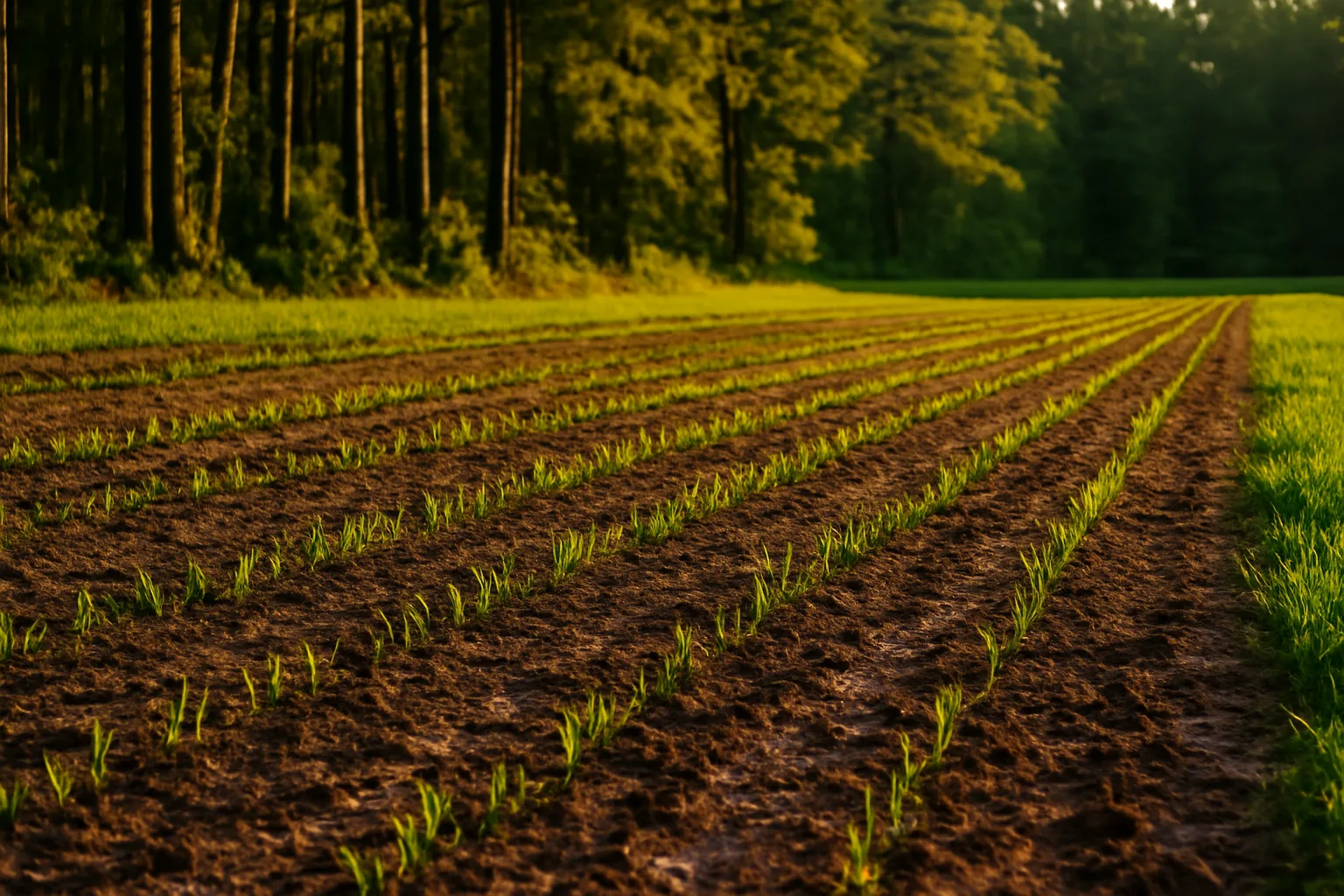
What is a food plot, exactly?
A food plot is a planted patch of forage, usually somewhere between a quarter acre and several acres, put in specifically to feed and hold deer on a property. It's not the same as a pasture or a hayfield, even though the seed can be identical. The goal is deer nutrition and, for most hunters, a place to catch a deer moving during shooting light. Louisiana State University AgCenter describes food plots as a tool for supplementing what native browse and mast already provide, not a replacement for habitat work [1]. That's an important distinction. A plot planted in the wrong spot, with no cover nearby, on soil that's never been limed, just burns money and rots in the ground. The Louisiana Department of Wildlife and Fisheries treats food plots as legal hunting practice as long as you're not creating an artificial feeding situation that violates the state's baiting rules; check the current LDWF hunting regulations before you plant anything near a stand you intend to hunt over, since bait and food plot definitions can get confused by hunters moving here from other states [2]. A plot you plant and walk away from is different, legally and practically, from a pile of corn dumped on the ground.
What is the best food plot for deer in Louisiana overall?
For the majority of Louisiana's hunting ground, a fall-planted mix of white clover, oats, and a brassica (turnips or forage rape) is the best all-around choice. It covers early season attraction, cold-weather tonnage, and perennial return the next year in one planting. Here's why that combination works across most of the state. Oats germinate fast and give you green growth within two to three weeks, which matters in a state where bow season often opens in late September or early October and food is still scarce until acorns start dropping. Clover, especially white clover varieties, tolerate Louisiana's mild winters and can produce forage from October through the following summer if you mow and fertilize it. Brassicas add tonnage late, after a couple of frosts convert their starches to sugars and make them a lot more palatable. This isn't a one-size answer for the whole state, though. Louisiana runs from the sandy, acidic piney woods of the Kisatchie area down through heavy river-bottom clay in the Mississippi Delta parishes down to marsh-adjacent ground near the coast. Soil pH, drainage, and shade cover vary enough that a plan built for Madison Parish clay won't perform the same in Vernon Parish sand. That's the honest answer: there's a strong regional default, but a soil test still runs the show.
When should you plant food plots for deer in Louisiana?
| Clover (white/red) | Oct 1 - Nov 15 | Needs lime if soil pH is below 6.0 |
|---|---|---|
| Oats/wheat/rye | Oct 1 - Nov 15 | Fast germination, good nurse crop for clover |
| Brassicas (turnips, rape) | Sept 15 - Oct 15 | Plant a little earlier than clover for bulb development |
| Soybeans/cowpeas | April - May | Warm-season, high deer pressure risk while young |
| Iron clay peas | April - June | Drought and heat tolerant, good for sandy soil |
Most of Louisiana falls in USDA Plant Hardiness Zone 8b to 9a, with a few northern parishes touching 8a. That puts the state's fall planting window from early October through mid-November for cool-season plots, and a spring window from March through April for warm-season plots like iron clay peas or soybeans if you're in a spot with less deer pressure. The LSU AgCenter's food plot publications generally recommend getting cool-season seed (clover, oats, wheat, brassicas) in the ground between October 1 and November 15, timed so you catch fall rain and cooler soil temperatures without waiting so long that growth stalls before hard frost [1]. Plant too early in September and Louisiana heat can still cook young clover seedlings. Plant too late into December and you risk thin stands going into winter. Spring plots are a smaller part of most Louisiana plans because deer season is closed and turkey season overlaps some of that planting window, but if you're managing for antler growth and lactating does, April-planted soybeans, cowpeas, or lablab can add real protein tonnage through summer. Just know that deer pressure on young spring plots in Louisiana's warm, high-rainfall climate is intense, since native browse is thinner in early spring than people expect. A rough planting calendar for the state: | Forage type | Plant window in Louisiana | Notes |
When should you plant oats for deer in Louisiana?
Plant oats in Louisiana between early October and mid-November, aiming for the first real cool front and a decent rain forecast. Oats are one of the fastest-germinating cool-season grains, often showing green in 7 to 10 days under good moisture, which is exactly why so many Louisiana food plotters use them as the first thing deer find in a fall plot. Oats also work as a nurse crop. Drilled or broadcast with clover, the oats come up fast and give clover seedlings some shade and wind protection while the clover root system establishes. By December, deer are hitting the oats hard, and by February the clover is starting to take over as the oats mature and get less palatable. One caution specific to Louisiana: oats don't handle hard freezes as well as wheat or rye. Louisiana rarely sees the deep freezes that would kill oats outright, but a bad cold snap in a north Louisiana parish can set back growth more than it would with winter wheat. If you're in the northern part of the state and want more cold tolerance, blend in some wheat or cereal rye rather than planting oats alone.
Do deer like clover, and is it worth planting in Louisiana?
Yes, deer readily eat clover, and it's one of the most consistently used food plot forages nationwide, including in Louisiana. White clover in particular is a preferred, high-protein forage, commonly tested at 20 to 25% crude protein in good stands, which is well above what most native browse offers during winter and spring [3]. Clover's advantage in Louisiana specifically is its perennial nature in a mild-winter climate. A well-maintained white clover stand can produce for three to five years, giving you forage from fall through the following summer without replanting every season. That's a real cost advantage over annual-only plots, assuming you keep up with mowing weeds down and a maintenance lime and fertilizer application based on your soil test. The catch is soil pH. Clover performs best in a pH range of roughly 6.0 to 7.0, and a lot of Louisiana ground, especially the acidic piney woods soils in the central and western parishes, sits well below that without lime [4]. Skipping the lime step is the single most common reason a Louisiana clover plot fails or thins out fast. Get a soil test first. It's cheap and it tells you exactly how much lime you need instead of guessing. For structured help turning a soil test into an actual seed and fertilizer plan, a lot of hunters use a Custom Food Plot Plan, which for a one-time $99 fee takes your soil test results and property details and builds out a planting plan. Your soil test lab is still the authority on exact lime and fertilizer rates; a plan like this translates that data into a seed mix and planting calendar.
When should you plant turnips for deer in Louisiana?
Plant turnips in Louisiana between mid-September and mid-October, a couple weeks earlier than you'd plant clover. Turnips need roughly 60 to 90 days to fully bulb out and reach peak palatability, and that bulb development is what makes turnips valuable late in the season, after a frost converts starches to sugars and deer start digging up and eating the roots as well as the tops. In Louisiana's climate, that frost-driven sugar conversion usually happens in December or January depending on how far north or south you are. Coastal parishes might not get a hard freeze until very late in the season, if at all some years, which can delay when deer really key in on the bulbs versus just eating the leafy tops. Turnips need decent soil fertility and a pH close to neutral to bulb well; the University of Tennessee Extension notes brassicas generally perform best with phosphorus and potassium levels built up according to a soil test, and thin, sandy, unfertilized soil produces mostly leaf growth with small or absent bulbs [5]. If your soil test comes back low on phosphorus, that's worth fixing before you plant turnips, not after.
Do deer eat sorghum, and does it fit a Louisiana plot?
Deer will eat grain sorghum, but it's a secondary food plot choice in Louisiana, better suited as a screening or standing-grain component than a primary attractant. Sorghum is more commonly planted as a wildlife food source for dove, quail, and turkey, or as a tall screening crop that also drops grain deer will clean up in winter. Compared to soybeans, cowpeas, or corn, sorghum generally draws less deer preference in side-by-side plantings, though actual local pressure and available alternative forage change that a lot. In Louisiana specifically, sorghum's heat and drought tolerance make it a fit for sandy, marginal ground in the piney woods or for a border planting around a primary clover or brassica plot, where it also offers visual screening for deer approaching a stand. If your main goal is deer nutrition and attraction, sorghum shouldn't be your first choice for a Louisiana food plot. If you want a dual-purpose screen and supplemental winter grain source, it's a reasonable secondary planting.
What are deer's favorite foods, and how does that guide plot choice in Louisiana?
Deer preference studies and extension research consistently rank a handful of foods at the top: acorns (especially white oak group acorns), soybeans, clover, and cowpeas tend to top most forage preference trials, with brassicas and cereal grains rated lower but still readily eaten, especially after a frost or when other food is scarce [6]. In Louisiana, native mast matters enormously to this equation. The state has heavy oak cover in the bottomland hardwoods and upland pine-hardwood mix, and in a good acorn year, deer will often ignore a food plot almost entirely in favor of acorns dropping in the woods. That's not a food plot failure, it's just deer doing what deer do when the free, high-fat, high-carb food is on the ground already. This is part of why a mixed plot (clover plus a grain plus a brassica) tends to outperform a single-species plot in Louisiana. You're hedging against a heavy mast year killing your plot traffic in October and November, while still having something green and available in January and February when acorns are gone and deer are under real nutritional stress heading into late winter.
Do deer like honey, or is that a myth for food plots?
Deer don't forage for honey in any meaningful way relevant to food plots; this question usually comes from confusion with commercial deer attractant products that use a honey or molasses-based scent, or from Honey Locust trees, which deer absolutely do eat the pods and seeds of. Wild deer aren't raiding beehives for honey the way a bear will. Honey Locust (Gleditsia triacanthos) is native across much of Louisiana and drops sweet, sugary seed pods in fall that deer readily browse, and some Louisiana landowners plant or preserve honey locust trees specifically for that mast drop [7]. If you're hearing "deer and honey" together, it's almost always this tree, or a liquid scent-based attractant product, not actual honey.
Does Louisiana's soil change which food plot is best?
Yes, significantly. Louisiana's soils split roughly into three broad categories that matter for food plots: the acidic, sandy to loamy piney woods soils of the central and western parishes, the heavy clay and silt loam of the Mississippi River and Red River bottomlands, and the poorly drained, often waterlogged soils near the coast and in the Atchafalaya Basin region. The LSU AgCenter's soil testing program is the right starting point for any Louisiana food plot, and their lab reports pH along with phosphorus, potassium, calcium, and magnesium levels so you know exactly what to add . Piney woods soil commonly needs substantial lime, sometimes 1 to 2 tons per acre on a first application, to bring pH up into clover's preferred range. River bottom soils tend to run more fertile and closer to neutral pH already, meaning less lime but sometimes more attention to drainage since heavy clay holds water and can drown out a plot after a wet fall. Coastal parishes dealing with poor drainage or occasional saltwater intrusion after storm surge need to think hard about brassica and clover placement, since neither tolerates standing water for more than a few days. In that kind of ground, raised planting rows or picking the highest, best-drained corner of a field matters more than seed selection. This is really the core argument for testing your specific dirt instead of copying a neighbor's plot recipe. Two properties twenty miles apart in Louisiana can need completely different lime rates and even different forage species.
What equipment do you actually need for a Louisiana food plot?
At minimum, you need something to break ground (disc, harrow, or a no-till drill), a way to spread seed and fertilizer (broadcast spreader, tow-behind or handheld), and a way to pack the seed in, which can be as simple as driving over it with an ATV or a section of chain-link fence dragged behind a tractor. For small plots under an acre, a lot of Louisiana hunters get by with an ATV, a tow-behind disc, and a hand-crank or ATV-mounted broadcast spreader, total cost usually landing somewhere in the $1,500 to $3,000 range for a basic used setup, though prices vary a lot by region and equipment condition. No-till drills cost more upfront but save time and often get better seed-to-soil contact, which matters most for small-seeded forages like clover that fail if buried too deep. Soil pH correction requires lime, and lime is heavy and slow to change soil chemistry, generally taking several months to fully react, so getting it down as early as possible ahead of your fall planting window pays off. If your soil test calls for 1 ton of lime per acre and you're spreading by hand or with a small spreader, budget real time for that task; it's the least glamorous part of food plotting and the most commonly skipped.
How do you put a full plan together for your specific property?
Start with a soil test, not a seed bag. Pull samples from several spots in the plot area, mix them, and send them to your state extension lab or a private ag lab; the LSU AgCenter offers this service and it typically costs under $10 to $20 per sample . That test tells you your pH, phosphorus, potassium, and organic matter, and that data should drive every decision after it, including how much lime you need and whether your soil can support clover without heavy amendment. From there, match your species selection to your region within the state, your soil test results, and your realistic planting window given deer season dates and your own schedule. A quarter-acre plot on good river bottom soil with a pH already near 6.5 can go straight to clover and brassicas with modest starter fertilizer. A half-acre plot on unlimed piney woods sand needs lime months ahead of planting and probably needs a cheaper annual grain in year one while the lime works into the soil. If you'd rather not build that plan from scratch, the Custom Food Plot Plan takes your soil test numbers, region, and plot size and turns it into a specific seed mix and fertilizer schedule for a one-time $99 fee. It's general planning guidance built from your test results, not a substitute for what your soil lab's own recommendation sheet says about your exact lime and fertilizer rates. For broader background on species selection, food plot whitetail and deer food plots cover plot design basics that apply across regions, and deer food plot seed and food plot seed go deeper on specific species if you want to compare options beyond the clover-oats-brassica mix covered here.
Frequently asked questions
What is the best food plot for deer in Louisiana on a budget?
A simple oats and winter wheat blend is the cheapest reliable option, often costing under $30 to $50 per acre for seed alone. It germinates fast, needs less soil correction than clover, and still draws deer through fall and winter. Add clover later once you've got a soil test and can budget for lime.
Do deer eat sorghum in Louisiana food plots?
Yes, deer will eat grain sorghum, but it's generally a lower-preference food compared to soybeans, clover, or cowpeas. It works better in Louisiana as a screening plant or dual-purpose planting for dove and quail that also feeds deer in winter, not as a primary attractant.
Do deer like clover more than other food plot options?
Clover ranks among the top-preferred food plot forages in most studies, often testing 20-25% crude protein in good stands. Deer use it heavily fall through summer where winters stay mild. It requires decent soil pH (roughly 6.0-7.0) to thrive, so Louisiana's acidic soils often need lime first.
When should I plant food plots for deer in Louisiana?
Cool-season plots (clover, oats, wheat, brassicas) go in from early October through mid-November across most of Louisiana. Warm-season plots (soybeans, cowpeas, iron clay peas) go in during April and May. Exact timing shifts a little by parish and by fall rainfall.
When should I plant oats for deer in Louisiana?
Plant oats between early October and mid-November, timed to a cool front and expected rain. Oats germinate in about 7 to 10 days under good moisture and often work best mixed with clover as a fast-growing nurse crop.
When should I plant turnips for deer in Louisiana?
Plant turnips mid-September through mid-October, earlier than clover, since bulbs need 60 to 90 days to develop. Frost converts starches to sugars in the bulbs and greatly increases deer interest, usually by December or January depending on your parish.
What is a food plot exactly?
A food plot is a planted area, often a quarter acre to a few acres, seeded specifically to feed and hold deer on a property. It supplements native browse and mast rather than replacing habitat management, according to LSU AgCenter guidance on wildlife food plantings.
What are deer's favorite foods overall?
Acorns, especially white oak group acorns, soybeans, clover, and cowpeas consistently rank as top preferred deer foods in extension research. In Louisiana, heavy native mast years can pull deer away from food plots entirely, which is why mixed plantings hedge against that swing.
Do deer like honey?
Not in any way relevant to food plots. The confusion usually comes from honey-scented commercial attractant products or from Honey Locust trees, whose sweet seed pods deer readily eat in fall. Wild deer don't seek out actual honey the way bears do.
Is clover or a brassica better for a Louisiana food plot?
They serve different purposes, so most plans use both. Clover gives you perennial forage from fall through summer with high protein. Brassicas like turnips give you a late-season tonnage boost after frost sweetens the bulbs. Neither replaces the other in a well-built plot.
Do I need to lime my food plot soil in Louisiana?
Very often, yes. Louisiana's piney woods soils in particular tend to run acidic, sometimes needing 1 to 2 tons of lime per acre to bring pH into the 6.0-7.0 range clover and brassicas prefer. A soil test from your state extension lab tells you the exact rate needed.
Are there legal restrictions on food plots or baiting in Louisiana?
Louisiana regulates bait and feed differently from planted food plots, and the rules can be nuanced around timing and placement. Check the current Louisiana Department of Wildlife and Fisheries hunting regulations before hunting over any planted area to confirm it meets the legal definition of a food plot rather than bait.
Sources
- LSU AgCenter, Food Plots for Wildlife publication: Food plots supplement native browse and mast and recommended cool-season planting window of Oct 1-Nov 15
- Louisiana Department of Wildlife and Fisheries, Hunting Regulations: State rules distinguish planted food plots from baiting/feeding practices
- LSU AgCenter, Soil Testing and Lime Recommendations: Clover prefers soil pH roughly 6.0-7.0 and Louisiana soils often need lime to reach that range
- University of Tennessee Extension, Brassicas for Deer Food Plots: Brassicas need adequate phosphorus and potassium to bulb properly, or produce mostly leaf growth
- University of Georgia Extension, Deer Food Plot Forage Preference: Acorns, soybeans, clover, and cowpeas rank among top-preferred deer forages
- USDA Forest Service, Plant Fact Sheet - Honey Locust: Honey Locust seed pods are readily browsed by deer and native to Louisiana
- LSU AgCenter, Soil Testing Lab Services and Fees: LSU AgCenter offers soil testing services with per-sample fees for pH and nutrient analysis