Last updated 2026-07-25
TL;DR
Maintaining a clover food plot means mowing 3-4 times a season to keep it in a vegetative state, spraying grass herbicide like clethodim as needed, testing soil every 2-3 years, and topping off potassium and lime per that test. Do it right and a stand of ladino or red clover holds for 4 to 5 years before you need to reseed.
what is a food plot, and why does clover need ongoing maintenance
A food plot is a planted area, usually somewhere between a quarter acre and a few acres, put in specifically to grow forage for deer and other wildlife rather than for harvest and sale. It's farming, just with a different customer. Clover plots are popular because they're perennial, meaning you don't till and replant every year like you would with brassicas or beans. But perennial doesn't mean maintenance-free. Clover competes with grass and weeds constantly, and if you ignore it, fescue and foxtail will choke it out inside two seasons. The USDA NRCS notes that white clover stands need periodic mowing and weed control to stay productive and persist for multiple years [1]. Left alone, a clover plot turns into a weed patch by year two. The payoff for maintaining it right is real. A well-kept clover plot can run 25% to 30% crude protein during active growth, according to extension forage testing done at land-grant programs [2]. That's better than almost anything else you can plant. If you haven't planted yet and want help figuring out species and acreage for your specific ground, PlotSeason's $99 Custom Food Plot Plan at /plot-plan-builder walks through soil type, sunlight, and browse pressure before you buy seed.
do deer like clover, and is it really a favorite food
Yes. Clover is consistently one of the most preferred forages in deer diet studies, and most food plot guides from state wildlife agencies and universities list it near the top of recommended perennial species [3]. It's palatable, digestible, and available for a long growing window compared to annuals. Asking what deer's favorite food is doesn't have one clean answer, because it changes by season and region. In spring and summer, deer key in on high-protein forages like clover and soybeans. In fall, they shift hard toward acorns and other mast when it's available, and browse annual grains like oats when mast is scarce. Clover's advantage is that it's one of the few things deer will hit hard almost year-round, minus a dormant stretch in the coldest months. If you're comparing species for a new plot, it helps to look at what's already growing well on similar ground nearby. Check out food plot whitetail for a rundown on how clover stacks up against brassicas, beans, and cereal grains for different goals.
when to plant food plots for deer, and does the timing affect maintenance later
| Deep South | Feb-Mar | Sept-Oct | Sept-Oct | Aug-Sept |
|---|---|---|---|---|
| Mid-South / Transition | Mar-Apr | Aug-Sept | Aug-Sept | Jul-Aug |
| Upper Midwest / North | Apr-May | Jul-Aug | Aug | Jul-Aug |
Planting window depends on what you're planting and where you live, but timing done right up front means a lot less maintenance headache later. Weeds that get a head start on a poorly timed planting are much harder to control after the fact. For perennial clover, most extension guides recommend spring planting (March through May in the transition zone, later in the northern tier) or a late summer planting timed 45 to 60 days before your first frost, which lets roots establish before winter [4]. Frost-seeding clover into existing thin stands in late winter, when the ground is still doing freeze-thaw cycles, is another proven method that costs almost nothing in equipment. For annuals planted alongside or after clover fades, timing works differently. Oats generally go in during late summer to early fall, roughly 6 to 8 weeks before your first hard frost, so they can put on growth before cold shuts them down [4]. Turnips follow a similar late-summer window, usually late July through August depending on latitude, since they need 80 to 100 days to bulb up before deer start hitting the tubers hard after a frost sweetens them [5]. Here's a rough planting window table by region. These are generalized; your local extension office and a soil test will get you closer to exact dates for your county. | Region | Clover (spring) | Clover (late summer) | Oats | Turnips |
how often should you mow a clover food plot
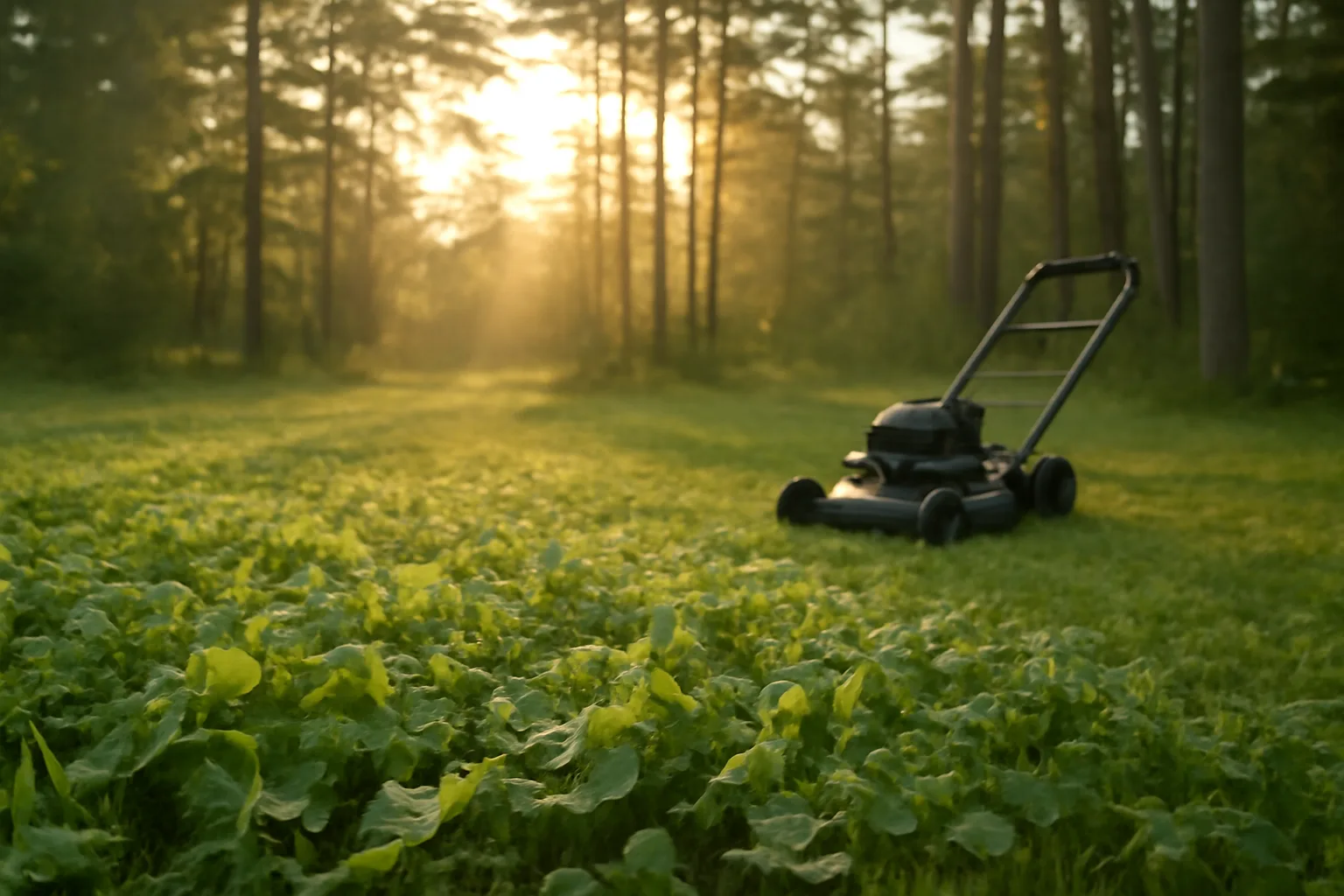
Mow clover 3 to 4 times during the growing season, keeping it to a height of 4 to 6 inches after each cut. The goal is to knock the clover back before it flowers and goes to seed, which keeps the plant in a vegetative, high-protein growth stage instead of putting energy into seed production. Mowing also controls weeds that would otherwise shade out clover and take over. Most university extension forage programs recommend mowing whenever weeds start to outpace the clover canopy, rather than sticking to a rigid calendar, since growth rates vary with rainfall and temperature [2]. In a wet year you might mow five times. In a drought year, two might be plenty, and mowing too aggressively during dry stretches can stress the stand. One practical note: don't mow the whole plot at once if you're hunting over it in season. Mow in strips or sections so there's always some taller cover and some fresh, tender regrowth, which tends to pull deer in during daylight.
how do you control weeds and grass in an established clover plot
Grass is clover's biggest long-term enemy, and the fix is a grass-selective herbicide like clethodim or sethoxydim, which kill grasses without harming the clover. These are labeled for use in clover food plots and are sold under several trade names at farm supply stores. Always read the label rate for your specific product and follow it exactly, since rates vary by grass species and growth stage. Broadleaf weeds are trickier because most broadleaf herbicides will also kill clover, since clover is a broadleaf itself. Options are more limited: 2,4-DB is one of the few products labeled for use on clover that suppresses certain broadleaf weeds without wiping out the stand, but it still requires careful rate and timing decisions [6]. For heavy broadleaf weed pressure, mowing before weeds seed out is often more reliable than trying to chemically thread the needle. A lot of hunters skip herbicide entirely and lean on mowing plus proper fertility, since a thick, healthy clover stand naturally out-competes a lot of weed pressure. That's a fine approach on smaller plots where you're willing to mow more often.
how often should you soil test and fertilize an established clover plot
Test soil every 2 to 3 years once a clover plot is established, and follow the lime and fertilizer recommendations that come back from your results. Clover is a legume, so it fixes its own nitrogen through root bacteria once inoculated properly, meaning it generally doesn't need nitrogen fertilizer the way corn or brassicas do [7]. What clover does need, consistently, is potassium and adequate soil pH. Most land-grant extension guides recommend keeping clover soil pH between 6.0 and 7.0, since clover struggles to take up nutrients in more acidic soil even if fertilizer is present [8]. If your test comes back at pH 5.5, no amount of fertilizer fixes that. Lime is the answer, and it takes months to fully react in the soil, so get it down early. Your soil test lab is the real authority here, not a generic online chart. Labs calibrate recommendations to your specific soil type, cation exchange capacity, and crop history, and their numbers should always override any rule-of-thumb figure you read in an article like this one, including this one.
when should you interseed or thicken up a thinning clover stand
If you're seeing more bare dirt or weeds than clover canopy, it's time to interseed rather than wait for a full stand failure. Frost-seeding, which means broadcasting clover seed onto existing thin ground in late winter and letting freeze-thaw cycles work it into the soil, is a low-cost, low-equipment way to thicken a stand without tearing it up. A light disking or dragging pass before broadcasting improves seed-to-soil contact and germination rates, though it's not strictly required if you're frost-seeding into naturally cracked, frozen-thawed ground. Extension guidance generally recommends interseeding when clover density drops below roughly 40% to 50% canopy cover, since below that point weeds and grass take over faster than clover can recover on its own [2]. Most white clover stands, per NRCS planting guides, run productive for 3 to 5 years with good maintenance before yield and stand density decline enough to justify a full reseed [1]. Red clover tends to be shorter-lived, often 2 to 3 years, which is worth knowing if you planted a red clover blend expecting a 5-year stand.
do deer eat sorghum, and does it fit into a clover plot rotation
Yes, deer will eat sorghum, particularly the grain heads once they mature and especially after a frost sweetens the starches. It's more commonly used as a screening or standing-crop cover plant, planted alongside beans or corn, than as a stand-alone attractant, since deer generally prefer softer forages like clover or soybeans when both are available. Sorghum isn't something you'd interplant directly into an existing clover stand. It's tall, competes hard for sunlight and water, and doesn't fit the mowing regimen clover needs. If you want a grain component on your property, it usually makes more sense as its own separate plot rather than mixed into perennial clover ground. For a broader look at how grain and forage species compare for different plot goals, see deer food plot seed.
do deer like honey, and does that matter for food plot planning
Deer aren't drawn to honey the way people assume from marketing around scent products and mineral licks. There's no solid wildlife research showing deer seek out honey as a food source in the wild, and it's not part of any natural deer diet documented in state wildlife agency forage studies. Deer are herbivores built around browse, forbs, mast, and agricultural crops, not sugars from bee products. Where you'll see honey mentioned is in scent-based attractant products marketed for food plots or mineral sites, often as a sweetener additive. Those products haven't been shown in peer-reviewed wildlife research to outperform a well-maintained clover or brassica plot for pulling deer. Check your state's baiting and feeding regulations before using any attractant. Rules vary widely, and some states classify sweet-scented additives under baiting restrictions. A properly maintained food plot, not a jar of honey, is what moves deer onto your property and keeps them there.
what pairs well with clover if you want a fall attractant added
Clover alone can thin out in cold months in northern climates, going semi-dormant, so a lot of hunters overseed or rotate in oats and turnips to extend the plot's draw into hunting season. Oats add fast, tender fall growth deer hit hard right after germination. Turnips add a bulb crop that deer often ignore in early fall and then hammer hard after the first few frosts convert starches to sugars, a well-documented pattern noted in several state wildlife agency food plot guides [5]. A common rotation is a clover base with a strip or section of oats and turnips planted alongside it in late summer, giving you three growth stages and three textures of forage in one plot. That variety also spreads out feeding pressure so the clover itself doesn't get hammered to the dirt by August. If you're weighing whether to go all-in on perennial clover or split acreage between clover and annuals, deer food plots breaks down the tradeoffs in more depth, including cost per acre and labor differences.
what equipment do you actually need to maintain a clover plot
You need less gear than most seed catalogs make it seem. A rotary mower (a bush hog on a tractor, or a heavy-duty push mower for very small plots) covers your 3 to 4 mowings a season. A boom or backpack sprayer handles spot spraying for grass and weeds. A simple soil probe or a coffee can and shovel gets your soil sample. For overseeding or frost-seeding, a hand-crank broadcast spreader is genuinely enough for plots under an acre or two. You don't need a no-till drill to maintain an existing stand, that's more of a first-planting tool. A light drag harrow or chain-link section dragged behind an ATV helps seed-to-soil contact when interseeding, but it's optional. What you don't need: expensive granular fertilizer blends bought off a shelf without a soil test behind them. That's the single most common waste of money in food plot maintenance, buying fertilizer by guess instead of by test result.
Frequently asked questions
Do deer eat sorghum?
Yes, deer eat sorghum grain, especially after a fall frost sweetens the starches, but it's usually planted as a standing grain or screen crop alongside corn or beans rather than as a primary attractant. Deer typically prefer softer forages like clover or soybeans when both are available on the same property.
Do deer eat clover, and do they actually like it?
Yes, clover is one of deer's most preferred food plot forages, showing up near the top of nearly every state wildlife agency and extension planting guide. It runs 25% to 30% crude protein during active growth stages according to university forage testing, making it a strong choice for spring and summer nutrition.
When should you plant food plots for deer?
Timing depends on species and region. Perennial clover generally goes in during spring (March-May) or late summer 45-60 days before first frost. Annual grains like oats need 6-8 weeks of fall growth before frost. Check your state extension office for county-specific planting windows.
When should you plant oats for deer?
Plant oats roughly 6 to 8 weeks before your area's first hard frost, which usually lands in late summer to early fall depending on latitude. This gives oats enough time to establish tender fall growth that deer prefer before cold weather slows growth.
When should you plant turnips for deer?
Turnips generally go in from late July through August, depending on your region, since they need 80 to 100 days to bulb up. Deer often ignore the bulbs early on and start hammering them hard after the first few frosts sweeten the starches.
How often should you mow a clover food plot?
Mow clover 3 to 4 times per growing season, cutting it back to 4-6 inches each time. This keeps clover in a vegetative, high-protein state and prevents grass and weeds from shading it out. Mow more in wet years, less during drought stress.
How long does a clover plot last before you need to reseed it?
A well-maintained white clover stand typically lasts 3 to 5 years, per NRCS planting guidance, before density and yield decline enough to justify reseeding. Red clover is shorter-lived, usually holding productively for 2 to 3 years.
What is a food plot?
A food plot is a planted patch of land, usually a quarter acre to several acres, seeded specifically to provide forage for deer and other wildlife rather than for commercial harvest. Common plantings include clover, brassicas, cereal grains, and soybeans.
What is a deer's favorite food?
There's no single favorite, it shifts by season. In spring and summer deer favor high-protein forages like clover and soybeans. In fall, natural mast like acorns takes priority when available, with deer shifting to planted grains and brassicas as mast supply runs out.
Do deer like honey?
There's no solid wildlife research showing deer seek out honey in the wild. It shows up mainly as an additive in commercial scent and mineral products, not as a documented natural food source. A well-maintained clover or brassica plot draws deer far more reliably.
How do you control weeds in an established clover plot without killing the clover?
Use a grass-selective herbicide like clethodim for grass control, since it won't harm clover. Broadleaf weeds are harder since most broadleaf herbicides kill clover too; 2,4-DB is one of the few labeled options. Mowing before weeds seed out is often the safer, cheaper route.
Does clover need nitrogen fertilizer to stay productive?
No, clover is a legume and fixes its own nitrogen through root bacteria once properly inoculated, so it generally doesn't need added nitrogen. What it does need is adequate potassium and a soil pH between 6.0 and 7.0, both of which your soil test will confirm.
Sources
- USDA NRCS, Plant Guide: White Clover: White clover stands need periodic mowing and weed control to persist for multiple years
- Mississippi State University Extension, Publication 2111: Establishing and Maintaining Wildlife Food Plots: Clover crude protein levels during active growth and mowing/interseeding thresholds
- University of Tennessee Extension, Wildlife Food Plots for Deer (W346): Clover is one of the most preferred and recommended perennial forages for whitetail food plots
- Oklahoma State University Extension, Establishing Wildlife Food Plots: Recommended spring and late-summer planting windows for perennial clover
- University of Georgia Extension, Wildlife Food Plots (Bulletin 1347): Turnip bulb development period and post-frost palatability increase
- University of Kentucky Cooperative Extension, AGR-172: Weed Control Recommendations for Kentucky: 2,4-DB is one of the few herbicides labeled for broadleaf weed suppression in established clover
- University of Missouri Extension, Clover for Wildlife Food Plots (G9421): Clover fixes its own nitrogen through root nodule bacteria once inoculated
- Virginia Cooperative Extension, Soil Acidity and Liming: Basic Information (452-901): Recommended soil pH range of 6.0 to 7.0 for clover nutrient uptake
- Michigan Compiled Laws, Section 324.40111c (Baiting and feeding of deer): State baiting and feeding rules vary and can restrict scented attractant use