Last updated 2026-07-25
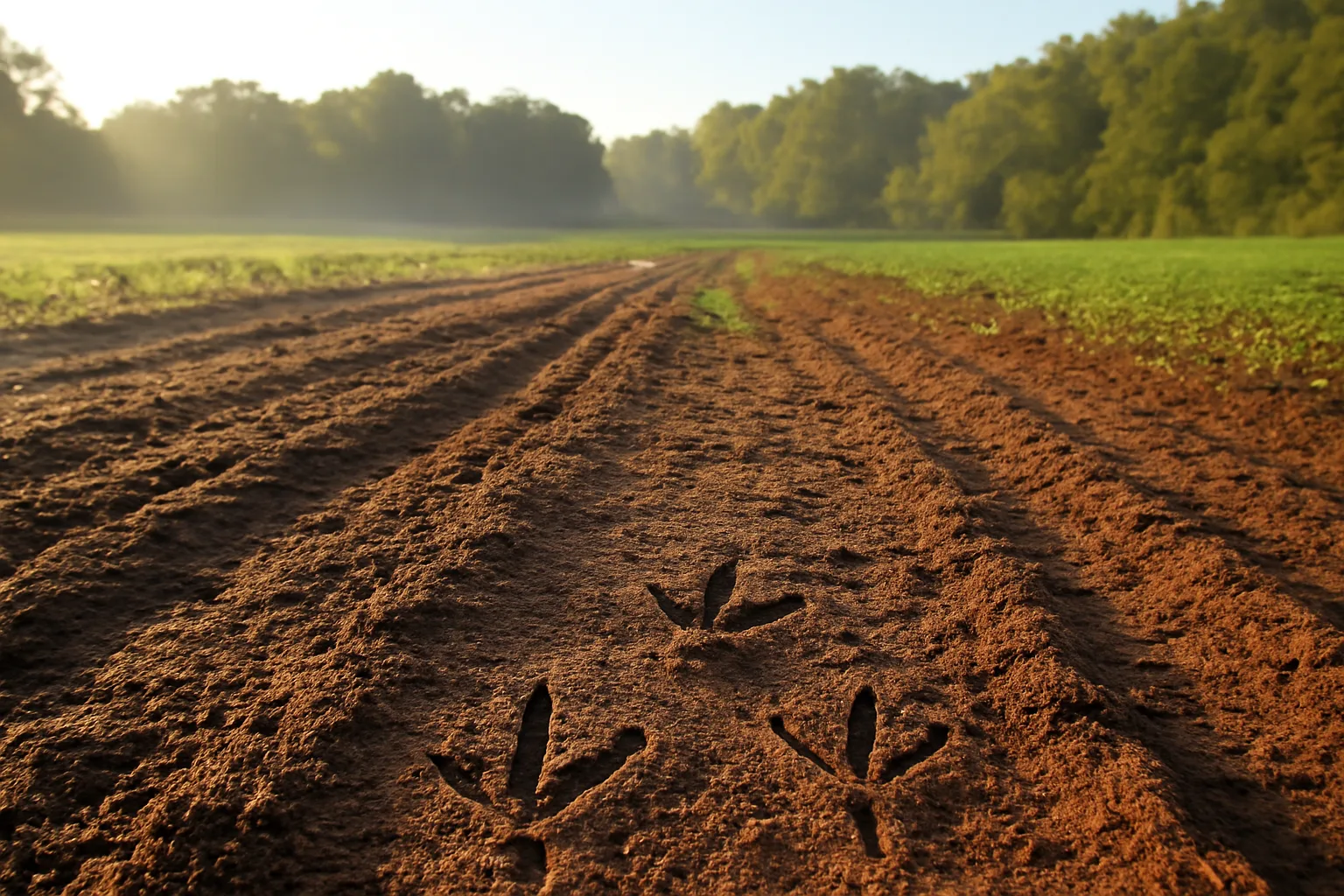
TL;DR
Turkeys mostly scratch for bugs and eat leftover grain, not growing forage, so real damage is rare. On new brassica or clover seedings, use temporary electric poultry netting, scare devices rotated every few days, and check your state's baiting rules before adding any feed-based deterrent or attractant nearby.
do turkeys actually damage food plots?
Mostly no. Turkeys are omnivores that spend most of their foraging time scratching leaf litter and thin soil for insects, seeds, and green shoots, not mowing down a clover field like deer do. State wildlife agency research describes turkey diets as dominated by insects in spring and summer (especially for poults) and mast, seeds, and waste grain the rest of the year [1]. The complaint that actually holds up is on freshly drilled seed, especially small-seeded brassicas like turnips or radishes, or a thin oat seeding. A flock of a dozen birds scratching through loose, warm soil can uproot seed before it germinates or expose it for other birds and rodents to finish off. Once plants are up and rooted, turkeys do far less harm. They'll walk through and peck at bugs, but they aren't grazing the plant itself the way deer do. If you're seeing real thinning in an established clover or chicory stand, look harder at deer browse pressure or a soil fertility problem before blaming turkeys. Turkeys get scapegoated a lot for damage that's actually rabbits, groundhogs, or just overgrazing deer.
why are turkeys drawn to a food plot in the first place?
Freshly disked or drilled ground is an easy meal. Tilling and light disking bring earthworms, grubs, and cutworms to the surface, and a bare seedbed is far easier to scratch through than sod or leaf litter. That's the main draw, not the seed itself in most cases. Open plots also give turkeys what they want structurally: visibility. Turkeys are prey animals that rely on eyesight to spot predators, so they favor open fields and short-grass or bare-dirt areas where they can see a coyote or hawk coming from a distance. A food plot, especially one that's freshly worked or lightly seeded, checks every box: easy food, good sightlines, and low ground cover. Waste grain left from a spring or fall planting, corn stubble nearby, or a mineral lick site can pull them in too. If you're running a mineral station or supplemental feed near your plot, know that many states regulate or restrict feeding and baiting for turkey and deer hunting purposes, and rules differ by species and season. Check your state wildlife agency's current regulations before setting anything out [2].
how do you keep turkeys out of a new seeding?
Temporary electric poultry netting is the most reliable physical barrier, and it's the same product a lot of small-scale poultry keepers use to protect gardens from chickens. Install it around the seeded area for the first 10 to 14 days after planting, which covers the window when seed is most exposed and germination is happening. Once plants have a true leaf or two and roots are set, pull the netting and reuse it elsewhere. A cheaper, lower-effort option is to pack or roll the seedbed firmly after drilling. Turkeys scratch loose, fluffy dirt far more effectively than a firm, rolled surface. A cultipacker pass after seeding does double duty: better seed-to-soil contact for germination, and a surface that's harder for turkeys (and for wind and rain) to disturb. Scare tactics work, but only if you rotate them. Turkeys habituate fast to anything that stays in one place, so a single scarecrow or reflective tape strip loses effect within a week or two. Moving inflatable predator decoys, mylar tape, or motion-activated sprinklers every few days keeps them guessing longer. None of these are permanent fixes; they're bridges to get a planting past its vulnerable window.
what is a food plot, and why does timing matter so much for turkey damage?
A food plot is a planted area on hunting land, usually somewhere between a quarter acre and a few acres, seeded with forage crops like clover, brassicas, cereal grains, or legumes to attract and hold deer (and often turkey, too) by giving them reliable food outside of natural browse. Most hunters plant one to draw deer into bow range, build a herd's nutrition base, or both. Timing matters for turkey damage because the riskiest period for any plot is the two-week germination window right after seeding, when seed is loose in the soil and plants haven't rooted yet. If you can get seed planted, packed, and past that window before turkey flocks pattern into the field, you avoid most of the problem entirely. Planting into slightly cooler, wetter conditions when grass and clover in surrounding fields are also greening up gives turkeys other food sources competing for their attention, which helps too. For a full planning framework matched to your region and soil, the food plot whitetail guide breaks down species selection and layout, and if you want species-specific seed guidance the deer food plot seed article covers blends by region.
when to plant food plots for deer (and how that affects turkey pressure)
Timing splits into two windows almost everywhere in whitetail range: spring/summer for warm-season plots (soybeans, cowpeas, some clover establishment) and late summer into early fall for cool-season plots (brassicas, cereal grains, clover frost-seeding). University extension planting guides generally peg spring plot windows from April through June depending on latitude, and fall windows from mid-August through early October, with the goal of getting brassicas and grains up before the first hard frost [3]. Turkey pressure tends to run heaviest in spring, during and after nesting season when hens and poults are working fields hard for insects, and again in fall when flocks group up and range widely for mast and waste grain. A late-August brassica planting in the North, or a September planting in the Mid-South, often threads the needle: early enough to establish before frost, late enough that spring poult broods aren't yet scratching through it. Regional variation is real here. A plot in Wisconsin planted in late August faces a much shorter fall growing window than one in Alabama planted in mid-September, so check your local extension office's frost date tables rather than going by a generic calendar.
when to plant oats for deer, and are oats a turkey magnet?
Oats are typically planted late summer to early fall for a fall/winter deer plot, generally six to eight weeks before your area's first killing frost, since oats need that runway to establish decent tonnage before growth slows [4]. In the North that often means mid-August to early September; in the South, September into early October works. Oats do draw turkeys, mainly because the loose, tilled seedbed common to a grain drilling is exactly the scratching habitat they favor, and oat groat itself is a food source turkeys will eat directly off the ground before it germinates. If turkey pressure is a known problem on a given field, drilling instead of broadcasting, then packing hard with a cultipacker, cuts down on exposed seed considerably. A firm seedbed with oats covered at roughly half an inch to an inch depth is much less scratchable than a loose broadcast-and-harrow job.
when to plant turnips for deer, and why are they especially vulnerable to turkey scratching?
Turnips go in the ground roughly 60 to 90 days before your first expected fall frost, which in most of the whitetail's range lands somewhere between late July and mid-August [5]. That timing lets the bulb size up before cold weather, since turnips are prized as a food plot crop specifically for that late-season energy-dense bulb and leafy top. Turnip seed is tiny. It runs roughly 150,000 seeds per pound, and it's typically broadcast at a shallow depth of about a quarter inch or less. That combination of small seed size and shallow planting depth makes turnip plantings the single most vulnerable crop to turkey scratching damage of anything commonly planted in a deer plot. A flock working a freshly broadcast turnip field for a few days can meaningfully thin a stand before it ever gets going. The fix is the same cultipacking principle: broadcast, then run a cultipacker or drag a section harrow lightly to firm the surface without burying seed too deep. A firmed seedbed germinates faster too, which shortens the vulnerable window on both ends.
do deer eat sorghum, and does planting it help distract turkeys from other plots?
Yes, deer eat sorghum, particularly the grain heads once they mature, and sorghum (including grain sorghum and forage sorghum types) is used in some regions as a summer annual for tonnage and cover, though it's more of a secondary or blended crop than a primary deer draw compared to soybeans or cowpeas [5]. Sorghum won't specifically pull turkeys away from a nearby clover or brassica plot in any documented way. Turkeys will feed in a mature sorghum field for the grain and the insects it harbors, but there's no research showing a sacrificial-crop effect between plot types. If you're trying to reduce pressure on a vulnerable brassica seeding, the more reliable move is spatial and temporal separation: plant brassicas away from a field turkeys already pattern into, or stagger planting so the brassica establishes during a lower-turkey-activity window rather than counting on sorghum to pull birds elsewhere.
do deer eat clover, and do deer (and turkeys) actually like it?
Deer eat clover heavily and consistently, and it's one of the most planted food plot forages in North America because it's a high-protein, palatable perennial that regrows after grazing. White clover varieties like Durana and Ladino, along with red clover blends, are staples in extension-recommended deer forage mixes across most of the whitetail's range [6]. Do deer like clover? Yes, generally more than almost anything else available to them seasonally; it's routinely near the top of preference studies and grazing surveys, alongside soybeans and native browse like greenbrier and honeysuckle depending on region. Turkeys will also walk clover fields readily, mainly hunting for insects in the canopy rather than eating the clover leaf itself, so a mature clover stand handles turkey traffic well since there's no exposed seed to scratch up once it's established. The risk window for clover is narrow and mostly at frost-seeding or initial establishment, when seed is on the surface. After that, an established clover stand is about as turkey-proof as a food plot crop gets.
what are deer's favorite foods, and do deer like honey?
Deer's actual dietary favorites, based on browse studies and extension forage guides, run toward soft mast (acorns, apples), high-protein legumes (soybeans, clover, cowpeas), and native browse like honeysuckle and greenbrier, with acorns often cited as one of the most preferred fall foods where available due to fat content [4]. Preference shifts seasonally: spring and summer favor high-protein forbs and legumes, fall favors mast and grain, winter favors whatever's left standing with any energy density, often brassica bulbs or leftover soybeans. Do deer like honey? There's no real research or extension guidance on deer eating honey specifically, and it isn't a practical food plot or attractant question since honey isn't a plantable crop and isn't something deer encounter naturally in meaningful quantity. If you're seeing this question online, it's likely conflated with commercial deer attractant products that use sugar or molasses-based scents, which is a different topic from food plot planning and, depending on your state, may fall under baiting regulations that restrict use during hunting season [2].
should you use scare tactics, decoys, or fencing, and which works best?
| electric poultry netting | $150-$400 | full season if maintained | moderate, install/remove | |
|---|---|---|---|---|
| mylar tape/flags | $15-$40 | 3-7 days before habituation | low | |
| inflatable predator decoy | $30-$60 | 1-2 weeks, rotate placement | low | |
| cultipacking seedbed | cost of equipment pass | permanent (structural fix) | one-time pass | |
| timing plant date around frost windows | free | full season | planning only | Realistically, the combination that works best is a firm, packed seedbed plus timing your planting to avoid peak turkey activity, with scare tactics or temporary fencing as backup only on the highest-risk, smallest-seed plantings like turnips or radishes. Spending real money on permanent turkey fencing for a multi-acre plot isn't worth it. Turkeys just aren't causing enough damage on established forage to justify it. |
Fencing is the most reliable, but it's also the most labor-intensive and it's realistically only worth it on small, high-value plantings like a quarter-acre turnip patch or a garden-scale brassica test plot. Electric poultry netting, typically sold in 42 to 48 inch heights with built-in step-in posts, runs roughly $150 to $250 for a 100-foot section from most agricultural suppliers, and it needs a charger, which adds cost and a power source. Scare devices (mylar tape, inflatable predator decoys, motion-triggered sprinklers) cost far less, often under $50, but they lose effectiveness within days to a couple weeks as birds habituate. Rotating two or three different scare methods on a schedule, rather than relying on one, extends their usefulness some. Here's a rough comparison for a typical half-acre to one-acre plot: | method | approx. cost | effective window | labor |
does soil fertility or plot design reduce turkey scratching?
Somewhat, indirectly. A well-limed, properly fertilized seedbed germinates faster and more evenly, which shortens the exposed-seed window that's the real vulnerability period. If your soil test calls for lime to correct pH (most food plot legumes and brassicas want a pH in the 6.0 to 6.8 range for good nutrient uptake) and you skip it, slower, patchier germination means more days of loose dirt and exposed seed sitting there for turkeys to work over. Your soil test results and the lab's specific lime and fertilizer recommendations are the real authority here, not a general rule of thumb, since soil chemistry varies field to field and even zone to zone within one plot. Plot shape and location matter less for turkey deterrence specifically, but a plot tucked against timber edge with less open sightline is generally less attractive to turkeys than a wide-open field center, since turkeys favor visibility for predator detection. If you're designing a new plot layout from scratch, the deer food plots overview covers shape and placement basics, and a $99 Custom Food Plot Plan at /plot-plan-builder can map species and layout to your specific acreage and soil test if you want it dialed in beyond general guidance.
is it legal to use feed or attractants to lure turkeys away from a plot?
It depends entirely on your state, and the rules differ for turkey hunting versus deer hunting versus general wildlife feeding, so there's no single national answer. Some states allow baiting for deer but restrict it for turkey, some ban supplemental feeding outright during certain seasons for disease-management reasons (chronic wasting disease concerns have driven several states to restrict deer feeding specifically), and enforcement and definitions of "bait" vary by agency [2]. Before setting out corn, mineral, or any commercial attractant near a plot with the intent of pulling turkeys elsewhere, check your state wildlife agency's current hunting regulations digest. This is one of the more frequently updated rule categories, and a guide that was accurate two seasons ago may not be now.
Frequently asked questions
Do turkeys really hurt an established food plot?
Rarely. Once clover, brassicas, or grains are rooted and growing, turkeys mostly just walk through hunting insects rather than eating the forage itself. Real damage is almost always limited to the first two weeks after seeding, when turkeys scratch loose soil and can uproot or expose seed before it germinates.
Do deer eat sorghum?
Yes, deer eat sorghum grain and will browse the plant, though it's typically used as a secondary summer annual for tonnage and cover rather than a primary attractant crop compared to soybeans or cowpeas, which most extension forage guides rank higher for deer preference.
Do deer eat clover, and do deer like clover?
Deer eat clover readily and it's one of the most preferred food plot forages available, ranking near the top of extension preference studies. White clover varieties (Durana, Ladino) and red clover are standard in deer forage blends across most of whitetail range because of high protein content and regrowth after grazing.
When should you plant food plots for deer?
Most regions split into two windows: spring/summer (roughly April through June) for warm-season plots like soybeans and cowpeas, and late summer into early fall (mid-August through early October) for cool-season plots like brassicas, oats, and clover. Exact dates depend heavily on your local first-frost date, so check your extension office's frost tables.
When should you plant oats for deer?
Oats generally go in six to eight weeks before your area's first killing frost, which is roughly mid-August to early September in northern states and September into early October farther south. That runway lets oats establish enough growth before cold slows them down.
When should you plant turnips for deer?
Turnips typically go in 60 to 90 days before first fall frost, landing around late July to mid-August in most of whitetail range. That window lets the bulb size up before winter, since the bulb and late-season energy are the main reason hunters plant turnips.
What is a food plot?
A food plot is a planted patch, usually a quarter acre to a few acres, seeded with forage like clover, brassicas, or grain to attract and feed deer (and often turkey) on hunting land. Hunters plant them to hold deer nearby, improve herd nutrition, or create predictable feeding patterns for bow season.
What are deer's favorite foods?
Acorns and other soft mast typically top preference studies due to fat content, followed closely by high-protein legumes like soybeans, clover, and cowpeas, and native browse such as honeysuckle and greenbrier. Preference shifts seasonally, with brassica bulbs and leftover grain becoming more important in late winter.
Do deer like honey?
There's no meaningful research or extension guidance on deer eating honey, and it isn't a practical food plot topic since honey isn't plantable and deer don't encounter it naturally in any real quantity. This question likely gets confused with commercial sugar or molasses-based deer attractant products, which are a separate topic and sometimes regulated under state baiting rules.
Will fencing keep turkeys out of a food plot?
Temporary electric poultry netting, generally 42 to 48 inches tall, works well on small high-value plantings like a turnip patch, running roughly $150 to $400 for a 100-foot section plus a charger. It's rarely worth the cost or labor on a multi-acre plot since established forage doesn't suffer much turkey damage anyway.
Do scare tactics like decoys or reflective tape actually work on turkeys?
Somewhat, and only short-term. Turkeys habituate to a stationary scare device within days to about two weeks, so a single decoy or tape strip loses effect fast. Rotating two or three tactics on a schedule and moving them every few days extends usefulness, but none of it is a permanent fix.
Does packing the seedbed after planting reduce turkey scratching?
Yes, meaningfully. Running a cultipacker or section harrow to firm the soil after broadcasting or drilling makes the surface much harder for turkeys to scratch through than loose, fluffy tilled dirt. It also improves seed-to-soil contact, which speeds germination and shortens the window seed sits exposed.
Is it legal to bait or feed turkeys to draw them away from a plot?
It depends on your state; baiting and feeding rules differ by species, season, and agency, and several states restrict supplemental feeding for disease-management reasons. Check your state wildlife agency's current hunting regulations before setting out any feed or attractant, since rules in this category change often.
Sources
- Pennsylvania Game Commission, Wild Turkey Natural History and Management: Turkey diets are dominated by insects (especially for poults) and mast, seeds, and waste grain seasonally
- Michigan Department of Natural Resources, Hunting Digest: Baiting and Feeding Regulations: States regulate or restrict baiting and feeding for hunting purposes, with rules differing by species and season
- University of Tennessee Extension, PB1769: Establishing and Managing Wildlife Food Plots: Cool-season food plot planting generally runs mid-August through early October depending on region
- Mississippi State University Extension Publication 2111, Establishing Wildlife Food Plots: Oats and other cool-season grains should be planted roughly six to eight weeks before first frost to establish properly
- Oklahoma State University Extension, PSS-2132: Establishing Food Plots for White-tailed Deer: Turnips and other brassicas are typically planted 60 to 90 days before first fall frost to allow bulb development
- University of Missouri Extension, G9421: Wildlife Food Plots: White and red clover varieties are among the most recommended and palatable food plot forages for deer