Last updated 2026-07-26
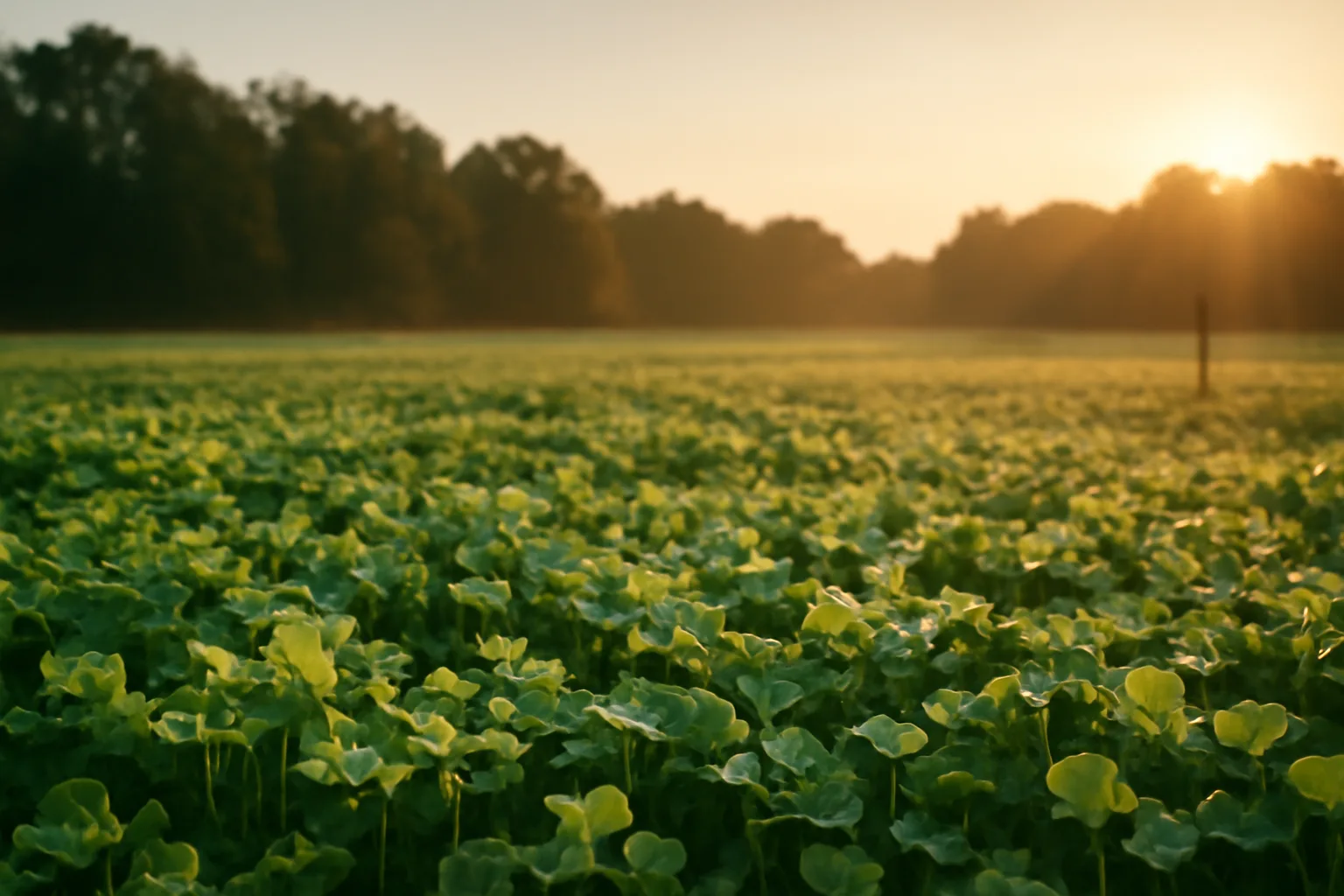
TL;DR
The best spring food plot seed is usually a perennial clover blend or, if soil is warm enough, forage soybeans or lablab. Clover establishes well in early spring (soil temps around 50°F), while soybeans and sorghum-type forages need soil closer to 60-65°F. Skip oats and turnips in spring; those are fall plantings.
What is a food plot, and why does spring planting matter?
A food plot is a planted patch of ground, usually a half-acre to several acres, managed specifically to grow forage that deer and other wildlife will eat. It's not the same as a pasture or a hayfield, even though the seed and equipment overlap a lot. Most plots sit on private or leased land and get planned around a hunting season, but the agronomy underneath is just farming at a small scale. Spring planting matters because it's the window for warm-season annuals and for establishing perennials like clover and alfalfa before summer heat sets in. Get the timing wrong and you're fighting weed pressure, poor germination, or a plot that peaks in July when nobody's hunting yet. The spring plant list is shorter than the fall list. Spring is really about clover, soybeans, lablab, cowpeas, chicory, and sometimes a grain sorghum or milo blend for summer cover and fall seed heads. Oats, brassicas like turnips, and cereal grains belong in the fall calendar, not spring. More on why below.
When should you plant food plots for deer in spring?
| Deep South (Gulf Coast, peninsular FL) | Feb-early March | Late Feb-March | March-April | |
|---|---|---|---|---|
| Lower Midwest/Mid-South | Mid-March to early April | March-April | April-May | |
| Upper Midwest/Northeast | Late April-May | April-May | Late May-June | |
| Northern tier (MN, WI, ME, upper MI) | Mid-May | May | Late May-June | These are general ranges. Your county extension office publishes a specific frost-free date for your area, and that's a better anchor than any generic zone map. If you're planning a whole-property rotation rather than one plot, it helps to map spring plantings against your fall calendar so you're not scrambling in August. See our deer food plots overview for how the two seasons fit together. |
Spring planting windows run from late March through early June depending on your zone, and they're set by soil temperature, not the calendar date. Clover and other perennials can go in as soon as soil hits about 50°F, while warm-season annuals like soybeans, cowpeas, and sorghum want soil closer to 60-65°F and no more frost risk. A rough zone breakdown, based on typical last-frost dates from NOAA climate normals and land-grant extension planting guides: | Zone (general region) | Typical last frost | Clover/perennials | Soybeans, lablab, cowpeas |
Do deer like clover, and is it worth planting in spring?
Yes. Clover is one of the most consistently preferred forages in whitetail diet studies, and it's the default answer to "best spring food plot seed" for most of the country. White clover (Trifolium repens) and red clover (Trifolium pratense) both show up repeatedly in university forage trials as high in crude protein, often 25-30% on a dry matter basis in young growth, which beats almost every other plot option [1]. The advantage of planting clover in spring is that it's a perennial. Get a stand established well (proper lime, proper pH, proper mowing to control weeds) and you can get 3-5 years out of one planting before you need to reseed. That's a real cost advantage over annual plots you replant every single year. The catch: clover is slow to establish and hates competition from weeds and grass in its first 60-90 days. Spring seedings need clean, firm seedbeds, and a lot of failures trace back to planting into weedy or rough ground rather than a bad seed choice. If you want the broader case for clover against other perennial options, our food plot whitetail guide breaks down clover versus chicory versus alfalfa in more depth.
Do deer eat sorghum, and does it belong in a spring plot?
Deer will eat sorghum and grain sorghum (milo) seed heads, mostly in late summer and fall when the grain matures, but sorghum isn't a primary spring forage choice on its own. It's more useful as a screening/cover crop component or as part of a summer blend that also includes something deer actually browse on while it's green, like cowpeas or soybeans. Sorghum is planted in late spring once soil is reliably above 65°F, similar timing to corn. It's drought-tolerant and cheap, which is why it shows up in a lot of dove field and screening mixes, but on pure browse value for spring and summer, it's well behind clover, soybeans, and lablab. If your goal is spring/summer nutrition for deer rather than late-season standing grain or visual screening, sorghum shouldn't be your main seed.
Do deer eat honey, or is "honey" seed a marketing term?
Deer don't eat honey in any meaningful dietary sense; it's not a forage and it's not part of natural whitetail nutrition. If you've seen "honey" attached to a food plot product name, it's almost always a brand or blend name, not an ingredient, similar to how "Honey Hole" or "Honeycomb" get used as marketing labels for clover or brassica blends. Don't buy or avoid a product based on the word "honey" in the name. Read the actual seed tag for species and percentages instead. That's true of any branded blend: the legal seed label on the bag (required under most state seed laws) lists the actual species and purity, and that's the only part worth trusting.
When to plant oats for deer, and why not in spring?
Oats are a fall planting in almost every whitetail region, not a spring one. Oats are a cool-season annual grass that deer hit hard in September through November and again in early spring green-up, but planting them in spring means they'll head out, get tough, and die back with summer heat before doing much good. The standard oat window is roughly 6-8 weeks before your first fall frost, which for most whitetail country lands somewhere between mid-August and mid-September. If oats survive a mild winter (common in the South and Mid-South), you'll get a bonus flush of green-up in late winter/early spring, but that's leftover growth from a fall planting, not a new spring seeding. If your plot plan has oats in it, that's a fall-calendar item. Pair it with a spring warm-season plan instead of trying to force oats into a spring slot.
When to plant turnips for deer, and should they go in this spring?
No, don't plant turnips in spring. Turnips and other brassicas (radishes, rape, kale) are fall/winter plots, planted roughly 60-90 days before first frost so the tubers and leaves mature right as cold weather hits and sweetens the plant through frost-triggered starch conversion to sugar. That timing puts brassica planting in July through early September depending on your zone. Brassicas planted in spring will bolt to seed in the heat and never bulb properly, and deer generally won't touch bitter, unfinished brassica greens the way they hit a frost-sweetened turnip patch in December. If turnips are part of your rotation, they belong on the fall side of your calendar, alongside oats and winter wheat, not the spring side.
What are deer's favorite foods, and how should that shape spring seed choice?
Whitetail diet studies consistently show deer preferring forbs, browse (woody leaves/twigs), soft mast (acorns, fruit), and agricultural crops like soybeans and clover when available, with actual preference shifting hard by season and region. There's no single "favorite" food across all deer everywhere; it's driven by what's regionally abundant, what's most digestible at that life stage, and what's simply available given local land use. What that means for spring plot seed selection: don't chase a single "magic" species. Clover and soybeans consistently rank high in preference and nutrition studies because they're high-protein legumes, not because of any special attractant property. A doe in spring is trying to recover from winter and build up for fawning; a legume-heavy plot with 20%+ crude protein does more for her than a grass or grain crop will. Realistically, a mixed approach beats a monoculture almost every time. A blend of clover with a small percentage of chicory, or soybeans planted alongside a perimeter of taller cover, gives deer more of what they actually want across the season and gives you more insurance against one component failing. Check our food plot seed comparisons for blend options by region.
What's the best food plot seed for spring, species by species?
| White/red clover | Perennial spring/summer forage | ~50°F+ | 25-30% [1] | 3-5 years | |
|---|---|---|---|---|---|
| Forage soybeans | High-tonnage summer forage | 60-65°F+ | 20-30% (leaf, pre-pod) | Annual | |
| Lablab | Heat/drought tolerant summer forage | 65°F+ | 18-24% | Annual | |
| Cowpeas (iron & clay) | Fast-growing, cheap summer legume | 60-65°F+ | ~20% | Annual | |
| Chicory | Drought-tough perennial, deep taproot | ~50°F+ | 15-20% | 3-5 years | |
| Grain sorghum/milo | Screening, fall grain, not primary browse | 65°F+ | Low (grain-focused) | Annual | For most hunters with a single spring plot and limited time, a clover/chicory perennial blend is the highest-value, lowest-maintenance choice once established. If you've got acreage to spare and want tonnage for summer nutrition (especially useful on properties running a lot of deer), a soybean or soybean/cowpea mix delivers more total forage but costs more in seed and needs better soil fertility to really produce. See deer food plot seed for specific product-level comparisons within these categories. |
There's no single "best," but there is a clear short list that outperforms everything else for most whitetail properties in spring. Here's how the main options stack up. | Species | Best use | Soil temp to plant | Crude protein (young growth) | Stand life |
How does soil testing change your spring seed choice?
Soil test results should drive both what you plant and how much fertilizer and lime you apply, and this matters more in spring than in fall because you're often establishing a stand that has to last years, not months. Clover in particular is sensitive to low pH; most extension guides put the target range at 6.0-6.5 for clover and other legumes, and stands seeded into acidic soil below that range struggle to fix nitrogen properly even with good seed genetics [2]. If your soil test comes back with pH under 6.0, that's not a seed problem, it's a lime problem, and no amount of "better" seed fixes it. Lime takes months to fully react in soil, so ideally you're applying it the fall before a spring planting, not the same week you plant. If you're planting this spring with acidic soil and no time to lime and wait, you may be better off with a more pH-tolerant annual (soybeans and cowpeas tolerate slightly lower pH better than clover) for this year, while you correct pH for a clover planting next spring. Your soil test lab is the actual authority here, not a general article like this one. Follow their specific lime and fertilizer recommendations for your field, since regional soil chemistry varies enough that generic ranges can be off for your specific ground.
What equipment do you actually need for spring plot planting?
At minimum: a way to test and amend soil (or a soil probe and bags to send to your local extension lab), a way to kill existing vegetation (herbicide and a sprayer, or disking), a way to get seed-to-soil contact (drag harrow, cultipacker, or no-till drill), and a way to fertilize based on your soil test. You don't need a $40,000 tractor to plant a good plot. A lot of successful small plots get planted with an ATV, a pull-behind sprayer, and a hand or tow-behind broadcast spreader. Clover and other small seeds need very shallow planting depth, often 1/4 inch or less, and a cultipacker or light drag after broadcasting does more for germination than any amount of extra seed. Soybeans and cowpeas are bigger seeds and tolerate deeper planting (roughly 1-1.5 inches), closer to row-crop depth, and a no-till drill gives more consistent stands than broadcasting alone, especially in weedy fields. One overlooked spring equipment issue: mowing timing on existing clover stands. If you've got clover from a prior year, a spring mow before it flowers helps knock back weed competition and keeps the stand from getting rank and stemmy, and it costs nothing but a pass with a mower.
Check your state's baiting and feeding rules before you plant
Food plots are legal in every state as an agricultural practice, but some states draw a legal line between a planted food plot and "baiting" or supplemental feeding, and the rules are not the same everywhere. Some states regulate hunting over any exposed grain or mineral, some regulate distance from a stand, and some states have no restriction on plots at all since they're considered normal agriculture rather than bait. Because this varies by state and sometimes changes year to year, check your state wildlife agency's current regulations before you plant, especially if your plot design includes any exposed grain, mineral, or feed component rather than standing forage. Don't rely on a national article (including this one) for that specific legal answer; go to your state agency's page directly.
How do you turn a soil test into an actual spring plot plan?
Once you've got a soil test back, the practical order is: apply lime if pH is low (ideally months ahead, but better late than never), pick species that match your soil temp window and your goals (perennial clover for a low-maintenance multi-year plot, or annual legumes for maximum spring/summer tonnage), broadcast or drill at the recommended rate for your seed (rates vary widely by species, so follow the seed tag, not a generic number), and fertilize based on the test's N-P-K recommendation rather than a flat "one bag per acre" guess. This is also where a lot of hunters get overwhelmed juggling multiple plots, multiple soil types, and a fall calendar on top of the spring one. If you want a starting point that turns your specific soil test and property goals into an actual planting plan rather than general advice, that's exactly what our $99 Custom Food Plot Plan is built to do. It's general guidance built around your test results and goals, not a substitute for your soil lab's site-specific lime and fertilizer recommendations, but it does the species-and-timing legwork so you're not guessing.
Frequently asked questions
Do deer eat sorghum?
Yes, deer eat sorghum grain, mostly once seed heads mature in late summer and fall. It's not a strong spring browse choice on its own; it works better as a component of a summer cover/grain mix than as a primary spring forage species.
Do deer eat clover?
Yes, clover is one of the most consistently preferred whitetail forages, often 25-30% crude protein in young growth. Both white and red clover work well in spring plots, and established stands can produce for 3-5 years before needing reseeding.
When should you plant food plots for deer?
It depends on the species. Perennials like clover go in early spring once soil hits about 50°F; warm-season annuals like soybeans need soil near 60-65°F. Fall species (oats, brassicas, cereal grains) go in roughly 60-90 days before your area's first frost.
Do deer like clover more than other plot species?
Clover consistently ranks high in preference and protein among plot species, but "favorite" varies by region, season, and what else is available. Many managers pair clover with chicory or soybeans rather than relying on one species alone.
When should you plant oats for deer?
Oats are a fall planting, typically 6-8 weeks before first frost, roughly mid-August to mid-September in most whitetail regions. Spring-planted oats head out and die back before summer ends, so they're not a spring plot choice.
When should you plant food plots for deer in general, by season?
Spring plantings (clover, soybeans, lablab, cowpeas) go in once soil temps hit 50-65°F depending on species. Fall plantings (oats, wheat, brassicas, turnips) go in 60-90 days before first frost. Check your county extension office for your specific frost dates.
When should you plant turnips for deer?
Turnips are a fall/winter plot, planted roughly 60-90 days before first frost, generally July through early September. Turnips mature and sweeten as frost hits; spring-planted turnips bolt in summer heat and never bulb properly.
What is a food plot?
A food plot is a planted area, usually a fraction of an acre to several acres, managed specifically to grow forage for deer and other wildlife. It uses standard farming practices (soil testing, fertility, species selection) scaled down and aimed at a hunting property instead of commodity production.
What are deer's favorite foods?
There's no single universal favorite; whitetail diet studies show strong preference for forbs, soft mast, browse, and legume crops like soybeans and clover, with preference shifting by season and region. Legumes tend to rank highest among plot species due to high protein content.
Do deer like honey?
No, honey isn't part of deer diet or nutrition. If you see "honey" in a food plot seed product name, it's a brand name, not an actual ingredient; check the seed tag for real species content instead of the marketing name.
What's the best spring food plot seed for a first-time planter?
A clover blend is the most forgiving choice for beginners: it's forgiving on timing within its window, comes back for multiple years once established, and university extension data consistently shows strong deer preference and protein content. Just get your soil pH corrected first.
Can you plant soybeans and clover together in spring?
Not usually in the same blend long-term. Soybeans are annuals that get browsed down and die back at frost, while clover is a perennial meant to persist. Many managers plant them in separate plots or in a rotation rather than mixed together.
How much does it cost to plant a spring food plot?
Costs vary widely by seed choice, acreage, and whether you're buying lime/fertilizer. Clover seed often runs $3-6 per pound at typical seeding rates of 6-10 lbs/acre; soybean seed and the fertility it needs generally costs more per acre than clover once established.
Do I need a soil test before planting a spring food plot?
Yes, strongly recommended. A soil test tells you actual pH and nutrient levels, which determines lime and fertilizer needs and can even affect which species will establish well. Your state land-grant extension office typically offers low-cost soil testing and interpretation.
Sources
- USDA Natural Resources Conservation Service, Conservation Reserve Program: Wildlife Habitat provisions, 7 CFR 1410: Food plots and wildlife habitat plantings are managed under federal conservation program rules covering vegetative cover establishment
- Iowa State University Extension and Outreach, PM 1885: Soybean Planting Date and Soil Temperature Considerations: Warm-season legumes like soybeans need soil consistently above 60°F for reliable germination
- University of Georgia Extension, Circular 942: Forage Legume Establishment and Management: Young clover growth can test 25-30% crude protein on a dry matter basis
- Mississippi State University Extension, Publication 2111: Establishing and Maintaining Wildlife Food Plots: Clover requires a firm seedbed and shallow seeding depth of about 1/4 inch
- University of Tennessee Extension, PB1769: Wildlife Food Plots for Tennessee: Fall small grain plots like oats are typically planted 6-8 weeks before first frost
- Clemson Cooperative Extension, Land-Grant Press LGP 1023: Brassicas for Wildlife Food Plots: Brassicas like turnips are planted 60-90 days before first frost to mature through cold weather
- Warren, R.J. and Krysl, L.J., "Foods of Whitetail Deer," summarized in USDA Forest Service Southern Research Station General Technical Report SRS-5: Whitetail diet preference shifts seasonally among forbs, browse, mast, and agricultural forage
- University of Kentucky Cooperative Extension, AGR-1: Lime and Fertilizer Recommendations: Target soil pH for clover and other legume establishment is generally 6.0 to 6.5