Last updated 2026-07-25
TL;DR
The best dove food plots use browntop millet, grain sorghum, or sunflowers planted 60-90 days before your state's dove season opener. Sunflowers give the biggest draw but take longer to mature. Millet is cheapest and fastest. Always check your state's baiting rules before mowing, disking, or spreading seed near a hunting area.
What is a food plot, and how is a dove field different from a deer plot?
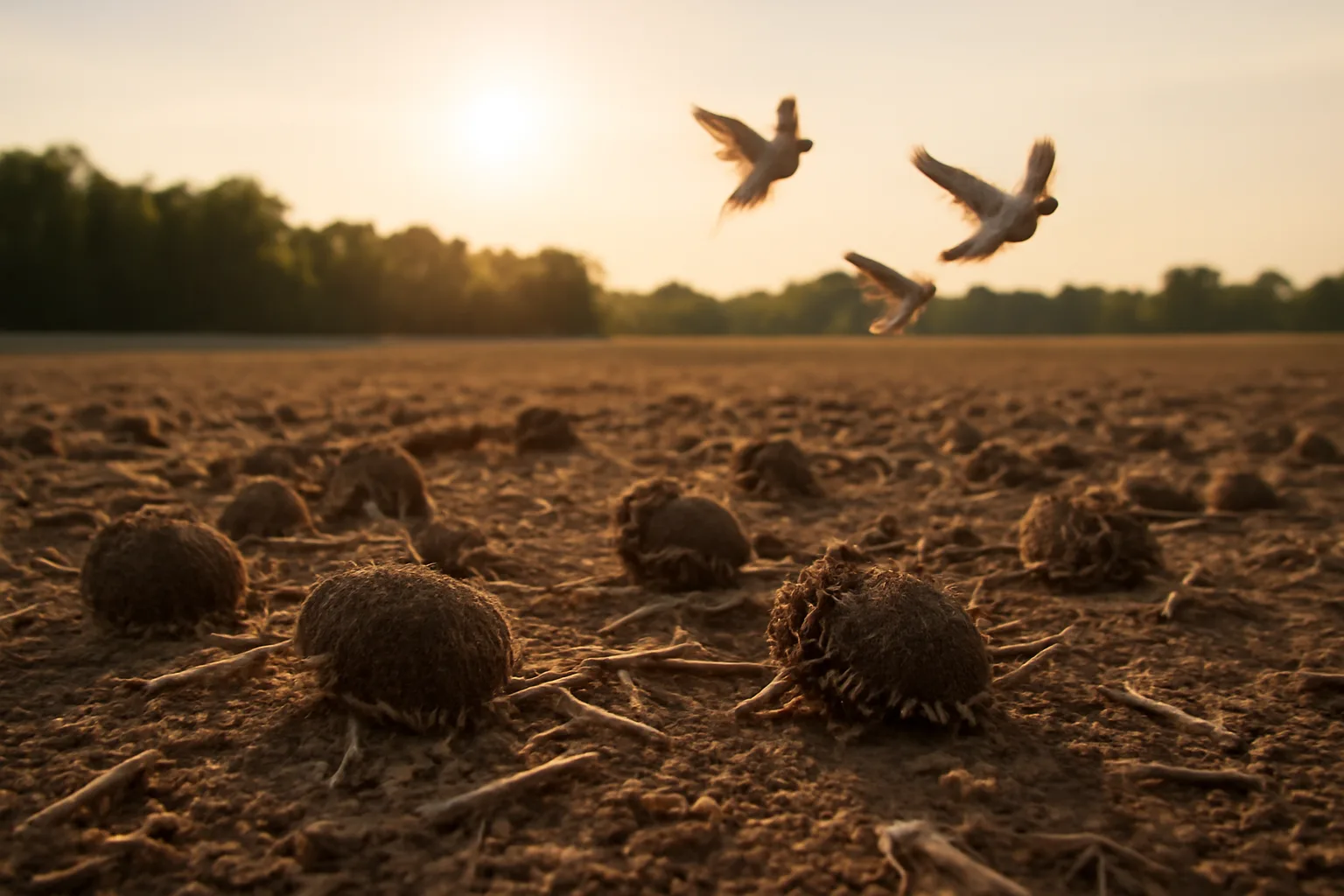
A food plot is any planted area meant to attract and hold wildlife by producing food they'll actually eat. For deer, that usually means clover, brassicas, or cereal grains grazed directly off the plant. Dove fields work differently. Doves are almost entirely seed eaters that feed on the ground, so the goal isn't a living plant deer will browse all season. It's a stand of grain that you deliberately knock down, mow, or disk right before the season so the seed hits bare dirt where doves can find it. That distinction matters legally as much as agronomically. A dove field manipulated in the normal course of farming (planting, then harvesting or mowing as part of a standard agricultural practice) is legal in every state. Scattering extra grain on top of that field to sweeten it, though, crosses into baiting almost everywhere. The U.S. Fish and Wildlife Service defines baiting for migratory birds as placing or scattering "salt, grain, or other feed" to lure birds to an area, and hunting over a baited area carries federal penalties under the Migratory Bird Treaty Act [1]. If you're planning a mixed-use property, a dedicated dove field and a separate deer program can coexist fine. Just don't expect one planting to do both jobs well. Deer want a plot they can hit all summer and fall; doves want a big, sun-baked opening with grain heads knocked to the ground a few weeks before opening day.
What are doves' favorite foods, and which plants work best?
| Browntop millet | 60-70 days | Low | Fast, cheap, reliable first-season field | |
|---|---|---|---|---|
| Grain sorghum (milo) | 90-120 days | Moderate | Big seed head, good in dry regions | |
| Sunflowers (black oil or confection) | 90-110 days | Moderate to high | Highest visual draw, needs more inputs | |
| Corn | 100-120 days | Moderate | Works but usually overkill for doves alone | |
| Buckwheat | 70-90 days | Low to moderate | Good shoulder-season option, matures fast | Sunflowers get the most attention because a blooming sunflower field is a striking sight and doves genuinely load up on the seed once heads dry and droop. But sunflowers need more fertility, more time, and more management (including watching for head-clipping weevils in some regions) than millet does. If you're planting your first dove field and want something forgiving, browntop millet or a millet-sorghum mix is the safer bet. A lot of guides list wheat, oats, and even clover seed as secondary dove foods, and doves will pick at waste grain in almost any harvested field. But none of those match millet, sorghum, or sunflower for pure dove numbers per acre. |
Mourning doves are granivores. Research from the University of Georgia and other extension programs consistently ranks browntop millet, grain sorghum (milo), sunflowers, and corn among the top draws, with millet often the single most reliable producer for a first-year field because it germinates fast and matures in about 60 to 70 days [2]. Here's how the main options stack up: | Species | Days to maturity | Seed cost (rough) | Best use |
Do deer eat sorghum, and can one field serve deer and doves?
Yes, deer will eat sorghum, particularly the young leaf growth early in the season and the grain later if it's accessible. But sorghum isn't a preferred deer forage the way soybeans or clover are, and most deer plot guides treat it as a secondary or filler crop rather than a primary planting. If you're trying to stretch one field across both dove season (often opening around Labor Day weekend in the Central and Eastern zones) and deer season a month or two later, sorghum or a sorghum-sunflower mix is one of the few crops that can plausibly do double duty. Doves work the disked, dropped grain in September. Deer will browse remaining stalks and any regrowth into October and November. Just know you're compromising on both ends. A field optimized purely for deer (say, a brassica-clover blend) won't draw doves at all, and a field optimized purely for doves won't hold deer traffic the way a dedicated food plot for whitetail will. If your property has room for two plots, split them. Run a real deer program on your best plot and use a smaller, sunnier field for dove-specific grain.
Do deer like clover, and does it belong anywhere near a dove field?
Deer like clover a lot. It's one of the most consistently preferred forages in whitetail research, high in protein and digestible energy during spring and summer growth. But clover does nothing for doves. Doves want bare ground with seed on it, not a dense perennial legume stand. If you're planning a property with both a clover plot for deer and a grain field for doves, keep them physically separate and don't try to blend the two purposes into one planting. A thick clover stand actually works against a dove field's appeal, since doves avoid heavy ground cover where they can't see predators approaching. For deer-specific plantings, a straight clover mix or a deer food plot seed blend built around clover and chicory is the better call, kept in its own location.
When should you plant food plots for deer versus dove fields?
Timing is the biggest difference between the two programs, and it trips up more new landowners than seed selection does. Deer food plots follow a two-season calendar. Spring/summer plots (soybeans, cowpeas, clover) typically go in after the last frost, often April through June depending on your zone. Fall plots (brassicas, cereal grains, clover) go in 60 to 90 days before your first hard frost, which extension programs generally place in the August to September window for most of the whitetail's range, adjusted for your specific USDA plant hardiness zone. Dove fields run backward from a single date: your state's dove season opener, which in most Central and Eastern management units falls on or near September 1. Work backward 60 to 90 days from that date depending on species. Millet needs about 60-70 days to head out and dry down. Sorghum and sunflowers need 90-110 days. That means most dove plantings go in the ground in May or June, roughly the same window as summer deer plots, just with a completely different end goal: you're aiming for the grain to be mature and ready to knock down right before the opener, not standing and green.
When to plant oats for deer
Oats are a fall cereal grain planted for deer, not for doves. Extension guidance from Oklahoma State University puts the ideal window at 6 to 8 weeks before your area's first killing frost, which lines up with a late August to mid-September planting across most of the whitetail range, and slightly earlier (August) in the northern tier and later (into October) in the Deep South [3]. Oats germinate fast, often showing green in 5-7 days with adequate moisture, and they're one of the most palatable cereal grains for deer through fall and early winter until hard freezes shut growth down. They're a poor fit for a dedicated dove field since deer graze the leaf tissue before much grain ever forms. If you want a fall cereal grain and dove attraction in the same rough season, sorghum is the better dual-purpose choice; oats are a deer-only play.
When to plant turnips for deer
Turnips and other brassicas go in during late summer, typically 90 to 100 days before your first expected hard frost, which puts most plantings in late July through August depending on latitude [3]. Turnips need that long runway because deer generally won't touch the bulbs and leaves heavily until after a frost sweetens the plant by converting starches to sugars. That late-season timing makes turnips useless as a dove crop; they mature well past dove season and produce leafy growth, not exposed grain. They're strictly a fall/winter deer plot, often blended with cereal grains or clover to extend the plot's draw from September through the end of hunting season. If you're building a fall program, a food plot seed blend that pairs brassicas with a fast cereal grain covers both the early season and the post-frost window in one planting.
Do deer like honey, and does that matter for food plots?
No, honey isn't a meaningful part of deer diet or food plot planning, and it has nothing to do with dove fields either. This question shows up in search because people sometimes confuse mineral or attractant products (some of which use molasses or sweet scents) with actual forage planning. Deer are drawn to sugar and carbohydrate-rich foods in general, which is part of why brassicas taste better after a frost and why fruit like apples and persimmons get hit hard in fall. But there's no extension research or wildlife agency guidance recommending honey, molasses, or sugar-based attractants as a food plot input, and in many states, scattering sweet feed or syrup-soaked grain to draw deer or doves runs into the same baiting restrictions covered below. If you want a genuine sugar draw for deer, standing brassicas and soft mast trees do that job through normal plant chemistry, no additives needed.
What are the baiting rules for dove fields, and how do they differ by state?
This is the section that actually gets people in legal trouble, so read it carefully and then read your own state's regulation, because the details vary. Federally, the Migratory Bird Treaty Act and its implementing regulations prohibit hunting doves (and all migratory game birds) over bait. The U.S. Fish and Wildlife Service's regulation at 50 CFR 20.21(i) makes it unlawful to take migratory game birds "by the aid of baiting, or on or over any baited area" where a person knows or reasonably should know the area is baited [1]. Critically, the rule includes a carve-out: hunting over an area that's been manipulated through "normal agricultural planting, harvesting, or post-harvest manipulation" is legal, even though the field is full of exposed grain. Scattering extra grain, or mowing a field in a way that isn't a recognized agricultural practice, is what turns it into an illegal baited area. States layer their own rules on top of the federal baseline, and some are stricter about specific practices like top-sowing wheat into a standing crop or how long you have to wait after mowing before hunting. Because this varies, check your state wildlife agency's migratory bird hunting regulations before you plant or manipulate a dove field, not after. A quick call to your state agency's wildlife or law enforcement division is worth ten minutes on the phone before season. A general rule that keeps most landowners clean: plant a normal crop, harvest or mow it using a standard method you could explain to a game warden with a straight face, and don't add anything extra to the ground afterward.
How do you actually plant and prep a dove field, step by step?
Start with soil testing, the same as you would for any deer plot. A basic soil test through your state land-grant extension office (most run $10-20 per sample) tells you pH and nutrient levels, and your test results, not a generic online chart, should drive your lime and fertilizer rates. Most dove grain crops (millet, sorghum, sunflowers) do best in the 5.8 to 6.5 pH range, similar to most deer forage crops. A rough planting sequence: 1. Test soil in late winter or early spring, and lime according to your results if pH is low. Lime takes months to fully react in the soil, so apply early. 2. Prepare a clean seedbed by disking or spraying out existing vegetation. Dove fields do best on open, sunny ground, at least a few acres if you can manage it. Small fields under an acre draw fewer birds. 3. Plant browntop millet, grain sorghum, or sunflowers (or a blend) in late spring to early summer, timed 60-110 days before your season opener depending on species. 4. Fertilize according to your soil test. Grain crops are typically nitrogen-hungry compared to legumes like clover, so don't skip this step. 5. As the season opener approaches, mow, disk, or otherwise knock down mature grain heads using a normal agricultural method, leaving seed exposed on bare ground. 6. Confirm your state's specific rules on timing between manipulation and hunting, and on what counts as legal manipulation, before you open the field to hunters. If you're building both a dove field and a deer program on the same property, treat them as separate projects with separate soil tests, separate planting windows, and separate goals. Trying to force one field to do both jobs usually means it does neither one well.
Where does a dove field fit into a broader food plot plan?
Most properties running a real food plot program have room for a dedicated dove field alongside a fall deer rotation, a summer legume plot, and maybe a clover perennial. If you're mapping out a whole-property plan for the first time, it helps to think in terms of zones and calendar windows rather than picking crops one at a time. A deer food plots overview is a good starting point if dove season is really just the appetizer before your main whitetail program. We build a lot of these property-wide plans at PlotSeason. Our $99 one-time Custom Food Plot Plan uses your soil test, your zone, and your acreage to lay out what goes where and when, dove field included if that's part of your goal. It's general guidance built from your inputs, not site-specific agronomy advice; your soil test lab is still the final word on lime and fertilizer rates for your dirt.
Frequently asked questions
Do deer eat sorghum?
Yes, deer eat sorghum, especially the young leaf growth and later the grain, but it's not a top-tier preferred forage like soybeans or clover. Most programs use it as a secondary crop or a dual-purpose planting that can also draw doves, rather than a primary deer plot.
Do deer like clover?
Deer strongly prefer clover. It ranks among the most consistently selected forages in whitetail research because of its high protein and digestibility during spring and summer growth. Clover has no role in a dove field, though, since doves need bare ground with exposed seed, not dense leafy cover.
When should you plant food plots for deer?
Spring/summer plots (soybeans, cowpeas, clover) go in after your last frost, often April through June. Fall plots (brassicas, cereal grains) go in 60-90 days before your area's first hard frost, generally August through September depending on your USDA hardiness zone.
When should you plant oats for deer?
Plant oats 6 to 8 weeks before your area's first killing frost, which is roughly late August to mid-September across most of the whitetail range, earlier in the northern tier and later in the Deep South. Oats germinate fast and are highly palatable through fall until hard freezes stop growth.
When should you plant turnips for deer?
Plant turnips 90 to 100 days before your area's first expected hard frost, usually late July through August depending on latitude. Turnips need that long window because deer typically won't hit the bulbs hard until after a frost converts starches to sugars in the plant.
What is a food plot?
A food plot is a planted area designed to attract and feed wildlife, most commonly deer or upland/migratory game birds. Deer plots usually feature living forage like clover or brassicas grazed in place, while dove fields grow grain crops that get mowed or disked down so seed lands on bare ground.
What is the best food plot for doves specifically?
Browntop millet is usually the best starting choice because it matures in 60-70 days and is cheap and forgiving. Grain sorghum and sunflowers draw doves just as well or better but need a longer growing season and more fertility management.
What are deer's favorite foods?
Whitetail research consistently ranks clover, soybeans, and other legumes among the most preferred forages due to high protein content, with acorns and other soft/hard mast also drawing heavy seasonal use. Brassicas become highly preferred after a frost sweetens the leaves and bulbs.
Do deer like honey?
There's no research or extension guidance showing honey is meaningful deer forage or a useful food plot input. Deer are drawn to sugar-rich foods generally, which is part of why frosted brassicas and fall soft mast get hit hard, but that's normal plant chemistry, not honey or syrup attractants.
Can you hunt doves over a field you planted and then mowed?
Generally yes, as long as the mowing counts as a normal agricultural practice under federal migratory bird rules (50 CFR 20.21). Problems start when you scatter extra grain on top of the field or manipulate it in a way that isn't a recognized farming practice. State rules add further detail, so check your state wildlife agency before hunting.
How big does a dove field need to be to actually draw birds?
There's no strict legal minimum, but practically, several acres of open, sunny ground works far better than a small clearing under an acre. Doves want wide sightlines to spot predators while feeding on the ground, so bigger, more open fields consistently draw more birds.
Can one field work for both deer and doves?
Sort of. A sorghum or sorghum-sunflower planting can feed doves off dropped grain in September and still offer deer some stalk and regrowth browse into fall. But you're compromising both uses; a dedicated deer plot and a dedicated dove field, planted separately, will outperform a single dual-purpose field.
Sources
- U.S. Fish and Wildlife Service, 50 CFR 20.21(i) baiting regulation: Federal definition of baiting for migratory bird hunting and the agricultural manipulation exception
- University of Georgia Extension, dove field management publication: Browntop millet, sorghum, and sunflowers rank among the top dove field crops, with millet maturing in about 60-70 days
- Oklahoma State University Extension, PSS-2905, "Food Plots for Deer": Oats should be planted roughly 6-8 weeks before the first killing frost for optimal fall deer forage
- U.S. Fish and Wildlife Service: Doves are protected under the Migratory Bird Treaty Act, which underlies federal baiting restrictions for dove hunting.
- University of Georgia Extension: Recommendations on planting oats as a cool-season forage for deer food plots.