Last updated 2026-07-26
TL;DR
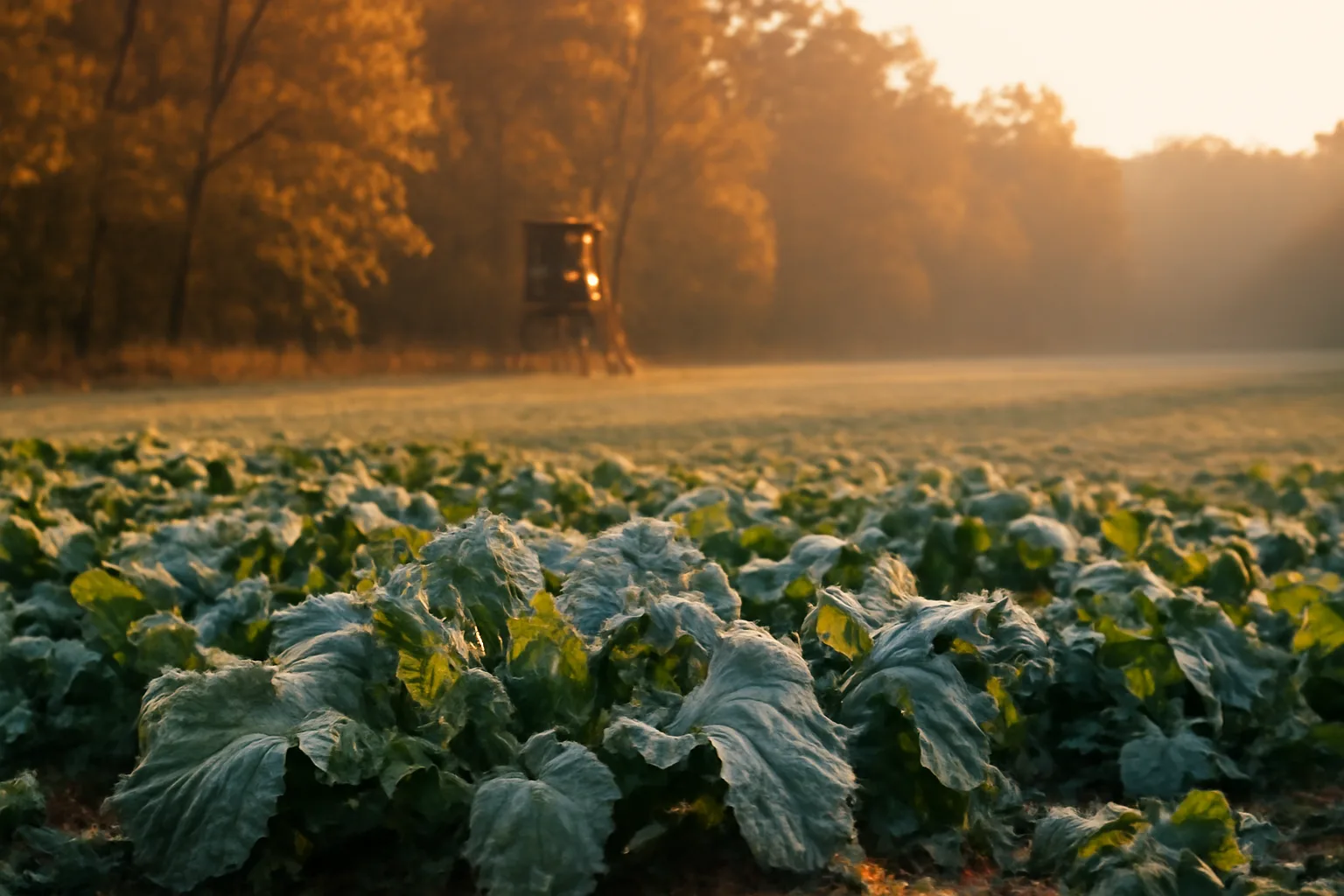
The best bow hunting food plots pair a perennial (clover or chicory) for season-long draw with an annual (brassicas, oats, or a cereal grain blend) planted 60 to 90 days before your first hunt. Clover pulls deer in September; brassicas and oats peak after frost sweetens the leaves in October and November, right through archery season.
What is a food plot, exactly?
A food plot is a planted area, usually a half acre to a few acres, established on hunting ground to grow forage that draws and holds deer. It is not a garden and it is not corn thrown in a pile. The two broad types are perennial plots (clover, chicory, alfalfa) that you plant once and maintain for 3 to 5 years, and annual plots (brassicas, cereal grains, soybeans) that you replant each year. Bow hunters usually run both: a perennial plot for summer and early fall pattern-building, and an annual plot timed to peak right as the rut and cold weather hit. A plot's job changes with the calendar. In August it is about holding does and fawns in a predictable pattern. By November it is about pulling in a rutting buck who needs calories after chasing does for two weeks. No single plot species does both jobs equally well, which is why the best bow season setups mix at least two plot types on a property. For a broader look at how plot types differ, see food plot whitetail. Size matters less than most first-time planters think. A quarter acre kill plot tucked in timber can outperform a five acre field plot for bow hunting specifically, because it forces deer into range instead of letting them feed 80 yards out.
When should you plant food plots for deer?
| 3-4 (northern MN, WI, upper MI) | Late April-May or early Aug | Late June-mid July | Early-mid Aug | |
|---|---|---|---|---|
| 5-6 (southern MN, IA, OH, PA, KY) | April-May or mid Aug-early Sept | Mid July-early Aug | Mid Aug-early Sept | |
| 7-8 (southern MO, TN, NC, GA, AL) | March-April or Sept-Oct | Aug-early Sept | Sept-early Oct | If you only have one weekend to plant this year, plant brassicas or a brassica/cereal blend first. They forgive a late start better than clover does, and clover planted too late into fall often fails to establish enough root reserve to survive winter. |
Timing depends entirely on what you are planting and your USDA hardiness zone, not a single calendar date. Perennials like clover go in during spring (April to May in northern zones) or late summer (mid-August to early September). Annuals like brassicas and cereal grains are planted in July through September so they mature right before bow season opens. The general rule extension agronomists use: brassicas and turnips need 80 to 100 days from planting to a fully bulbed, frost-sweetened plant, so back-time from your first hard frost. Oats and other cereal grains need less, often 45 to 60 days to reach good grazing height, which is why they can go in later than brassicas. Here is a rough planting window table by zone. Treat it as a starting point and adjust for your local frost dates. | Zone (USDA hardiness) | Clover/perennials | Brassicas/turnips | Oats/cereal grains |
Do deer like clover, and why is it a staple bow season plot?
Yes. Clover is consistently one of the most preferred forages in whitetail diet studies and food plot trials, and it is the closest thing to a set-it-and-forget-it plot for bow hunters. White clover and red clover both test out at roughly 25 to 30 percent crude protein in vegetative growth stages, well above what most native browse offers in late summer, according to forage quality data compiled by USDA's National Agricultural Library forage information system [1]. Clover's real advantage for bow season is that it is palatable from the day it emerges through the first hard freezes. Deer will hit a clover plot in velvet-growing August the same way they hit it in late September during early archery openers. That consistency lets you pattern deer on a clover field for weeks before you ever hang a stand. The tradeoff: clover goes semi-dormant and loses appeal once brassicas and acorns show up and once temperatures drop hard, which is exactly when rut activity ramps up. That is the main reason serious bow hunters do not rely on clover alone for a November hunt. It is a September and early October tool, plus a strong spring/summer draw for scouting and trail camera work. White clover (Ladino types) tolerates more shade and mowing than red clover, which makes it the better call for a smaller wooded plot near a stand site. Red clover handles heat and drought a bit better in southern zones. Either needs a soil pH close to 6.0 to 6.5 to perform, so a soil test before planting is not optional if you want it to last three seasons instead of one [2].
Do deer eat sorghum?
Yes, deer eat grain sorghum (milo), both the standing seed heads and the foliage, though it is usually planted more as a screening and late-season grain crop than a primary attractant plot. Sorghum's real value on bow hunting ground is cover: it grows 5 to 8 feet tall and gives you a visual screen for stand access and a standing food source that holds up into winter when other plots are grazed out. Deer will browse sorghum foliage through summer and fall, then hit the grain heads hard once they dry down and drop in late fall. It is drought tolerant and cheaper per acre than corn in a lot of regions, which is why some Midwest food plotters use it as a corn substitute on marginal ground. For bow season specifically, sorghum is a secondary player. It is not going to out-draw a fresh brassica plot in October, but a strip of it bordering a clover or bean field gives you both a food source and the cover you need to slip into a stand without spooking deer bedded nearby.
When should you plant oats for deer, and do deer like them?
Plant oats 45 to 60 days before your target hunting window, which for most bow seasons means a planting date in late July through early September depending on zone. Oats are a cool-season annual cereal grain that deer graze readily as soon as it reaches a few inches of growth, and it stays palatable well into fall because oats keep some green leaf tissue even after light frosts. Oats are often the single best "quick fix" plot for bow hunters who get a late start. They germinate fast, usually 5 to 10 days in warm soil, and they tolerate poor seedbeds better than clover or brassicas. A lot of commercial fall blends use oats as the fast-growing nurse crop mixed with slower brassicas, so you get grazing pressure relief on the young brassica plants while they establish. Deer preference for oats is well documented in food plot trials, and oats often rank alongside winter wheat and rye as top cereal grain choices, though deer generally show a stronger preference for oats over wheat and rye when all three are planted side by side in comparison plots. Oats also winterkill in zones 5 and colder, meaning the plot naturally residues down into spring rather than requiring you to terminate it, which is a small but real convenience for rotation planning.
When should you plant turnips for deer, and do deer eat them?
Plant turnips 80 to 90 days before your first expected hard frost, which lands most zone 5-7 planters in a mid-July to mid-August window. Deer absolutely eat turnips, both the leafy tops early in the season and the bulbs later, but the timing of that preference shift is the whole game with brassicas. Here is the pattern extension research and food plot trial data consistently show: deer hit turnip leaves lightly through September and October, sometimes barely touching them, then hammer both leaves and bulbs hard after the first hard frosts convert starches in the plant to sugars. That is not superstition, it is basic plant physiology. Frost damages cell walls and triggers a starch-to-sugar conversion that makes the tissue taste sweeter and more digestible. This is why turnip plots often look like a failure in early bow season, sparse browsing, plants looking untouched, and then get grazed to the dirt by Thanksgiving. If your bow season closes before your first hard frost, turnips alone are a poor choice. Pair them with oats or a cereal grain in the same plot so there's something palatable before the frost hits, and you get the late-season turnip surge as a bonus once temperatures drop. Bulb size and yield depend heavily on soil fertility, particularly phosphorus and potassium, so a current soil test matters more for brassica plots than almost any other planting decision you'll make . For species-specific brassica blend options, deer food plot seed breaks down common mixes.
What are deer's favorite foods, and how does that change by season?
Deer preference shifts by season and by what is locally available, but across food plot trials and diet studies a few forages consistently rank at the top: soybeans and clover in summer, acorns and other hard mast in early fall, and brassicas plus standing corn or beans in late fall and winter . There is no single universal favorite. It is a moving target tied to nutrition needs and availability. In spring and summer, does need protein for lactation and bucks need it for antler growth, so soybeans, clover, and cowpeas (all 20-30% crude protein forages) get hit hardest. Come September and October, acorns become the dominant preference wherever oaks are producing, because mast provides fat and carbohydrates deer need heading into the rut and winter, often outcompeting planted plots in a good acorn year. By November and December, energy density matters more than protein, which is why brassicas, corn, and standing soybeans pull hard. The sugar conversion in frosted brassicas and the raw caloric density of corn and beans make them the highest-value late season foods available on most properties. The practical takeaway for bow hunters: don't fight the acorn crop. If you're hunting early season and there's a heavy white oak drop nearby, your plot will likely take a back seat until that mast is gone. Plan your plot species and stand placement assuming deer will move between mast and plots, not choose one exclusively.
Do deer like honey, and is there any truth to sweet attractant claims?
There is no credible wildlife research showing deer seek out honey in the wild or that it functions as an effective food plot or attractant additive. Deer do have a documented preference for sweeter forage, which is the real mechanism behind frost-sweetened brassicas and why molasses-based mineral licks get attention, but that is different from deer actively foraging on honey itself. Most of what circulates online about honey as a deer attractant is anecdotal, tied to commercial scent or mineral products that include sugar or molasses as a minor ingredient, not standalone honey. If you're looking for a sugar-driven draw, a frosted brassica plot or a mineral supplement with molasses has actual field data behind it. Straight honey does not, and it is also impractical and expensive to apply at any scale relevant to a food plot. One more note: many states regulate or outright prohibit baiting and supplemental feeding for hunting purposes, and the legal definition of "bait" sometimes includes things people don't expect, mineral blocks, apples, even food plots planted or maintained in certain ways in a few jurisdictions. Check your state wildlife agency's baiting and feeding regulations before adding any attractant, honey included, to your plot strategy .
How do you build a bow-season plot plan around soil test results?
Start with a soil test, not a seed bag. Extension soil testing labs typically report pH, phosphorus, potassium, and organic matter, and most food plot species (clover, brassicas, cereal grains) perform best in a pH range of 6.0 to 7.0 . Below that range, lime applications are the fix, but lime takes months to fully react in soil, so test in spring for a fall planting whenever possible. Your soil test report is the actual authority here, not a general article like this one. Lime and fertilizer recommendations are calculated against your specific soil chemistry, your target crop, and sometimes your region's typical rainfall and CEC (cation exchange capacity). A university or private ag lab report will give you pounds-per-acre recommendations tailored to what you're planting; use those numbers over any generic bag-rate guidance. If you'd rather not run the numbers yourself, PlotSeason's $99 one-time Custom Food Plot Plan takes your soil test results, your zone, and your acreage and builds a planting plan around them, general guidance built for your situation, not a substitute for your soil lab's specific lime and fertilizer recommendations. It is a planning tool, not a guarantee of deer activity or a harvest.
What equipment do you actually need for a bow-season food plot?
For plots under 2 acres, most hunters get by with an ATV or side-by-side, a pull-behind disc or tiller, a broadcast spreader, and a cultipacker or drag to firm the seedbed. A tractor with a 3-point implement setup speeds things up on larger acreage but isn't required for small kill plots tucked in timber. Seedbed prep matters more than the seed you buy. Brassica and clover seed is small and needs good seed-to-soil contact at a shallow depth, generally a quarter inch or less. A common mistake is broadcasting seed onto rough, cloddy ground and skipping the cultipack step, which leaves seed sitting on top exposed to birds and drying out before it germinates. Herbicide is worth the cost for perennial clover plots specifically, since grass and weed competition is the number one reason clover plots fail in year two. A grass-selective herbicide labeled for use in clover lets you knock back competition without killing the clover itself. For annual brassica or cereal grain plots, a burndown herbicide (glyphosate) 2 to 3 weeks before planting handles existing vegetation more reliably than tillage alone on ground with heavy weed pressure. For a rundown of species-specific seed choices and blends by plot goal, see food plot seed and deer food plots.
Frequently asked questions
Do deer eat sorghum?
Yes, deer eat both sorghum foliage and the grain heads once they dry down, though sorghum is used more often for screening and standing winter grain than as a primary bow-season attractant. It is drought tolerant and works well as a border planting around a clover or brassica plot to add cover near a stand site.
Do deer eat clover?
Yes, clover is one of the most consistently preferred whitetail forages, testing at roughly 25 to 30 percent crude protein in vegetative growth. Deer graze it from spring through early fall, though preference drops once brassicas and acorns become available in late October and November.
When to plant deer food plots?
Timing depends on species: perennials like clover go in April-May or mid-August to early September, brassicas need planting 80 to 100 days before your first hard frost, and cereal grains like oats need only 45 to 60 days before your target hunt window. Always back-time from your local first frost date, not a fixed calendar date.
Do deer like clover more than other food plot options?
Deer show strong, consistent preference for clover through summer and early fall, but that preference drops once acorns drop and brassicas sweeten after frost in late October and November. Clover is best treated as a season-long draw and early bow season plot, not a standalone November food source.
When to plant oats for deer?
Plant oats 45 to 60 days before your target hunting window, which usually falls in late July through early September depending on your zone. Oats germinate fast, in as little as 5 to 10 days, and stay palatable through several frosts, making them a reliable quick-turnaround bow season plot.
When to plant food plots for deer overall?
There's no single date; annuals like brassicas and cereal grains go in July through September timed to peak around your hunting season, while perennials like clover are planted spring or late summer. Match planting time to your USDA hardiness zone and expected first frost date for best results.
When to plant turnips for deer?
Plant turnips 80 to 90 days before your first expected hard frost, typically mid-July to mid-August in zones 5 through 7. Turnip bulbs and leaves become far more palatable after frost converts plant starches to sugar, so timing the planting to hit that frost window matters more than with most other plot species.
What is a food plot?
A food plot is a planted area on hunting land, usually a half acre to several acres, established with annual or perennial forage species to supplement natural deer browse and improve hunting opportunity. It differs from baiting because it's a growing crop, not a pile of feed, though some states still regulate certain plot practices under baiting law.
Do deer like clover in food plots year-round?
Clover stays palatable from spring through early fall and even into winter in warmer zones, but it goes semi-dormant in cold weather and loses appeal compared to frosted brassicas or standing grain once real cold sets in. It's strongest as a summer and early bow season food source.
What are deer's favorite foods across the season?
There's no single favorite; preference shifts with nutritional need and availability. Soybeans and clover dominate in summer, acorns and other hard mast take over in early fall wherever oaks are dropping, and brassicas, corn, and standing beans become top choices in late fall and winter.
Do deer like honey as an attractant?
No credible wildlife research supports honey as an effective deer attractant. Deer do prefer sweeter forage, which is why frost-sweetened brassicas and molasses-based mineral supplements work, but that's a different mechanism than deer seeking out honey itself in the wild.
How far before bow season should I plant my food plot?
Plant brassicas 80 to 100 days before your first hard frost, oats and cereal grains 45 to 60 days before your hunting window, and clover in spring or by early September so it establishes before winter dormancy. Missing these windows is the most common reason plots underperform in bow season.
Is a soil test really necessary before planting a bow season plot?
Yes. Most food plot species need a soil pH of 6.0 to 7.0 to perform well, and phosphorus and potassium levels directly affect brassica bulb size and clover stand longevity. A soil test tells you exact lime and fertilizer needs instead of guessing with generic bag rates.
Sources
- NOAA National Centers for Environmental Information, U.S. Climate Normals 1991-2020: Source for local frost date data used to back-time plot planting
- USDA Natural Resources Conservation Service Plant Guide, White Clover (Trifolium repens): Crude protein content of white clover in vegetative growth stages
- University of Georgia Extension Circular 1350, Soil Testing for Food Plots: Recommended soil pH range of 6.0 to 6.5 for clover establishment and persistence
- Oklahoma State University Extension, Evaluating Forage Preference of White-tailed Deer (PSS-2126): Deer preference comparisons among cereal grains including oats, wheat, and rye
- USDA Forest Service, Fire Effects Information System, Odocoileus virginianus Species Review: Seasonal shifts in whitetail deer food preference among mast, legumes, and browse
- University of Missouri Extension Guide G9111, Soil Testing and Fertilization for Food Plots: Optimal soil pH range of 6.0 to 7.0 for most common food plot species